You’ve seen the headlines, the endless cycle of violence in the Middle East. But do you know where it all began? The borders, the conflicts, the broken promises—they all trace back to a forgotten front of World War I, a campaign that was far worse, far more complex, and far more consequential than you ever imagined. This is the story of the Palestine campaign, a tale of brilliant generals, desperate charges, and a tragedy of promises made and abandoned, whose echoes still shape our world today.
I spent two weeks immersed in primary sources—diaries, letters, after-action reports—and what I found was a campaign that defies belief. It had the last great cavalry charge in modern warfare, an Oxford archaeologist leading a guerrilla army in Arab robes, and a British general who entered Jerusalem on foot out of respect for its sanctity. It featured a battle in September 1918 that destroyed two Ottoman armies in six days, a victory so complete that military historians rank it among the greatest in British arms. Yet almost nobody talks about it.
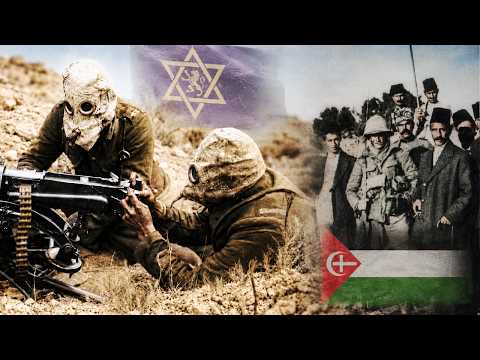
But before the battles, you need to understand the setting. In 1914, Palestine was a backwater of the Ottoman Empire, a land of ancient cities and harsh deserts, controlled for 400 years from Constantinople. Its population was a mosaic—Arab Muslims, Christians, Jews, Ottoman administrators, and European missionaries. The strategic importance of the region lay in the Suez Canal, Britain’s imperial lifeline, and when the Ottomans joined the Central Powers in October 1914, Palestine became a front line.
The British initially advanced cautiously. General Archibald Murray, commander of the Egyptian Expeditionary Force, was a competent administrator but a cautious field commander—the wrong man for the job. His first attempt to take Gaza in March 1917 came close to success but was called off due to confusion. Instead of admitting failure, Murray lied, reporting a victory and tripling Ottoman casualties. London, believing him, ordered a second attack.
The Second Battle of Gaza in April 1917 was a disaster. The Ottomans, under the capable German officer Friedrich Kress von Kressenstein, had reinforced their positions. British tanks, used for the first time in the desert, proved useless. The infantry attacked in waves and was cut down. After three days, the British had suffered over 6,000 casualties, three times the Ottoman losses, and Gaza remained in Ottoman hands. Murray was recalled, his career in ruins.
His replacement was General Edmund Allenby, a man of imposing stature and volcanic temper. His subordinates called him “the Bull,” and his transfer to Palestine was seen as an exile from the Western Front. But Allenby was exactly what the campaign needed. Within weeks, he transformed the morale of the Egyptian Expeditionary Force, moving his headquarters forward, visiting every unit, and making it clear that failure was no longer an option. But Allenby also carried a personal tragedy: his only son had been killed in France in July 1917, just as Allenby arrived in Egypt. He channeled his grief into relentless work, and his officers noted a contained intensity in everything he did.
Meanwhile, another figure was making his mark: T.E. Lawrence. Born in Wales in 1888, Lawrence was an Oxford archaeologist who had worked in Syria and spoke fluent Arabic. In 1916, he was sent to Arabia to liaise with the Arab Revolt against the Ottomans. Lawrence understood that the Arabs could not defeat the Ottomans in conventional battle, but they could wage a guerrilla war, tying down enemy forces by attacking railways and supply lines. He blew up bridges, ambushed columns, and made the Hijaz Railway a permanent vulnerability.
His most audacious operation came in July 1917: the capture of Aqaba. The Ottoman garrison expected an attack from the sea, but Lawrence led a force of 500 Arabs across the desert to take the city from the landward side. The guns were pointing the wrong way. The garrison surrendered with minimal Arab losses. Aqaba became the Arab Revolt’s port, and Lawrence’s reputation was made.
But Lawrence knew a secret that would haunt him: the British had promised the Arabs independence, but had also signed the Sykes-Picot Agreement with France, dividing the region into spheres of influence. The promises were incompatible, and Lawrence knew it. He fought on, but the knowledge of the betrayal to come weighed on him.
Back on the Palestine front, Allenby was preparing his next move. He needed to break the Ottoman line at Gaza, but this time he would not attack frontally. Instead, he planned to strike at Beersheba, the eastern anchor of the Ottoman line, using a brilliant deception. Intelligence officer Richard Meinertzhagen devised a ruse: he rode toward the Ottoman lines, allowed himself to be shot at, and dropped a bloodstained haversack containing fake operational orders indicating an attack on Gaza. The Ottomans believed it and reinforced Gaza, leaving Beersheba vulnerable.
On October 31, 1917, the Desert Mounted Corps, 40,000 men and horses, marched through the night to approach Beersheba from the east. The infantry attacked from the south, but by late afternoon the town had not fallen. The horses had been without water for days, and if Beersheba’s wells were not taken by nightfall, they would die. The Australian Light Horse commander, Lieutenant General Harry Chauvel, ordered a charge.
What happened next was the last great cavalry charge in history. Eight hundred men of the 4th and 12th Australian Light Horse regiments, armed with rifles and bayonets, galloped across three kilometers of open desert toward entrenched Ottoman positions. The Ottoman gunners had registered their ranges for infantry, not cavalry at full gallop. The shells fell behind the charging horsemen. The machine guns could not track them. The dust cloud obscured the defenders’ view. Within an hour, Beersheba was taken, the wells secured, and the Ottoman garrison destroyed. Australian casualties: 31 killed, 36 wounded. Ottoman losses: over 1,000 dead and wounded, 1,148 prisoners.
The charge at Beersheba broke the Ottoman defensive line. Gaza fell a week later, and Allenby advanced north. On December 9, 1917, the mayor of Jerusalem surrendered the city to two British sergeants who had been looking for eggs. Allenby entered Jerusalem on foot on December 11, a deliberate gesture of respect for the holy city. It was a Christmas present for Britain, and the name alone—Jerusalem—gave the public a victory they could celebrate.
But the campaign was not over. Lawrence and the Arab forces continued to operate on Allenby’s right flank, attacking supply lines and tying down Ottoman troops. And Lawrence carried the burden of knowing that the promises he was making would not be kept. He described himself as a man in fancy dress, never truly one of the people he fought alongside.
In September 1918, Allenby launched his final offensive: the Battle of Megiddo. He had assembled overwhelming force—8 to 1 in cavalry, 2,000 guns, complete air superiority. Through elaborate deception, he convinced the Ottomans that the main attack would come across the Jordan, while he concentrated his forces on the coast. On September 19, after a brief but intense artillery barrage, the infantry broke through the Ottoman Eighth Army’s front. The cavalry poured through the gap and swung east, cutting off the retreat of three Ottoman armies.
The pursuit was relentless. The Desert Mounted Corps rode 70 miles in 34 hours. The RAF and Australian Flying Corps bombed the retreating Ottoman Seventh Army in the Wadi Fara, destroying it as a coherent formation in just 60 minutes. Within six days, two Ottoman armies had been effectively annihilated. 75,000 prisoners, 360 guns captured. British and Dominion casualties: fewer than 5,000. It was one of the most complete victories in British military history.
Damascus fell on October 1, and the Ottoman Empire signed an armistice on October 30. The campaign was over, but its consequences were just beginning. The promises made to the Arabs were betrayed. Sykes-Picot was implemented, and the modern Middle East was born—a region of contested borders and unresolved conflicts. Lawrence died in 1935, haunted by what he had done. Allenby became a celebrated hero, but the bridge named after him over the Jordan River is a crossing point in a region still scarred by the decisions made in those conference rooms.
This is the story of the Palestine campaign—a campaign far worse than you think, not because of the battles, but because of what came after. The men who fought—the Australians at Beersheba, the Arabs with Lawrence, the Ottomans who surrendered—they had no say in the peace. And the world we live in now still bears the weight of their victory and the betrayal that followed.
But here is the part that lingers longest after the guns fall silent. The men who won the war were not the men who wrote the peace. Allenby’s soldiers, Lawrence’s tribesmen, the Ottoman conscripts who surrendered with their guns pointed the wrong way—they all went home to a map they had no hand in drawing.
Lawrence understood this better than anyone. He had promised the Arabs freedom with one hand while London signed it away with the other. “I had believed these things,” he wrote, “had seen the falseness of many of them, had been made false by them myself.” That sentence sits in Seven Pillars like a confession no court ever demanded.
The Balfour Declaration promised a Jewish homeland while pledging to protect the rights of those already living there. Sykes-Picot carved up the Levant between Britain and France. Both promises were made in good faith by men under the pressure of a world war—and both were impossible to keep at once. The diplomats knew it. They hoped it would somehow work out. It did not work out somehow.
Allenby walked into Jerusalem on foot out of reverence. A century later, a bridge bearing his name carries people across the Jordan between worlds still arguing over what that December meant. The general who delivered a Christmas present to Britain left behind a region that would never stop unwrapping it.
So the campaign ends not at Megiddo or Damascus, but in the gap between what soldiers achieve and what politicians do with it. The charge at Beersheba was not luck—it was weeks of preparation, courage, and timing. The peace was not bad luck either. It was choices, made deliberately, by men who could see the consequences coming and made them anyway.
That is the tragedy the desert keeps: the last cavalry charge was magnificent, and the victory it bought was squandered before the horses were even watered.
Now the question is yours. If you had stood in that Jaffa Gate in December 1917—knowing what the conference rooms would do with the city—what would you have told the men who had just won it?
Report this article
Select a reason for reporting:






