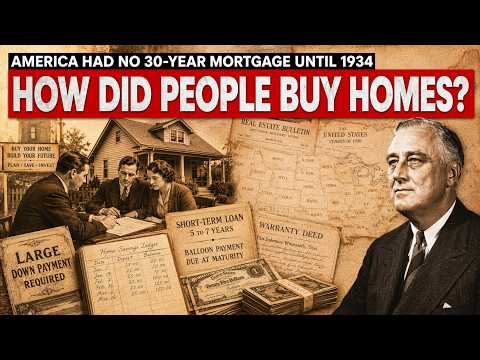
Imagine signing a contract that could cost you your home with a single missed payment—not a monthly installment, but the entire remaining balance, all at once. That was the reality for millions of Americans before 1934. The 30-year fixed-rate mortgage, now a cornerstone of the American Dream, didn’t exist. Instead, home buyers faced a gauntlet of financial traps: massive down payments, short-term loans, and the dreaded balloon payment that loomed like a guillotine. How did ordinary people buy homes in a system stacked against them? The answer reveals a story of power, innovation, and a government intervention that reshaped the nation—but not without deep flaws.
In the early days of the Republic, land ownership wasn’t about banks or mortgages; it was about the government and its vast territories. The Land Ordinance of 1785 divided public land into massive tracts, priced beyond the reach of most. Even when the Homestead Act of 1862 offered 160 acres free to those who worked it, it solved rural settlement, not urban housing. As cities swelled with industrial workers, the question of how to finance a home became a crisis. With average wages around $400 a year, a 50% down payment on a $4,000 house was impossible. The alternative? A balloon mortgage: interest-only payments for 3–5 years, then the full principal due in one crushing lump sum. “You were renting the idea of ownership,” with a ticking clock counting down to disaster.
Then came the Great Depression. Banks failed by the thousands, foreclosures swept the nation at a rate of nearly a thousand families a day, and half of all mortgages fell into default. The system was collapsing, and the government had to act. In 1933, the Home Owners’ Loan Corporation refinanced over a million troubled mortgages, proving that long-term, fully amortizing loans worked. But it was in 1934 that everything changed. The National Housing Act created the Federal Housing Administration (FHA), which insured mortgages, slashed down payments, and introduced the long-term fixed-rate loan—the seed of the 30-year mortgage. “This was the moment when the modern American mortgage was born,” a radical overhaul that turned a short-term gamble into a stable, predictable commitment.
But the FHA alone wasn’t enough. In 1938, Fannie Mae was created to establish a secondary mortgage market, ensuring a continuous flow of capital. Then World War II and the GI Bill supercharged the system, offering veterans no-down-payment loans and fueling the suburban boom. Homeownership skyrocketed from 43.6% in 1940 to 61.9% by 1960. Yet, this prosperity came with a dark side: redlining systematically excluded Black Americans from the very programs that built the middle class. “The suburban dream was deliberately constructed as a white dream,” and its effects persist today.
As we unravel this history, we’ll explore how the 30-year mortgage became both a pillar of American wealth and a source of enduring inequality—and what it means for the future of homeownership.
The story of American housing finance is not just a story of good intentions gone wrong—it’s a story of how good intentions, when filtered through the prejudices of the people who hold power, can bake inequality into the very architecture of a society. And the architecture of American suburbia was being drawn in real time, with a red pencil in hand.
But here’s what makes the redlining story so insidious: it wasn’t a secret. It was federal policy. The FHA’s underwriting manuals explicitly warned against introducing “incompatible racial and social groups” into neighborhoods, arguing that such mixing would destabilize property values. “The government didn’t just ignore the market—it actively shaped it, using race as a proxy for risk.” Lenders who wanted FHA insurance had no choice but to comply. The maps became self-fulfilling prophecies: deny credit to a neighborhood, and watch it decay; then point to the decay as proof that the neighborhood was a bad investment all along.
And the consequences compounded over generations. A white family that bought a $7,000 Levittown house in 1950 with a GI Bill loan watched that home appreciate into a six-figure asset by the 1980s. Their children inherited down payments. Their grandchildren went to college on home equity. Meanwhile, a Black family in the same era, barred from those suburbs and confined to redlined neighborhoods, could only watch from the other side of the color line. “The 30-year mortgage was a wealth-building machine—but the machine had a whites-only entrance.”
Now, you might assume that when the Fair Housing Act passed in 1968, outlawing discrimination in housing sales and rentals, the problem was solved. It wasn’t. The law changed the rules on paper, but the practices had already shaped the landscape. Banks found new ways to exclude: reverse redlining, where lenders targeted minority neighborhoods with predatory subprime loans; steering, where real estate agents quietly guided Black buyers away from white neighborhoods; and the persistent gap in family wealth that meant even fair lending couldn’t level a playing field that had been tilted for decades.
By the 1970s, the American mortgage system faced a new set of pressures. Inflation was surging, and the fixed-rate mortgage—that beautiful, predictable instrument—became a liability for banks. If you’d locked in a 4% mortgage in the 1960s and inflation hit double digits in the 1970s, the bank was losing money on your loan every single month. Depositors, meanwhile, were pulling their money out of savings accounts to chase higher yields elsewhere. This was called disintermediation, and it threatened to strangle the entire system.
The government’s response would set the stage for the next great transformation—and the next great catastrophe. In 1970, Fannie Mae was privatized and a new player entered the field: Freddie Mac, the Federal Home Loan Mortgage Corporation. Together, they began packaging mortgages into securities that could be sold to investors worldwide. “The mortgage was no longer a relationship between a borrower and a bank—it was a commodity, sliced, diced, and traded on global markets.” This innovation solved the funding problem, but it also severed the link between the people who made the loans and the people who bore the risk.
And that severed link, as we now know, would prove catastrophic. When lenders no longer held the loans they originated, the incentive to verify a borrower’s ability to repay began to erode. Why check income carefully if you’re going to sell the loan to Wall Street next week? Why worry about a risky borrower if the risk gets passed along to someone else? The seeds of 2008 were planted in the 1970s, watered in the 1990s, and fertilized by deregulation in the early 2000s.
But let’s not get ahead of ourselves. Before we reach the meltdown, there’s another chapter in this story—one that involves the rise of the adjustable-rate mortgage, the savings and loan crisis of the 1980s, and the strange career of a financial instrument that was supposed to protect homeowners but ended up exposing them to new dangers. The 30-year fixed-rate mortgage survived the turmoil of the 1970s, but it did so by sharing the stage with a cast of riskier characters.
And through it all, the fundamental question remained: who gets to own a home in America, and who gets left outside looking in? The answer, as we’ve seen, has never been purely about economics. It’s about power, about policy, and about the stories we tell ourselves about who deserves the American Dream.
The 1980s arrived like a wrecking ball. The savings and loan associations—those community institutions that had been the backbone of working-class homeownership for a century—were suddenly on life support. Inflation had pushed interest rates into the double digits, and the S&Ls were caught in a vice: they held long-term, low-interest mortgages while paying high rates to depositors. “They were bleeding cash every month, and deregulation gave them a casino to gamble in.” Congress, in a bipartisan fit of deregulation fever, allowed S&Ls to invest in risky commercial real estate and junk bonds. The result was a binge of speculative lending, fraud, and eventual collapse. By the early 1990s, more than 1,000 S&Ls had failed, costing taxpayers over $130 billion. The institution that had once embodied mutual self-help was dead.
But the 30-year mortgage didn’t die with them. It adapted. The secondary market, now dominated by Fannie Mae and Freddie Mac, became the circulatory system of American housing finance. Banks originated loans and immediately sold them off, replenishing their capital to lend again. This was efficient, but it introduced a new kind of distance. “The person who approved your loan might never see your face again—and might not care if you defaulted.”
Meanwhile, a new product was creeping into the mainstream: the adjustable-rate mortgage, or ARM. In the 1980s, ARMs were marketed as a way for young families to afford homes when fixed rates were sky-high. The pitch was seductive: a lower introductory rate for the first few years, then adjustments based on market conditions. But for many borrowers, those adjustments were a trap. When rates spiked, their monthly payments ballooned, and families who had stretched to buy a home suddenly found themselves underwater.
Still, the 1990s brought a boom. The economy roared, homeownership climbed past 65%, and the dream seemed more accessible than ever. But beneath the surface, the old demons were stirring. The Community Reinvestment Act, originally passed in 1977 to combat redlining, was strengthened in the 1990s, encouraging banks to lend in underserved neighborhoods. That was a noble goal, but it collided with another trend: the securitization of mortgages into complex financial products. Wall Street had figured out how to turn mortgages into bonds, and investors worldwide were hungry for yield. The logic was simple: the more loans you originated, the more fees you collected, and the more securities you could sell. “The incentive to lend responsibly was replaced by the incentive to lend prolifically.”
By the early 2000s, lending standards had crumbled. No-documentation loans, interest-only mortgages, and teaser rates became commonplace. Borrowers were offered loans they couldn’t possibly repay, and many were steered into them by brokers who earned higher commissions for riskier products. The term “subprime” entered the national vocabulary—a polite word for loans designed to fail.
And fail they did. When the housing bubble burst in 2006 and 2007, foreclosures swept the nation once again. This time, the crisis wasn’t confined to a few thousand families; it was global. Mortgage-backed securities had been sold to pension funds, municipalities, and banks around the world. When the underlying loans went bad, the entire financial system seized up. Lehman Brothers collapsed. Fannie Mae and Freddie Mac were taken over by the government. The Great Recession cost millions of Americans their homes and their jobs.
The parallels to the 1930s were unmistakable. Once again, a housing finance system built on short-term thinking and reckless risk had imploded. Once again, the government had to step in to prevent total collapse. But this time, the rescue was different. The banks were bailed out, but millions of homeowners were left to fend for themselves. “The system was saved, but the people it was supposed to serve were often left behind.”
In the aftermath, new regulations emerged—the Dodd-Frank Act, the Consumer Financial Protection Bureau—aimed at preventing another meltdown. Lending standards tightened. The 30-year fixed-rate mortgage, battered but resilient, remained the gold standard for borrowers. Yet the fundamental tensions remained: housing as a commodity versus housing as a home, the profit motive versus the public good, and the stubborn persistence of racial and economic inequality in who gets to own and who gets left out.
Today, the 30-year fixed-rate mortgage endures—still the most popular loan in America, still backed by the same government scaffolding built in the 1930s. But the cracks are showing. Housing prices have outpaced wages for decades, and for many young families, the dream feels further away than ever. “We built a system that works—but only if you can afford the ticket to ride.”
The lesson of this history is not that the 30-year mortgage is broken, but that it was never a finished product. It was invented, patched, and reinvented in response to crisis. And if the past century teaches us anything, it’s that the next crisis—climate-driven migration, automation, a new wave of foreclosures—will demand another reinvention.
The question isn’t whether the American Dream will change. It already has. The real question is: who will be allowed to share in it next?
What do you think—should the 30-year mortgage be reformed, replaced, or protected at all costs? Let me know in the comments.
Report this article
Select a reason for reporting: