Imagine a nation that ran on coal—not metaphorically, literally. Every lamp in every parlor, every furnace in every factory, every locomotive hissing out of every station, every warship steaming across every ocean of the British Empire. For roughly two centuries, Britain’s heart beat on a diet of carbon dug out of its own soil by hundreds of thousands of men crawling through tunnels in the dark.
In 1913, more than a million people worked in British coal. The country operated around 2,500 pits, produced nearly 290 million tons a year, and sent a third of it out to a hungry world. Coal was not just an industry—it was the physical substance of British power. And then, within a lifetime, it was gone.
On December 18, 2015, the last deep coal mine in Britain, Kellingley Colliery, lifted its final shift to the surface and shut its gates. Nine years later, on September 30, 2024, the last coal-fired power station, Ratcliffe-on-Soar, generated its final kilowatt and powered down. Britain, the nation that invented the coal-fired power station in 1882, became the first G7 country to walk away from coal entirely. The industry that built the modern world had been reduced to a museum exhibit.
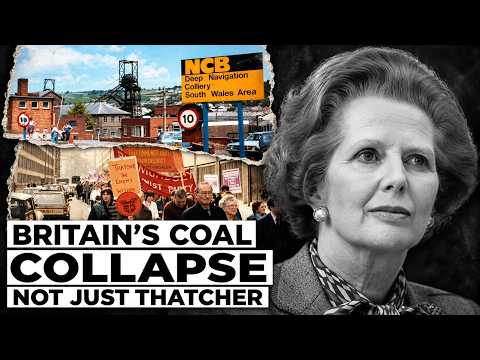
Ask a hundred people on a British street what killed the pits, and 95 will give you the same two words: Margaret Thatcher. The grocer’s daughter from Grantham, the Iron Lady, the prime minister who stared down Arthur Scargill in the great strike of 1984 and 1985 and ground the National Union of Mineworkers into submission. It is one of the most enduring political convictions in modern Britain, repeated at every anniversary, chanted at every protest, written into every Labour speech from the former coalfields.
The problem is that it is only partly true. The real story of why Britain’s coal industry collapsed is longer, stranger, and in many ways more cynical than the Thatcher-did-it narrative allows. There was a geological problem, an economic problem, a technological problem, a geopolitical problem, and a quiet decision made in a Westminster office in 1977 that laid out the exact blueprint for everything that followed.
By the time Thatcher moved into Downing Street in 1979, the mines were already dying. What she did was pull the trigger. The gun had been loaded for decades. This is the real reason Britain’s coal industry collapsed, and it begins long before anyone had heard of the Iron Lady.
To understand what was lost, you have to understand what coal once meant. In the Victorian era, King Coal was not a nickname—it was a job description. Coal was the fuel that smelted the iron, forged the steel, drove the ships, heated the homes, and lit the streets of a global empire. Entire regions, from the Rhondda Valley in South Wales to the Durham coalfields, from the pits of Nottinghamshire to the collieries of Fife and Ayrshire, existed because of coal and for coal. The pit was not just where you worked; it was where your father worked, and your grandfather worked. The brass band, the Miners’ Institute, the welfare hall, the terrace of houses looking out over the slag heap, the local chapel, the choir, the rugby club, the Labour Club—all of it grew out of the single economic fact that there was coal under the ground and men to bring it up.
The work itself was dangerous beyond modern comprehension. Men worked on their knees in seams only three feet high, breathing air thick with coal dust that would eventually calcify in their lungs and kill them decades after they had left the pit. Methane explosions wiped out entire shifts. Roof falls crushed men into the floor. Pit ponies lived their entire lives underground, going blind in the darkness. Boys as young as twelve went down the shaft before child labor laws finally pushed the age up. The famous 1842 Royal Commission on Children’s Employment, which exposed six-year-old girls hauling tubs of coal through tunnels on their hands and knees, led to the Mines Act of that same year—one of the first serious pieces of industrial safety legislation anywhere on Earth.
British coal did not just build the modern world; it wrote the modern labor movement. By 1920, there were roughly 1.2 million people on the books of Britain’s coal mines. The industry’s peak output had come just before the First World War, when 287 million tons were produced in a single year. But even in that moment of maximum extraction, something was already starting to go wrong. The seams closest to the surface, the easiest and cheapest to work, had been exhausted after a century of hard mining. The remaining coal was further down, harder to reach, more expensive to produce. And beyond Britain’s borders, newer coalfields in the United States, Germany, Poland, and later Australia and South Africa were coming online with better geology and lower costs. Even in the roaring ’20s, when British coal still looked unassailable, the global market was quietly turning against it.
The interwar years were brutal. The general strike of 1926, which began as a defense of miners’ wages and conditions, ended in defeat and bitter resentment. For nine days, roughly 1.7 million workers across Britain walked off the job in sympathy with the miners, who were resisting a demand that they accept longer hours for lower pay. When the Trades Union Congress called off the general strike after nine days, the miners were left to fight alone. They held out for another six months, slowly starving, before finally crawling back to work on terms worse than the ones they had struck against. The bitterness of 1926 scarred coalfield politics for generations.
The depression that followed gutted demand. By the time the Second World War arrived in 1939, the coal industry was exhausted, under-invested, and demoralized. The pits had kept the war effort fueled, but they had done so with aging equipment and an aging workforce—propped up during the war itself by the Bevin Boys, young conscripts sent down the mines instead of into the armed forces because coal production had become a matter of national survival.
When Clement Attlee’s Labour government swept into power in 1945, nationalization was not just an ideological project. It was, in the view of its supporters, a rescue operation. On January 1, 1947, the National Coal Board took over the entire industry. More than 1,600 mines across the country, around 850 private coal companies, millions of tons of equipment, over 100,000 houses, and the service contracts of around 720,000 miners all passed from private hands into state ownership overnight.
Signs went up at the pithead gates declaring that each colliery was now being managed by the National Coal Board on behalf of the people. The former owners received about £164 million in compensation. The miners got a five-day working week, improved wages, and a pension scheme. The country got, in theory, a strategic national asset finally run for the benefit of the whole economy, rather than for the dividends of a handful of coal lords.
And for a brief, shining moment in the late 1940s, it worked. Britain still ran on coal. By 1960, fossil fuels still accounted for an astonishing 99% of the country’s energy production, and around 70% of what was actually consumed. Nationalization had delivered on its most basic promise. The lights were on, the furnaces were lit, and the state owned the thing that kept them that way.
But just as the National Coal Board was tightening its grip, the ground was shifting beneath its feet. Three new forces were quietly moving against coal, and none of them had anything to do with trade unions or conservative politicians. The first was oil. The second was gas. The third was the air itself.
The Clean Air Act of 1956, passed in response to the Great Smog of London in December 1952, which killed an estimated 4,000 people in a single week, began the long legal eviction of coal from British homes. Smokeless zones were drawn around towns and cities. Open coal fires, that defining feature of the British interior for generations, began to be replaced by gas, electric heaters, and smokeless fuels. The act was expanded in 1968. By the end of the 1970s, most households had simply stopped burning coal. The domestic market, once a huge pillar of demand, was quietly being closed.
The second blow came from the North Sea. Natural gas was discovered in commercial quantities beneath the North Sea in 1959, and oil followed in 1969. In 1966, the British government made what might be the single most consequential energy decision of the twentieth century. It committed to converting the entire national gas system from coal-derived town gas to natural gas pumped straight out of the sea floor.
The conversion project ran from 1966 to 1977, with gas engineers reaching into more than 34 million appliances across the country, fitting new burners, swapping out jets, adjusting pressures. By the time it was finished, an enormous chunk of what had been the coal industry’s bread and butter—the manufactured gas sector—had simply ceased to exist.
Meanwhile, the railways, which for over a century had been among the most reliable customers for coal in the world, were switching to diesel. The merchant marine was switching to oil. The Royal Navy, which had converted its battleships from coal to oil before the First World War, had long since completed its transition. Even the generation of electricity, which was supposed to be coal’s safe haven, was starting to welcome challengers in the form of oil-fired stations and the first generation of nuclear power plants.
The result was a quiet massacre of pits that had almost nothing to do with Westminster politics. Under Harold Wilson’s Labour government in the 1960s, hundreds of collieries were closed and the workforce was cut without a national strike. Between 1960 and 1970, employment in the industry fell from more than 580,000 to around 290,000. Nearly half the jobs in the sector disappeared in a decade under a government that was supposed to be the industry’s traditional friend.
The miners did not strike. The communities grieved, but they did not rise. The decline looked like fate, like weather, like something nobody could do anything about. Nobody, that is, until 1972.
By the early 1970s, the miners had had enough. Their wages, once among the highest in British industry, had slipped badly against the pay of other workers. On January 9, 1972, more than 280,000 miners walked off the job in the first national miners’ strike since 1926. The union, now led by a new generation of organizers, had learned to use mass pickets with surgical precision. Flying pickets—busloads of miners rushing from pit to pit and from fuel depot to fuel depot—began paralyzing the country’s energy supply with astonishing speed.
On February 9, 1972, Edward Heath’s Conservative government declared a state of emergency. Days later, a three-day working week was imposed to conserve electricity. By the end of February, the Wilberforce inquiry had awarded the miners a sizable pay rise and the strike was over. The miners had crushed the government.
Two years later, they did it again. In late 1973, as the OPEC oil embargo sent global energy prices soaring, the miners imposed an overtime ban and then, from February 9, 1974, a full national strike. Heath, facing another energy emergency, imposed another three-day week starting on January 1, 1974. On February 7, he called a snap general election under the banner of a single question: who governs Britain? The country answered—not you. Harold Wilson’s Labour came back into power, immediately handed the miners a pay rise of around 35%, and ended the three-day week on March 7, 1974.
For the miners, these victories felt like vindication. For the Conservative Party, they felt like a national humiliation. And in a small Westminster office, a quiet right-wing MP began drafting a document that would change everything.
His name was Nicholas Ridley, and his 1977 blueprint—stockpiling coal, dual-fired generators, mobile police, a breakaway union—was executed with icy patience once Thatcher won in 1979. When the strike came in 1984, the lights never went out. “We had to fight the enemy without in the Falklands,” Thatcher said. “We always have to be aware of the enemy within.”
But the real killing field was 1990, when electricity privatization let generators buy the cheapest fuel—and they chose North Sea gas. Heseltine’s 1992 announcement closed 31 pits in a single afternoon, more jobs lost in one autumn than the strike had taken in a year.
Kellingley’s last lump of coal now sits behind glass in a Wakefield museum. Thatcher pulled the trigger—but geology loaded the gun, and a thousand quiet choices aimed it.
So tell me: was it Thatcher, the market, or all of us who let the pits die? Drop your coal emoji and your verdict below.
Report this article
Select a reason for reporting:






