For thirty years, Johnny Carson invited America into his television home, interviewing thousands of celebrities. But behind that familiar desk, he wasn’t just conducting interviews—he was studying human behavior with scientific precision. “Johnny noticed things about people that even they didn’t know about themselves,” revealed a long-time Tonight Show producer. He could read microexpressions, catch the smallest details in how someone carried themselves. And when it came to beautiful women, his observations were particularly thorough.
In his later years, after retiring from the spotlight, Carson occasionally shared private insights with close friends. During one evening at his Malibu home, after several glasses of high-end Scotch had loosened his typically guarded demeanor, he surprised his guests by naming the eight most extraordinarily beautiful women ever to appear on his show. “It wasn’t just about conventional beauty,” explained someone present that night. “Johnny talked about presence, that indefinable quality that made the cameras love certain women, that made the studio audience hold their breath, that occasionally made even television’s most polished professional momentarily lose his train of thought.”
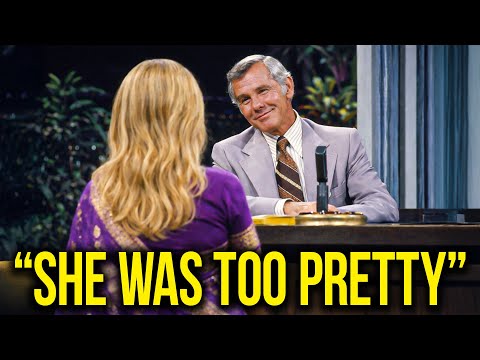
Tonight, we reveal Johnny Carson’s personal list of the eight most beautiful women ever to grace The Tonight Show. Not just their stunning physical attributes, but the unique qualities Carson himself observed about each during their unforgettable appearances.
Let’s begin with the woman Carson once described as having the kind of beauty that makes time stop—an actress whose mere entrance into the studio caused the legendary host to momentarily forget his own name.
“Would you welcome Raquel Welch?”
When Raquel Welch walked onto the Tonight Show stage for the first time in 1970, something extraordinary happened. Johnny Carson, television’s most controlled and controlling host, was momentarily speechless. For a man whose career was built on unshakable professional polish, those few seconds of visible discomfort spoke volumes about the overwhelming impact of Welch’s presence.
“She appeared multiple times and always left the audience breathless,” remembered a camera operator. “The reaction was physical. You could feel the collective intake of breath when she walked out. I operated camera two, positioned to capture the guest entrance, and my director would always whisper into my headset before she appeared, ‘Take your time on this one. No one’s going to complain.'”
What made Welch’s appearances particularly memorable wasn’t just her extraordinary physical beauty, though that was undeniable, but the confidence with which she carried herself. Unlike many gorgeous actresses who downplayed their looks with self-deprecating humor or affected modesty, Welch moved with an unapologetic awareness of her effect on others.
“She doesn’t enter a room, she takes it over,” Carson once said off camera, according to a producer. “And he meant it as high praise. Johnny had a special appreciation for guests who understood their own power and wielded it deliberately.”
Raquel knew exactly what she was doing every second she was on camera—her timing, her gestures, even the way she crossed and uncrossed her legs. It was like watching a masterclass in how to own a television appearance.
Behind the scenes, Welch’s appearances created a particular kind of organized chaos among the Tonight Show staff. The normally professional crew would find increasingly creative reasons to be on set during her segments, leading to what one staff member called “the Raquel effect”—a mysterious doubling of male employees in Studio One whenever her name appeared on the booking sheet.
“We had guys from accounting suddenly needing to check something with production during her segments,” laughed the camera operator. “Engineers who typically stayed in their booths would find urgent equipment issues that needed addressing on set. Even NBC executives who rarely showed up for tapings would materialize and stand in the wings. Johnny noticed it, too. He once quipped during a commercial break, ‘If she signed up for the army, there’d be no draft dodgers.'”
For Carson himself, Welch represented a particular challenge to his professional composure. Known for maintaining a slight emotional distance from even his most dazzling guests, he found himself occasionally struggling to maintain that characteristic detachment during their interviews.
“There was one appearance where she wore this red dress with a neckline that defied physics,” remembered the producer. “Johnny started a question, lost his train of thought mid-sentence, glanced down at his blue card, then looked back up and said, ‘I’m sorry, what was I saying?’ It got a huge laugh because everyone knew exactly what had happened. Johnny rarely got flustered on air, so when it did happen—and with Raquel it happened more than once—it was both funny and humanizing.”
Despite these occasional moments of distraction, what Carson admired most about Welch was her intelligence and self-awareness. Unlike some beautiful actresses who resented being known primarily for their looks, she had made peace with her image while strategically using it to build a substantial career.
“Johnny once told me, ‘Raquel understands exactly who she is and what she represents,'” shared a talent coordinator. “‘She doesn’t fight it or apologize for it or pretend it’s not real. That’s rare and refreshing.’ Coming from Johnny, who spent his life studying people, that was significant insight.”
This appreciation for Welch’s authenticity was evident in how Carson interviewed her, asking substantive questions about her career choices, her experiences as one of Hollywood’s first Latina leading ladies—though rarely acknowledged as such during that era—and her perspectives on an industry that often reduced her to her physical attributes.
“Their conversations had surprising depth,” observed the writer. “Johnny didn’t just toss her softball questions about her latest project or compliment her appearance. He engaged with her as someone with interesting thoughts and experiences. That respect, combined with the obvious appreciation of her beauty, created interviews that were simultaneously substantive and charged with this wonderful unspoken tension.”
As we leave behind Welch’s American glamour, we turn to European sophistication personified—the Italian screen legend whose mere presence on Carson’s stage created what one staff member called a masterclass in sensuality without saying a word.
“Hey, E. Hotchner calls Sophia ‘Living and Loving,’ and it’s a great kick to welcome her tonight. Would you welcome Sophia Loren?”
When Sophia Loren made her first appearance on the Tonight Show in 1979, the atmosphere in Studio One transformed. The international film icon brought with her not just extraordinary beauty, but an old-world sophistication and sensuality that seemed to exist in a different dimension from typical Hollywood glamour. Her entrance alone—confident, unhurried, regal—announced that this was no ordinary guest.
“Carson was visibly flustered during their first sit-down,” recalled a director who worked that night. “Johnny prided himself on treating every guest the same, whether they were an unknown comedian or the biggest star in the world. But with Sophia, something shifted. His body language changed completely. He was leaning forward more, laughing a little too enthusiastically at her comments, touching his tie repeatedly. All these small tells that those of us who knew him well recognized as signs that Johnny Carson, the master of television cool, was genuinely affected by her presence.”
Unlike American beauties who often projected an approachable cheerfulness, Loren brought a European gravitas and sensual maturity that seemed to catch Carson slightly off guard. Her responses to his questions were thoughtful and occasionally provocative, delivered with an Italian accent that transformed even mundane observations into something that sounded like poetry.
“You don’t interview Sophia Loren, you try to survive her,” laughed a Tonight Show writer who prepared for her segments. “That wasn’t meant as a criticism—quite the opposite. She brought this wonderful intensity to the conversation. Her eyes would lock onto Johnny’s when she was speaking, and you could almost see him fighting to maintain his professional demeanor. There was a moment when she was describing a scene from one of her films, and she put her hand on Johnny’s arm to emphasize a point. I thought we might need to cut to commercial just to give him a chance to regain his composure.”
What made Loren particularly fascinating as a guest was the contrast between her smoldering screen persona and her surprisingly thoughtful, sometimes philosophical conversational style. Where viewers might have expected a sex symbol focused on glamour, they instead encountered a woman with substantive insights on everything from Italian neorealist cinema to the challenges of maintaining authenticity in Hollywood.
“Italian icon with legendary curves and smoldering confidence,” noted a television critic who covered her appearances. “But what made her so compelling was that the beauty was just the beginning. Her intelligence, her perspective as a European artist working in the American system, her experiences growing up in war-torn Italy—all of it came through in these surprisingly substantive conversations with Carson. She wasn’t just gorgeous, she was fascinating.”
Behind the scenes, Loren’s appearances created a particular kind of reverent preparation among the Tonight Show staff. Unlike the barely controlled chaos that accompanied some beautiful guests, Loren inspired what one crew member described as almost religious respect—a hush falling over typically boisterous production teams as they prepared for her arrival.
“The crew treated her like visiting royalty,” remembered a production assistant who worked several of her appearances. “Not just because of how she looked, but because of what she represented—this international film legend who had worked with the greatest directors in cinema history. There was none of the usual backstage joking or horseplay when Sophia was booked. Everyone was on their absolute best behavior, determined to show her the respect they felt she deserved.”
For Carson, Loren represented a particular type of guest—one whose cultural significance and artistic accomplishments demanded serious engagement, even as her extraordinary beauty created an undeniable undercurrent of attraction. This tension between intellectual respect and physical appreciation resulted in interviews that hummed with a unique energy.
“Johnny had this wonderful mixture of awe and admiration with her,” observed someone who worked closely with Carson. “He was clearly dazzled by her beauty—who wouldn’t be? But he also genuinely respected her as an artist who had built a remarkable career on her own terms. That combination made their interviews special. Johnny would ask a thoughtful question about her work with De Sica or Fellini, leaning in with genuine interest for her answer, while simultaneously seeming slightly distracted by the totality of her presence. It was charming because it was so authentic.”
What viewers at home might not have fully appreciated was how Loren’s appearances differed from her encounters with most American interviewers. Where many hosts focused primarily on her status as a sex symbol, Carson consistently engaged with her complete identity—as an artist, a mother, and a woman who had survived wartime poverty to become an international icon.
“She responded to that respect by giving Johnny her best self,” noted the writer. “Their conversations had real substance, even as they were wrapped in this delightful packaging of mutual attraction and admiration. She would talk about serious subjects—her difficult childhood, the challenges of being taken seriously as both beautiful and talented, her navigation between European and American film traditions—but with this wonderful warmth and occasional flirtatiousness that kept the interviews from ever feeling heavy.”
As we shift from Loren’s sophisticated European allure to our next subject, we encounter a very different kind of beauty—the all-American freshness that literally stopped the show when she first sat across from Carson’s desk.
Bo Derek, Elizabeth Taylor, Farrah Fawcett, Diahann Carroll, Ursula Andress—each name drew a nod of recognition from the guests around Carson’s Malibu table. But it was the final name that silenced the room.
“Marilyn,” Carson said quietly. “The one who never sat in that chair.”
He spoke of her not as a sex symbol but as a wounded, intelligent soul the industry had failed to see. “We all missed who she really was,” he admitted. “We saw what we wanted to see.”
That confession—from the man who had studied thousands of faces—hung in the air like smoke. The eight women were beautiful, yes. But what Carson truly prized was presence, authenticity, the unguarded spark behind the glamour.
And one ghost, forever absent, remained the standard against which all the rest were measured.
Which of Carson’s eight would you have most wanted to see walk onto that stage?
Report this article
Select a reason for reporting:






