It is mid-December 1989, and the icy wind of Bucharest cuts through the crowd like a blade. Over 50,000 people stand in Palace Square, their faces pale, their bodies trembling—not just from the cold, but from decades of fear. They have been herded here, some pulled from classrooms, others from factories, to witness what the regime promises will be a triumphant display of loyalty. But beneath the surface, something is shifting. The air is thick with tension, and the man they are forced to applaud, Nicolae Ceaușescu, is about to make a fatal mistake.
For nearly 25 years, Ceaușescu has ruled Romania with an iron fist. His secret police, the Securitate, have infiltrated every corner of life, turning neighbor against neighbor and silencing dissent before it can breathe. But just days earlier, in the city of Timișoara, a spark was lit. A local priest dared to speak out, and when soldiers opened fire on unarmed protesters, the bloodshed did not crush the revolt—it ignited it. The flames of rebellion spread like wildfire, and Ceaușescu, isolated and desperate, believed a massive rally broadcast live on national television would reaffirm his power. He could not have been more wrong.
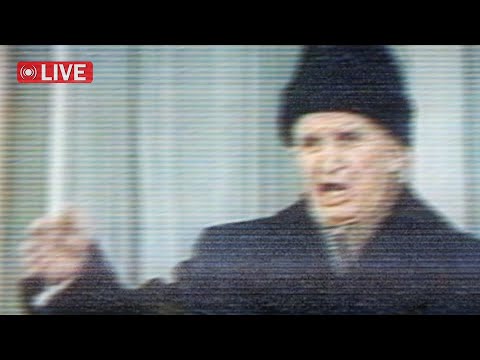
On December 21st, Ceaușescu steps onto the balcony of the Central Committee building, his impeccable suit a stark contrast to the gray, freezing day. He raises his hand, and the square erupts in applause—or so it seems. But look closer: the cheers are too perfect, too mechanical. Hidden loudspeakers blast pre-recorded applause, while the crowd stands rigid, their eyes empty. Only the first few rows move, as if puppets on strings. “This is a provocation! A conspiracy against me!” Ceaușescu mutters, his voice cracking as shouts of “Timișoara!” rise from the back. The script is unraveling.
Panic sweeps through the balcony. Elena, his wife, screams, “Someone is shooting!” Guards rush the couple inside as demonstrators break through barricades. The state cameraman, following orders, tilts his lens toward the sky, but the truth is already out. The people have tasted freedom, and they will not be silenced.
To understand how this moment shattered a dictatorship, we must go back. Nicolae Ceaușescu was born in 1918 in a humble peasant village, but ambition drove him to Bucharest as a teenager, where he joined the underground communist movement. Imprisoned for his activities, he met Gheorghe Gheorghiu-Dej, a relationship that would propel him to power. By 1965, after Dej’s death, Ceaușescu became the general secretary of the Romanian Communist Party. Initially, he seemed a moderate, even refusing to support the Soviet invasion of Czechoslovakia in 1968, earning Western sympathy. But that reformist veneer soon crumbled.
In the 1970s, Ceaușescu consolidated an authoritarian regime, creating a cult of personality that portrayed him and Elena as the “parents of the nation.” The Securitate kept millions under surveillance, and fear became the glue of society. In the 1980s, his obsession with paying off foreign debt plunged Romania into misery. He ordered the export of almost all agricultural and industrial production, leaving shelves empty and homes freezing. While ordinary citizens stood in lines for bread, the Ceaușescus lived in luxury, amassing wealth and building monuments to their megalomania, like the colossal Palace of the Parliament. “The contrast between official propaganda and daily reality became unbearable,” and the people knew they were living a lie.
As communism collapsed across Eastern Europe in 1989, Ceaușescu refused to accept reality. When protests erupted in Timișoara, he ordered brutal repression, but the massacre only fueled the revolt. His mental isolation proved fatal. Instead of negotiating, he insisted on more control. Thus, when he stepped onto that balcony on December 21st, history had already turned against him. The man who had risen from poverty to absolute power was about to face the rebellion of his own people—and the world was watching.
The chase was short and humiliating. Nikolae and Elena were seized in a military barracks in Târgoviște, their faces ashen, their hands trembling—not with cold, but with the sudden, unbearable realization that the crowd they had ruled for a quarter-century now wanted them dead. They were shoved into makeshift cells, guarded around the clock, while in Bucharest the new provisional government, led by Ion Iliescu, debated what to do. The streets were boiling. “Give us the Ceaușescus!” the people chanted, their voices hoarse from shouting. Any delay, the leaders feared, could spark a counter-coup or a rescue attempt by loyalist Securitate units still hiding in the shadows.
So they chose speed over justice. On the morning of December 25th—Christmas Day—an extraordinary military tribunal was hastily convened inside the very barracks where the couple was held. There was no courtroom, no jury of peers, no real defense. The charges were read aloud: genocide against the Romanian people, the systematic destruction of the national economy, abuse of power, and an attempt to flee with more than a billion dollars stashed in foreign accounts. Ceaușescu listened with a smirk, his chin lifted in defiance. “I do not recognize this court,” he spat. “It is a farce, a political lynching.”
Elena was worse. She interrupted the judges repeatedly, her voice shrill, her hands shaking with rage. “You have no right! We built this country!” she screamed, but her words fell into a void. The session lasted barely two hours. No witnesses were called. No evidence was presented beyond the prosecutor’s damning summary. The verdict had been decided long before the gavel fell: guilty on all counts, death by firing squad, immediate execution.
When the sentence was announced, Nicolae tried one last maneuver. He demanded to be brought before Parliament, claiming the trial was illegal. His voice, once capable of silencing a nation, now echoed off bare walls and found no answer. He then made a single request: that he and Elena be executed together. The request was granted—not out of mercy, but out of a grim desire to close the chapter in one stroke.
Soldiers brought ropes to bind their wrists. Both refused vehemently. “We will not run,” Nicolae insisted, his pride still burning even as his world collapsed. “We are not cowards.” The guards hesitated, then followed protocol anyway. The couple was led into the courtyard outside the barracks, where a wall of gray concrete waited. Elena began to cry—not tears of remorse, but of fury and disbelief. She shouted insults at the soldiers, denying every accusation, her voice cracking as the reality of the moment pressed down on her.
Nicolae, in contrast, was eerily calm. He straightened his coat, looked at the firing squad, and began to sing. It was the Internationale, the socialist anthem he had heard a thousand times at party congresses. His voice, thin and wavering, rose into the freezing air: “Arise, ye prisoners of starvation…” He managed only a few lines before the order was given. The bursts of gunfire cut him short, and both bodies crumpled to the ground, side by side, their blood staining the snow.
The execution lasted seconds, but its impact would echo for decades. For years, Romanians had believed Ceaușescu was untouchable—a near-mythical figure upheld by fear and propaganda. Watching him judged and shot so swiftly shattered that myth forever. For the first time in a generation, the people understood that absolute power could be overthrown, that even the most feared man in the country could bleed like anyone else.
That night, images of the bloodied corpses were broadcast on national television. The footage was grainy, almost surreal, but it was proof. The regime was truly dead. In homes across Romania, families gathered around flickering screens, some cheering, others weeping, many simply staring in stunned silence. The contrast between the sacred date and the bloody end felt almost biblical—a divine gift after years of hunger and silence.
But the story did not end with the gunfire. In the days that followed, Romania teetered on the edge of chaos. The National Salvation Front, hastily assembled from former party figures and dissident intellectuals, moved to fill the vacuum. Yet the streets remained restless. “We did not suffer for a new dictatorship!” students shouted in University Square, suspicious that Iliescu’s men—many of them former communists—were simply recycling the old elite under a new banner.
In Târgoviște, the barracks where the Ceaușescus had been held became a pilgrimage site. Ordinary citizens walked past the bullet-scarred wall, some spitting on the ground, others leaving flowers. A factory worker from Ploiești told a foreign reporter, “I stood in line for bread for ten years. Now I stand here, and I feel nothing. Not joy. Not hatred. Just… emptiness.” That emptiness was the true legacy of the regime—a society hollowed out by fear, its trust in institutions shattered.
The trial itself drew sharp criticism from abroad. Human rights organizations condemned the haste, the absence of due process, the theatrical nature of the verdict. But for most Romanians, the question was simpler. “Where were the courts when my brother was taken by the Securitate and never returned?” asked one woman in Bucharest. “Where was justice for the children who froze in unheated apartments?” The summary execution, however flawed, felt like the only language the old regime understood.
What few knew at the time was how close the couple had come to escaping. In the chaos of December 22nd, as the crowd stormed the Central Committee building, a helicopter had lifted the Ceaușescus from the roof. For a brief, terrifying hour, they believed they might reach an airbase and flee abroad. But the pilot, hearing the frantic radio chatter and sensing the tide had turned, feigned mechanical trouble and landed in a field near Titu. From there, the couple commandeered a car, then another, before being recognized and handed over to the army.
The details of that flight remain murky. Some accounts claim Elena screamed at the pilot, threatening his family. Others say Nicolae sat in stony silence, clutching a briefcase stuffed with cash and documents. “He kept repeating that the army would save him,” a soldier later recalled. “He could not accept that the army was no longer his.”
In the months that followed, the Securitate was formally disbanded, but its files—millions of them—survived. The question of who had informed on whom became a national obsession. Neighbors eyed neighbors, colleagues distrusted colleagues. “We were all victims,” a writer observed, “but we were also all complicit.” The moral reckoning Romania needed was messy, incomplete, and in many ways still unfinished.
Economically, the transition was brutal. Prices soared, factories closed, unemployment climbed. The promises of 1989 gave way to the harsh realities of the 1990s. Yet something had changed irrevocably. When miners were bused into Bucharest in June 1990 to beat student protesters, the country watched in horror—but it also watched in real time, on independent television, and it did not look away. The fear that had once silenced the nation had cracked, and it could never be fully restored.
Today, the wall in Târgoviște is a quiet monument. Visitors speak in hushed tones. Schoolchildren learn the date: December 25th, 1989. And on cold winter nights, when the wind sweeps across Palace Square, some say you can still hear the echo of that thin, wavering voice singing the Internationale—cut short, like a regime that believed itself eternal and learned, in a single volley of gunfire, that it was not.
In the years that followed, Romania’s path remained uneven. The miners’ rampage of June 1990 left scars that took decades to heal, and the former communists who seized power proved adept at surviving the very revolution they had hijacked. Yet the myth of invincibility never returned. Whenever a politician grew too arrogant, too sure of his permanence, Romanians only had to remember the frozen balcony and the silenced anthem.
Nicolae and Elena were buried in unmarked graves in Ghencea Cemetery, their plots deliberately unmarked to prevent pilgrimage. But memory found a way. When a journalist tracked down the location years later, visitors began arriving—not to mourn, but to stare at the plain earth and remind themselves that power is borrowed, never owned.
On the twenty-fifth anniversary of the execution, an elderly woman who had stood in Palace Square that day told a reporter through her tears, “I was forced to clap for him. I clapped with my hands, but my heart was already singing a different song.” The camera captured her trembling smile, and the nation understood: freedom begins the moment the applause turns counterfeit.
So the question lingers, as it does for every nation with a dark chapter: when the crowds cheer and the loudspeakers roar, how do we know if it is genuine devotion—or simply the sound of a regime that has already fallen silent?
Report this article
Select a reason for reporting:






