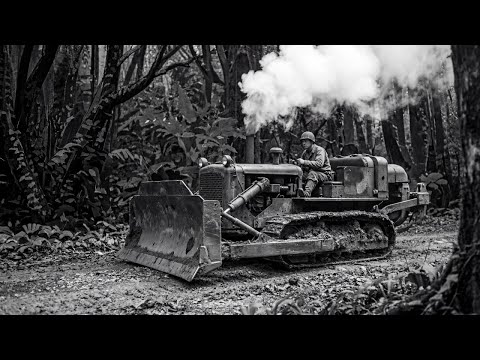
The jungle didn’t care about promises. It had swallowed conquistadors and entire expeditions, and now it stood between the Allies and victory in the Pacific. Every day spent bogged down in the mud was another day for the Japanese to fortify, to bleed the advance slower. The official projection: six weeks to carve a serviceable road through thirty miles of terrain that devoured machines. Six weeks the generals didn’t have.
Lieutenant Wesley Crawford, a 26-year-old engineer from Penn State, had followed the manual at first. He’d operated his bulldozer by the book, filed reports, requested more equipment. The equipment never came. The reports vanished into administrative void. And the jungle kept winning.
Then something shifted. Maybe it was the morning he watched a patrol return with three men on stretchers, ambushed on a trail that should have been a road by now. Maybe it was the night he lay awake listening to distant Japanese artillery, knowing that if supply lines weren’t secured, those guns would pound American positions into dust. Maybe he was simply tired of losing to mud.
Whatever the catalyst, Wesley Crawford made a decision that would have earned him a court-martial under different circumstances. He stopped following the manual.
He studied the D7 bulldozer not as a soldier studies a weapon, but as a craftsman studies a tool not quite right for the task. The blade was broad and flat—perfect for spreading earth on level ground, useless for cutting through root systems denser than concrete. The engine had power to spare, but the transmission rationed it carefully, designed for endurance rather than brute force. Every feature that made the bulldozer excellent for peacetime construction made it merely adequate for jungle warfare. And adequate was another word for insufficient.
Crawford spent his evenings sketching modifications by kerosene light, interviewing mechanics, consulting with Seabees who had been improvising since they hit the beaches. Slowly, a design emerged. Not elegant, not sanctioned, not anything that would ever appear in an Army Corps of Engineers manual—but something that might actually work. He would rebuild the bulldozer into something it was never meant to be: a tool designed for building turned into a weapon for destroying everything in its path.
The modifications began on a Saturday morning when Crawford was supposed to be resting. He and six volunteers—three mechanics, two welders, and a Seabee named Kowalski who claimed he could fabricate anything from scrap metal and spite—descended on the idle D7 like surgeons on a patient who had stopped responding to conventional treatment.
They removed the standard blade and replaced it with something built from salvaged ship plating and the steel teeth of excavator buckets scavenged from a bombed-out Japanese position. The new blade was narrower, sharper, angled like the prow of an icebreaker. It would not spread earth. It would slice through it. They reinforced the cutting edge with high-carbon steel from a destroyer’s armor. When finished, the blade could split a three-foot tree trunk without slowing.
But the blade was only the beginning. They stripped down the transmission and bypassed the governor that limited engine RPMs—a modification that voided every warranty and violated every safety regulation, but gave the bulldozer access to its full power. The engine, designed to run at a conservative 1,800 RPM, could now scream up to 2,400. The strain would destroy it eventually, but eventually was a problem for later. Right now, they needed speed.
They welded additional armor around the radiator and engine block, not to stop bullets—though it would do that incidentally—but to shield against branches and debris the machine would now smash through rather than push aside. They added a second set of headlights on a roll bar, powerful enough to turn night into noon. Because if this worked, Crawford intended to run twenty-four hours a day.
The most radical modification came last. They removed the standard exhaust and replaced it with straight pipes that vented the engine’s roar directly into the jungle. The noise would be deafening, inhuman—the mechanical shriek of a beast that did not belong in any natural ecosystem. The Japanese defenders hiding in the trees would hear it coming from miles away. But Crawford was counting on that. He wanted them to hear it. He wanted them to lie awake at night, listening to the sound of American industry grinding toward them, unstoppable as a glacier, inevitable as dawn. Terror, he had learned, was a weapon as effective as any blade.
When they finished, the machine looked like something assembled by a madman. The blade jutted forward like a battering ram. The armor plating gave it the profile of a tank. The straight pipes made it sound like a dragon in its death throes. One mechanic stepped back, wiped his hands on a rag, and said what everyone was thinking: “Sir, if this thing doesn’t kill us first, it might actually work.”
Crawford did not smile. He simply climbed into the driver’s seat, fired the engine, and felt the entire frame shudder with barely contained violence. The modified governor unleashed the engine’s full fury. The sound was apocalyptic. Birds fled the canopy in panicked clouds. Men covered their ears. And Lieutenant Wesley Crawford, twenty-six years old, with a degree in civil engineering and no business being a wartime innovator, felt for the first time since landing on this cursed island that he had a fighting chance.
The test run began at 0600 the following morning. Crawford had not asked for permission. He had not filed a report. He had simply aimed his Frankenstein bulldozer at a section of jungle that had resisted two weeks of conventional clearing and dropped the blade.
The engine roared. The treads bit into the earth. And the jungle, which had stood unconquered for millennia, began to die.
The blade hit the first tree—an ironwood giant that would have required an hour of axe work to fell—and sliced through it like a knife through butter. The tree toppled. The bulldozer did not slow. It hit the second tree, the third, the tenth. Roots that had tangled underground for centuries snapped like violin strings. The volcanic soil that had been impossible to move sprayed out behind the machine in rooster tails of black mud. Crawford did not steer around obstacles. He drove through them, and in his wake, where there had been impenetrable wilderness, there was now a road.
The men who witnessed it would later struggle to find words. Some compared it to watching a dam break—the same sense of unstoppable force, of nature yielding to something more powerful than itself. Others spoke of biblical imagery, of mountains cast into the sea, of valleys raised up. But the most common description was simpler and more honest: It was like watching the future arrive early.
By noon, Crawford had carved three miles of road through terrain that was supposed to take a week. By sunset, he had reached five miles. He ran the bulldozer in shifts, handing the controls to trained operators while he supervised, adjusted, fine-tuned. They discovered the modified blade worked best at a slight upward angle, that the engine could sustain peak RPMs for forty-five minutes before needing to cool, that the straight pipes needed clearing of carbon buildup every six hours. They learned by doing, by failing, by adapting. And the road grew longer.
Word spread through the division like wildfire. Officers arrived to observe. Engineers took photographs. Skeptics who had dismissed Crawford as a reckless amateur stood speechless as the impossible became routine. By the end of the third day, the modified bulldozer had accomplished what the projection said would take six weeks: thirty miles of road, rough but serviceable, wide enough for supply trucks and troop transports, carved through jungle that had never known a wheeled vehicle.
The supply lines that had been choking were suddenly flowing. Artillery that had been stranded in the rear was rolling forward. The entire advance, which had been stalling, lurched back into motion. And at the center of it all was a machine that should not have existed, operated by a man who had decided that official limitations were merely suggestions.
But the story does not end with the road. Because what Crawford had created was not just a tactical solution, but a philosophical shift. The standard bulldozer represented American faith in engineering perfection—the belief that if you designed something correctly the first time, it would work in any circumstance. Crawford’s modification represented something different: the belief that adaptation mattered more than perfection, that ingenuity in the field could surpass planning in the laboratory, that the men who faced the problems were often better equipped to solve them than the men who never left the drafting room.
It was a very American idea—this notion that the rules could be rewritten by anyone willing to hold a wrench and think dangerously. And it terrified the generals almost as much as it impressed them.
The official response was complicated. On one hand, Crawford’s innovation had achieved results that could not be ignored. On the other hand, he had violated protocols, modified government property without authorization, and created a machine that was, by any reasonable safety standard, a lawsuit waiting to happen. There were discussions about courts-martial. There were memos about maintaining proper chains of command. But there were also urgent requests from other commanders in other sectors—men who had heard about the road-building miracle and wanted their own modified bulldozers immediately.
Practicality won. Crawford was promoted to captain and assigned to train other engineers in his techniques. The modifications were standardized, refined, documented, and spread across the Pacific theater. Wherever American forces needed to move faster than the jungle could resist, Crawford’s bulldozers appeared—ugly, loud, effective, and utterly unstoppable.
The Japanese soldiers who heard those machines approaching learned to fear them in ways they did not fear American infantry or artillery. The infantry could be ambushed. The artillery could be evaded. But the bulldozers were different. They represented something with no equivalent in Japanese military doctrine: the idea that logistics could be weaponized, that roads themselves could be instruments of conquest, that the American capacity to simply build faster and move more supplies would ultimately matter more than courage or tactical brilliance.
There are captured diaries from Japanese defenders in the Solomons, Burma, and the Philippines that speak of the demon machines that ran day and night, that could not be stopped by terrain or weather or sabotage, that seemed to embody some fundamental truth about the enemy they faced. Americans did not accept limitations. They engineered around them.
One diary entry, recovered from a Japanese officer killed in the Battle of Bougainville, describes listening to Crawford’s bulldozers working through the night: “We can hear them always now, even when they are kilometers away. The sound comes through the earth itself, a grinding that never stops. Our commanders say we must hold this position, that the jungle will protect us as it always has. But the jungle is disappearing. Every morning the sound is closer. Every morning the trees fall. We were told that Americans are soft, that they cannot endure hardship, that their machines will fail in the wilderness. But these machines do not fail. They do not tire. And I begin to think that we have underestimated not their strength, but their refusal to accept defeat. They do not fight the jungle. They erase it. And when the jungle is gone, we will have nothing left to hide behind.”
This was the psychological dimension of Crawford’s innovation—the part that could not be measured in miles of road or tons of supplies moved. It was the realization spreading through enemy ranks like a slow poison: that the United States possessed not just material superiority, but something more dangerous—an institutional permission to improvise, to discard what did not work and build something better on the spot. Japanese forces were trained to execute plans with precision. American forces were trained to achieve objectives by any means necessary. And in a war fought across jungles and islands and vast distances where the textbook answers rarely applied, that difference was decisive.
The bulldozer itself became a symbol, featured in newsreels back home as evidence of American ingenuity and resolve. But the newsreels, with their triumphant narration and stirring music, missed the deeper truth. What made Crawford’s modification significant was not that it was brilliant—plenty of engineers could have conceived similar changes given time and resources. What made it significant was that Crawford had the authority—or seized the authority—to implement it immediately, without waiting for permission from some distant committee. In that sense, the modified bulldozer was a perfect expression of the American military at its best: decentralized, pragmatic, willing to let a lieutenant with a good idea change the course of a campaign.
After the war, Crawford returned to Pennsylvania and resumed his career as a civil engineer. He designed bridges and highways, supervised construction projects, lived a quiet life that bore little resemblance to his months in the Pacific. He rarely spoke about the bulldozer. When asked, he would shrug and say he had simply done what needed doing, that any competent engineer would have arrived at the same solution, that he had been lucky more than clever. This was either humility or honesty, or some combination of both.
But those who served with him remembered differently. They remembered a man who had looked at an impossible problem and refused to accept that impossibility was final. They remembered a machine that sounded like the end of the world and worked like the hand of God. They remembered roads appearing where there should have been only jungle. And they remembered learning, in the most visceral way possible, that the war would be won not by the side with the best plans, but by the side that could abandon its plans fastest when reality demanded something different.
There is a photograph taken sometime in late 1943 that captures the essence of the story. It shows Crawford’s modified bulldozer at rest, parked beside a newly cut road that stretches into the distance, straight as a rifle shot, flanked by the stumps of trees that had stood for centuries until they met American steel. The blade is caked with mud. The armor plating is dented from impacts no one had bothered to record. And in the background, barely visible, is a convoy of supply trucks rolling forward toward the front lines—their passage made possible by a lieutenant who had decided that his bulldozer was too slow and that waiting for someone else to solve the problem was not an option.
It is not a famous photograph. It does not appear in the great histories of World War II. But it deserves to, because it captures a truth often forgotten in the accounts of battles and strategies and great men making great decisions: wars are won in the margins by the people who refuse to accept that the tools they have been given are good enough, who look at the gap between what is and what must be and decide to build a bridge across it with their own hands. Even if—especially if—no one has given them permission.
The road Crawford built is gone now, reclaimed by the jungle decades ago, buried under new growth that erased all evidence of the violence that once passed through. But the idea remains. It lives in every combat engineer who modifies equipment in the field. In every unit that finds a better way to accomplish its mission than the one described in doctrine. In every military that trusts its people to think rather than simply obey. It lives in the recognition that the greatest weapon any nation can field is not a machine, but a culture that empowers its youngest members to look at problems and see possibilities rather than limitations.
The bulldozer was too slow, so they made it faster. The jungle was too thick, so they cut through it. The war was too big, so they fought it one innovation at a time, one improvisation at a time, one impossible task at a time—until the impossible became routine and the enemy learned too late that they were not fighting soldiers or tanks or ships, but something far more dangerous: an entire nation that had built its identity on the belief that every problem has a solution, and that anyone with a wrench and an idea has the right to go looking for it.
Decades later, a young Army engineer visiting Guadalcanal found a rusted track link half-buried in the regrowth. He turned it over in his hands, wondering what machine had left it there, what urgency had driven it forward.
He would never know Crawford’s name. But he understood the lesson the steel had carried: the jungle doesn’t care about rank or regulation—it only yields to those who refuse to stop moving.
That is the quiet inheritance of every improvised solution: it outlives the war, the machine, and the man, passing from wrench to wrench across generations who never learn where it began.
So here’s the question for you: if the manual says six weeks and the mission says six days—what would you build, and who would you dare to ask for permission?
Report this article
Select a reason for reporting:






