In 1968, America struck oil at Prudhoe Bay—a field so vast it promised to quench the nation’s thirst for decades. But the oil lay trapped beneath the Arctic tundra, 800 miles from the nearest ice-free port. The only way out was a pipeline, a steel artery four feet wide, running hot across ground that melts into mud the moment you warm it. Engineers called it impossible. The tundra, they said, would swallow any pipe laid upon it. Yet, in the summer of 1977, oil did reach the sea, and a company called Alyeska counted 32 workers dead in the attempt. Twenty days before that first barrel flowed, one of its own pump stations exploded. How did they do it? The answer lies in the frozen ground itself—and in the stubbornness of the people who refused to let it win.
The first lesson came early. In 1968, Alaska’s governor ordered a winter road pushed 400 miles north from Livengood to Prudhoe Bay. Bulldozers scraped the tundra down to solid ground, and by March 1969, trucks were rolling. Then spring came, and the road vanished. The scraped-away moss had been the only insulation keeping the permafrost frozen. Sunlight melted the ice beneath, and the road became a long trench of water—the Hickel Canal. A whole winter’s work, $700,000, and all it moved was eight tons of freight. Three cargo planes could have done the same.
So they tried the sea. In August 1969, the tanker Manhattan, fitted with an ice-breaking bow, set out to conquer the Northwest Passage. She made it to Prudhoe Bay, but the ice had battered her hull and wrecked her instruments. The voyage proved the sea was the wrong road. Humble Oil decided a pipeline was cheaper. “800 miles of it,” one engineer later said, “was not cheap.” The pipe—100,000 lengths of Japanese steel—was already waiting at Valdez. But where to put it?
The oil comes up at 120 degrees. It must stay hot, or it thickens and stops. The ground, however, is permafrost—frozen silt holding up to 50 percent ice. Warm it, and it loses strength, settles, flows. Think of a hot frying pan on a frozen pond: the pan is fine for a moment, then it sinks. The original plan buried the pipe in a ditch. Engineers drilled soil cores and found the ice. The burial plan was dead before a single section went in.
While they redrew, the lawyers took over. A federal judge stopped the project in April 1970. It stayed stopped for three years, until Vice President Agnew broke a Senate tie in 1973. All that time, the Japanese pipe sat in the rain at Valdez. Meanwhile, the north showed what it could do. In January 1971, at Prospect Creek camp, the thermometer read 80 below zero—the coldest temperature ever recorded in the United States. Steel gets brittle at that cold. Diesel turns to jelly. Every weld would have to survive both ends of a 175-degree swing.
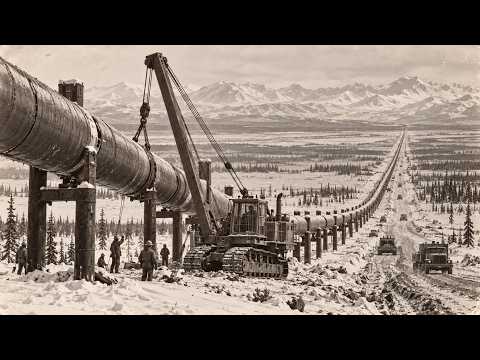
The engineers went back to the frying pan. If you can’t bury a hot pipe in frozen silt, you lift it into the air. Gravel and bedrock could still take a buried pipe, but ice-rich ground would get stilts. About 420 miles would run above ground, 376 buried, and 4 miles buried in a special way—refrigerated ditches. But stilts had their own problem: frost jacking. A steel leg driven into frozen ground conducts heat. Summer sun warms the steel, the ground around it melts, and winter freezes it again, gripping the leg and pushing it upward. Do that every year, and the leg works its way out like a fence post.
The answer was a tube inside the leg—two of them, each two inches wide, sealed and charged with ammonia under pressure. In winter, the ammonia at the bottom boils, rises to aluminum fins at the top, gives up its heat to the Arctic air, and runs back down as liquid. All winter long, every leg pulls heat out of the ground and throws it into the sky. In summer, it stops. It’s a freezer that runs on winter itself. Thousands of these legs stand along the line today, and nobody turns them on.
But a design is not a pipeline. They needed a road to haul the pipe north, and after the Hickel Canal, everyone knew what an Arctic road could become. In April 1974, crews started the haul road from the Yukon River to Prudhoe Bay—358 miles. This time they did the opposite of 1968: they didn’t scrape the tundra, they covered it. A thick pad of gravel laid on the living moss became a new blanket, and the frozen ground underneath never felt the sun. Thirty-two million cubic yards of gravel, 170,000 flights of equipment and fuel, 3 million hours of labor. On September 29, 1974—154 days after they started—the haul road was finished. It was the first highway in America to cross the Arctic Circle.
But a road that starts at the Yukon is only useful if you can cross the Yukon. The bridge there would run 2,295 feet. In August 1974, a cofferdam at Pier 4 failed, and they had to pull the whole thing out and start over. Through the winter, freight crossed on a road of ice. The bridge they finally finished changes length with the seasons—the steel deck grows and shrinks by almost two feet between winter and summer. Hold on to that number, because the pipe has the same problem.
On March 27, 1975, crews lowered the first stretch of pipeline into the ground under the Tonsina River—1,900 feet of pipe carried by 12 side-boom tractors moving together like pallbearers. That date was not a coincidence: 11 years earlier to the day, the Good Friday earthquake had destroyed Valdez and killed 32 people. The pipeline was built to end in a town that had already been destroyed once by moving ground, and the line itself had to cross that kind of ground, too. North of the Alaska Range, the route crosses the Denali Fault, where one side of the earth can lurch sideways past the other. You can’t stop a fault from moving, so the engineers laid the pipe on long steel beams on supports that would let it slide—20 feet sideways and 5 feet up or down without breaking. Whether that number was right, nobody would know until the earth tested it.
By the summer of 1975, the pipeline had turned into dozens of jobs at once, spread over 800 miles. Valdez tripled in population in 17 months; a two-bedroom apartment that rented for $286 went for $1,600. Fairbanks was worse. Police officers quit to become pipeline security guards at $1,000 a week. A tent maker sold $240,000 worth of tents in a year because people had nowhere else to sleep. A journeyman welder grossed $1,505 in a 184-hour week—more than a member of Congress made in a month. In October 1975, 28,072 people were on the job, living in 29 camps along the route. The biggest, at Isabel Pass, had 1,652 beds. The smallest, at Sourdough, had 112. They came from everywhere, and they worked in conditions that could kill you.
At the head of it all was Frank Moolin, the senior project manager. The histories describe him the same way: he drove people. The project had a staggering list of contractors, unions, and camps, and Moolin’s job was to make all of it move in the short window when the ground and the weather allowed. That window decided everything. Some rivers could only be crossed when frozen. The schedule was drawn around the ground.
On the elevated stretches, the pipe zigzags. Seen from the air, it looks like someone drew it with an unsteady hand. But every bend is a place where the pipe can flex. When it heats up and grows, the zigzags get a little sharper and the pipe slides sideways in its shoes. When it cools, they relax. It’s the same reason a garden hose laid out in loose curves can be pulled a little longer without kinking. 78,000 legs went in that way, and for every leg, somebody had to drill a hole, set a pipe, weld a crossbeam, and fit a shoe—in places where the nearest town might be 200 miles away.
Then there was the water. Alyeska counts 34 major river crossings and nearly 500 smaller ones. Every one was a place where the pipe had to go under or over moving water. Rivers up there braid and wander; a channel that runs along one bank this summer can be cutting across the other bank next spring when the ice breaks up in slabs the size of houses. So the river crossings went deep, and the pipe in them was wrapped in concrete—not for strength, but for weight. An empty steel pipe four feet wide is mostly air, and in a river, air floats. The concrete jacket held it down. That worked as long as everything went to plan. On one river, it didn’t.
Then there were the animals. The route crossed the ranges of two caribou herds. Nobody knew whether a herd would walk under a pipe on stilts or turn back. So the elevated line was raised high enough in places for animals to pass beneath, and in other places the pipe dropped into the ground for a short stretch just so they could walk over it. Alyeska counts about 579 animal crossings along the main line. But some of those crossings were exactly where the ground was full of ice. And that brings me back to the four special miles. In a few places, the engineers needed the pipe underground for a highway or for animals on ground that could not take a warm pipe. So they buried the pipe in insulation and refrigerated the ditch. To carry hot oil past a herd of caribou, they built a refrigerator in the ground and put the oil pipe inside it.
October 1975 had two dates Alyeska still lists. The first came early in the month: the Yukon River Bridge was finished. On October 10, there was a ceremony, and the haul road was tied to the rest of Alaska across the biggest river in the state. For the first time, a pipeline truck could drive from Fairbanks to the Arctic Ocean without waiting for the river to freeze. The second came on October 26: Alyeska announced the project was half done. Half done in October, with winter arriving. And the half that was left was the hard half. The easy flat ground near the camps had gone in first. What remained were the mountain passes, the canyons, and the long frozen miles in the Brooks Range.
The plan for that second half was built around a single idea: you start this pipeline once and it stays on forever. The oil would go in, the pipe would fill, and from that day on it would never be allowed to stop, because hot oil that stops in an Arctic pipe starts to cool, and cold crude turns thick. Hold on to that, because the day the oil was turned on, it would stop more than once.
But the legs were only the bed. The pipe itself was still coming, and it came in pieces. Every section that left Japan was 40 or 60 feet long—more than 100,000 of them. In Fairbanks, welders joined pairs into double joints, 42,000 of those, so trucks could haul longer pieces up the line. Out in the field, crews welded those pieces end to end. Alyeska counts 66,000 field welds. The welders were mostly members of Pipeliners Local 798 out of Tulsa, Oklahoma. “Take your typical 798 pipeline welder,” one history says, “feed him a few drinks, and he’ll probably tell you he’s God’s greatest gift to welding.” The steel wasn’t all the same, either. For about 466 miles, the pipe wall was just under half an inch thick; for the other 334 miles, it was thicker, a little over half an inch, where the line needed more strength. Every weld was supposed to be x-rayed. A film was shot through the joint, the film was read, and a weld with a flaw got cut out and done over. That’s how you know a pipe will hold hot oil under pressure for decades.
That summer, the x-rays started lying. The company doing the x-ray work was a subcontractor called Ketchbaw Industries. One of its employees, a Fairbanks man named Peter Kelly, later testified to Congress about what he’d seen. He said he’d personally falsified about 30 x-rays and had watched others doing it before and behind him. Films were falsified to show good joints. According to Kelly, it went on for about a month and a half in the summer of 1975 over more than 70 miles of the pipeline. He gave the reason in one plain sentence: it was to keep Ketchbaw moving down the pipeline and keeping up with its contract. The schedule again. The same window that drove everything else had just driven somebody to fake the one test that mattered most.
In September 1975, a former Ketchbaw employee went to court, and the story was out. Alyeska fired its x-ray contractor. Congress called hearings, and everyone wanted to know: how many of the welds already in the ground were good? Alyeska went back to a 150-mile stretch and found that 8 percent of the manual welds there had defects. The federal government ordered an independent review of the records for every weld done that year—30,800 of them. Of those, 3,955 came back questionable. Roughly one weld in eight from that whole year. Every one a place where hot crude was supposed to be held in by a joint nobody could vouch for. And a lot of them weren’t up on legs where you could reach them. They were in ditches, under river crossings, already covered. In the stretch Alyeska rechecked first, there were 3,748 welds, and about two-thirds were already buried. Alyeska went back for every one. Where a film was missing or doubtful, and the weld was underground, the weld had to be checked again—and that meant reaching it. Where the check failed, it meant cutting out the joint and doing it over. By September 1976, more than 3,000 of the questionable welds had been redone or cleared as safe. The repairs cost about $55 million. A month and a half of faked film had turned into a year of going backward.
And that year, 1976, was supposed to be the year the line got finished. Frank Moolin had set the goal himself. He told the press that all of the line would be installed, insulated, and hydro-tested by November 1. Then he admitted the problem in a sentence the construction history still quotes: “In some areas,” he said, “we did eat our cake last year.” He meant the easy ground was gone. Everything left was the kind of country that had stopped the Hickel road and turned back the Manhattan, and now there was a date on it.
That was the summer Diane Shanker came onto the line. She was 21, just out of Reed College, living in Fairbanks with no construction experience at all. She’d heard a rumor that the welders union—the same Local 798—was being forced to hire women. So she went to the union office and talked the office manager into sending her out. They sent her to an all-male welding crew, mostly men from the South, as a welder’s helper. Her first job was to crawl on her hands and knees under the pipe and pick up the stubs of spent welding rod the welders dropped. When she was moved up to grinding the welds, her crew threatened to quit, saying it was too dangerous for a woman. One day the crew agreed not to speak to her at all. That lasted about four hours. Another time, a man on the crew threw her into the water after she’d told them she couldn’t swim. He was gone from the camp right away. She stayed. Years later, she told an interviewer that the work wasn’t the hard part. She said she’d carried more weight on a tray waiting tables than she ever had to carry on that job. When she’d worked enough hours to earn her union card, she was turned down and told she’d be fired on the spot if she kept pushing. She later testified in a federal discrimination case against the union. She’s retired now, living in Anchorage. I like knowing that the welds on this pipe were ground smooth, in part, by a 21-year-old who’d been told she’d never get her card.
Up at the north end of the line, the work never stopped for winter, because on the North Slope, winter is when the ground is at its best. Alyeska’s fact book describes that country plainly: a flat plain with no trees running from the foothills of the Brooks Range to the Arctic Ocean. For 56 days in winter, the sun never rises. Temperatures drop to 60 below, and with the wind, the cold can feel like 135 below. In the middle of the day, there’s a kind of long twilight, and the fact book says it’s enough light to drive without headlights. So picture a welding crew out there at noon in December in that blue half-light, working inside a little shelter pulled over the joint to keep the wind off the arc. Hot metal at 60 below. Every weld has to cool slowly and evenly, or the cold cracks it. Then summer comes, and that same plain turns into a sponge. The top layer thaws, the water can’t drain down through the frozen ground underneath, and the whole slope becomes a field of ponds and mud that a boot sinks into. Heavy machines tear it up. That’s why the gravel road and the gravel work pad mattered so much. Alyeska measures the work pad along the line as 790 miles long—a gravel shelf running almost the whole way from Prudhoe to Valdez, so the machines would never have to touch the tundra. 790 miles of gravel laid down just to keep from touching the ground. That’s how seriously they took what happened to the Hickel Road.
And on that same North Slope, in the summer of 1976, one of those welded sections broke loose. June 1976, on the Sagavanirktok River—the Sag, as everybody called it. A stretch of concrete-coated pipe 1,700 feet long had been laid in a trench under the river. Remember what the concrete was for? Weight, to hold the pipe on the bottom. It came up anyway. 1,700 feet of pipe floated to the surface of the river. That’s about a third of a mile of steel and concrete lying on top of the water where it had been buried. And the crews had a clock on them. The environmental rules gave them a 24-hour window to work in that river. They got the pipe back down and fixed it in four hours. Four hours for a pipe the length of five football fields that had just floated out of a river in the Arctic.
But the Sag was flat country. The mountains were still waiting, and the mountains had their own clocks. At the south end, the oil needed somewhere to go, and in 1976, the marine terminal at Valdez was rising across the bay from the new town. It would cost about $1.4 billion by itself, close to a fifth of the whole project. Tankers would tie up there to take on the oil. One of the loading berths was built as a floating platform with 13 buoyancy chambers, and it weighed 6.5 million pounds. They built it to float because the ground under Valdez had already shown, in 1964, what it could do to anything set on it.
So the two ends of the line were getting ready. In between, the hardest country on the whole route was still in the way. Start with Keystone Canyon, just outside Valdez, where the pipe climbs out of the coast through a narrow gorge with rock walls on either side. The winter before, more than 300 inches of snow fell there—25 feet. Parts of the work in Keystone were so steep that pipe had to be flown in by helicopter. Out on the line, the men who had to make it work were in the cabs. One description of what a sideboom operator needed said he must be able to sit on a sideboom at 40 below and not freeze up. The sideboom tractors were the backbone of the job: a crawler with a crane arm on its side, lifting a section of pipe that weighs tons, while three or four others lift the same section a few dozen feet down the line, all of them inching forward together over ice.
Then Thompson Pass, the last mountain wall before the sea. Alyeska’s fact book gives the steepest grade on the whole route there: 145 percent. 55 degrees. Say that out loud, and it sounds like a mistake. A grade is how far you climb for every 100 feet you go forward. A 100 percent grade means you climb 100 feet for every 100 feet—a 45-degree slope, the angle of a steep roof. 145 percent means you climb 145 feet for every 100 you move forward. The ground is closer to a wall than a hillside, and the pipe had to go straight up it, four feet wide, in sections that weighed tons, with every weld on it x-rayed, and this time the films were going to be real.
And at the north end, in the Brooks Range, there was Atigun Pass, the highest point on the line at 4,739 feet. Atigun was the opposite problem from the rivers. The pass was full of permafrost and glacial soil, so the pipe should have gone up on legs. But Atigun is avalanche country. A pipe on legs in that pass would be swept away by the first big slide. So they put it on the ground, in a way only this job would think of. They built a concrete box about 6,000 feet long, and lined it with 21 inches of Styrofoam. The hot pipe went inside the box. The insulation kept its heat from the frozen ground, and the concrete kept the mountain off the pipe. And the box had to be closed before the snow. In Atigun, that meant October. If the snow came first, the season was gone, and the pass would sit open all winter. They closed it in time, which sounds like a small sentence, until you remember that if they hadn’t, a half-finished trench full of pipe would have sat open at the top of the Brooks Range all winter, under avalanches, while every other part of the line waited on it.
November 1 came—Moolin’s date. The line was not done. The last section of pipe went in on December 6, 1976, near Thompson Pass on that same mountain wall. At least five weeks late. And with the pipe finally in the ground from end to end, the people who had built it faced the only question that had ever mattered: would the ground hold once the oil was hot inside it?
The final weld was made on May 31, 1977, near Pump Station 3. Three weeks later, they found out. On June 20, at 10:26 in the morning, oil entered the pipe at Prudhoe Bay. Ahead of it went a cleaning plug, then pressurized nitrogen to keep test water from freezing. Behind came the crude—barely moving, pushing into 800 miles of cold steel. The line fill alone took over 9 million barrels. The front crawled south at a mile an hour, a slow walk.
Then it stopped. On July 4, near milepost 489, crews found nitrogen leaking. The super-cooled gas had cracked the steel from the inside. They cut out the section and restarted. Four days later, Pump Station 8 exploded, killing one worker and destroying the pump building. The line sat full of cooling oil. It would not pump again for eight months.
But the oil kept moving. It crossed the Denali Fault on its sliding beams, climbed Isabel Pass, and slid down Thompson Pass. On July 28, 1977, at two minutes past eleven at night, oil reached Valdez at 45 degrees. Behind it, the legs stood where they’d been set. Nothing had sunk. The ground had held because the pipe never really touched it.
Today, you can drive the Dalton Highway beside it, see the zigzag and the fins against the sky. In 2002, a magnitude 7.9 earthquake moved the fault 18 feet sideways. The pipe slid and never broke. The engineers had guessed right.
So here’s my question for you: if you drove that road tomorrow, would you trust a fifty-year-old freezer running on winter to keep the ground frozen under a river of hot oil—or would you lie awake listening for the crack?
Report this article
Select a reason for reporting:






