The gangway clanged down onto the scorched pier, and the men who had spent four years fighting the Japanese stepped onto the soil of a defeated empire. It was February 21, 1946. Before them, the harbor of Kure lay choked with sunken warships—the skeletal remains of the shipyard that had built the Yamato. Behind the docks, the city was a blackened smear from the firebombings of the previous July. And yet these soldiers were not here to fight. They were here to occupy, to disarm, and to dismantle the last remnants of Japan’s war machine.
But this was no ordinary occupation. The force they belonged to—the British Commonwealth Occupation Force—had been announced just three weeks earlier, and its commander was not British, not Indian, not New Zealand. The officer sitting behind the desk in Kure was an Australian. Lieutenant General John Northcott, former Chief of the General Staff of the Australian Army, now held authority over 45,000 men from four nations. The irony was not lost on anyone who remembered Gallipoli, where Australian infantry had been thrown into battle under British plans and British officers, without a single voice from Melbourne being consulted. Now, in February 1946, the roles were reversed.
British and Indian battalions in Japan received their orders through a chain of command that ended at an Australian desk. This arrangement would last as long as they remained in the country. The Australian component alone was responsible for 57,000 square kilometers—Shimane, Yamaguchi, Tottori, Okayama, Hiroshima, and the island of Shikoku across the water. More than 20 million Japanese civilians lived within those boundaries.
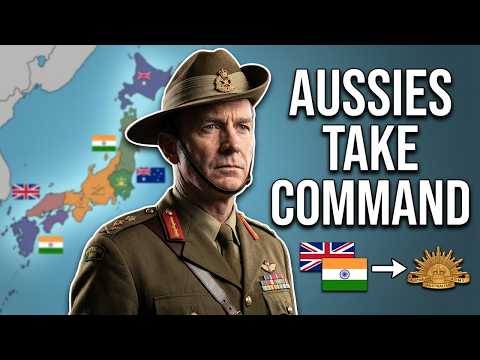
The mission was not to govern. That was American. General Douglas MacArthur, as Supreme Commander for the Allied Powers, ran the military government of Japan from Tokyo. No Australian had ever held authority over Japanese civil administration. Instead, the Commonwealth task was narrower and, in its own way, harsher. It began when intelligence sections in Australian battalions were handed lists of map references—each one a grid square on a Japanese Army map. Inside those squares lay what remained of the armed forces of the Japanese Empire.
The occupation had begun on September 2, 1945, and in its first months it was run entirely as an American operation. Britain, Australia, India, and New Zealand spent that time negotiating the Commonwealth’s share of the tasks. The announcement finally came on January 31, 1946. Command was assigned to Australia. The main Australian forces arrived three weeks later, and by mid-year, four national contingents were in place across the western provinces.
Of the 45,000 troops, about 16,000 were Australian. Only 4,700 were infantry. Another 5,300 were support and supply—because a force stationed on the far side of the Pacific needed men to move supplies more than it needed men to carry rifles. 2,200 belonged to the air wing. 130 came from an Australian general hospital, expecting a flood of war wounded, only to find itself treating dysentery and broken ankles.
The infantry were the 34th Infantry Brigade, made up of the 65th, 66th, and 67th Battalions, and they came ashore at Kure in the early months of 1946. The brigade spread across the region in battalion sectors, each covering a stretch of coastline and a series of inland valleys. A single infantry company might be responsible for securing a city of 30,000 people and every road leading into it. There was no enemy in front of them, no front line anywhere. Yet the work went on 14 hours a day.
The air component was known as BCAIR, flying Mustangs. Nos. 76, 77, and 82 Squadrons operated from Bofu, later moving to Iwakuni on the Inland Sea. Their patrol area covered every province in the Commonwealth zone, flying low and slow, searching for weapons and ammunition that no one had reported. A single-seat fighter was an odd tool for that kind of search, but it was the only means capable of covering 57,000 square kilometers in a working week. The Navy sent the cruisers Australia, Hobart, and Shropshire, backed by a succession of destroyers and frigates—Arunta, Bataan, Culgoa, Murchison, Shoalhaven, Quadrant, Quiberon. Landing ships Manoora, Westralia, and Kanimbla ferried personnel and supplies to and from Kure. Their work in the Inland Sea was police work: patrols against smuggling, against Koreans crossing illegally into Japan, with Mustangs overhead spotting boats before the ships could.
Alongside the Australians stood the British Indian Division, known as BRINDIV, under Major General David Cowan. Cowan was a Burma man who had led the 17th Indian Division through the fighting at Imphal and Kohima. His soldiers were among the most experienced jungle troops in the British Empire. The 2nd New Zealand Expeditionary Force held its positions beside them. And to the east, across the boundary, lay the U.S. Eighth Army—the largest single military formation in the country. The Commonwealth zone was the western wing of the entire occupation, the only part of Japan where the senior officer was not American.
That Australian command deserves to be understood precisely, because it is often distorted in the telling. Australian sergeants did not issue orders to British battalions. Australian officers did not inspect Indian infantry platoons. Australian authority sat at the top of the structure at the same level of power, where operational directives were written, areas assigned, and reports sent to the governments concerned. Cowan ran his division. Northcott ran the force to which Cowan’s division belonged. The distinction mattered—and it would matter even more as the years wore on and the force began to shrink.
The inspections began almost immediately. Intelligence sections in the battalions took grid squares from headquarters at Kure and set out with a truck and an infantry section to find out what was inside them. Some squares contained nothing at all. Others held ammunition stacked in tunnels on hillsides, or sheds full of rifles, or vehicles and machinery that had fed the Japanese war effort until the previous August. The men doing the counting were in their early twenties, and they had learned their trade in New Guinea and Borneo.
The terrain made the work slow. Western Honshu is a country of short, sharp hills falling toward the water, with valleys that carry one road and one river and no alternative routes. Shikoku, across the strait, was worse. Japanese ammunition dumps had been dug into tunnels inside those hills precisely because they were hard to reach and harder to bomb. An Australian section spending a day walking into a valley, opening a steel door, and counting shells by flashlight was performing exactly the task Japanese engineers had made difficult on purpose.
What they found was sorted into categories. Anything with immediate military value was destroyed. Anything convertible to civilian use was converted. The rest was either retained by the occupying force or handed back to Japanese authorities for use in a country that had almost nothing left. Trucks became trucks again. Machine tools went to workshops to make things people could use in daily life. The decisions about where each item went were made by junior Australian officers with instructions in their pockets. The demolition itself was carried out by Japanese civilians—swinging hammers, running cutting equipment, driving the machines, burning what should be burned, all under Australian supervision.
That is the picture at the heart of the whole story, and it is almost never told. The industrial machine that built the fleet at Kure and armed the divisions that fought across the islands was taken apart by the people who built it, supervised by men from Queensland and Victoria with notebooks.
Hiroshima lay about 20 kilometers from the coast at Kure, inside the Australian zone. Australian troops passed through it on their way to somewhere else, and units were quartered within sight of it. What they saw in 1946 was mostly flat ground crossed by tram lines and temporary housing going up in rows. The force had no part in what happened there on August 6, 1945. It inherited the consequences as a piece of ground it was now responsible for, and it got on with the job.
Kure itself became the center of Australian life in Japan. A naval town that had lost its reason for existing, with a population that had been building warships in July and foraging for food by September, now hosted an Australian garrison living in its midst. The relationship on both sides was wary and mostly quiet. Australians who had been told for four years exactly what the Japanese soldier was capable of found themselves buying vegetables from his mother, and there was no evidence anywhere to explain how they felt about it.
By the end of 1946, the things to be found on a disarmament mission were running out. The tunnels were emptied, the sheds counted, and the aircraft flying over the provinces were coming back with nothing to report. The brigade’s work shifted to guard duties and training, and the rifle ranges began to fill because there was nothing else to do with three battalions of infantry. The occupation stopped being an operation and became a garrison, and garrisons rot if you leave them alone.
Garrison duty is corrosive in a specific way that anyone who has done it will recognize. The men were young, far from home, doing work that was ostensibly finished in a country whose language they did not speak, with no date for their return. Discipline problems multiply in that environment, and so does paperwork. Robertson would spend a large part of his time as commander managing a force whose principal enemy was its own idleness. The training programs that filled the schedule existed to keep the men busy as much as to keep them ready.
That drift is why the force began to come apart. The governments looking at the bill for keeping 45,000 men in a country that had already been disarmed started asking why they were there. Britain was struggling with an empire disintegrating in half a dozen places and needed the battalions elsewhere. India was months away from independence and partition, which took Indian units out of any imperial arrangement anywhere. The reductions began in early 1947 and never stopped once they started. The troops went home in stages over the next two years.
By the end of 1948, the British Commonwealth Occupation Force was entirely Australian—and kept the name anyway, because to change it would have been to admit that the Commonwealth’s part of the arrangement was over. For roughly two-thirds of the period the force existed, the Commonwealth in Japan meant Australians and no one else. The flag came down over the British Commonwealth Force headquarters. The Australian flag stayed exactly where it was.
That is the shape of the thing, and it deserves precision because the numbers inflate every time the story is told. British and Indian troops served under Australian command in Japan for nearly three years, from the landings in early 1946 until the last of them withdrew. Australian command of the force itself ran from beginning to end. From the day it formed to the day it dissolved, every commander of the British Commonwealth Occupation Force was an Australian officer. Two men held the post across the whole span, and both were from the Australian Army.
Northcott handed over in June 1946 to Lieutenant General Horace Clement Hugh Robertson, known in the Australian Army as “Red Robbie.” Robertson had commanded in the Western Desert and in the islands, and was famous for telling men above his rank exactly what he meant. He took command of Japan and kept it until November 1951—five and a half years in one post. He was the Australian face of the occupation for almost its entire existence.
By 1949, the Australian force in Japan was a shadow of what it had been. The Mustang squadrons shrank until only No. 77 Squadron remained, flying from Iwakuni. The infantry shrank to a single battalion—3 RAR—understrength and waiting to be shipped home. Men counted the months. The whole establishment had the feel of an operation winding down, and everyone in it knew it.
Then, on June 25, 1950, North Korean divisions crossed the 38th parallel and drove south. Seoul fell within three days. The nearest Commonwealth ground troops to the fighting were in western Japan, a few hundred kilometers across the Tsushima Strait, sitting in barracks with little to do. The nearest Commonwealth fighter squadron was on the runway at Iwakuni, already fueled, with pilots who had flown over that same water for years and knew its weather better than anyone alive. No. 77 Squadron was in the middle of its farewell ceremony. The unit had been told it was going home to Australia. The arrangements were made, the parade was underway, when word arrived that the squadron would be sent to Korea immediately. The flight home was cancelled on the spot. The Mustangs that had spent four years hunting hidden ammunition dumps in the hills of Japan were armed, briefed, and sent across the strait. Australians were flying combat missions over Korea days after the war began.
Robertson issued the order for the ground force himself. 3 RAR would move to Korea as soon as the battalion was brought up to strength and reinforcements arrived from Australia to fill its ranks. Lieutenant Colonel Charles Green took command—a officer who had fought in Greece and New Guinea and was thirty years old when he took the battalion. What had been the exhausted last garrison battalion of an occupation force became a battalion ready for war in a matter of weeks. 3 RAR crossed to Korea and joined the line as part of the 27th Commonwealth Brigade under United Nations command, run by MacArthur from Tokyo. The battalion made its name quickly. Within weeks it was doing the kind of work that gets a unit mentioned in other people’s after-action reports, pushing north with the advance and holding ground that was supposed to be too costly to hold. It stayed in Korea for the rest of the war and never returned to Japan as an occupation unit. Green himself did not survive the campaign’s first months.
The reason Australia was in Korea so fast comes down to geography and the six years before it. Australian ground troops were among the first Commonwealth forces to reach the fighting because they were already standing nearby with their bags packed. The base at Kure became the main Commonwealth supply and hospital base for the Korean campaign. Iwakuni became the forward air base. The occupation infrastructure built to dismantle a war machine was converted and used to feed a new one.
This is the part of the story that closes the circle. The piers where Australians unloaded their cargo in February 1946, in a harbor full of sunken ships, became the piers they loaded from for Korea in the second half of 1950. The same cranes lifted the same kinds of crates in the opposite direction. Japanese dockworkers themselves worked the pier, paid this time, on the exact other side of the arrangements. The men who sailed through Kure in 1950 passed the wreckage of a fleet their fathers and older brothers had helped sink five years earlier, and most of them no longer noticed it was there.
It also settled a question that had been hanging in Australian foreign policy since the fall of Singapore. Australia had entered the Second World War as a dominion whose forces were distributed to British commanders in theaters chosen in London. It came out of the occupation of Japan having run a multinational force—including British and Indian formations—from an Australian headquarters for six years, with no British general anywhere in the chain above it. Nobody described that as a declaration of anything at the time. The record simply shows that it happened, and it happened in the country Australia had spent the war expecting to be invaded by.
The British Commonwealth Occupation Force was terminated on April 28, 1952—the day the peace treaty with Japan came into effect and the country stopped being occupied territory. Its remaining tasks were handed to a new organization called British Commonwealth Forces Korea, which took over the bases, the hospital, and the supply chain. Robertson commanded that too. The occupation force ceased to exist on paper, and most of its buildings and half its staff simply changed the sign on the door.
Six years, two Australian commanders, and not one from anywhere else. A zone holding more people than the entire population of Australia at the time, and an Australian brigade with orders to dismantle everything in it that could still fire a shell. Australia had never before occupied the territory of a sovereign state it had helped defeat, and it has not done so since.
The event sits in the gap between the Second World War and Korea—exactly the gap where national memory tends to fade. There are no military parades for it. No Anzac Day ceremonies center on Kure, no film has been made about the 34th Brigade, and the men who did it came home to a country that had already decided the war ended in 1945 and was not interested in the four years of cleaning up that followed. Ask an Australian today who commanded the British and Indian troops in occupied Japan and you will get a blank stare. The answer is a man from the Australian Army with red hair and a sharp temper, sitting in an office in a burned naval town, running an army four governments handed him.
So here is the question that remains: if a nation can command an empire’s soldiers for six years in a defeated land and then forget it ever happened, what else has slipped through the same gap—and who decides which parts of history are worth remembering?
Report this article
Select a reason for reporting:






