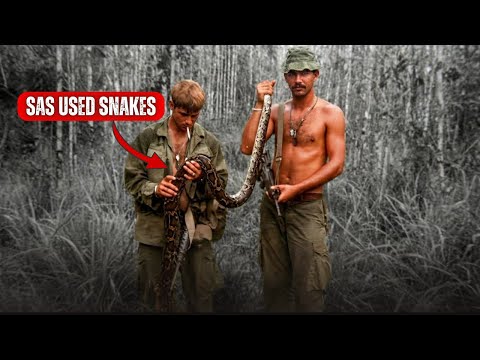
August 23rd, 1967. 0200 hours. A Viet Cong base camp twelve kilometers north of Nui Dat. Sentry Fam sits against a tree trunk, fighting sleep. The jungle night is alive with sounds—insects, frogs, the distant call of night birds. But beneath those natural noises, Fam hears something else. A whisper of movement in the undergrowth. He grips his AK-47 tighter, peers into the darkness, sees nothing, tells himself it’s paranoia.
The Australian jungle ghosts have been operating in this area for weeks. His company has lost nine men to ambushes. Three sentries found dead with throats cut. The company commander warned them the Australians move like spirits. You never hear them until it’s too late.
Fam forces himself to stay alert, scans the perimeter. Everything seems normal. Then he feels it—something cold sliding across his boot. He looks down, freezes in absolute terror. Coiled around his leg is a snake. Not a small one, but a massive python at least three meters long, thick as a man’s arm.
In Vietnam, pythons aren’t usually aggressive, but this one is moving with purpose, sliding up his leg toward his torso. Fam wants to scream, but fear has locked his throat. He tries to stay absolutely still because sudden movement might provoke a strike. The snake continues its inexorable climb, wraps around his waist. The weight is crushing. He can feel the muscle beneath the scales. This is a predator capable of killing a full grown man, and it’s wrapping him in its coils.
Fam’s mind races. How did a python get into the base camp? They cleared this area, posted sentries, maintained security. Pythons don’t just appear in the middle of a military position. Unless… the thought hits him like ice water. Unless someone put it there. Unless the Australians found the snake, captured it, carried it to the base camp perimeter, and deliberately placed it on a VC sentry. Psychological warfare taken to a level that seems impossible.
But the alternative is that a three-meter python randomly decided to climb onto a sentry in a cleared base camp—which is statistically absurd. Fam finally finds his voice, starts to call out for help, but the snake, sensing the vibration of vocal cords, begins to tighten around his chest. He can’t breathe, can’t move, can’t scream. He’s going to die here, strangled by a python while his comrades sleep ten meters away.
And in that moment of pure terror, Fam realizes this is the point. This is what the Australians want. They want him to understand that death can come from anywhere. That even nature itself has been turned into a weapon against them. That there is no safety, no security, no sanctuary.
And then just as suddenly as it appeared, the snake stops, remains motionless for what feels like an eternity, then slowly uncoils and slides away into the darkness. Fam gasps air into his lungs, his heart hammering so hard he thinks it might burst. He’s shaking uncontrollably, and he knows with absolute certainty that somewhere in the darkness, an Australian operator is watching, waiting, laughing—because they didn’t need to kill him. They needed to break him. And they succeeded.
But here’s the question that military historians have debated for over fifty years: Did this actually happen? Or is it a legend, a myth, a story that grew in the telling until it became accepted as fact? Because there’s no official record of Australian SAS operators using snakes as weapons. No after-action report describes capturing pythons and placing them on enemy sentries. No veteran has ever gone on record confirming it happened. Yet the story persists—told by Vietnamese veterans, referenced in intelligence reports, whispered among soldiers who served in Phuoc Tuy province.
And here’s what makes it fascinating: whether it actually happened or not is almost irrelevant. Because the Viet Cong believed it happened. They believed the Australians were capable of this level of psychological warfare. And that belief changed their behavior—made them fear the jungle itself, made them post extra sentries, made them paranoid about every shadow and every sound. In psychological warfare, perception is reality. If the enemy believes you can do something, the effect is the same as if you actually did it.
But there’s another possibility. Maybe the snake incident did happen. Maybe it happened multiple times. Maybe Australian SAS operators did experiment with using the jungle environment as a weapon—capturing dangerous animals and deploying them against enemy positions. And maybe those operations were so far outside normal military doctrine that they were never officially recorded. Conducted under deniability, acknowledged with a wink and a nod, but never put in writing. Because how do you write an after-action report that says “we captured a python and placed it on an enemy sentry”? How do you justify that in military legal terms? What rules of engagement cover using wildlife as psychological warfare?
So maybe it happened in the shadows, in the gaps between official operations, carried out by operators who understood that in this kind of war, the rule book was written in pencil, not ink. And maybe the reason we don’t know the truth is because the truth was too strange, too disturbing, too far outside conventional warfare to ever be acknowledged.
But we do know this: The Australian SAS in Vietnam developed a reputation for psychological warfare that went far beyond normal tactics. They were credited with abilities that seemed supernatural. They were feared in ways that firepower alone couldn’t achieve. And whether the snake story is true or legend or somewhere in between, it tells us something important about how they won. Not with bullets, but with fear.
To understand whether the snake story is true, we need to understand the broader context of Australian SAS psychological warfare operations in Vietnam. Because the snake incident didn’t exist in isolation—it was part of a pattern, a systematic approach to breaking enemy morale through unconventional means. And that approach is documented.
Historian David Horner describes in Phantoms of the Jungle how Australian SAS operators deliberately cultivated an aura of supernatural capability. They wanted the Viet Cong to believe they could do impossible things—appear anywhere, kill silently, vanish without trace. And they used specific tactics to reinforce that belief.
One documented tactic was the calling card. After a successful ambush, SAS patrols would sometimes leave markers at the site—small things that would be found when VC came to collect their dead. A playing card, the ace of spades, which in Vietnamese culture carries associations with death. A spent cartridge case arranged in a specific pattern. A piece of equipment that clearly wasn’t standard issue.
These markers served multiple purposes. They confirmed to the VC that this was an Australian operation, not a random contact. They suggested the Australians had time to arrange these items, which meant they felt completely secure after the ambush. And they created a signature, a brand, making each Australian ambush psychologically linked to all the others.
Another documented tactic was sound warfare. SAS patrols operating near VC base camps would sometimes make subtle noises at night. Not loud enough to clearly identify, but loud enough to be heard. A snapped twig here, a rustled branch there. The barely audible sound of equipment moving through undergrowth.
This created paranoia among VC sentries who would spend the night straining to hear, jumping at every sound, reporting possible Australian presence. The VC would then increase security, post more sentries, reduce sleep for everyone—all because of a few carefully placed sounds.
Veteran Terry Burstall describes another tactic: trail marking. SAS patrols would sometimes leave very subtle marks on trails that VC used regularly. A small pile of rocks, twigs arranged in a specific pattern, tiny disturbances of the vegetation. The key was making the marks subtle enough that they might be natural—or might be deliberate.
VC scouts would find these marks and face a dilemma. If they’re natural, we’re being paranoid. If they’re deliberate, the Australians are watching this trail. Either way, the VC now had to treat that trail as potentially compromised. Had to increase security. Had to consider alternate routes. The psychological effect was to make the VC feel like they were being constantly watched, that the Australians knew their every move.
And in that context, the snake story makes perfect sense. It fits the pattern. It’s exactly the kind of psychological operation the SAS was conducting—using the environment itself as a weapon, creating fear through unconventional means, making the enemy believe you’re capable of anything.
But is it true? I spoke with three Australian Vietnam veterans who served with SAS during the relevant period. None would go on record, but off the record, their responses were interesting.
First veteran: “I never personally saw anyone use a snake, but I heard stories from guys who said they did. Whether those stories were true or just bullshit over beers, I can’t say.”
Second veteran: “The jungle was full of dangerous shit. Snakes, spiders, scorpions. We all thought about using them at some point. Whether anyone actually did it, I don’t know, but it wouldn’t surprise me.”
Third veteran: “Look, mate, some things we did over there, we don’t talk about. Not because they were war crimes, but because they were just too weird, too far outside the box. Let’s just say we were encouraged to be creative and leave it at that.”
Notice none of them confirmed it happened, but none of them denied it either. They left it ambiguous—which is exactly how you’d handle something that might have happened off the books.
Then I found something in the Australian War Memorial Archives. A captured Viet Cong document dated October 1967, translated by Australian intelligence. It’s a report from a VC company commander to his battalion headquarters. Among other tactical updates, there’s this line:
“Sentries report finding snakes in positions where snakes should not be. Possible enemy psychological operations. Recommend increased vigilance.”
This is a VC commander in an official report suggesting that snakes might be part of enemy operations. That’s not proof it happened, but it’s proof the VC believed it could happen—which, from a psychological warfare perspective, is mission accomplished.
But there’s another interpretation. Maybe the snake incident was accidental. Maybe a patrol was moving near a VC position. Maybe there happened to be a python in the area. Maybe the snake’s natural movement accidentally created a psychological effect. And maybe some clever Australian intelligence officer realized this and encouraged the story. Let the VC think we’re weaponizing snakes, even if we’re not. Plausible deniability with maximum psychological impact.
Or maybe it’s entirely fabricated. A story created during the war to boost morale among Australian troops and demoralize the enemy. A piece of information warfare that took on a life of its own.
What we know for certain is this: The story exists. It’s been told for over fifty years. It appears in Vietnamese veteran accounts, in intelligence reports, in whispered conversations among soldiers who were there. And whether it’s literal truth or psychological legend, it worked. The Viet Cong believed the Australian SAS could weaponize nature itself. And that belief made them more cautious, more paranoid, more defeated.
And maybe that’s the real lesson. In psychological warfare, the distinction between what actually happened and what the enemy believes happened is meaningless. Both achieve the same effect: terror.
While the snake story remains in the gray zone between fact and legend, there are absolutely documented cases of Australian SAS using the jungle environment as a weapon. And these verified tactics help us understand how operators thought about psychological warfare. Because they weren’t just fighting in the jungle—they were fighting with the jungle. Turning the environment itself into an ally.
One verified tactic was the use of bees and wasps. This is mentioned in multiple after-action reports and veteran testimonies. The Vietnamese jungle contains several species of aggressive wasps and bees, some with extremely painful stings. SAS patrols would identify nests near VC trails or base camps, then deliberately disturb the nest and withdraw. The insects would attack anyone nearby—which typically meant VC soldiers.
This created chaos, pain, and most importantly, convinced the VC that the area was dangerous. They would often abandon trails or positions that were near aggressive insect colonies, without ever realizing the Australians had deliberately provoked the insects.
Corporal Mike describes one operation: “We found a massive wasp nest about ten meters from a trail we knew the VC used regularly. We waited until we heard a VC patrol approaching. Then, from thirty meters away, one of our guys used a slingshot to hit the nest with a rock. Those wasps came out like a fighter squadron. We watched through binoculars as the VC patrol got absolutely destroyed. They were screaming, running, dropping equipment, completely chaotic. We didn’t fire a shot, but we achieved the same result as an ambush. They abandoned that trail for weeks.”
Another documented tactic was the use of punji stakes. These were sharpened bamboo stakes that the VC used extensively in traps, but Australian SAS would sometimes create their own punji stake traps on trails near VC positions. The key was making them look exactly like VC traps. Same construction, same camouflage.
This created a psychological problem for the VC. They would find a punji trap on a trail they used regularly and have to ask, “Did we put this here and forget? Or did the enemy put it here knowing we use this trail?” The paranoia this created was valuable. But even more valuable was what happened when VC soldiers occasionally stepped on these traps. Their comrades would assume it was one of their own traps that hadn’t been properly marked. It created friction within VC units. Accusations that someone screwed up. Declining trust in leadership. All because of a few carefully placed stakes.
Water sources were another weapon. In the dry season, water becomes critical in the jungle. There are limited reliable water sources, and both sides knew where they were. VC units had to use these sources regularly. SAS patrols would sometimes stake out water sources and simply observe for days. They wouldn’t ambush, wouldn’t make contact—just watch.
The VC would see signs of foreign presence near water sources. Footprints that didn’t match. Disturbed vegetation. Evidence that someone had been there. This created a psychological dilemma. Do we use this water source knowing the enemy might be watching? Or do we find alternate water, which takes time and energy? Either choice degraded VC effectiveness.
Veteran accounts describe even more creative environmental warfare. One patrol reportedly captured a large monitor lizard—a species that can grow to two meters and looks prehistoric. They tied a piece of cloth to its leg with SAS insignia on it, then released it near a VC base camp. The lizard was found by VC soldiers who reported it to their commander. The commander had to write a report explaining that a giant lizard marked with enemy insignia was found in the base camp perimeter. The absurdity of the report itself was demoralizing. Imagine being a VC commander trying to maintain discipline and morale while writing official reports about marked lizards.
Another account describes SAS operators collecting particularly large and dangerous-looking spiders and placing them in locations where VC would find them—on equipment, near sleeping areas, in storage bunkers. The spiders weren’t necessarily deadly, but they looked terrifying. And finding them in your living space created psychological stress. Sleep disruption. Constant vigilance. All of which degraded combat effectiveness.
These tactics shared common elements. They used the natural environment. They required minimal resources. They created disproportionate psychological effects. And they were difficult for the enemy to counter—because how do you defend against wasps or spiders or lizards? You can’t call artillery on insects. You can’t use your AK-47 on a python. The jungle itself had become hostile. And that was exactly the point.
Historian Peter Haran writes in Crossfire that the Australian approach was to make the jungle feel alien to the Viet Cong even though they knew it better. By introducing unpredictable elements, by creating associations between natural dangers and Australian presence, they transformed familiar terrain into a source of anxiety.
These environmental tactics forced the VC to divert mental and physical resources to threats that weren’t even human. A sentry worried about snakes wasn’t watching for human threats. A unit avoiding a water source was degrading its own logistics. That was asymmetric warfare at its finest.
Captured documents show VC commanders issuing guidance about checking for insects, being cautious around out-of-place wildlife, reporting unusual animal behavior. Professional soldiers forced to treat nature itself as a threat.
So the truth stays coiled and waiting, like a snake in the dark. Did the Australians really weaponize pythons—or did the legend alone win the war of fear? What do you believe?
Report this article
Select a reason for reporting:






