The sky over Rabaul was a brilliant, deceptive blue on the morning of January 20, 1942. On the ground, young Australian pilots of No. 24 Squadron scrambled to their aircraft, hearts pounding with a mixture of fear and defiance. They were about to fly into history—not as conquerors, but as sacrificial lambs.
These men, many barely out of their teens, were strapping into CAC Wirraways—affectionately called “school buses”—while over 100 Japanese aircraft, including the legendary Zero, bore down on them. The contrast could not have been starker: elite Japanese naval aviators in the world’s most advanced fighter against a handful of Australians in armed trainers. It was a mismatch that would expose the catastrophic cost of a failed national strategy.
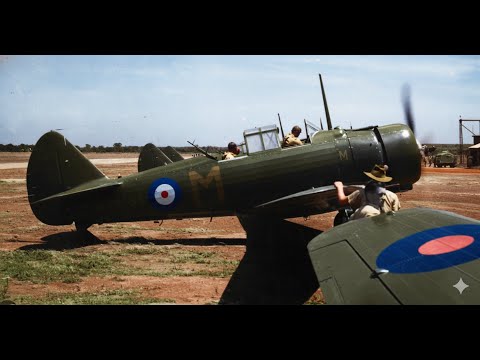
The roots of this tragedy lay in decades of complacency. Australia had anchored its defense on the Singapore strategy—a belief that the British Empire would provide an impregnable shield in the Pacific. But by early 1942, that shield had shattered. Great Britain, locked in a life-or-death struggle with Hitler, had no ships or modern aircraft to spare. The promised Spitfires never came.
Instead, Australia was left to fend for itself with the remnants of an abandoned colonial policy. The Commonwealth Aircraft Corporation, a fledgling enterprise, had produced the Wirraway as a trainer—a stable, forgiving machine designed to teach cadets, not to dogfight. With its two .303 machine guns and thin skin, it was no match for the Zero’s 20mm cannons and blistering speed.
“We knew we were flying coffins,” one survivor later recalled. “But what choice did we have?”
The pilots of No. 24 Squadron had spent weeks improvising, bolting bomb racks onto their trainers and praying their guns would fire. Ground crews worked miracles with limited tools, scavenging parts from wrecks. Every takeoff was an act of defiance against the political failure that had left them so poorly equipped.
As the sirens wailed, eight Wirraways lifted off into the tropical sky. The Zero pilots, veterans of China and Pearl Harbor, spotted the clumsy trainers and almost laughed. “They were like sheep wandering into a wolf pack,” a Japanese ace later wrote. The Australians climbed desperately, but the Zeros dove with predatory grace, cannons blazing.
Within minutes, the air was thick with cordite and the sight of burning trainers spiraling into the sea. The Wirraways were so slow that the Japanese had to lower their landing gear to stay behind them. It was a massacre. In just seven minutes, six of the eight Wirraways were shot down. Young men died in cockpits that offered no armor, no self-sealing tanks—nothing but courage.
The survivors limped back to pockmarked airfields, smoke rising from the wreckage. The news sent shockwaves through Australia. The war was no longer a distant European conflict—it was here, on their doorstep. The barefoot pilots had paid the ultimate price to prove a point: a nation that cannot defend its own skies is at the mercy of its enemies.
But from the ashes of Rabaul, a legend was born. The story of the school buses that fought Zeros would become a symbol of Australian resilience—a reminder that courage can sometimes bridge the gap between desperation and survival.
The survivors of that seven-minute slaughter did not have time to mourn. Within hours of the massacre, the order came down: Rabaul could not be held. The Japanese ground forces were already massing on the beaches, and the remaining Wirraways—those that could still fly—were ordered to evacuate to Port Moresby. It was a retreat that tasted of ash and humiliation, but it was also the beginning of something the high command in Melbourne had not anticipated.
The pilots who climbed out of their battered trainers in New Guinea were not broken men. They were furious. They had watched their mates burn in cockpits designed for flight school, and they had done so while flying machines that belonged in a museum. “We weren’t beaten by the Japanese,” Sergeant Pilot John Archer reportedly said. “We were beaten by our own government’s faith in a country that wasn’t coming.”
That fury became fuel. Stripped of any illusions about British protection, the men of No. 24 Squadron threw themselves into the grim business of jungle warfare. They flew whatever could still get off the ground, often patching bullet holes with scavenged duralumin and filtering fuel through their own shirts to remove sand. There were no replacement aircraft waiting, no factory-fresh parts—only the bush ingenuity that would come to define the RAAF in the Pacific.
Meanwhile, in Melbourne, the political establishment was reeling. The fall of Singapore on February 15, 1942—just weeks after Rabaul—had shattered the last vestiges of the Singapore strategy. Prime Minister John Curtin made a historic declaration: Australia would look to America, not Britain, for its salvation. But even as he spoke, the grim truth was that Washington’s priorities lay in Europe. The promised flow of P-40 Kittyhawks and P-39 Airacobras was a trickle, not a flood.
It was in this desperate vacuum that the Commonwealth Aircraft Corporation received its impossible assignment. The Wirraway had proven to be a death trap in combat, but its production line was the only one Australia had. Engineers were ordered to transform the trainer into a genuine fighter. They had fourteen weeks to do it—or Australia might not have an air force left to defend.
The resulting aircraft, the CAC Boomerang, was a Frankenstein’s monster of necessity. It kept the Wirraway’s wing and tail but swapped the sluggish radial engine for a 1,200-horsepower Twin Wasp. Two 20mm cannons and four .303 machine guns were bolted into the wings. It was stout, ugly, and unforgiving—but it was Australian, built from the ground up by a nation that had finally stopped waiting for rescue.
When the first Boomerang took to the skies over Fishermans Bend in May 1942, the workers who built it wept. They had done what the British Empire had promised and failed to do: they had given their pilots a fighting chance. The Boomerang would never match the Zero in a turning dogfight, but it could take punishment, dive like a demon, and—most importantly—it was available.
Back in New Guinea, the barefoot pilots of No. 24 Squadron heard the news with grim satisfaction. They had been the sacrificial lambs, the men sent to a knife fight with a spoon. But their sacrifice had bought something precious: time. Time for the factories to roar to life, for the Boomerang to be born, for Australia to learn the hardest lesson of its young history—that survival is not granted by distant allies but earned by those willing to build their own shield.
Yet even as the Boomerang entered service, a new threat loomed on the horizon. The Japanese were advancing down the Kokoda Track, their eyes fixed on Port Moresby. The barefoot pilots knew that the jungle war was about to reach its bloody climax—and that they would be flying into the storm once more.
The men who had survived Rabaul were now scattered across the jungle airstrips of Papua, flying whatever could still stagger into the air. Some had been reassigned to transport duties, ferrying wounded soldiers out of the mud and disease of Kokoda. Others flew reconnaissance missions in Wirraways so patched with scavenged metal that the ground crews joked they were held together by hope and chewing gum.
But it was on one such mission, in May 1943, that Sergeant Pilot John Archer would deliver the blow that Tokyo never saw coming. He was flying low over the jungle near Gona, scanning for enemy troop movements, when a silver glint caught his eye below. A Mitsubishi A6M Zero—the very predator that had slaughtered his comrades at Rabaul—was cruising with the arrogant confidence of a pilot who believed these skies belonged to him.
Archer knew the math. The Wirraway could not outrun the Zero. It could not outturn it. It could barely outclimb a tropical thunderstorm. But it could dive—and in that dive, the trainer’s weight became a weapon rather than a liability. He pushed the stick forward, and the Wirraway screamed downward, rivets groaning under stresses the airframe was never designed to bear.
The Japanese pilot saw him too late. He banked away, but Archer was already committed, lining the Zero in his primitive sights. He squeezed the trigger, and the twin .303s—guns the enemy had mocked as peashooters—ripped a concentrated burst into the Zero’s engine and cockpit. The fighter, built for agility at the expense of armor, lacked self-sealing tanks. It erupted in a ball of flame and fell into the sea.
When the report reached Australia, it landed like a thunderclap. A training plane had killed the world’s most feared fighter. General Douglas MacArthur personally awarded Archer the Silver Star, but the true prize was psychological: the myth of Japanese invincibility had been shattered by a barefoot pilot in a school bus.
The kill did more than boost morale. It validated everything the Boomerang program represented—that Australian ingenuity, wedded to Australian desperation, could punch above its weight. Archer’s Wirraway, riddled with patched bullet holes and smelling of engine oil, was later shipped home and placed in the Australian War Memorial. It stands there still, a monument not to a perfect machine but to a perfect moment of defiance.
Yet the war in the Pacific was far from won. As Archer’s victory was celebrated in Melbourne, the Japanese were consolidating their grip on the northern coast of New Guinea. Fresh intelligence suggested a new offensive was brewing—one aimed squarely at the Allied airfields around Port Moresby. The barefoot pilots, still flying their patched trainers alongside the first Boomerangs, knew what was coming.
The storm was not over. It was only gathering.
The storm broke on a humid morning in June 1943, when the drone of Japanese bombers echoed across the Papuan hills. This time, the barefoot pilots of No. 24 Squadron were not alone. Alongside their patched Wirraways, the first Boomerangs of No. 84 Squadron clawed into the sky—stout, ugly, and unmistakably Australian.
“They came in expecting another seven-minute massacre,” one pilot recalled. “They got something else entirely.” The Boomerangs could not outturn the Zeros, but they could take hits that would have shredded a Wirraway. They dove through the bomber formations, cannons blazing, scattering the enemy like startled birds.
The raid was broken. Not annihilated—never that—but broken. As the surviving Japanese aircraft fled north, the men on the ground understood the truth: the era of the sacrificial pawn was over. Australia had finally built its own shield.
In the decades that followed, the story of the barefoot pilots faded from memory. The Spitfires and Mustangs took the glory; the school buses were forgotten. But in the halls of the Australian War Memorial, Archer’s Wirraway still stands—patched, scarred, and silent.
It whispers a truth every nation must learn: freedom is only as secure as the will to defend it, and courage without preparation is a recipe for tragedy. The barefoot pilots paid for that lesson in blood, so their country would never again fly into a knife fight with a spoon.
And yet, the question lingers—do we honor their sacrifice by preparing for tomorrow’s storms, or have we merely traded one complacency for another? What do you think—are we still building shields, or still waiting for rescue?
Report this article
Select a reason for reporting:






