There is a certain kind of silence that soldiers learn to fear more than gunfire. On the coral ridges of Peleliu in the autumn of 1944, the Japanese defenders came to know that silence intimately. It arrived without warning—one moment a man would be crouched in a cave mouth 1,500 yards from the American lines, confident that the distance itself was a fortress, and the next moment the rock beside his head would explode into razored fragments, and the man beside him would fold over without a sound.
No rifle crack loud enough to place. No visible muzzle. Just the impossible arrival of death from a range where nothing was supposed to reach. For weeks the men of the Japanese garrison had believed they understood the American way of war. They were about to learn that one Marine had decided the rules did not apply to him—and by the time they understood what he was doing, dozens of them were already dead.
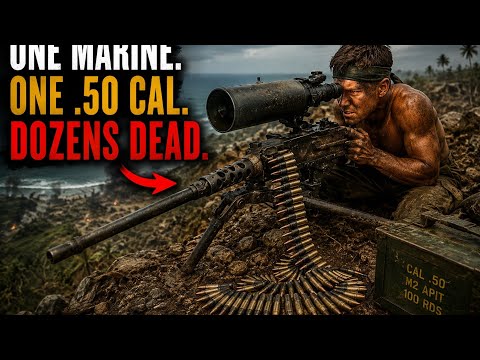
His name was Corporal Wade Halloran, and before the war he had been nobody in particular. He grew up on a hardscrabble stretch of country in the hill folds of Eastern Kentucky—the kind of place where a boy learned to shoot before he learned to read properly because meat on the table depended on it. His father had given him an old bolt-action rifle when he was nine, and a single box of cartridges that had to last the whole winter.
That scarcity taught Wade something the Marine Corps rifle range never could: every shot mattered. You did not spray and hope. You waited. You read the wind moving through the poplar leaves. You accounted for the way a bullet falls across a hollow. And you fired once. A boy who missed went to bed hungry.
By the time Wade was fifteen, he could drop a squirrel from the top of a tall hickory without spoiling the meat. The men in his county spoke of him the way people speak of anyone touched by a gift they cannot explain.
None of that seemed to matter when the Corps assigned him to heavy weapons. Wade had wanted to carry a rifle. Instead, they handed him the Browning M2—an 84-pound monster of a machine gun that fired a cartridge as long as a man’s hand—and told him his job was to hose down tree lines and force enemy heads into the dirt. Area suppression, the instructors called it. You were not supposed to aim the thing at any one man. You pointed it in a general direction, held the trigger, and let the sheer weight of fire do the work.
The manual listed the gun’s effective range against point targets somewhere near 1,800 yards, but nobody took that number seriously because everybody knew a machine gun was a blunt instrument. It was a broom, not a scalpel.
Wade accepted the assignment the way he accepted most things the Corps decided—quietly and without complaint. But a small, stubborn part of him kept looking at that big gun and thinking about the hickory trees back home.
Peleliu was supposed to take three days. The generals had promised as much before the landings. What the Marines found instead was a nightmare carved out of coral and volcanic rock—a ridge system the Japanese had spent months turning into a honeycomb of caves and tunnels and firing positions, each one covering another, each one impossible to see until it opened up and killed you. The men called the worst of it Bloody Nose Ridge, and the name did not begin to describe it.
The heat sat on everything like a wet wool blanket. The coral cut through boot leather, and from those high fortified slopes, the Japanese defenders rained fire down on the exposed Americans below with a patience that felt almost personal.
The worst of it came from the snipers. Not the ordinary rifleman who fired and reloaded and fired again, but the trained marksmen who had claimed the high caves and settled in like spiders. They had scoped Arisaka rifles and a genius for concealment, and they had learned to shoot Marines who were bringing water forward or dragging a wounded man to the rear. They aimed for the men who mattered most—radio operators, corpsmen, anyone with the markings of a leader.
Over three days, Wade’s company lost more men to those distant scoped rifles than to any assault, and the horror of it was that there seemed to be nothing anyone could do. The snipers fired from ranges that swallowed any answering shot. A Marine could empty a full magazine at a muzzle flash 1,500 yards up the slope and watch every round fall short into the coral, and the man who had fired it would already be sliding back into the dark of his cave, unhurt and unbothered, to wait for the next target.
Wade watched all of this from behind his Browning with a growing sense of quiet fury. His crew had been told to lay suppressive fire across the ridge whenever the snipers opened up. They did—and it accomplished exactly nothing. The bullets sprayed wide across a hillside the size of a small town, and the enemy simply waited them out.
But Wade had been watching the muzzle flashes through a battered pair of field glasses, and he had started to notice something the doctrine ignored. The flashes came from the same places over and over. The third cave from the left. The split boulder near the crest. The dead tree leaning against the cliff face. The snipers were not moving around. They were nested.
And a man who stays in one place, Wade thought, is a man who can be hit—if only you could reach him.
His assistant gunner was a lanky Wisconsin kid named Pete Salco—nineteen years old and quick with numbers in a way that surprised people who took his easy grin for foolishness. Salco had done two years toward an engineering degree before he enlisted, and he could work out a math problem in his head faster than most men could find a pencil.
On the fourth morning, when the sniper fire had gone quiet in the false peace of the early hours, Wade laid out what he had been thinking. Salco listened with his head cocked to one side.
The way Wade explained it was simple. The .50-caliber round left the barrel of that Browning at around 2,900 feet per second—faster than any rifle bullet either of them had ever fired. A round moving that fast carried a long way. Sure, it dropped, and sure, the wind pushed it, but drop and wind were just numbers, and numbers could be figured.
Wade had been doing exactly that on the back of a ration carton, working out how far the bullet would fall across 1,500 yards and how long it would take to get there, using the same instinct he had used to lead a squirrel in a swaying tree. The only thing standing between him and the sniper in that third cave was arithmetic—and a steady enough platform to shoot from. Everything else was just people telling him a machine gun could not do something he was fairly sure it could.
Salco chewed on this for a long moment. Then he grinned that easy grin and said the numbers checked out, more or less. And if the corporal was fool enough to try it, he would be fool enough to spot for him.
They needed a way to aim precisely, though, and the Browning’s iron sights were built for area work, not for putting a single round on a target the size of a man’s chest a mile off. The answer came from a wrecked Marine sniper rifle left in the aid station—its stock shattered by shrapnel, but its scope intact. Wade pried the four-power optic loose and, with a good deal of cursing and a length of salvaged wire, rigged it onto the receiver of the Browning so that it looked down the barrel true. It was an ugly, improvised, half-mad piece of gunsmithing. It was also, though Wade did not know it yet, about to rewrite what the men on that ridge believed was possible.
They spent the better part of a day preparing the position. The Browning already sat on its heavy tripod behind a low wall of sandbags and coral chunks, but for what Wade had in mind, it needed to be as stable as a rooted oak. The smallest tremor in the gun would throw a shot wide by many feet at that range.
They packed sandbags tight around every leg of the tripod. They wedged coral beneath the mount to kill any wobble. Salco sketched a range card on a scrap of cardboard, pacing off the visible landmarks against the ridge and marking each one in careful increments, so that when a target appeared near the split boulder, they would both know without a word that it sat at roughly 1,450 yards. And when a man showed himself at the dead tree, they would know it was closer to 1,600.
Wade cranked the elevation on the gun until it accounted for the long fall of the bullet, and he set the traverse stops so that his swing was limited and steady rather than loose and swinging. The Browning was designed to soak up the recoil of a hundred rounds a minute. Wade meant to fire it one round at a time.
The first real test came on the fifth morning, and it began the way all of it began—with a Japanese soldier who believed he was safe.
His name was Sergeant Kenji Sato, though of course Wade would never know that. Sato had been a sniper in the emperor’s army for two years. He was good at it. He was patient, careful, and utterly convinced of one fact that had kept him alive through the fighting in the Philippines and the retreat that followed: the Americans could not reach him. From his cave, high on the ridge behind a shelf of rock that hid all but his rifle and his eyes, he had killed eleven Marines since the landings, and he had done it with the calm detachment of a man tending a garden.
That morning he settled into his firing position with a cigarette between his lips, in no particular hurry, watching the American lines below through his scope for a target worth a bullet. He had done this hundreds of times. The distance was his moat. The distance had never once betrayed him.
1,500 yards away, Wade Halloran laid his cheek against the cold metal of the Browning and put the improvised crosshairs on the small pale smudge that was Sato’s face. Salco lay beside him, glasses to his eyes, reading the drift of the cooking smoke that curled up from the ravines.
“A little left wind,” Salco murmured. “Hold a hair right.”
And Wade shifted his aim by an amount so small it would have meant nothing to any other machine gunner in the Pacific. He drew a slow breath the way his father had taught him, let half of it out, and held. His whole body went still. And then, with the same patient certainty he had carried out of the Kentucky hills, he squeezed.
The Browning fired a single round—a sharp, isolated crack that rolled across the ridges and died. The tracer they had loaded every fifth cartridge was not in the chamber this time, so there was no red streak to follow, only the long, terrible pause of a bullet in flight. Two full seconds.
And at the end of those two seconds, on a ridge 1,500 yards away, Sergeant Kenji Sato’s world simply ended. The heavy round struck the rock a hand’s width from his skull and blew a spray of coral shards across his face. For the first time in two years of war, the sniper who could not be reached felt the shockwave of an American bullet against his own cheek. He recoiled so violently he nearly fell backward into his cave. The cigarette dropped from his mouth. He stared out across the impossible distance with his heart hammering against his ribs, trying to understand what he had just felt, refusing to believe it—and then a second round struck the shelf of rock in front of him, and he abandoned the position entirely, scrambling deep into the dark on his hands and knees like an animal fleeing a fire.
Down below, Salco let out a low whistle. Wade said nothing. He was already thinking about the correction, already reading how the wind had pushed the round, already adjusting for the next shot. But something had shifted in the space of those two seconds, and both men felt it. The moat had been crossed. The distance that had protected the enemy for a week was no longer a wall. It was just air—and air could be crossed by a fast enough bullet in the hands of a man patient enough to aim it.
Word of the shot moved through the American lines before noon. A machine gunner who was trying to snipe with a .50 cal, they said, half laughing—and men came crawling over from neighboring positions to see the crazy Kentucky corporal who thought he could pick off individuals with a weapon built to knock down trucks.
Lieutenant Ambrose came too—a career officer with a skeptic’s face and a good pair of binoculars—and he watched the enemy ridge for a while and noticed something that wiped the doubt off his features. The ridge had gone quiet. The cave mouths that had spat sniper fire all week were still. Whatever the corporal was doing, the enemy had noticed it too, and they did not like it one bit.
Over the days that followed, Wade and Salco turned their gun pit into something that had never existed in any Marine field manual. It was a machine gun position that behaved like a sniper’s nest. They mapped every feature of the enemy ridge onto their range cards, working out the distance to each cave and boulder and dead tree down to the nearest fifty yards. They loaded their belts with a tracer every fourth or fifth round so Wade could watch his fall of shot and correct without exposing himself.
Salco became an artist of the wind, glancing at the way the scrub moved on the slopes and the way the smoke bent above the ravines, calling out windage that let Wade connect on the first or second shot. The two of them stopped functioning like a machine gun crew and started functioning like a rifle team. One man shooting, one man reading the field. Both of them talking in the low, economical shorthand of men who had learned to trust each other completely.
And on the far side of the valley, the Japanese defenders began to come apart.
This is the part the survivors talked about for the rest of their lives. The enemy had walked between positions in daylight, lounged in cave mouths, watched the Marines through their scopes with the easy confidence of men behind castle walls. All of that stopped. One horrifying kill at a time, they learned there was no longer anywhere on the ridge that was safe.
They could not even trace the fire. No wall of tracers, no roar of sustained fire—only the isolated crack of a single distant weapon, and then a man was dead. A captured corporal later confessed he had abandoned three excellent firing positions, terrified of what he called “the gun that fires one bullet.” Some swore the American shooter could see through rock.
Wade fired maybe two belts a day, each round a small deliberate act. Ambrose began folding his gun into the planning like artillery, and the Marines advanced into ground that should have been a killing field. When the ridge finally fell quiet, Wade cleaned his Browning, worked the scope loose, and set the gun back the way the Corps had issued it. A weapon is only as limited as the man behind it believes it to be.
What would you have done, handed that 84-pound broom and told to stop thinking like a marksman?
Report this article
Select a reason for reporting:






