In the spring of 1944, American Thunderbolt pilots over Germany were passing around a piece of advice that sounded backward: if a Messerschmitt gets on your tail, shove the nose down and dive. Let him follow you, then pull out hard. Four years earlier, that same Messerschmitt—the Bf 109—had been the fighter everyone else ran from. Over England in 1940, it outclimbed the Hurricane and the Spitfire and could slip away in a dive they could not follow. So how did the most feared fighter in Europe become the one American pilots wanted chasing them downhill?
The answer was a flaw built into every version of the airplane. Its pilots felt it. Its designers never fully cured it. And in 1940, British engineers got their hands on a captured one, took it into the air, and turned that flaw into numbers.
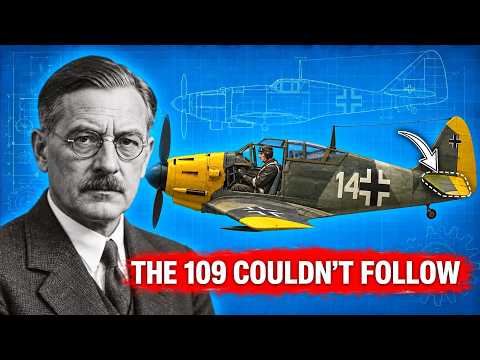
Nine years before those Thunderbolt pilots started comparing notes, the 109 was the most modern fighter in the sky. Willy Messerschmitt and Robert Lusser designed it at Bayerische Flugzeugwerke, and the first prototype flew in 1935. It was small, all-metal, and thin-winged, and by the time production ended, more than 34,000 had been built.
Two features made it dangerous. Automatic slats along the leading edge of each wing slid open as the fighter slowed, keeping air flowing smoothly over the wing. So the 109 stalled gently even under hard G. And its Daimler-Benz engine used direct fuel injection, which meant it kept running when the pilot shoved the stick forward and threw himself against his straps. A German pilot in trouble could bunt over into a dive under negative G and simply leave.
Over southern England in the summer of 1940, that trick worked again and again. A Hurricane or Spitfire pilot who pushed his nose over to chase a bunting Messerschmitt felt his Merlin engine cough and stall for a second or two—its float carburetors starved of fuel while the German pulled away below him.
Germany knew its fighter’s strengths and wanted its pilots to use them. That August, the Luftwaffe’s test center at Rechlin, with Major Werner Mölders taking part in the evaluation, advised against being drawn into turning fights unless the fighter’s performance could be brought to bear. Climb, dive, strike, and leave. That was how the Messerschmitt was meant to fight.
And yet in the middle of that summer, British pilots started noticing things that did not fit. Eugene Tobin was one of the Americans flying with the Royal Air Force, a volunteer with No. 609 Squadron. During the battle, three yellow-nosed Messerschmitts dropped on him from above. Tobin threw his Spitfire into a hard, tight circle. The 109s were committed to their dive and moving fast, and for some reason, they could not bend their paths to match his. They shot straight past.
Then there was the trick. RAF pilots learned that when a 109 got onto their tail, they could half-roll, pull into a steep dive, and haul back hard close to the ground. Time after time, the German followed them down and never came back up. A British report written later described Messerschmitts that would go straight into the ground without a shot being fired. Nobody had hit them. The pilots had chosen to follow. Something inside the airplane had killed them.
Four years later, one of Germany’s highest-scoring aces would run into that same something over Germany, hauling on his stick with one hand ruined by an American bullet. His story is coming. First, the answer. And it was sitting in a hangar at Farnborough.
On the 4th of May 1940, a captured Messerschmitt Bf 109E—the version its pilots called the Emil—landed at the Aeroplane and Armament Experimental Establishment at Boscombe Down. The British gave it the serial AE479 and passed it to the Royal Aircraft Establishment at Farnborough. The engineers and test pilots there did something no fighter pilot in the middle of a fight could ever do. They measured it at slow speed.
The Emil was a delight. Between 150 and 200 mph, the test pilots rated its ailerons close to ideal—light and quick in the hand. Then they flew it faster. Past 200, the ailerons turned unpleasantly heavy. From 300 toward 400, the test pilots described them with one word: solid.
That was the flaw. The faster the 109 flew, the harder its controls fought the man holding them. At 400 mph, Farnborough found a pilot exerting all his strength could apply no more than one-fifth aileron. Rolling to 45 degrees of bank took four seconds—a figure the report called quite excessive for a fighter. Four seconds is a long time with a Spitfire behind you.
The reason sat inside the cockpit. The Emil’s canopy was so narrow that a pilot could not get his arm into a strong position to swing the stick sideways. The Farnborough team estimated he could push about 40 pounds of sideways force in that space against 60 or more if he had been given room. And the top of the stick moved only about four inches from side to side. The air pressing against the ailerons grew with every mile an hour. The pilot’s strength stayed exactly where it was. Somewhere past 300, the air began to win.
The elevator was worse, and the elevator was what got men killed. Above 250, the test pilots found it too heavy. The team estimated the stick force in a dive probably ran above 20 pounds for every G the pilot tried to pull. Diving at 400, a man heaving back as hard as he could could not pull enough G to black himself out. The 109 would come out of the dive. It would simply come out slowly and only if there was enough sky beneath it.
Now the clues make sense. The Messerschmitts that shot past Eugene Tobin were too fast to bend their paths. The Germans who chased RAF pilots into steep dives found too late that their elevators would only give them a gentle pull-out, and the ground came up before it finished.
German pilots had a tool for this. Beside the seat sat a large trim wheel that tilted the entire horizontal tailplane. Wind it back and the tail did some of the pulling for you. But if a pilot had trimmed the fighter nose-down to hold it in the dive, the report noted recovery was difficult unless he wound that wheel back first. Five and three-quarter turns carried the tailplane through its full range. That is a lot of cranking with the ground filling the windscreen.
None of this made the Emil a bad fighter. When the Farnborough aerodynamicists Morgan and Smelt presented these results to the Royal Aeronautical Society in 1944, they concluded that in the autumn of 1940, faults and all, the 109 had been a formidable opponent. At low speed, it was superb. It stalled gently and climbed hard, and in skilled hands, it had killed a great many Allied airmen.
In 1940, the flaw was a weakness a sharp RAF pilot could exploit. It would take four more years of war to turn it into something much worse. The British had measured one model. The obvious question was whether Messerschmitt had fixed it.
On the 10th of July 1941, they got a chance to find out. Hauptmann Rolf Pingel commanded the first group of Jagdgeschwader 26, a Knight’s Cross holder with 22 victories. That day, his Bf 109F—the newer version called the Friedrich—came down in a forced landing near the road between Deal and Dover in Kent. It was in good enough shape to fly again.
That October, the Air Fighting Development Unit at Duxford flew Pingel’s Friedrich against a Spitfire Vb. It was a cleaner, faster, better airplane than the Emil. Its ailerons were more effective than the Spitfire’s fabric-covered ones. Dived to 420 mph indicated, with the controls trimmed for level flight, it could still make fairly tight turns—but by then the elevator had gone heavy and the ailerons had stiffened appreciably.
The unit’s report of the 28th of October stated the consequence in five words. In that regime, the report said, violent evasion is not possible. It added that pulling out of a high-speed dive near the ground would be difficult, and suggested this might explain the occasional reports of Friedrichs seen diving straight into the ground without apparently being fired at.
Nine days after the unit took delivery, Pingel’s captured Friedrich went into a dive near Falmouth. The unit diary recorded that the dive steepened almost to vertical and the fighter never recovered. It would be easy to blame the stiff controls. The aircraft had been suffering oil pressure trouble. The report does not name a cause, and neither should we.
The British knew this disease from the inside, because their own fighter had caught it first. Early Spitfires wore fabric-covered ailerons that ballooned and stiffened at high speed. On the 7th of November 1940, Supermarine test pilot Jeffrey Quill first flew a Spitfire fitted with metal-skinned ailerons. He later wrote that the change was spectacular—the controls far lighter at the top of the speed range. Britain reworked its answer within months. The 109 kept its narrow cockpit and its short stick for the rest of the war.
And then the war itself changed around it. Every new version of the 109 got faster, and every one got heavier. The Emil Farnborough tested weighed about 5,580 pounds. When the British later weighed a captured Gustav—the 109G—it came in at nearly 7,500. Its Daimler-Benz 605 made about 1,550 horsepower at 22,000 feet, and each square foot of its wing now carried 43.5 pounds, up from 32 on the Emil.
More weight, more power, more speed. Nothing added room to the cockpit or length to the stick.
The fighting moved, too. By 1943, the air war over Western Europe was being fought at high altitude and high speed, around American bomber streams, by escort fighters built for exactly those conditions. Jesse Gannum of the 353rd Fighter Group put it simply in his tactical notes: German aircraft had some bad characteristics at high speed and high altitude, and American pilots should use them. Every year the fight drifted further into the zone where the 109 was weakest.
The Americans arrived with a fighter built to live there. That April, the Republic P-47 Thunderbolt flew its first combat missions over Western Europe. Alexander Kartveli had designed an enormous fighter around the Pratt & Whitney Double Wasp radial and a turbosupercharger, and Republic would build more than 15,600 of them—more than any other American fighter. An Army Air Forces proving ground report in December 1942 had rated its rate of roll the best of any American fighter tested. Its pilots called it the Jug. What it did best was go downhill.
The Thunderbolt’s first months were hard. On the 26th of June 1943 near Forges-les-Eaux in France, Lieutenant Robert S. Johnson of the 61st Fighter Squadron, 56th Fighter Group, was escorting bombers when Focke-Wulf 190s of the second group of Jagdgeschwader 26 tore into his flight. Cannon shells burst in his cockpit. Oil sprayed across his windscreen and hydraulic fluid soaked his legs. Johnson later counted 21 cannon-shell hits in the airplane and more than 200 machine-gun bullets. The Thunderbolt brought him home anyway.
Those were Focke-Wulfs, not Messerschmitts, but the lesson carried over. The Jug could take a beating that would have broken a lighter fighter. The 56th’s commander, Hubert Zemke, built the group’s tactics around that weight. Come in from above, fire, and use the speed of the dive to recover to height or to break clear. By August of 1943, the 56th had become the leading air-superiority group in Eighth Fighter Command, and Zemke’s pilots noticed something about the men they were fighting. Under pressure, the Germans went down.
For a German pilot, it made perfect sense. A dive had saved him over Kent. A dive had saved him over Russia. It was the escape his fighter had been built around. Against a Thunderbolt, though, the dive led straight into the one fight the P-47 was made to win—a fight where the heavier fighter gained speed faster, and where the Messerschmitt’s controls grew stiffer every second it stayed in the dive.
And one German ace was about to learn that with his own hands.
By May 1944, Luftwaffe fighters were being ground down over Germany, and Hauptmann Günther Rall had been sent west to help stop the bleeding. A veteran of Jagdgeschwader 52 with 275 victories by war’s end, he now commanded the second group of Jagdgeschwader 11 at Eschborn.
On the 12th of May, Rall led his 109s as top cover against an American raid and dropped onto a flight of Thunderbolts from the 56th—Zemke’s flight. Rall’s guns set one P-47 on fire. Then the rest of the 56th closed around him. Four Thunderbolts lined up behind his tail.
Rall knew exactly what a P-47 could do in a dive. He had no other way out, so he pushed the nose down anyway. As the Messerschmitt tipped over, rounds smashed into the cockpit. His left hand took a blow like a hammer. His thumb was gone.
The heavier American fighters came down after him, closing as the speed built. At the bottom of the dive came the part the British had measured four years earlier. The stick fought him. With one hand shattered, Rall hauled back with everything he had left, dragged the 109 out of the dive, zoomed for height, and bailed out.
That is the ace promised earlier—and this is the Farnborough flaw seen from inside the Messerschmitt. Rall survived, recording his memories decades later for the National World War II Museum. He remembered the Thunderbolts diving much faster than his 109. The 56th claimed 18 109s that day for three Thunderbolts lost. German records for Jagdgeschwader 11 show 11 109s lost, two pilots killed, and five wounded. Even the German number was a disaster for a single afternoon.
Seventeen days later, Eighth Fighter Command gathered the advice of its best pilots into a tactical booklet called The Long Reach. Harry DeHuff of the 78th Fighter Group gave Thunderbolt pilots one blunt rule: if you are outnumbered, dive like hell. Zemke wrote that for four months the enemy had mostly tried to escape by outdiving his group, and that the Germans could not touch the dive of the P-47.
But the version you have probably heard needs one honest correction. No order has surfaced telling American pilots to dive, wait for maximum speed, and pull hard to trap a 109 in its own controls. What exists is advice written by the pilots themselves and printed by their command, and it rested mainly on the Thunderbolt’s own dive. The trap built around the Messerschmitt’s heavy elevator was British. RAF pilots worked it out over Kent in 1940, and the record of Messerschmitts flying into the ground belongs to them.
Mustang pilots were even less sure the dive was the answer. Everett Stewart of the 355th Fighter Group judged the P-51 and the 109 roughly even in a dive and at low altitude, and he preferred steep, uncoordinated turns as the Mustang’s best escape. British trials of the Mustang III that spring reached a similar answer: turn hard first, and dive only if you have to.
The flaw was real, though, and it never went away. Captain Eric Brown of the Royal Navy later flew a captured Gustav. He found its elevators extremely heavy, wrote that in a dive at about 400 mph the controls felt as though they had seized, and noted that 109G pilots still tended to bunt into a steep dive as their way out of trouble.
On the 3rd of December 1944, the RAF’s Air Fighting Development Squadron finished its trials of a captured 109G-6. Four and a half years after Farnborough first measured the Emil, the report found the Gustav’s ailerons growing increasingly stiff, especially above 350 indicated. Above that speed, it said, the elevator trim was practically impossible to operate. The one tool German pilots relied on to crank themselves out of a dive had stiffened, too. The cockpit, the report added, was narrow and cramped for a pilot of more than average size. In hard rolls, the slats kept snapping open, which the British testers dryly called embarrassing.
The Gustav still had real teeth. The same trials found it could leave a Spitfire IX behind in a dive without difficulty. Against a Mustang III, though, it lost. The Mustang steadily outturned and outrolled it—though the story that the Mustang simply outrolled the 109 at speed is not in the record. Messerschmitt did try. The last production version, the K-4, was specified with small servo tabs on the ailerons to ease the load on the pilot’s arm. Surviving evidence suggests few ever flew with them.
The Americans had their own wall, and they hit it hard. On the 13th of November 1942, before the Thunderbolt ever fought over Europe, Lieutenants Harold Comstock and Roger Dyer dived their P-47s from around 35,000 feet. Comstock felt a bump and then the stick would not move. Even with maximum effort, he could not budge it. He began rolling the trim tab back, and somewhere below 30,000 feet the big fighter started to come out of it. He recovered between 20 and 25,000 feet. Dyer ran into the same wall in his own dive. Republic’s publicity department announced that the pair had dived at 725 mph. The Air Force never confirmed anything like it.
Roger Dyer survived that dive. He was killed in action over France on the same June day that Robert Johnson limped home. An Eighth Fighter Command report on the Thunderbolt warned that its controls grew very stiff at extreme speed and that above 600 mph true air speed it was virtually impossible to move the elevator without the trim tab. Later Thunderbolts were fitted with dive-recovery flaps. The Mustang had hard limits, too. At 25,000 feet, British trials capped a Mustang III at 376 indicated; at 35,000, the ceiling dropped to 298. Past those numbers, compressibility took the airplane away from its pilot, whatever flag was painted on its sides.
So the American fighters could pull out where the 109 struggled. Nothing about it was effortless. The edge was a matter of margins—the Thunderbolt’s weight and roll, the Mustang’s clean dive, and the German habit of reaching for the same escape that had worked over Kent.
The Smithsonian’s National Air and Space Museum holds a 109G-6 today. Its German pilot defected, landed at Caserta in Italy, and surrendered to an American liaison squadron. A few Emils still fly. Modern test pilot Rob Erdos flew one with Vintage Wings of Canada, and he found that pulling it out of a dive at about 280 mph took both hands to reach 3½ G—both hands, in calm air, with nobody shooting at him.
When the odds turn against you, dive and pull out hard. The Thunderbolt pilots who passed that advice around in 1944 were standing on a lesson first learned over Kent four years earlier by pilots who found out exactly how heavy a Messerschmitt stick could get—and how much sky a German needed to pull it back.
So here is the question for you: if you were a 109 pilot in 1944, knowing the stick would fight you all the way down, would you still have pushed the nose over—or found another way out?
Report this article
Select a reason for reporting:






