Under the dazzling lights of Old Hollywood, where every smile was rehearsed and every scandal buried, a darker truth lurked behind the silver screen. These were the stars who could make millions laugh, cry, and fall in love—but behind closed doors, their own children often faced a very different performance. From W.C. Fields’ sarcastic disdain for kids to Joan Crawford’s terrifying reign at home, the private lives of Tinseltown’s biggest names were riddled with estrangements, custody battles, and wounds that never healed. What happened when the cameras stopped rolling? The answers are more shocking than any script.
Some of these legends saved their coldest acts for their own families. Others were damaged souls repeating the neglect they’d suffered. But one thing is certain: the perfect images Hollywood sold came at a devastating price—paid not by the stars, but by their children.
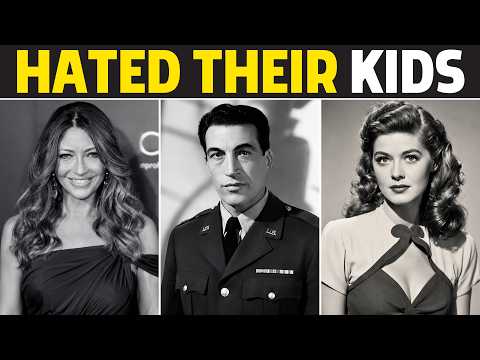
Take W.C. Fields, the king of misanthropic comedy. His son, William Jr., grew up hearing strangers joke about a father who supposedly hated children. The truth? Fields and his wife separated early, and father and son spent years apart. “Money could not create ordinary memories or daily trust,” biographers note. Fields sent support checks, but the boy was left with a famous surname and an unanswered question: was the cruel joke just an act, or the only honest thing his father ever performed?
Then there’s Groucho Marx, whose rapid-fire wit could slay any opponent—except his own son. Arthur Marx later described his father as neglectful, remembering a home shaped by criticism and emotional distance. “Every serious feeling could become a punchline,” and every vulnerable moment escaped through sarcasm. A child asking for comfort might receive wit instead of reassurance. Audiences heard brilliance; his family heard a man who couldn’t speak without turning life into another performance.
The Barrymore dynasty tells an even darker tale. John Barrymore, the legendary Shakespearean actor, was a fading, unstable presence by the time his daughter Diana understood his fame. She met not the heroic figure from posters but an aging man whose career and health were collapsing. “Absence can feel exactly like rejection to a child,” and Diana spent years longing for a father she barely knew. One generation later, the wound reopened. John Drew Barrymore, Diana’s half-brother and father of Drew Barrymore, repeated the pattern. Drew’s childhood unfolded while her father drifted in and out unpredictably. She later described confusion and a lack of reliable parental boundaries—until she finally created distance to protect herself. The Barrymores produced extraordinary performers, but talent moved through the generations more easily than stability or safety.
Ingrid Bergman’s scandalous departure from Hollywood left her young daughter Pia behind. Newspapers condemned Bergman as a mother who walked away, and custody battles kept them apart for years. Though their relationship eventually improved, “to a young daughter, adult explanations could not change the empty chair.” Hollywood forgave Bergman long before Pia could recover those lost childhood years.
And then there’s Joan Crawford—perhaps the most infamous of all. Christina Crawford’s memoir Mommie Dearest painted a portrait of frightening discipline and emotional humiliation, while her twin sisters remembered a loving mother. The truth remains disputed, but one fact is undeniable: Crawford excluded Christina and Christopher from her will, a final punishment from beyond the grave. “The woman who feared exposure was exposed by her own child.”
These stories are not simple verdicts. They are fragments of lives lived under unbearable pressure, where fame demanded perfection and children paid the price. Some parents recognized their failures too late; others never did. But the question lingers: how many of these legends secretly hated their own children—and how many simply hated themselves?
Rita Hayworth’s daughters knew a truth the screen never showed. Behind five marriages and a career that kept her constantly in motion, Hayworth left her daughter Rebecca Welles shuffling through boarding schools and organized programs. Rebecca later made a painful observation—the separations weren’t caused only by filming, but by the many marriages repeatedly reshaping the family. “Every sparkling entrance concealed a private life that could change direction without warning.” Her younger daughter Yasmin took a different path, caring for Hayworth after Alzheimer’s erased the woman they’d known.
Joan Fontaine’s story carried its own cold symmetry. She spent decades locked in a celebrated feud with her sister Olivia de Havilland, and later lost closeness with her own daughters as well. Her first daughter Deborah grew distant, and her adopted daughter Martita’s relationship with her reportedly deteriorated into silence. “Perhaps her daughters felt managed rather than loved,” biographers suggest. The elegant actress who feared betrayal seemed to allow pride to make every distance permanent.
Veronica Lake’s decline told a harsher version. By the late 1960s, her career had faded, her finances had collapsed, and she admitted in an interview that she rarely saw her children. There was no open hatred—just disconnection while she struggled to manage herself. “Children do not experience a parent’s absence as a neat biography,” but as missed birthdays and the belief that another crisis would always come first.
Then came Zsa Zsa Gabor and her only child, Francesca Hilton—a feud that turned private conflict into public theater. Gabor joined a legal action accusing Francesca of financial wrongdoing and mistreatment, while her husband Frédéric Prinz von Anhalt controlled access to the ailing star. “Was the action truly an expression of Gabor’s wishes, or was a medically vulnerable woman being influenced?” The public never received a satisfying answer. Francesca spent her final years fighting to reach her own mother—and died before Gabor did.
Hedy Lamarr’s story ended in legal erasure. During her marriage to Gene Markey, she adopted a boy named James and presented him publicly as her son. Then the relationship collapsed so completely that his place in her life was almost wiped away. Sent to boarding school around age twelve, James became estranged for decades. “When she died, he discovered that he had been excluded from her will.” He argued that Lamar had treated him as her child and could not simply remove that history when it became inconvenient. The inventor who imagined future technology could not find a path back to the boy who once called her mother.
Jackie Gleason, the Great One, filled every screen—but his daughters Geraldine and Linda remembered the empty space whenever that personality walked out the door. His marriage to Genevieve Halford deteriorated as fame, nightlife, and other women expanded. “Occasional grand gestures could not replace routine parenting.” A child needs someone who remembers the ordinary details, not only someone who arrives carrying gifts after months away. Gleason treated being their father like a guest appearance rather than a permanent role.
Orson Welles left behind a similar unfinished quality. His daughter Christopher described a relationship shaped less by daily parenting than by occasional appearances from a magnetic visitor. He traveled constantly, consumed by creative projects that swallowed money and time. “A child who adores an unpredictable parent may wait forever.” Welles could organize hundreds of performers around a camera, yet struggled with the smaller discipline of returning, listening, and remaining available after the excitement ended.
And Laurence Olivier reportedly expressed embarrassment about his own son Tarquin in his writing—words that cut deeper than any absence. After his marriage to Jill Esmond ended and Vivien Leigh took over his emotional life, father and son reportedly went around seventeen years without seeing each other. “A child can survive distance. What is harder to escape is knowing that the parent admired by millions once looked at him and felt shame.” Tarquin’s later memoir was surprisingly forgiving, but generosity does not erase the words. On stage, Olivier could locate the hidden feeling inside Shakespeare’s most difficult characters. At home, acceptance remained a role he never fully mastered.
John Huston’s children grew up inside a legend that left little room for them. Anjelica and Tony lived in rural Ireland while their father traveled, directed, gambled, and built the myth of the fearless Hollywood adventurer. “She and her brother lived in beautiful surroundings, but beauty did not prevent them from feeling left behind.” When Anjelica entered acting through his film A Walk with Love and Death, their private tension followed them onto the set. Still a teenager and uncertain, she needed a father’s protection—but Huston responded as a demanding director, impatient when she failed to meet his standards. Their relationship improved with time, and she later won an Academy Award in Prizzi’s Honor, directed by him. Yet that triumphant ending hides the earlier cost. John gave his children culture, stories, and remarkable opportunities. What he did not reliably provide was ordinary availability. “Fatherhood demanded stillness, repetition, and patience—the less glamorous responsibilities he too often left for somebody else.”
Kirk Douglas understood strength in a way that left little room for softness. He had survived poverty, anti-Semitism, and Hollywood’s brutal uncertainty, and he expected his sons to develop the same toughness. His youngest son Eric struggled for years with addiction and the belief that he could never equal his father or his older brother Michael. “Assistance sometimes arrived as control,” with rehabilitation, money, and stern advice all offered with the force of an order. Kirk loved his children—he wrote letters while traveling and was determined not to abandon them as his own father had—but love passed through the system he trusted: pressure, discipline, competition, survival. To a vulnerable son, that system could feel less like encouragement than permanent judgment. “The father who survived everything could not protect Eric from feeling that survival alone was never enough.”
Spencer Tracy’s story began with a diagnosis that shattered him. When he learned his infant son John was deaf, Tracy convinced himself it was punishment for his own moral failures. Rather than moving closer to the child, he withdrew. His wife Louise became the driving force behind John’s education and later established the John Tracy Clinic, which helped families of children with hearing loss. Tracy contributed financially and cared about the clinic’s work, but he spent much of his life away from the family home. “A father may believe he is leaving because he cannot bear his own pain, while the child sees only another departure.” John grew into a successful man whose life inspired important work, but his father’s retreat left Louise carrying responsibilities that should have been shared. Audiences admired Tracy’s quiet sensitivity on screen. At home, that sensitivity sometimes turned inward, becoming self-punishment rather than compassion.
George C. Scott’s intensity made him perfect for generals and angry fathers—and according to his son Campbell, some of that difficulty existed inside the family. Campbell recalled that his father left when he was around twelve or thirteen after the collapse of Scott’s marriage to Colleen Dewhurst. Their relationship became distant. “George may have felt deeply while showing very little. For a child, however, invisible affection offers limited comfort.” When Campbell announced his ambition to act, his mother offered direct support. His father’s response was quieter and harder to read, leaving Campbell to interpret approval through fragments. The commanding actor who rejected an Academy Award also seemed uncomfortable with softer forms of recognition—praise, tenderness, emotional dependence. “Silence, repeated long enough, begins to sound exactly like indifference.”
Yul Brynner’s son Rock later wrote a revealing biography presenting his father as magnetic, generous at times, and extremely difficult. Years of touring, affairs, and constant work pulled Brynner away from his wife and children, and accounts of his marriages connect their breakdowns to his relentless performing schedule and neglect of family responsibilities. Rock acknowledged the privilege of being the child of a famous actor—but privilege did not make his father easier to approach. “Yul’s perfectionism could turn every interaction into an examination.” This was a man who played a king so often that audiences could barely separate actor from character, and his family lived beneath that crown. Children need someone who can enter a room without demanding that every person adjust to his mood. “The man at its center could make everyone feel like a supporting character, even in their own home.”
Ronald Reagan made millions feel close to him while his own children struggled to understand what he was feeling. Patti Davis later described a household containing love and emotional wounds, and her relationship with her parents became openly rebellious. Ron Reagan also described his father as kind but emotionally guarded—a man easier to admire than to know completely. “He could tell stories, deliver speeches, and project optimism while remaining personally difficult to reach.” That ability helped him survive political conflict, but inside a family the same protective distance could leave children feeling as though they were speaking to a carefully defended surface. His Alzheimer’s diagnosis eventually brought Patti closer to him, and as his public identity faded, she encountered vulnerability that had previously been hidden. “The smile was real, but it did not always open the door behind it.”
Eddie Fisher’s departure from Debbie Reynolds for Elizabeth Taylor reorganized Carrie Fisher’s childhood around a father who became mostly absent. Carrie later said he defined her more through absence than presence—a sentence that captured years of disappointment with painful efficiency. Eddie remarried repeatedly and had children in different households while his career declined and personal problems shaped his public image. “Carrie developed her famous humor partly as a way of surviving a family in which tragedy and absurdity were always mixed together.” Father and daughter finally reconciled when Carrie was an adult, and she spoke about him with wit, irritation, and affection—refusing to make him either a hero or a complete villain. But that late piece cannot restore the missing childhood. “Children do wait, but waiting changes them. By the time he returned, Carrie no longer needed the father she had once imagined.”
Paul Newman admitted he would not have wanted to be one of his own children. His son Scott grew up beneath an impossible image, and died at 28 after combining substances. “Recognition arrived after the person most affected could no longer hear it.” Even a decent man can leave a child feeling permanently measured against a legend.
Shirley MacLaine’s daughter Sachi remembered waiting for a mother rarely there; MacLaine called the memoir untrue. “A child may still remember looking toward a door and learning not to expect it to open.” Richard Burton’s daughters learned a father could love them and still disappear. Josephine Baker’s rainbow tribe were loved—but also required to perform unity for strangers.
Betty Hutton returned with apologies her daughters were too guarded to accept. Charlie Chaplin’s son had to leave home before discovering who he was. Marlon Brando created more family bonds than he had stability to maintain. Mercedes McCambridge’s story ended in tragedy no performance could match.
Peter Sellers, Tony Curtis, and Jerry Lewis each wrote final verdicts in their wills—exclusions their children could interpret but never revise. Ryan O’Neal’s family turned every wound public. Henry Fonda’s daughter needed a screenplay before she could ask her father to acknowledge her pain.
Loretta Young and Clark Gable let a daughter carry a famous face without permission to carry the name. Barbara Stanwyck and her son became, in one biographer’s words, two orphans. Marlene Dietrich absorbed her daughter into her own legend. Bette Davis removed BD from her will. Bing Crosby’s children could not agree on the man behind the voice. And Joan Crawford’s control was finally taken by the child she could no longer answer.
Old Hollywood sold perfect faces, but these stories reveal how often that perfection was staged. Some children forgave, some parents recognized their failures, others carried anger to the end. Which account changed the way you see a screen legend—and do you believe these stars hated their children, or simply themselves?
Report this article
Select a reason for reporting:






