The sky was bleeding from black to gray, and the three boys knew what that meant. They had been told the night before, in a language they barely understood but fully comprehended: at sunrise, they would be executed. Their hands were bound behind their backs, the ropes biting into wrists too thin for the oversized uniforms that hung on them like shrouds. The youngest was fourteen, maybe thirteen. He stared at the frozen dirt between his boots and tried not to cry. He failed.
The middle boy squeezed his eyes shut and moved his lips in silent prayer. The oldest sat with his back straight, trying to look brave, but his hands trembled. He was sixteen. He had fired a rifle at the Canadians yesterday. He had watched a soldier fall. Now he sat against a cold barn wall in the German countryside, waiting for the sun to rise and the bullets to come.
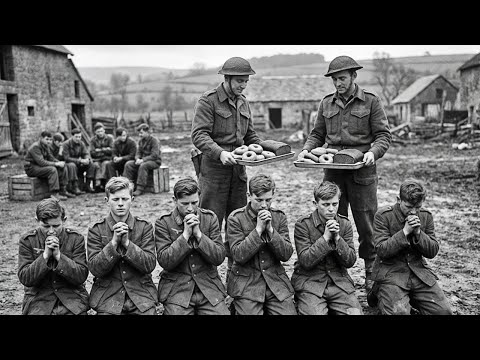
They had heard the stories. Everyone had. In the final chaotic weeks of the war, Allied soldiers lined up German prisoners—young and old—and shot them. No trials. No questions. This was war. This was justice. This was revenge. The boys expected nothing less. They had been raised on Nazi propaganda that painted the enemy as monsters, beasts without mercy. They believed it. Why wouldn’t they? It was all they had ever known.
But then they smelled something. Something sweet. Something warm. Something that made no sense at all. Donuts. Fresh donuts. The scent drifted through the cold morning air, cutting through the fear and the stench of their own sweat. The boys exchanged confused glances. This was a trick. It had to be. A final cruelty before the end.
A truck engine rumbled closer. The boys tensed. This was it. The moment their lives would end. The youngest began to sob openly, tears carving clean lines through the dirt on his cheeks. The oldest closed his eyes. The praying boy whispered faster.
The truck stopped. Doors opened and slammed shut. Boots crunched on the frozen ground, growing louder. The boys kept their eyes down. They didn’t want to see the rifles. They didn’t want to see the faces of the men who would kill them.
But the footsteps stopped. And then a voice—calm, steady—spoke in English. The boys didn’t understand the words, but they understood the tone. It wasn’t anger. It wasn’t hatred. It was something else entirely. Something they hadn’t expected.
Three weeks ago, these boys had been at home. Hans, the youngest, had been helping his father on their small farm outside Bremen. Friedrich, the middle boy, had been reading adventure novels in his room in Hamburg. Klaus, the oldest, had been studying mathematics, dreaming of becoming an engineer. They had mothers who cooked them breakfast. Fathers who taught them how to fix things. Little sisters who annoyed them. They had lives.
Then the Nazis came.
They took every boy over thirteen. They handed them uniforms that swallowed their bodies and rifles they barely knew how to hold. They told them Germany needed heroes. They told them the enemy was coming and only the brave could stop them. When Klaus hesitated, an SS officer placed a pistol against his mother’s temple and asked him to reconsider. He didn’t hesitate again.
By April 1945, Germany was collapsing. The Russians were coming from the east. The Americans and British from the west. The Canadians—battle-hardened men who had fought through Normandy, Belgium, and the Netherlands—were pushing through the north, town by town, village by village. They had seen the worst the war could offer. They had liberated concentration camps. They had watched their closest friends die days before the end. They were exhausted. They were grieving. They were furious.
And still, the children kept shooting.
Two weeks earlier, in this very town of Friesoythe, a German sniper had killed a Canadian battalion commander. The Canadians, pushed past the edge of reason, had burned much of the town to the ground. Buildings that had stood for centuries became ash and rubble. That was the mood when the three boys were captured. That was the fury waiting for them.
Now, in the gray dawn, Captain William Chen stepped out of the truck. He was thirty-one, born in Vancouver to a Chinese immigrant father and a Scottish mother. He had faced prejudice his entire life, but he had proven himself in battle after battle. His men respected him because he was fair, brave, and cared about them. He walked toward the barn where three German boys waited to learn their fate.
Chen stopped and looked at them. The youngest had brown hair sticking up in every direction, his face smeared with dirt and tears. He couldn’t have been older than fourteen. Chen had a younger brother named David back home. David was fifteen. He played hockey, complained about chores, and made their mother laugh. This German boy could have been David. Same thin arms. Same frightened eyes.
How had the world broken so badly that children ended up here with rifles in their hands?
Chen walked to where his officers stood. They showed him the intelligence reports. Hitler was throwing everything at the Allies in these final weeks. Old men. Young boys. Anyone who could hold a rifle. Most didn’t want to fight. They had been forced. The SS and the fanatics had threatened their families. Fight or your mother dies. Fight or your sister goes to the camp. The boys had no choice. They were victims as much as anyone.
But Chen also saw his wounded soldier. Campbell was being loaded onto a medical truck, his leg bandaged, his face pale from blood loss. He would live, but he would carry those scars for the rest of his life. These boys had done that. Children or not, they had fired on a Canadian soldier. Some of Chen’s men wanted justice. They wanted revenge. They had lost so much that they couldn’t let this pass.
Chen thought about the Hitler Youth he had faced in Normandy. They had fought like demons. They refused to surrender even when the battle was lost. They charged Canadian positions screaming Hitler’s name and died by the hundreds. They had been brainwashed so thoroughly that they chose death over surrender. They believed the propaganda. They died for lies.
He looked at his men. He saw the exhaustion in their faces, the grief, the anger. They had been fighting for nearly six years. They had earned the right to be angry. They had earned the right to demand justice. But Chen also saw something else in the eyes of some of them. Doubt. Sorrow. Conflict. They didn’t want to execute children any more than he did. They just didn’t know what else to do.
Chen made his decision.
He walked to where the boys sat and knelt in front of them. He looked into each of their eyes. Then he stood and gave an order that surprised everyone.
“Untie them,” he said. “Bring them food.”
The soldiers stared at him. One began to protest, but Chen raised his hand.
“That’s an order,” he said quietly. “Untie them.”
The ropes were cut. The boys rubbed their wrists. They looked bewildered. This made no sense. Why untie them if they were about to be executed?
The captain walked to the truck where a mobile canteen had been set up. Volunteers were there to provide food and coffee for the soldiers at the front. They had just made a fresh batch of donuts. The smell was incredible. After months of rations and field food, Chen took three donuts and three cups of coffee. He carried them back to the boys.
He handed the first donut to the youngest. “Here,” Chen said in English, though he knew the boy wouldn’t understand. “Eat.”
The boy stared at the donut like it was a bomb. He looked at Chen’s face, searching for a trick. Was it poisoned? Was it a cruel joke before execution? Chen took a bite of a fourth donut to show it was safe. The boy’s hands trembled as he took a bite. Then he started crying again. But these tears were different. Not terror anymore. Relief. Confusion. Gratitude. He couldn’t process it all.
Chen gave the second donut to the wounded boy. The child whispered something in German. It sounded like: “Danke. Thank you.” He tried to eat, but he was shaking so badly he could barely hold the donut. Coffee spilled on his uniform. He didn’t care. He hadn’t eaten real food in days, maybe weeks. He devoured the donut like it was the most precious thing in the world.
The oldest boy took his donut but didn’t eat it. He stared at it. Then he stared at Chen. Why are you doing this? his eyes asked. Chen just nodded at him. Eat, the gesture said. The boy finally took a small bite, then a bigger one. Then he was eating fast, stuffing the donut into his mouth like he was afraid it would disappear.
Not all the Canadian soldiers were happy about this. Private Davies walked away in disgust. He couldn’t watch. To him, this felt like a betrayal of Campbell and all the other men they had lost. How could they feed the enemy? How could they show kindness to people who had shot their friends? Other soldiers felt the same. They turned their backs, smoked cigarettes, and tried to process what was happening.
But Sergeant Morrison, who had led the patrol, did something unexpected. He had lost his best friend two days ago to a German sniper. He had every reason to hate these boys. Instead, he sat down on the ground next to the youngest. He pulled out a cigarette and lit it. Then he offered it to the boy. The boy took it with trembling fingers and took a small puff. The boy coughed. He wasn’t used to smoking. Morrison almost smiled. Just a kid, he thought. Just a scared kid caught in something horrible.
A Canadian soldier named Private Hoffman stepped forward. His grandparents had come from Germany before the First World War. He still spoke a little German. Captain Chen asked him to translate. Hoffman knelt and began speaking to the boys in their language. Relief washed over their faces instantly. Finally, someone who could understand them.
The story came out in fragments and tears. They had been recruited two weeks ago, taken from their homes, given uniforms and rifles. They had three days of training. Three days. Then they were sent to the front and told to fight. They didn’t want to. They never wanted any of this. But an SS officer told them that if they refused or retreated, their families would be executed. Their mothers, their fathers, their little brothers and sisters. So they fought. Their families’ lives depended on it.
The oldest boy, who had tried to look brave, finally broke down. He was sobbing as he spoke. Hoffman translated. The boy said he had never believed in Hitler. He never thought Germany would win. He fired at the Canadians not because he hated them or wanted to kill them. He fired because the SS officer was behind him with a pistol. If he didn’t fight, the officer would shoot him and then go shoot his mother. That was the choice. Kill or watch your family die.
The Canadians listened to the translation. The anger on some faces began to fade. Others remained skeptical. But everyone understood now. These weren’t fanatics. They weren’t true believers. They were just boys caught in an impossible situation. Boys used as weapons by evil men. Boys who deserved mercy, not bullets.
Captain Chen stood and spoke to his men. “We’re not executing them,” he said. “They’re prisoners of war. They’ll be sent to a POW camp and treated properly.”
Some soldiers nodded. Others turned away but didn’t argue. The decision was made. These boys would live.
The wounded boy needed medical attention. His shoulder was still bleeding through the crude bandage someone had tied. Captain Chen called for Corporal Jackson, the unit’s medic. Jackson had just finished treating Campbell, the Canadian soldier the boys had shot. Now he was being asked to treat the enemy who had wounded his friend. He looked at Chen. Then he looked at the bleeding German boy. He sighed and picked up his medical kit.
Jackson knelt beside the boy and carefully cut away the torn uniform. The bullet had grazed the shoulder, leaving a deep groove in the skin and muscle but missing the bone. It was painful but not life-threatening. The boy flinched as Jackson cleaned the wound with antiseptic. It must have burned like fire. The boy bit his lip to keep from screaming. Jackson worked quickly and efficiently. He had done this thousands of times. Soldier or enemy, a wound was a wound.
He bandaged the wound properly and gave the boy some aspirin for the pain. As Jackson worked, he thought about the strangeness of the situation. An hour ago, he had been treating Campbell and cursing the person who shot him. Now he was using the same bandages and the same care on the German boy who had fired the shot. War made no sense sometimes. You were supposed to hate the enemy, kill them, destroy them. But how do you hate a fourteen-year-old child who is crying and scared and bleeding?
Jackson finished the bandage and patted the boy’s good shoulder. The boy looked at him with such gratitude that Jackson had to look away. Captain Chen gathered his men in a circle away from the boys. He needed to explain his decision to them. Some of the soldiers were still angry. They wanted to know why these German children got mercy while their friends got bullets.
Chen understood their position. Their anger, he felt it too. But he needed to make them understand. “We’re fighting to end this madness, not to make it worse,” Chen said. “These boys are victims of Hitler, just like everyone else he hurt. They didn’t choose this. They were forced into it. Executing them won’t bring our friends back. It won’t end the war any faster. It will only turn us into the monsters the Nazis told them we were. We’re better than that. We have to be better than that.”
Sergeant Morrison spoke up. He said Chen was right. He told the men about sitting with the youngest boy, seeing the fear in his eyes. “That’s not a soldier,” Morrison said. “That’s just a kid who fell into hell.”
Some of the men nodded slowly. Others still looked doubtful. Private Davies, who had been so angry before, remained silent. He didn’t agree, but he respected Chen enough to follow orders. Chen continued. He reminded them why they were fighting. They were fighting for freedom, for democracy, for the idea that people shouldn’t be forced to live under the rule of tyrants. If they executed children, even enemy children, they were betraying everything they had fought for. The Nazis were the ones who did that kind of thing. The SS executed people without trials. The Canadians were supposed to be different. They were supposed to represent something better.
Not everyone was convinced, but everyone accepted it. That was what discipline meant. You followed your leader even when you disagreed. And deep down, most of them felt relieved. None of them really wanted to shoot children. They just needed someone to tell them it was okay to show mercy. Chen had given them that permission.
Over the next few hours, the full story emerged. Private Hoffman stayed with the boys, translating what they said. The words poured out of them like water from a broken dam. They had been holding it all in for so long. Now that their fear of imminent death had passed, they could finally speak.
The youngest boy’s name was Hans. He came from a small farm outside Bremen. His father was a farmer. His mother made cheese. He had two little sisters, aged seven and nine. He had been in the Hitler Youth since he was ten because all boys were required to join. They told him it was like the Boy Scouts. They went camping and learned to march. It seemed fun at first, but then came the propaganda, the hatred, the lies. By the time he was twelve, he had been taught that Jews and Slavs weren’t really human, that Germany had the right to conquer everyone, that Hitler was something close to a god. Hans said he didn’t really believe it. Not deep down. But you couldn’t say that out loud. People who questioned Hitler disappeared. Families who seemed disloyal were punished. So he kept his mouth shut and went along with it.
Then two weeks ago, the SS came. They took every boy over thirteen. They gave them rifles and two days of training. They were told to defend the homeland or their families would die. Hans never wanted to hurt anyone. He just wanted to go home and help his father plant the spring crops.
The middle boy’s name was Friedrich. He was from Hamburg. His father had been killed in Russia in 1942. His mother worked in a munitions factory. He had an older brother missing somewhere on the Eastern Front. Friedrich admitted that he had believed the propaganda more than Hans had. He had wanted to be a hero. He had wanted to make his dead father proud. But when the fighting started, when he saw the real violence and death, he realized it was all lies. There was nothing glorious about war. There was only fear and pain and death. He had fired at the Canadians because the SS officer behind him would have killed him if he hadn’t. Now he was glad he had been a bad shot. He was grateful he had only wounded Campbell and not killed him.
The oldest boy’s name was Klaus. He came from a town near Hanover. His father was a schoolteacher who had always hated the Nazis but could never say so. Klaus had joined the Hitler Youth because he had to. But his father had taught him to think for himself, to question what he was told. Klaus knew the war was lost. He knew fighting was pointless. But when they threatened his mother and his ten-year-old sister, he had no choice. He fought to protect them. That was the only reason. Not for Hitler, not for Germany, but for his family.
The story spread through the Canadian unit like ripples on water. The soldiers who had been angry began to understand. These weren’t fanatics. They were hostages. Children with guns pointed at their families. What would any of them have done in that situation? If someone threatened to kill your mother unless you fought, wouldn’t you fight too? It was easy to talk about principles when your family was safe at home. These boys didn’t have that luxury.
The canteen volunteers who had made the donuts heard about what happened. They felt proud that their simple food had been part of something important. They made sure to give the boys more food. Bread, soup, and coffee. The boys ate like they were starving. They probably were.
By mid-afternoon, the boys were loaded onto a truck headed for a POW processing center. They were given blankets and more food for the journey. As the truck pulled away, Hans looked back at the Canadians. He raised his hand in a small wave. Sergeant Morrison waved back. It was a simple gesture, a small moment of human connection amid the divisions of war, but it mattered.
Captain Chen watched the truck disappear down the road. He wondered what would happen to those boys. Would they survive the war? Would they go home? Would they remember this day? He hoped they would. He hoped they would tell people that the Allies weren’t monsters. That decency could survive even in war. That mercy was stronger than hatred.
In his notebook, Chen wrote a brief report. Three minor enemy combatants captured, disarmed, and transferred to processing center. No executions carried out. It was a simple statement that didn’t capture the weight of what had happened. But Chen didn’t need fancy words. He had done the right thing. That was enough.
The story of these three boys was not unique. All across Germany in April and May of 1945, Allied soldiers were encountering children with weapons, by the thousands. The Hitler Youth had been transformed into a military force. Boys who should have been in school were manning defensive positions. They were firing panzerfausts at tanks. They were shooting rifles from windows and rooftops. They were dying by the hundreds every day.
Different Allied armies handled these child soldiers in very different ways. The Soviet army, advancing from the east, showed almost no mercy. The Russians had suffered terribly at the hands of the Germans. Over twenty million Soviet citizens had died. Entire villages had been wiped from existence. The brutality was unimaginable. So when Soviet soldiers found Hitler Youth fighters, they often shot them on the spot. Age didn’t matter. You fought, you die. The Soviets saw these boys as just more Nazis deserving of annihilation. It was harsh, but after what Germany had done to Russia, many understood the anger.
American forces were inconsistent in their approach. Some units treated child prisoners with compassion. They gave them food and sent them to camps. Other units were more severe. If they had just lost men to teenage soldiers, it was hard to find mercy. In the Ruhr pocket in April, American troops captured thousands of Hitler Youth members. Some were only twelve years old. Most were sent to processing centers. A few were simply released to find their way home. There was no clear policy. Each commander made his own choice based on his personal conscience and the mood of his men.
The British forces were somewhere in between. They documented several instances of compassion toward young prisoners. Sometimes British soldiers adopted young German POWs as unofficial mascots, giving them jobs in camp kitchens or helping with supplies. But British units also executed child soldiers, especially if they continued to fight after being ordered to surrender. It depended on the situation, the unit, and the day.
The Canadians had every reason to be as harsh as anyone. They had been hardened by years of brutal combat. The casualty lists from Normandy to the Rhine were devastating. Entire units had been decimated. Best friends had died in each other’s arms. They had witnessed atrocities that would haunt them forever. The anger inside the Canadian soldiers was real and justified.
But incidents like the one with Hans, Friedrich, and Klaus showed a different side. Despite their anger, despite their grief, many Canadian soldiers chose restraint when they could. They saw these boys as victims of Nazi brainwashing rather than as true enemies. News of these acts of mercy spread through both armies. German boys heard that surrendering to the Canadians or Americans meant safety, not torture. This changed the calculus. A boy who might have fought to the death because he believed Allied propaganda about brutality might instead throw down his weapon and raise his hands. That saved lives on both sides.
The strategic impact was real. As April turned to May, German resistance began to collapse faster in areas where Western Allies were advancing. Part of this was military reality. Germany was losing. The game was up. But part of it was psychological. Nazi propaganda had told Germans that the Allies were savage beasts who would torture and kill everyone. When that propaganda was proven false, when prisoners were fed and treated well, it undermined everything the Nazis had said. Boys went home and told their families that the Allies weren’t monsters. That word spread faster than any military advance. Town after town surrendered instead of fighting because people knew that surrender meant survival.
The numbers tell the story. In the final month of the war, hundreds of thousands of German soldiers surrendered to Western Allied forces. Entire divisions walked into captivity without firing a shot. Many of them included teenage soldiers who had been told they would be executed if captured. When they learned that was a lie, they chose life over pointless death.
How many lives were saved because of the mercy shown to a few boys with donuts? It’s impossible to know for certain. But every act of kindness was a seed that grew into hope.
The POW processing system was overwhelmed. Camps designed for thousands now held tens of thousands. The young prisoners posed special problems. Where do you put fourteen-year-olds with adult soldiers who might bully them? The Allies created special sections for juvenile prisoners. Boys under sixteen were often released quickly, especially if they had families to return to. Older teenagers went through de-Nazification programs. They attended classes that taught real history instead of propaganda. They learned that Hitler had lied about everything. For many, this was devastating. Their entire worldview collapsed. But it was necessary. They had to unlearn the hatred.
The impact on the soldiers who showed mercy was profound. Years later, Canadian veterans would speak of moments like these as their proudest achievements of the war. Yes, they had fought bravely. Yes, they had liberated countries and defeated evil. But choosing compassion when hatred was easier was a different kind of heroism. It took more courage to offer a donut to an enemy child than to pull a trigger. Any soldier could kill. Not every soldier could show mercy.
At veterans’ reunions decades later, someone would inevitably bring up the child soldiers. The old men with gray hair and wrinkled faces would remember teenagers in uniforms that were too big for them. They would talk about the choices they made. Some admitted they had wanted revenge at the time. Others said they never doubted that mercy was right. But they all agreed on one thing. They were glad they had chosen compassion. They were glad they had gone home knowing they hadn’t let the war turn them into monsters.
The enemy’s perspective mattered too. German soldiers who survived the war and experienced Allied mercy often became advocates for democracy and reconciliation. They joined veterans’ organizations that worked for peace. They spoke in schools and told young Germans what they had learned. War solves nothing. Hatred destroys everyone. The nations that showed them mercy were the ones Germany should have allied with after the war. This shaped post-war German politics. It helped Germany embrace NATO and the Western alliance. The seeds of peace were planted in POW camps where enemies became friends.
Both sides’ leadership drew conclusions. Allied commanders realized that psychological warfare was as important as military force. Treating prisoners well wasn’t just moral. It was strategic. It encouraged surrender. It reduced resistance. It saved Allied soldiers’ lives. After the war, these lessons influenced military doctrine. The Geneva Conventions were strengthened. Training emphasized that even enemies deserved basic human dignity. The idea that mercy could be a weapon became part of military thinking.
But perhaps the most important impact was simply this: the proof that even in the darkest hours of war, humanity could survive. That people could choose compassion over cruelty. That the best of human nature could endure even when everything pushed toward hatred. Three boys received donuts instead of bullets. And in that small moment, something bigger was proven. We don’t have to become like the evil we fight. We can win and still keep our humanity.
That lesson echoed through the decades.
Hans arrived home three months after the war ended. The POW camp released him in August 1945 because he was only fourteen. He walked for five days to reach his family’s farm outside Bremen. The farm was still there, but barely. His father had managed to keep it going somehow. His mother cried when she saw him walking up the road. His little sisters ran to hug him. They had thought he was dead. Everyone had thought he was dead.
Hans never forgot that morning against the barn wall. He had nightmares about it for years. In those dreams, the Canadian captain never gave him the donut. In the dreams, he heard the gunshots and felt the bullets and woke up screaming. His mother would hold him while he cried. Over time, the nightmares became less frequent, but he never forgot the smell of those donuts or the kindness in Captain Chen’s eyes.
Hans became a carpenter like his father before him. He married a local girl named Anna in 1952. They had three children. He didn’t talk about the war much. It was too painful, too shameful. But when his oldest son turned fourteen, Hans sat him down and told him the story. He explained how he had been given a rifle and told to fight. How he had fired at men and then waited to die. How a Canadian soldier had given him a donut instead of a bullet.
His son asked why he was telling him this. Hans said: “Because you need to know that enemies can be more human than your leaders. Because you need to know that one act of kindness can change everything. Because you need to know that even in the worst times, there are good people.”
Hans kept a small Canadian flag in his workshop until the day he died in 1998. He was sixty-seven years old. His grandchildren found the flag after his funeral and asked what it meant. Their parents told them the story of the donuts.
Friedrich had a harder time. He spent nearly a year in a POW camp because he was sixteen when captured, old enough to need de-Nazification classes. He sat in classrooms with other teenage soldiers and learned the truth about what Germany had done. The Holocaust. The extermination camps. The millions killed. Friedrich had believed in Hitler. He had wanted to be a hero. Now he knew that everything he had believed was a lie built on corpses. The guilt nearly destroyed him.
He returned home to Hamburg in 1946 and found his mother still alive but broken. His older brother had never returned from Russia. Friedrich got a job in construction, helping to rebuild the city his country had helped destroy. He worked hard. He never smiled. He carried the weight of shame like a stone on his back.
But in 1950, something changed. Friedrich met a woman named Greta who had survived Auschwitz. She was Jewish. She had lost her entire family. They met at a memorial service for war victims. They started talking. He told her his story. She told him hers. He expected her to hate him. Instead, she said he was a victim too. She said the Nazis had stolen his childhood and his innocence. She said forgiveness was possible if he chose to be different.
They became friends, then more than friends. In 1953, they married. People thought they were crazy. A former Hitler Youth marrying a Holocaust survivor. But they understood each other. Friedrich spent the rest of his life working for reconciliation. He spoke in schools. He told young Germans about the lies he had believed, the truth he had learned. He died in 2003 at the age of seventy-four. At his funeral, Greta said that a Canadian soldier had saved his life twice. Once with mercy, and once with the chance to become a better person.
Klaus never made it home. He survived the POW camp. He was released in early 1946. But when he returned to Hanover, he found his home destroyed by Allied bombing. His mother and sister had been displaced to relatives in the countryside. He set out to find them, but he fell ill on the way. Pneumonia. His body was weak from months of poor food. He died in a hospital in February 1946. He was only seventeen years old. No one knows if he ever saw his family again. His story ended just when it should have been beginning.
Captain William Chen returned to Canada in late 1945. He went back to Vancouver and tried to adjust to civilian life. It was hard. He had seen too much, done too much. The memories haunted him. But he married his high school sweetheart in 1947. They had four children. He became a teacher, just as he had been before the war. He taught history and tried to help young people understand what war really meant.
Chen rarely spoke about his military service, but in the 1970s, a student asked him if he had ever killed anyone. Chen was silent for a long time. Then he said: “No. The question wasn’t whether I killed anyone. The question was whether I saved anyone.”
He told the class about the three German boys. He told them about choosing mercy over revenge. He told them it was the hardest and best decision he had ever made. That student never forgot the story. She became a teacher herself and told her students. The story lived on.
Sergeant Morrison returned home to Ontario. He married and had two daughters. He became a police officer. He saw his job as protecting people, even those who made mistakes. When other officers wanted to be harsh, Morrison remembered those three boys and chose compassion whenever he could. He died in 1982. His daughters found his war diaries after he passed. He had written about the day they captured the child soldiers. The last line read: “Today I learned that mercy takes more courage than violence. I hope I never forget that.”
The women who ran the mobile canteen never knew the full impact of their work. They made thousands of donuts for thousands of soldiers throughout the war. Each one was a small comfort in difficult times. But those three donuts changed three lives, saved three lives. The women who made them were unsung heroes. They fed bodies and, unknowingly, fed hope.
There is no great monument to what happened that April morning in 1945. No statue of Captain Chen handing a donut to a frightened boy. No plaque on a barn wall in northern Germany. The exact location has probably been lost to time. Records from those chaotic final days of the war were often incomplete. Small moments of mercy weren’t recorded in official reports the way battles and casualties were.
The story lives on, not in stone or bronze, but in memory. In the stories families passed down through generations. In the accounts veterans shared at reunions. In the oral history of the war that often matters more than what’s written in books.
But the impact of that story and thousands like it shaped the world that came after. Post-war Germany had to rebuild not just buildings and roads, but trust. The German people had to learn to trust democracy after years of dictatorship. They had to learn to trust their former enemies who were now allies. This wasn’t easy. Germans had been taught for twelve years that the rest of the world wanted to destroy them. Breaking through that propaganda required proof that it had been lies. The proof came from moments like the donut incident, when German POWs returned home and told their families that the Allies had treated them fairly. That changed minds. When boys like Hans and Friedrich told their neighbors that Canadian soldiers had shown mercy, it built bridges. These personal testimonies were more powerful than any government statement.
People trust what their sons and brothers tell them more than what politicians say. The soldiers who chose mercy planted seeds of reconciliation. By the 1950s, West Germany was a strong ally of the United States, Canada, and Britain. Germany joined NATO in 1955. Former enemies became partners in defending democracy against communism. This transformation happened with remarkable speed. Only ten years after total war, Germans and Canadians were fighting on the same side. This wouldn’t have been possible if the war had ended with only bitterness and hatred. The mercy shown in those final days made future friendship possible.
Military doctrine changed because of lessons learned from the war. The Geneva Conventions were updated and strengthened after 1945. New rules were added about the treatment of prisoners. Soldier training programs began emphasizing that enemies deserved basic human dignity. The idea that showing mercy could be strategic, not just moral, became part of military thinking. Officers learned that treating prisoners well encouraged surrender, saved lives, and won hearts and minds. The donut was, in some ways, more powerful than the bullet.
For the Canadian military, stories like this became part of the national identity. Canada saw itself as a nation that fought bravely but honorably, that defeated evil without becoming evil. These stories were shared in military academies and training centers. Young soldiers learned that their predecessors had faced difficult choices and made the right ones. This created a culture that valued restraint and humanity even in the midst of combat. Canadian peacekeeping missions in later decades drew on this tradition. The idea that Canadian soldiers were strong but fair became a source of national pride.
The descendants of Hans and Friedrich grew up in a different world than their fathers. Hans’s children and grandchildren never knew war. They grew up in a democratic Germany that was prosperous and peaceful. They traveled freely throughout Europe. They made friends with people from France, Britain, and Canada. The walls that had divided Europe for centuries came down. The European Union was built on the idea that former enemies could become partners. None of this was guaranteed. It took work and sacrifice and a willingness to forgive.
Hans’s grandson visited Canada in 2015. He was thirty years old, a software engineer from Berlin. He went to the Canadian War Museum in Ottawa. He saw exhibits about the battles his grandfather had been part of. He saw the uniforms and weapons and photographs. He stood before a display about the liberation of Germany and thought about the Canadian soldier who had given his grandfather a donut seventy years earlier. He wished he knew the soldier’s name so he could thank his family. But the name was lost. The kindness remained.
The lesson of this story echoes across the decades. War brings out the worst in humanity. It creates conditions for hatred, cruelty, and revenge. It gives people permission to do terrible things to each other. In war, killing enemies isn’t just allowed—it’s required. Orders are orders. Survival demands violence. The momentum of war pushes everyone toward darkness. It’s easy to become a monster. It’s easy to stop seeing enemies as human.
But war doesn’t have to destroy our humanity completely. Even in the worst circumstances, people can make choices. They can choose mercy over revenge. They can choose compassion over cruelty. They can choose to see the person instead of just the uniform. These choices are hard. They take courage. It doesn’t take courage to pull a trigger when everyone expects you to. It takes real strength to lower that weapon and offer food instead.
Captain Chen had every military and moral justification to execute those boys. His wounded soldier would have understood. His angry men would have supported it. History would not have judged him harshly. But he chose differently. He chose to see frightened children instead of enemy combatants. He chose to end the cycle of violence instead of continuing it. He chose the harder path. And that choice rippled through time in ways he never knew.
The three boys were among millions of victims of Nazi fanaticism. Children whose innocence was stolen. Young people forced to fight in a war they didn’t choose for a cause they didn’t understand. They were given rifles when they should have been given schoolbooks. They were taught hatred when they should have been taught to think. They were sent to die when they should have been learning to live. The system that did this to them was evil. But the children themselves were victims.
When we remember World War II, we usually remember the big moments. D-Day, Stalingrad, the atomic bombs, the concentration camps, the surrender ceremonies. These were important. But the small moments mattered too. A Canadian captain giving a donut to a German boy. A medic treating the enemy who shot his friend. Soldiers choosing compassion when hatred was easier. These moments showed what we can be at our best, even when everything pushes us toward our worst.
The story teaches us that enemies aren’t born—they’re made. That children aren’t responsible for the sins of their leaders. That showing mercy isn’t weakness but strength. That how we treat our enemies defines us more than how we treat our friends. That we share a common humanity. That a simple act of kindness can save a life and change the world.
A donut is just fried dough and sugar. But in that barn in April 1945, it became something more. It became proof that goodness survives even in the shadow of evil. That hope lives even in the grip of despair. That humanity endures even when everything tries to destroy it. Three boys expected death and received life. And in that moment, something important was preserved. Not just their lives, but the idea that even in war, we can choose to be better than war demands.
The war ended weeks later. The boys went home—or tried to. Hans became a carpenter, Friedrich a builder, Klaus a memory. Chen became a teacher, Morrison a policeman, Jackson a country doctor. None of them ever forgot that gray April morning.
Decades later, in 1985, a letter arrived at Chen’s home in Vancouver. It was written in careful English by a man named Hans, aged fifty-four. “I have looked for you for forty years,” it began. “You gave me a donut when I expected a bullet. I have told my children and grandchildren about you. You are the reason I believe in goodness.”
Chen read the letter three times, then wept. He wrote back. They corresponded until Chen’s death in 1999. Hans flew to Canada for the funeral. He stood at the graveside and said, in broken English, “Danke. Thank you. For the donut. For my life. For teaching me that enemies can be human.”
A donut is just fried dough and sugar. But on that morning, it became proof that humanity survives even the darkest war. Three boys expected death and received life.
So here is the question for you: If you were Captain Chen, facing those three frightened boys with every justification to pull the trigger, what would you have chosen—mercy or revenge? Share your answer below.
Report this article
Select a reason for reporting:






