At the Caldwell family’s Christmas dinner, surrounded by crystal and candlelight, my daughter’s mother-in-law lifted the wooden box I had spent three weeks crafting and called it ‘wonderfully sentimental.’ Her voice dripped with condescension as she compared it to the Rolex watches and company shares her family exchanged. But when my daughter quietly defended her mother’s memory, her husband stormed across the room and slapped her across the face. The sound cracked through the silence like a gunshot. Fifty guests froze. No one moved. No one spoke. I picked up the cracked wooden box, led my trembling daughter to my old truck, and made one call. ‘Begin step one. Freeze everything.’
By sunrise, their accounts were locked. Their projects had stopped. The entire family was calling me in panic. But they had no idea who they were really dealing with.
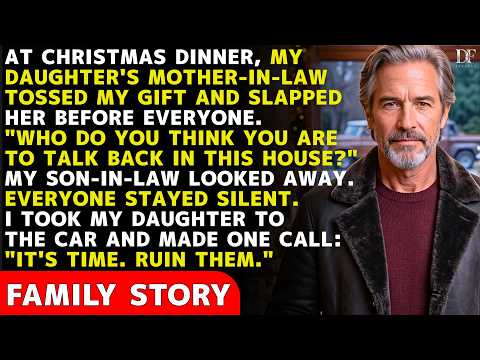
The drive to the Caldwell estate took 25 minutes from Gahanna, and I had made it enough times to know every turn without thinking. December air pressed cold against the truck windows as Christmas lights blinked from rooftops, cheerful and indifferent to whatever was about to happen inside that house. On the passenger seat sat a wooden box I had spent three weeks building in my shop—walnut, hand-jointed corners, a small brass latch I had polished twice before deciding it was good enough. Inside was the last photograph ever taken of my wife Helen and our daughter Meline together, two women laughing at something just outside the frame.
I was 60 years old, a widower, and to everyone at the Caldwell House tonight, I was nothing more than a furniture repair man from Gahanna who drove a 15-year-old pickup and wore flannel shirts to Christmas parties. That was exactly how I needed it to stay—for now.
The Caldwell estate rose at the end of a private lane. White columns, black shutters, windows tall enough to show the chandelier light pouring gold across the front lawn. More than 50 guests tonight, if the cars in the side lot were any indication. Range Rovers, Mercedes sedans, one silver Porsche parked sideways across two spaces with the casual arrogance of someone who had never once worried about a parking ticket.
I pulled the truck into the far corner of the lot and sat for a moment with the engine idling. A household staff member—young man, white dress shirt, black vest—held the front door open as I approached. He nodded at me with the kind of professional warmth that treated all guests equally regardless of what they were wearing. I appreciated that more than he would ever know.
Then I saw Meline.
She was standing near the base of the staircase in a deep blue dress, her dark hair pinned up, and my heart clenched the moment I saw her face. My daughter was beautiful, but tonight her cheeks were pale and her eyes carried something tight and hunted that she was working very hard to hide from the room.
The moment she spotted me, she crossed the floor quickly and wrapped both arms around me, pressing her face briefly against my shoulder. ‘Dad.’ Her voice was barely above a breath. ‘Don’t ask anything tonight. Please, just be normal, okay? Just be Dad.’
I held her for a moment and felt how rigid she was. Every muscle braced like she was expecting something to hit her. ‘Hey,’ I said quietly. ‘I’m just Dad, that’s all.’
She pulled back and gave me a smile that didn’t reach her eyes, then turned just slightly to look across the room. I followed her gaze and found Ryan standing near the fireplace with a bourbon in his hand, laughing at something, relaxed and easy—the picture of a man without a single thing on his mind.
Then for just a fraction of a second, Ryan’s eyes moved—not to me, but past me—to his left. Victoria Caldwell stood ten feet away, watching her son with an expression so brief and deliberate it would have meant nothing to anyone who hadn’t spent thirty years reading wood grain for hidden stress fractures. It meant something to me.
Victoria turned and extended one hand. ‘Walter, so glad you could make it.’ Her grip was brief and boneless. Across the room, Richard caught my eye and moved toward me with his campaign-stop handshake already extended. ‘Arthur, big night.’ He had called me Arthur for three years. I had never corrected him.
I looked back at Meline. She was watching Ryan again, her fingers pressed flat against the skirt of her dress, her jaw working slightly like she was reminding herself to keep breathing. I had seen that look before—not on my daughter, but on people who were frightened and doing everything they could not to show it.
Something was going to break tonight. I just didn’t know yet which direction it would fall.
The dining room held four round tables set for ten, each dressed in white linen with centerpieces of pine branches and white candles that cast a warm, flattering light over everything—the crystal, the silverware, the faces of people who had learned long ago how to look comfortable in expensive rooms. I found my seat near the end of the second table beside a woman named Patricia, who introduced herself as Victoria’s cousin from Cleveland. She had kind eyes and a slightly apologetic way of smiling, like she was perpetually embarrassed by something the rest of her family had done. I liked her immediately.
Meline was seated three chairs away, close enough that I could watch her without appearing to. Ryan sat at the far end of the table from his wife, which struck me as a choice rather than an accident. He was already on his second bourbon, laughing with the man beside him, gesturing broadly with his glass.
The wooden box sat on the table in front of Meline’s empty seat. She hadn’t brought it in herself—one of the staff had carried it from the entrance hall and placed it there. And now it sat among the pine branches and candles like something that had wandered into the wrong party.
Victoria took her seat at the head of the table, and the room settled into the particular attentiveness that hostesses like her command without asking. She lifted her wine glass, smiled at the assembled guests, and then her eyes moved to the wooden box.
‘Walter.’ Her voice carried easily across the table. ‘You brought us something handmade again this year.’
Several heads turned. I set down my water glass and met her gaze without hurrying. ‘It’s for Meline,’ I said. ‘Not for the table.’
Victoria reached across and drew the box toward her with two fingers the way you might handle something you expected to be dusty. She unlatched it, looked at the photograph inside, and her expression did something that wasn’t quite a smile and wasn’t quite pity, but landed somewhere between the two.
‘A wooden box and an old photograph,’ she said loud enough for the nearest two tables to hear. ‘How wonderfully sentimental.’ She set it back down and looked around the table. ‘We give each other Rolex watches and company shares in this family, but I suppose everyone expresses affection in the way they’re capable of.’
A ripple of polite laughter moved around the table. Patricia beside me pressed her lips together and found something very interesting to study in her bread plate. My jaw tightened, but I kept my face easy and my hands flat on the tablecloth.
Meline reached out and pulled the box to her side of the table. Her chin was up and her voice was steady when she said, ‘I love it, Dad. I’ve been wanting something like this for a long time.’
Victoria tilted her head. ‘Sweetheart, you don’t have to pretend. It’s a lovely gesture, truly.’ Her tone was the kind that wraps a blade in velvet. ‘Though, I do think it’s time you started developing a taste for finer things. You’ve been a Caldwell for three years now.’
The color in Meline’s face shifted—a slight draining, like water leaving a glass. She opened her mouth to respond, but Ryan spoke first from the far end of the table.
‘Mom.’ Just the one word—flat and quick—and I watched Meline’s shoulders drop half an inch at the sound of it. Not from relief, but from something that looked closer to submission. She closed her mouth.
I cut a piece of bread and said nothing, and stored everything I had just seen in the part of my mind where I keep things I intend to examine more carefully later.
Richard seized the moment to redirect the table’s attention. ‘The capital structure on this one is something special,’ he said, swirling his wine. ‘We’ve got a private fund backing the senior debt position—real patient money.’ I lifted my water glass and asked mildly, ‘What’s the loan-to-value ratio on the senior tranche?’ Richard blinked, looking at me the way people look at a piece of furniture that has unexpectedly spoken.
‘Sixty percent,’ he recovered. ‘Conservative. That’s how we structure everything.’ He had no way of knowing I had reviewed that exact project three months ago—flagged two optimistic revenue assumptions and placed the entire approval on hold. I was the patient money he was bragging about.
Then Victoria raised her glass toward Meline. ‘My daughter-in-law should feel grateful. Without this family, she’d still be the daughter of a furniture repair man.’ Meline’s knuckles went white on the edge of her chair, but she said nothing. Ryan didn’t defend her. Not one word.
Meline placed the wooden box gently on her lap, away from Victoria’s reach. ‘The box belonged to my mother,’ she said quietly. ‘Dad made it to hold the last photograph we have of her. I think that’s worth more than a watch.’
Victoria set her fork down with a precise click. ‘This table is not the appropriate place for grief performances. We have guests.’ Ryan stood. Every person at that table waited for him to defend his wife. Instead, he crossed the room in three strides and his open hand struck Meline across the face.
The sound cut through the room like something breaking that could not be repaired. The wooden box fell to the floor. ‘You were told how to behave tonight,’ Ryan said flatly. Fifty people stopped breathing. Victoria picked up her wine glass.
I was already on my feet. Every instinct screamed at me to drag him out by the collar, but that was the version they expected—Walter Hayes making a scene, escorted out by security. Instead I reached Meline, put one hand on her shoulder, and felt her flinch before she realized it was me.
‘Let’s go,’ I said low and even. I bent, picked up the wooden box, and placed it in her hands. ‘Right now. Don’t look at anyone.’ Behind us, Victoria said something about disruptions. Meline’s fingers shook against my arm.
‘Don’t,’ I said quietly. ‘She wants you to look back. Don’t give it to her.’
In the truck, I stood in the cold with my shaking hands pressed flat against the metal roof until they stopped. Then I took out my phone. Samuel answered on the second ring.
‘Samuel. Begin step one.’ A pause of exactly two seconds. ‘Understood. I’ll need until morning for the full credit acceleration. The audit referral I can initiate within the hour.’
‘Are you all right, sir?’ I looked through the window at my daughter, the mark on her cheek darkening. ‘No,’ I said. ‘But I will be.’
Northbridge Holdings controlled the senior debt on three of Caldwell Development’s largest projects. As senior lender, we held rights Richard’s attorneys had signed without imagining they’d ever be exercised—including an audit clause that froze every credit line until resolved. Nothing illegal. Just the quiet application of a contract by a man Richard had never bothered to look at directly.
Meline turned to me as I started the engine. ‘Since when do you have an attorney?’ ‘Since before you were born.’ She stared. ‘Dad, what’s going on?’
‘I’ve been watching the Caldwell financials for three months,’ I said. ‘Tonight gave me the only reason I needed to stop waiting.’ My phone buzzed face-down on the seat. Three words from Samuel: Step one complete.
In my kitchen, under honest yellow light, Meline finally told me everything—the forged loan guarantees with my signature, the threats, the three years of silence to protect me. ‘He said if I left, they’d come after the house, the shop. That you’d lose everything.’
I played back her voicemails from eight months ago. I had thought my daughter sounded tired. She had been terrified. ‘I’m going to need you to tell me everything,’ I said. ‘All of it, from the beginning.’
By morning, Daniel Crowe—my head of risk, former IRS criminal investigator—laid it all on the kitchen table: the shell company, the forged signatures, the wire fraud, the divorce papers Ryan had drafted eleven days before their anniversary. ‘This is no longer a family dispute,’ Daniel said. ‘This is an FBI matter.’
When we walked back into that house, Ryan dropped a folder of guarantees on the table and smiled. ‘Northbridge releases the frozen facilities by Friday, or we file these.’ I checked my watch. On cue, Samuel came through the door with Daniel, two bank representatives, and a documents examiner.
‘Walter Hayes,’ Samuel said, ‘founder and sole owner of Northbridge Holdings.’ The room stopped. Richard sat down without deciding to. ‘The patient money he mentioned at dinner,’ I said. ‘That was me.’
Ryan bolted for the door. Agent Simmons stepped through it. ‘FBI. I have a warrant for your arrest.’ The handcuffs clicked. Meline looked at him once and said, ‘I hope it was worth it, Ryan.’
Months later, in a barn in Granville with good bones and east-facing windows, I set the old hand plane in my daughter’s hands. ‘Put your hands flat on the wood first. Feel the grain. You go with it, not against it.’ The first curl rose pale and clean, and the smell of fresh walnut filled the air.
‘What do we build first?’ she asked. I looked at her—sawdust on her hands, her mother’s photograph on the wall behind her. ‘Something that lasts,’ I said.
I kept secrets with the best intentions, and they cost my daughter three years. If you love someone, give them the full version of who you are. Real strength isn’t loud—it arrives on time, with documentation, in a flannel shirt. The Caldwells built their own destruction brick by brick. I simply stopped holding the structure up.
So tell me—is there someone in your life who deserves the full version of you? Drop a comment below. I read every single one.
Report this article
Select a reason for reporting:






