He was called Il Duce, and by 1937, Benito Mussolini had already ruled Italy for fifteen years, transforming it into a fascist state through violence, propaganda, and grand public works. His March on Rome in 1922 had made him the model for dictators across Europe—including a young Adolf Hitler, who openly admired him. But Mussolini’s downfall was approaching, and the year 1937 would mark the beginning of the end.
On this day, Mussolini made an official visit to Nazi Germany, the rising power in Europe. Hitler, who had come to power four years earlier, held the Italian dictator in great esteem. “Mussolini is the world’s leading statesman,” said the Führer, “and nobody by far has the right to compare themselves to him.” For five days, from Munich to Berlin, Mussolini was shown around the new Germany and honored by the Nazis. “Never was such a welcome offered even to emperors,” he wrote to one of his mistresses in Rome. “I have conquered them. They are crazy about me.”
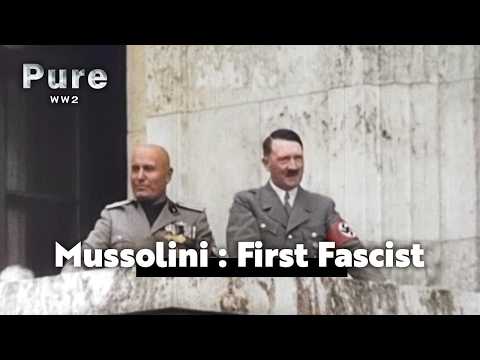
For a year, Hitler had flattered him and tried to make him an ally. He sent special envoys with plans to divide Europe into two spheres of influence: Central and Northern Europe for Germany up to the Baltic Sea, and Southern Europe for Italy bordering the Mediterranean. It was a highly confidential plan, and particularly timely for Il Duce. This was Mussolini’s dream—a dream which until now he couldn’t afford. At the Olympic Stadium in Berlin, a fired-up Mussolini committed himself to march alongside Hitler while proclaiming his wish for peace.
With this rapprochement, he hoped to give new impetus to his dictatorship, a golden opportunity to revive enthusiasm which was on the wane after his fifteen years in power. He knew how to seize the moment in all situations. He knew how to choose. Italians counted on him. He showed them he was acting for the good of the nation. Italy would join with Germany to conquer the world.
But there was a latent fear of being dominated—that Mussolini had been bewitched. In fact, Mussolini knew what to expect from Hitler. He had known the German chancellor since 1934, three years earlier, when he made an official visit to Venice. Their first discussions were tempestuous and his first impressions frightful. “A madman, a sex maniac,” confided Il Duce to his entourage. In July of 1934, a few weeks after Venice, the two powers almost came to arms when Hitler orchestrated a failed coup attempt in Vienna and ordered the assassination of Austrian Chancellor Engelbert Dollfuss, an Italian protégé. Mussolini sent several divisions to the border and publicly vented his anger against Nazi racism.
The tension was such that in 1935, a few months after the Austria crisis, Mussolini even attempted a rapprochement with the western democracies, France and Great Britain. But his dirty war in Ethiopia, which violated international law, scuppered that. Influenced by London and Paris, the League of Nations in Geneva condemned Italy and imposed economic sanctions on it. It was then in 1936 that Hitler made his first gesture by refusing to apply the sanctions and recognizing Italy’s right to build an empire. A friendly hand held out and quickly seized by Mussolini.
One of his family members encouraged him in this direction: his son-in-law, the young Count Ciano, husband of his daughter Edda. In the mind of the diplomat from the new fascist elite, an alliance between the two dictatorships was a natural step, and Mussolini had everything to gain from a rapprochement with Hitler. In 1936, Il Duce appointed Ciano his minister of foreign affairs, and the two men set out to fulfill an alliance with Germany.
The Civil War in Spain was their first common playing field. In 1936, General Franco, another admirer of Il Duce, became the leader of nationalist forces against the Republicans. He called on the two dictators for help. Hitler sent 7,000 men to Spain. Mussolini sent ten times more, including his son Bruno, still a bomber pilot. “What I remember very well was the great adhesion in the towns and villages,” recalled a volunteer. “Those eager to go as volunteers to Spain turned up to enroll in their hundreds, in their thousands. There was a riot.” The Germans bombed Guernica, the Italians Barcelona. Thousands died in the air raids. A good way, believed Mussolini, to harden his soldiers, to free them from the fear of domination and turn them into masters.
He wanted to create a new Italian man, a virile man with his jaw and chest proudly out, intent on ruling others. And yet war was less popular than fascist legend would have us believe. After victory in Málaga, the Italian army collapsed outside Madrid. Under poor leadership, many Italians deserted or intentionally wounded themselves. Thousands of them would die. “According to him, the Italians were the grandchildren of the Romans,” said a historian. “But not all of them were. In fact, practically nobody. If you give the Italians an empire, that’s great. But if they have to go out and conquer it with wars, then no, the new Italian warrior didn’t exist because we don’t have that natural warrior spirit.”
In Rome, a disappointed Mussolini began to doubt his Italians, these mandolin players, as he called them. In German eyes, his prestige was tarnished, but he refused to give up. “To build a great people,” he said, “you must force them into battle with a kick up the backside.” For the past few months, one woman had encouraged him: his new mistress, Clara Petacci, almost thirty years his junior. He met her on a road outside Rome during a hair-raising spin in a convertible. Mussolini called her “little Salomé” after the mistress of Julius Caesar. “I love you madly,” he wrote. “I want to harm you, be brutal with you.” “You are the epitome of beauty and power,” she replied. Her flattery always gave Mussolini the energy to bounce back.
But there was a problem. In March of 1938, as his army was floundering in Spain, Mussolini received dispiriting news: Hitler had entered Austria. An act he had opposed in 1934 due to his ties with the Austrian government. Il Duce was informed on the morning of the incursion, presented with a fait accompli—Hitler going behind his back. He felt he no longer counted for the Germans. In Europe, the spotlight was now on the Führer and not on him. But without Hitler, how could he build the Mediterranean Empire he dreamed of? Corsica, Malta, Tunisia, Gibraltar, the Suez Canal.
A few weeks later, in May of 1938, the Führer headed to Rome. Il Duce, who had invited him, gave orders to shower him with tributes. “They forced us to go to the station to watch his train pass by,” remembered a schoolboy. “There we were, sleepy-eyed, ordered to stand to attention, all in uniform. We were told that unity was strength. Only teamwork counted and that we belonged to a privileged group.” By rolling out all the pomp of the dictatorship, Mussolini intended to remind Hitler that he was the first fascist and thus impose equality in their relations.
In Rome, it was King Victor Emmanuel—who had appointed Mussolini as head of the government sixteen years earlier—who greeted Hitler. A simple matter of protocol, but frustrating for Il Duce. He had to walk a meter behind the two heads of state before seeing them head off to the Quirinal Palace where Hitler would stay. The following morning, Mussolini was back in his rightful place and the race for prestige begun in Berlin started again in front of the crowds.
Silvana Ajòkay, a Jewish girl from Rome, was on the parade route, too young to grasp the consequences. “Mussolini and Hitler in uniform saluting the crowd. And we school children were waving our little flags and shouting. To be honest, I didn’t feel a thing. To me, he was some man come to visit Italy. So, I can’t say seeing Hitler filled me with fear. Nope. It was like watching a movie.” This was a year and a half before the outbreak of World War II. Who in the crowd imagined what would soon come?
“I make him laugh,” Mussolini told his mistress. “When Hitler isn’t on view, he’s very pleasant and quite respectful.” To impress the Führer, Il Duce took him to Naples, where he had organized a giant mock naval battle, one of the strong points of the Italian armed forces. But in truth, it was Mussolini, the so-called master, who was won over. For several months, he had been observing how Hitler operated, his way of laying down the law, and making serious headway in constructing a totalitarian society in Germany. And he didn’t balk at copying him to make his own totalitarian dream come true.
In Trieste, without Hitler’s pressure, Mussolini launched a new attack—this time against the enemy within. Italy, a nation which had never really been anti-Semitic, was about to change. Within days, judged to be incompatible with the new Italian man, Jews became the bane of society and were expelled from governmental posts. No more rights or social welfare. Second-class citizens, barred from justice, education, and the press. “These filthy Jews must be wiped out,” said Il Duce in private. Strict measures were taken. Jews were forbidden from running banks and real estate companies, and mixed marriages were banned. In the name of the defense of the Italian race, presented as an Aryan race, 10,000 Jews were struck from the lists of the fascist party, including those who had participated in the March on Rome of 1922. As for Jewish children, they were excluded from school, like the young teenager Silvana, who had up until then cheered on Il Duce.
“It was awful, staying home when all my classmates went to school,” she recalled. “I could hear them on their way through the open window. It was unbelievable. We were even forbidden from going to the seaside. My dad loved going to the baths in Tivoli. He used to go by bus, but then he was forbidden from boarding it. There were bans for very simple things that we’d been used to doing forever. But worse than not doing them, it was the bans themselves that were ridiculous. It was stupid because lots of Jews had actively taken part in the fascist revolution. We were flabbergasted by the race laws. We just couldn’t accept them.” Laws taken badly by the Italian people, but ratified by the king, applied by the administration, and supported by the majority of party militants.
Mussolini knew what he was doing with anti-Semitism. By singling out Jews after communists, strikers, and Ethiopians, he intended to remotivate militants and once again create tension in the country. “There is only one remedy,” he said. “The principle of permanent revolution. Like a cyclist, if the dictator were to stop pedaling, he would fall.” A few days after the launch of his anti-Jewish campaign, he was back in Germany on the request of the international community, which was desperate to avoid plunging Europe into a new war. He was still working both sides. Daladier of France and Chamberlain of Britain asked him to reason with his friend Hitler, who was threatening to invade Czechoslovakia.
Extreme tension reigned. Europe was in a panic and on the point of exploding. It was Mussolini who would save the day. Back in the spotlight and flattered by his role as mediator between the great nations, he put forward a proposal which was originally suggested to him by the Nazis. Everybody signed the Munich Agreement. “A feat of diplomacy,” the international press called it. Mussolini, savior of world peace and lauded by his people. But the illusion did not last.
Six months later, the German army entered Prague, breaking the freshly signed agreement—and this time the mask fell. Surprised by the attack, Mussolini quit his role as mediator and set out to conquer Albania, a small country neighboring Italy. Immediately his fanatic supporters were screaming for more.
In Berlin, Hitler now had his eye on Poland, allied to France and Britain. World War II was imminent. For months his son-in-law Ciano had rung the alarm bells, but Il Duce insisted: “We must stand with Hitler, otherwise he’ll turn against us.” In May 1939, Ciano signed the Pact of Steel—a point of no return.
Hitler promised war would not break out before 1942. Another lie. In September, Germany invaded Poland. World War II had begun. At the last minute, Mussolini shirked his ally, declaring a strange new concept: “non-belligerence.” But when France was already two-thirds won, he declared war on Paris and London, hungry for his share of the booty.
For Italians, the hour of truth had come. After two decades of promised glory, the defeats arrived—Greece, North Africa, the loss of Ethiopia. “I am humiliated for not having turned them into a people of steel,” he confessed. In July 1943, the Allies landed in Sicily, and his own Grand Council voted him out of power after twenty-one years.
Arrested and imprisoned, he was rescued by German paratroopers and installed as a puppet at Salò. “I’m a living corpse,” he admitted. In April 1945, disguised as a German soldier, he was captured by partisans with Clara Petacci and executed. Their bodies were strung up by their feet in Milan.
In 1957, his body was reburied in Predappio, and a cult was born—unofficial, followed by a minority, but alive today. “A century on, his ghost still haunts Italian minds.”
Was Mussolini a product of his time, or does his ghost reveal something darker that still lingers in all of us?
Report this article
Select a reason for reporting:






