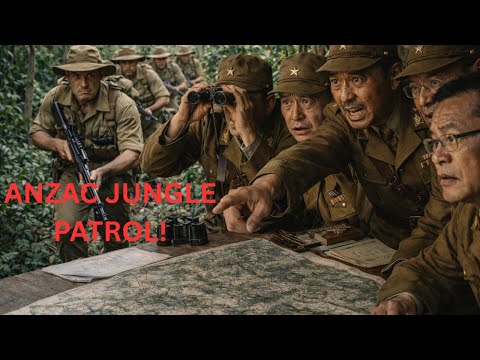
August 1942, New Guinea. The air was thick with humidity, clinging to everything like a wet blanket. The jungle pressed in on all sides, a tangle of green that felt suffocating in its closeness. The Australian forces, fresh off a brutal defeat at the hands of the Japanese, were now scrambling to defend the territory they had left. In the dense wilderness, every step was a gamble. The Japanese had their eyes set on Port Moresby, a crucial position, and they were closing in.
The Australians were running out of options. The Allies had expected the terrain to be difficult, but nothing could have prepared them for the brutal reality of jungle warfare. Heavy artillery, tanks, and air raids—methods that had worked in other places—proved useless here. The jungle was so thick that tanks couldn’t even move across the land. Air support was nearly impossible to coordinate with all the trees and hills, and the constant rain washed away any hope of keeping clear roads for artillery. Conventional war tactics were failing.
The Japanese, well-entrenched in their positions, knew this. The Australian soldiers, on the other hand, felt the weight of uncertainty hanging over them. The ground beneath their boots was slippery, and the air was thick with the buzzing of unseen insects. This was where the Australians found themselves on a late August morning, facing the harshest of challenges.
The numbers told a grim story. Out of 5,000 men assigned to the 39th Battalion, less than half could still move effectively. Casualties were rising daily as they fought desperately to hold on to every inch of land. The jungle had become a monster of its own, swallowing soldiers whole without a trace.
To add to the misery, the weather was relentless. It rained for days on end, and the soldiers had no choice but to keep moving, often without rest. Sleep came in short, fitful bursts, and each day felt like a never-ending battle. The constant rain turned the ground into a slippery bog, making every step treacherous.
But even more pressing was the looming threat from the Japanese. Reports showed they were getting closer by the hour. They were efficient, organized, and ruthless. The Japanese soldiers knew how to navigate the jungle just as well as the Australians did. They were experts in camouflage, moving silently through the dense foliage as they tracked their targets.
To make matters worse, they had air superiority. The Japanese bombers swooped down from the sky, relentless in their attacks. Their presence was a constant reminder of how vulnerable the Australians were. The thought of being caught in the open with nowhere to run was terrifying. The soldiers knew it wouldn’t take much for the Japanese to overrun them completely.
But in the midst of this crushing despair, a new idea was brewing. It wasn’t from the high command or the strategists sitting in comfortable rooms far away from the front lines. It wasn’t from the experts who had spent their careers studying warfare in far more predictable environments. It came from an unlikely source: Captain Horus William McKenzie, a man who had spent more time studying the land than studying military tactics.
McKenzie wasn’t a traditional soldier. He wasn’t a graduate of military academies or a man who had risen through the ranks of the army’s elite. Before the war, McKenzie had worked as a forest surveyor. He knew the land like few others. He understood the thick, tangled wilderness that surrounded them, its every twist and turn, its hidden paths and unseen dangers.
While the senior officers remained focused on traditional methods of warfare, McKenzie saw something they didn’t. Where they saw an impenetrable jungle, McKenzie saw opportunity. The dense trees, the heavy brush, the swamps—these were not obstacles to him. They were the keys to survival. The jungle could be used against the Japanese, turning the very environment that was hindering the Allies into their greatest weapon.
But this wasn’t an idea anyone else had considered. His proposal was as bold as it was untested. Instead of pushing large, heavily armed units through the jungle, the Australians should rely on small, mobile patrols—teams of soldiers who knew how to blend into the surroundings, move silently, and strike without warning.
McKenzie understood the enemy. He had seen the way the Japanese moved through the jungle, their silent movements, and their ability to disappear into the underbrush. He knew the Japanese forces were stretched thin, but they were also incredibly skilled in navigating this terrain. If the Australians could turn the tables and use the same tactics, they might have a fighting chance.
But his idea wasn’t popular. It was seen as risky, even reckless. The high command had little patience for such unconventional tactics. The generals and strategists were set in their ways. They were used to fighting battles with overwhelming force, with tanks and planes and big guns. The thought of small patrols sneaking through the jungle was almost laughable to them.
They doubted it would work, and in many ways they were right. It had never been done before. There was no blueprint, no historical precedent for this kind of warfare. But McKenzie was convinced it could work.
As the Australian forces faced their impending doom, McKenzie began gathering a small group of soldiers who shared his vision. These men weren’t the usual soldiers either. They weren’t the biggest or the strongest. They weren’t the most decorated. They were simply men who knew the jungle and could move with it, not against it. They understood how to be quiet when they needed to be, how to move like shadows, and how to read the land as if it were a map.
The first test came on a quiet morning in early September when McKenzie and his handpicked team were sent out to gather intelligence on Japanese positions. The orders were clear: move quietly, gather information, and return. The jungle was alive with sound—the hum of insects, the rustle of leaves in the breeze, the occasional chirp of distant birds. But McKenzie’s team was undisturbed. They moved like ghosts, creeping through the thick foliage. Each step was carefully planned, each breath measured. They knew the stakes. They knew how deadly a mistake could be.
The mission was a success. McKenzie’s men returned with vital intelligence that the Japanese forces hadn’t even suspected they were being watched. For the first time, McKenzie’s idea had shown promise. But it was only the beginning. There were many who still doubted him, many who saw his tactics as reckless, dangerous even. The idea of using small patrols was still considered a long shot. And the success of this first mission wasn’t enough to convince the higher-ups.
But McKenzie had planted a seed, and it was starting to grow. As the days wore on, the Australians were forced to adapt to their changing circumstances. The Japanese were relentless, and the ground they fought on grew even more treacherous with every passing day. The weather, the terrain, and the enemy were all working against them. But McKenzie’s team had learned something crucial: they could survive by becoming one with the jungle. They could fight back, not by overpowering the Japanese with sheer force, but by using the environment to their advantage.
The battle for New Guinea was far from over, but McKenzie’s patrols were beginning to shift the balance of power. It was a small victory, one that came at great cost, but it was enough to prove that even in the darkest of times, there was hope. And with each passing day, the Australians would learn more about how to use their greatest asset: the jungle itself.
September 1942 in the jungle of New Guinea was no easier than the months before. The air was thick with humidity and the heat clung to the soldiers like a wet blanket. The dense trees and tangled vines seemed to block out the sun, casting long, dark shadows that added to the oppressive atmosphere. The Australians were tired, hungry, and desperate.
But McKenzie had something different in mind. His idea of small patrols was no longer a mere theory. It was time to put it to the test on a larger scale. The success of his first mission had sparked hope, but now it needed to work in the real world against the full might of the Japanese forces.
McKenzie’s team was ready. He had handpicked each man not for their size or strength, but for their ability to blend into the jungle, for their knowledge of the land. He was no longer simply teaching them how to move quietly. He was teaching them how to become part of the jungle, how to use the environment as their shield and weapon.
The jungle wasn’t just a place to hide. It was an ally. The trees could hide them. The mud could slow the enemy down, and the thick foliage could be a cover to launch a surprise attack. But first, McKenzie had to prove it was more than just an idea.
The first major test came in early October when McKenzie and his patrol were sent on a dangerous mission. The goal was simple, but incredibly risky: sneak into Japanese territory and gather information on their troop movements. McKenzie knew that if they were discovered, the entire unit could be wiped out. But it was a chance to show the high command that his methods were worth considering.
The patrol was small, only a dozen men, each carrying the bare essentials: a rifle, some ammunition, a small supply of food, and a compass. No heavy equipment, no artillery—just the tools they needed to move swiftly and silently.
The soldiers moved with careful precision, the jungle alive around them. Every step was quiet, every sound muted. There was no room for error. The Japanese, used to relying on their strength and technology, were now faced with a different kind of enemy—small, quiet forces that used the jungle as their shield.
The first few days passed quietly. The soldiers moved at night, resting during the hot, humid days. They relied on the dense jungle to hide them, staying hidden from both the Japanese soldiers and the constant threat of aerial surveillance. The only sounds they made were the soft rustling of leaves underfoot, which quickly blended with the natural sounds of the jungle.
They moved with a precision and stealth that seemed impossible for men weighed down by the dangers of the jungle. But the soldiers were learning fast. They had become part of the jungle itself, and it had become a tool they could use.
As McKenzie’s patrol approached the Japanese encampment, tension hung in the air like a thick fog. They had no backup. If they were discovered, it would be a fight for their lives. The soldiers crouched low, moving forward inch by inch, their senses sharp, their hearts pounding.
The sight of Japanese troops—tired, worn, and unaware of the danger that was closing in—only fueled their determination. McKenzie’s patrol had no intention of getting into a full-on confrontation. Their goal was information, and they needed it fast.
They crept through the underbrush, using their knowledge of the terrain to stay hidden. The Japanese soldiers were close—so close that they could hear their voices, their footsteps. But McKenzie’s men were silent, staying just out of sight, moving like shadows through the thick foliage.
The mission was a success. McKenzie’s patrol returned with critical information that the Japanese forces hadn’t even suspected they were being watched. They had learned about the enemy’s positions, their weaknesses, and even their supply routes. The information would prove invaluable in the coming weeks, helping the Australians plan their next steps and disrupt the Japanese forces.
But more than that, it proved McKenzie’s idea had merit. It was not just a hopeful theory. It was a strategy that could work.
However, this success came with a cost. The mission had been dangerous, and the toll it took on the men was evident. They were exhausted from the constant strain of moving through the jungle, their bodies covered in cuts, bruises, and insect bites. The wet conditions made everything difficult, and their clothes were soaked through with sweat and rain. But despite the hardships, there was a sense of pride. They had proven that the small patrols, their stealthy approach, could work.
But this was only the beginning. McKenzie knew that in order to fully convince the high command and the rest of the Australian army, they would need to take things further.
Over the next weeks, McKenzie expanded his patrols, training more soldiers in the same quiet craft. The senior officers still grumbled, but the intelligence kept flowing in, and the results could no longer be ignored.
Then came late November, and a new assignment: not just to watch, but to strike. “We’re going to cut their supply lines,” McKenzie told his men, tracing a route through the tangled green. The stakes had never been higher.
By December, his ghosts had destroyed more than thirty supply depots, ambushed six patrols, and killed or captured over two hundred enemy soldiers. The Japanese, once so sure of themselves, were suddenly fighting shadows they could not see.
After the war, McKenzie returned home a changed man, carrying the weight of every life lost. He never sought medals or fame. His legacy lived instead in the doctrines of special forces around the world.
In the end, the jungle was never a barrier. It was a battlefield—and it belonged to those who learned to listen.
So tell us: when the odds are impossible, is the answer more force—or a smarter way to fight?
Report this article
Select a reason for reporting:






