The first sound wasn’t engines. It was tires—hundreds of bicycle tires hissing and rattling over the asphalt, coming down the road from Tampin in the midday heat. Then voices, men talking the way men talk when they’ve covered sixty kilometers since breakfast and haven’t been shot at in five weeks.
It was minutes before four in the afternoon on January 14, 1942. A wooden bridge spanned a small stream called Gemencheh on the main road between Tampin and Gemas in southern Malaya. Above the road, in a cutting where the road had been carved through a low hill, about 150 Australians lay in the scrub. They had been there since noon the day before—twenty-four hours. No fires, no talking, no movement in the daylight.
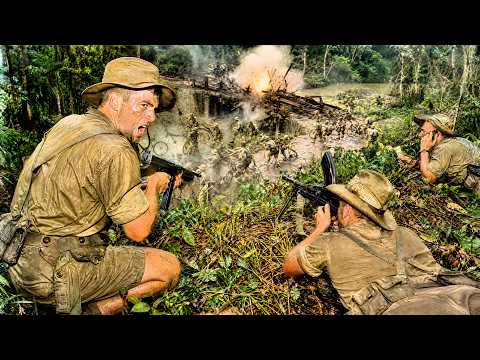
They were B Company of the 30th/2nd Battalion. Their commander was a man named Duffy. Their Bren guns were sighted to cover every yard of the road from the far bank to the near cut twice over. The bridge below them was wired with explosives. An artillery observer lay beside Duffy with a telephone line running five kilometers back to the battalion and to a battery of 25-pounders waiting for the signal.
The plan was simple. Let the scouts pass. Let the lead group cross the bridge toward Gemas where the rest of the battalion waited. Blow the bridge under the main force, shoot everything on the road, call the guns down on both banks, then withdraw.
No one in the company had ever done anything like this.
The first Japanese appeared. They were on bicycles. They rode in loose groups, rifles slung, some with shirts open. They crossed the bridge. They passed under the cutting close enough that the men lying above could hear their breathing. Duffy counted. Fifty. A hundred. Two hundred. Three hundred. He let them go.
Behind them, the road filled. This was the main column. Hundreds of men, three and four abreast, bicycles crowding onto the bridge. Those in the back pushing those in front. Further back, the sound of engines—tanks and trucks.
Duffy watched the bridge fill, then gave the signal.
To understand that signal, go back fourteen months to a showground in rural New South Wales. The battalion waiting on the Gemas road was the 30th/2nd of the Australian Imperial Force. Raised at Tamworth in November 1940, its men came from Dubbo, Goulburn, northern Sydney, Randwick, Walgrove, and Wagga Wagga. Farmers and farmhands, clerks and tradesmen, men from the country and men from the city. They were not regular soldiers. Almost none had seen combat.
Their commander, Lieutenant Colonel Frederick Gallaghan, had volunteered as a young man in 1916 and fought in the First World War with the 34th Battalion. He was six feet tall, dark-skinned, with black hair and brown eyes that men never forgot, and he stood perfectly straight. The battalion called him “Black Jack.” He wanted the 30th to be the best battalion in the Australian Army and to look it, so he trained it hard. He spared no one. Not the soldiers, not the officers, not himself. Some of his officers later said they feared Gallaghan more than they feared the Japanese. The men coined a name from that. They called themselves “Gallaghan’s Greyhounds.”
In July 1941, the battalion sailed to Singapore on a Dutch ship, the Johan van Oldenbarnevelt. It moved to Malaya with the rest of the 27th Brigade of the Australian 8th Division and trained in rubber plantations and jungle for months.
Then, in the early hours of December 8, 1941, the Japanese landed in northern Malaya and southern Thailand. The battalion took up battle positions around Kwang in Johor, then moved to Jemaluang near the east coast. For five weeks, the 30th watched the war crawl down the peninsula toward them. The news from the south was bad and always the same. British and Indian units fought, were outflanked, and withdrew. The Japanese did not stick to roads when roads were closed. They looped through rubber plantations and jungle, appeared behind defenders, set up their own roadblocks, and moved fast. Most of their infantry rode bicycles, many taken from Malaya along the way.
All that time, the Australian infantry in the south waited. No battalion of the AIF had yet fought the Japanese. Gallaghan used the time at Jemaluang, making his companies practice ambushes again and again. How to stay still, how to sight weapons, how to let an enemy column enter the killing zone, how to withdraw afterward. Headquarters in Malaya had decided that the way to fight the Japanese was by ambush, and Gallaghan was determined to have his battalion ready when its turn came.
On January 10, 1942, the battalion received its orders for the next fight. The Japanese were advancing down the main road toward Gemas. The 30th would be the first Australian infantry to face them.
Gemas was a small town, but it mattered. It was a railway junction where the line from western Malaya met the line from the east coast. The main road and the railway ran side by side toward it. The road from Tampin to Gemas ran east through rubber plantations and patches of forest. Twelve kilometers west of Gemas, it crossed a small river, the Gemencheh, over a wooden bridge. It was not an important bridge. Timber piles, a timber deck, only as wide as the road.
On the Gemas side of the bridge, the road passed through about thirty meters of flat, tree-covered ground. Then the road entered a low hill. The road builders had cut the hill straight through, and the sides rose like walls on either side, about four meters above the road, for forty meters. The tops of those walls were thick with scrub and creeping plants. A man lying on those tops could look straight down onto the road. But a man on the road could not see him.
That was the ambush ground. B Company would secure it. The company’s forward platoon would cover the bridge itself and about 150 yards of straight road on the far side. The rest would settle on the edges of the cutting above the road, with light Bren guns positioned to sweep it end to end.
Duffy placed Lieutenant Head’s platoon along the edge with his headquarters nearby. Lieutenants Jacky and Jones’s platoons were placed in steps along the road behind. Back on a side track called Quarry Road, a small group under the company sergeant major was deployed to secure the exit route. Under the bridge, engineers from the 2/12th Field Company prepared the explosive charges.
Gallaghan wanted to use his whole battalion here. When he looked at the ground, he saw there was room for only one company. He asked permission from the Australian division commander, General Gordon Bennett, to place that company alone, far forward of everyone else. Permission was granted. The rest of the battalion returned to the road toward Gemas. Five kilometers back, near a road marker called “Mile 61,” they dug trenches across the road and the railway beside it. Two anti-tank guns from the 2/4th Anti-Tank Regiment were brought up to face the road. In cuts on the road, the battalion set up a barrier of heavy concrete cylinders. Behind them were the guns of the 30th Battery of the 2/15th Field Regiment, 25-pounders. Their job, when the observer at the bridge called them, was to drop shells on both banks of the river and the road behind it.
So the plan had two parts. B Company was the striking force, and the battalion was the anvil. B Company would let the Japanese advance guard pass, then smash the main force at the bridge. The Japanese in front would continue on toward the battalion waiting at Mile 61. And while the Japanese at the bridge tried to absorb what had happened to them, the guns would fall on them.
Everything depended on the telephone. Gallaghan did not trust wireless. Wireless could be tapped. So B Company had no wireless sets. It was connected to the rest of the world by two telephone lines, one to battalion headquarters and one to the battery, strung five kilometers through rubber plantations, now lying in the rocky cuts.
It was the afternoon of January 13 and the rain was coming down hard. B Company marched up the road in the rain and took its position above the rocky cuts, thoroughly soaked. From here on, no one stood in daylight. The scrub was thick and hot and the ground beneath it crawled with life. Ants, mosquitoes, leeches in the wet places. The men lay on their stomachs with their rifles and machine guns beside them, and they did not slap what bit them because slapping made noise. No fires, no cooking, no smoking. They ate cold food from tins in silence. Everything they carried was wet from the rain. Their boots were wet, and their clothes stayed damp against their skin all night and dried on them in the heat of the next day. No one could do anything about it, so no one talked about it.
When the rain stopped, the heat returned. The heat in Malaya in January is wet heat. It does not come from the sun so much as it sits on a man and stays there. In the rocky cuts, away from any wind, it did not move at all.
Night came quickly near the equator. When it did, it became pitch dark under the scrub. And the sounds changed. Frogs, insects, and the river below them running over the wooden bridge piles. Duffy walked his line in the dark. He was Desmond Jack Duffy, and they called him Jack. He moved from position to position, making sure every weapon was in the right place and every man knew the route he would take when the time came to leave.
What did they know about the men waiting for them? Very little of the truth. Before the war, Australians had been told that Japanese soldiers were short, suffered from poor eyesight, were poorly trained, and would not stand up to European troops. The army had learned from the news of the past five weeks from the north that none of that was true. The Japanese had driven British and Indian divisions back hundreds of kilometers. They were veterans. Many had been fighting in China for years. The men in the trenches heard both stories. They did not know which one they were about to face.
The morning of the 14th broke hot. Nothing on the road. Noon, nothing. They lay in the heat and waited. Some slept. Most watched the bend of the road on the other side of the river. The midday grew later. Then, a few minutes before four, they heard the sound of tires.
That brings the story back to the signal.
At four o’clock, the engineers detonated the charge. The bridge went up. The timber deck and the men on it, the bicycles and their riders, rose into the air in one piece and came down in fragments into the river. The echo rolled down the road and across the trenches and back through the rubber trees toward Gemas.
Before the noise stopped, the Bren guns opened, then the light machine guns, then the rifles from both sides of the cutting and from the forward platoon at the bridge. Every weapon that had been pointed at that road for twenty-four hours fired at once at men packed three and four abreast with nowhere to go.
The Japanese on the near bank were trapped between the walls of the cutting. The walls rose four meters on either side of the road. They could not climb out. They could not see who was shooting. The men above them fired straight down. Grenades dropped from the edge of the cut onto the road. The Japanese rifles were strapped to their bicycles. Most never got a weapon into their hands.
The noise was so loud that the artillery observer lying beside Duffy thought for a moment that his own battery had begun to fire. It had not.
Bicycles piled on top of each other. Men fell on top of them. Men in the back pushed those in front and could not move them. On the far bank, where the bridge had been, the column crowded into the river and stopped. Men in front tried to halt. Men behind kept coming. Some were pushed into the water. Others jumped. Those who could, ran. They ran for the drains on either side of the road, for the edge of the rubber plantation, for anything that put dirt between them and the guns above.
Duffy’s men kept firing. Duffy later said the road across the river was covered with the dead and the dying.
The artillery observer lifted his telephone. He called for the guns.
The line was dead.
Somewhere along those five kilometers, the wire had been cut. There were two lines, one to the battalion and one to the battery. Both were out. The Japanese who had already passed through had cut them. A scout in the lead of the column, heading toward Gemas, had found the wires beside the road.
The 25-pounders were loaded. The gunners stood by their pieces waiting for the order. The order never reached them. The guns never fired.
So B Company fought the battle with what it had. Rifles, Bren guns, and grenades. The element of surprise. For a few minutes, the surprise was complete. The Japanese at the bridge had seen nothing, heard nothing, and had not been shot at in five weeks. Then they were being shot at from two sides at once by men they could not see.
But the Japanese column was not a column of new recruits. It was called “Mukaide Force,” after its commander, Colonel Mukaide. It was built around the 1st Tank Regiment with an infantry battalion and its own artillery. It belonged to the 5th Division, which had been fighting its way south since the first days of the invasion.
Those of them still alive on the road began to do what they had trained to do. They left the road. They found cover. They began firing back toward the edges of the cutting. Then, on the flanks, they began moving through the rubber plantations, around the ends of the cutting, toward the positions where B Company was hiding.
Duffy saw it. He had about 150 men, no artillery, and a few hundred Japanese on the opposite bank and in the drains with more coming from Tampin. Behind him, between his company and the battalion, were the 300 bicycle riders he had let pass. He had done what the company came to do. Staying longer would not kill more Japanese. It would only wipe out B Company.
He gave the order to withdraw.
Back on Quarry Road, the covering force waited to shield the exit. Men from the cutting and the bridge began falling back toward it. From the bridge explosion to the order to withdraw, the fight had lasted about twenty minutes.
No one ever agreed on how many Japanese died in those twenty minutes. The Australians there believed they killed around 600 at the bridge. Later reports estimated Japanese losses over the two days at Gemas at nearly 1,000. The Japanese brigade’s own war diary recorded 70 killed and 57 wounded—a figure that excluded attached units. Historians later offered estimates from a few hundred to over 800.
But another number mattered more to the Japanese: time. Their column had been stopped dead on the main road south. The tanks, trucks, and guns behind it were now stranded on the far side of a river without a bridge.
Look at the road as B Company leaves it. The bridge is gone. The stream is full of timber and bicycles. The cutting is carpeted with bicycles and the kits of the men who rode them. Smoke from the explosion still hangs over the water in air that does not move.
On the far bank, the Japanese were already shouting orders. B Company did not go back the way it came. That was impossible. The road to Gemas was the route the three hundred cyclists had taken, and they were somewhere on it between B Company and the battalion. So B Company went into the rubber.
Pulling a company out of an ambush is harder than putting it in. The men were spread along the tops of the cutting and down at the bridge. Some heard the order and some did not. As the light faded, B Company broke into separate groups, each trying to make its own way back to the battalion.
They did not all get out clean. Lieutenant Head, whose platoon had lined the road, shot a Japanese officer during the withdrawal and was wounded. His sergeant, a man named Dolan, brought him back to the rendezvous at Quarry Road. Lieutenant Jacky was also wounded, yet led his men in several bayonet charges to break through. Lieutenant Jones’s platoon stayed behind the others and fought a rear-guard action to hold the Japanese while the rest escaped.
Duffy took his group into the jungle in single file to work around the Japanese flank. By a quarter past five, the group behind him had lost contact with him. From then on, there were two columns moving through the same country, neither knowing where the other was.
Duffy had thirty-eight men—some from company headquarters, platoons from two sections, the engineers who had blown the bridge, and the artillery observer and his party whose guns had never fired. Duffy headed south toward the railway line. They ran into the Japanese. The firefight lasted about fifteen minutes. A sergeant named Nagle was killed. Another man was wounded. Then they got across.
After that came the dark. Under the trees there was almost no light. A rubber plantation in daylight looks like straight lines, row after row of identical trunks. At night it is nothing but blackness. A man can walk into the tree in front of him. He can walk in a circle and come back to where he started. And somewhere in the dark were the Japanese—the three hundred who had been allowed to pass, and the survivors from the bridge, working their way through. Behind them, the rest of the 5th Division.
In the dark, the only way to stay together was to stay close. The men moved in single file. They used no torches. They stopped whenever one of them heard something, waited, then moved on.
The other column, the one that had lost Duffy, was the larger one. Without realizing it, Jones and Jacky had followed Head’s group. The Japanese attacked that column twice. Both times they were driven off. The second time was by two platoons led by a corporal named Huntley. By the next morning, with the officers wounded, Sergeant Dolan had taken command of that column.
Private Jack Bland was in that column. The men called him “Kiwi.” He later described being on top of a hill with the rest of his group on the way back to the battalion lines. The forward platoon had run into the Japanese. A machine gun opened up. Bullets cut through the leaves above their heads. Then the Japanese were advancing behind them from the right. The men in front fell back. More firing broke out on the left and ahead.
The group decided it could not go forward. Bland remembered that the railway line was to their right, so they turned right toward it. The railway was the only thing in that country that ran in a straight line and led where they wanted to go.
Some of B Company found it and followed it east toward Gemas. Others stayed in the jungle and the rubber and worked their way out by compass or by guesswork. That night, six men from the column were reported missing. Bland was one of them. He came back.
They avoided the villages. A village meant dogs. Dogs meant noise. Noise might bring the Japanese. None of them knew which villages would help them, which would tell the Japanese where they were, and which would want no part of either side. Most of the workers in the rubber plantations of Malaya were Tamils from southern India. Some of them, during those two days, made up their own minds.
Sergeant Garner went out on patrol with three men from Duffy’s group. With him were a corporal named Hahn and a private named Noble. They ran into a Japanese patrol. Noble killed three of them with his machine gun. During the fight, Hahn jumped into a river to escape and became separated from the others. The Japanese captured him. A Tamil man freed him. Hahn was then given a turban and Indian clothing to wear. Disguised as a rubber worker, and helped by two Tamil men, he made his way through the Japanese until he found an Australian patrol and joined it.
Garner and Noble reached brigade headquarters on the 16th. They had nothing but the food they carried. They drank from streams. They sheltered from the heat under whatever cover they found and moved whenever they could.
At Mile 61, the battalion did not know where its forward company was. Both telephone lines were down. Gallaghan had not allowed a runner to be sent to the bridge. So no runner came back to tell them the ambush had been sprung. All the battalion knew was that it had heard the explosion and the firing, and then silence.
At 10:02 on the morning of the 15th, the battalion intelligence corporal, Owen Hickendorff, set out down the road in the dark to look for B Company. He did not find it. He himself did not return to the battalion until after it had withdrawn to the rendezvous at Fort Rose Estate.
B Company’s men were still out there when the sun came up on the 15th, and at some point that morning, in the rubber and jungle west of Gemas, they heard it. Guns—many of them—coming from the east, from the direction of Mile 61. The battalion’s battle had begun and they were outside it.
Imagine hearing that, lying in a ditch or under a bush a few kilometers from your mates, knowing the fight you spent months training for is happening without you, and that the Japanese between you and it are now a full Japanese column. They kept walking.
Over the next day and a half, the groups began to arrive. One platoon fought its way back through the Japanese lines. Other groups met no enemy at all. Some went to the battalion, others to the new positions east of Gemas after the battalion moved.
Duffy’s group reached battalion headquarters at about noon on January 16. By the battalion’s reckoning, he had spent thirty-nine hours in the jungle in enemy-held country. The walk back cost B Company one killed and nine wounded.
The Japanese did not wait for B Company to get home. Within an hour of the ambush, they were moving again. Their engineers went to a nearby sawmill, took its timber, and began rebuilding the bridge. In six hours it was done. The tanks could cross.
During the night, Japanese patrols felt their way down the road and found the edge of the battalion position. There were clashes in the dark. They remembered a man from the battalion named Blackwood running onto the road with his bayonet, shouting. By dawn on the 15th, the tanks had crossed the river, and the Japanese were no longer just a column that had ridden bicycles into an ambush. The 11th Regiment had arrived to join them. Behind the tanks was now a full regiment of fresh infantry.
At Mile 61, the battalion’s men spent the night listening. In the morning, they lay on the ground in their positions and waited for the Japanese to come to them.
Look at the roadblock—a cut in the ground like the one at the bridge. Concrete cylinders across the road, Australians lying on both sides of the road and along the railway beside it, facing the road toward them. Shortly after nine in the morning came the sound the battalion had waited for since the bridge blew: engines.
Two tanks rounded the bend toward the roadblock held by Captain Lamcraft’s company. At the end of the road stood two anti-tank guns of the 2/4th Anti-Tank Regiment. They were two-pounders, small guns, with a few men and a thin steel shield behind each. The gunners fired. The tanks turned back. The road was quiet for a while.
Then came three more tanks. Two medium and one light. This time solid shot was not enough. The shells hit but the tanks kept coming. So the gunners switched to high explosive. One tank caught fire. Another was disabled. The third hooked up the disabled tank and towed it away.
Later, more tanks advanced down the road, and the gunners and infantry managed to disable four of them. One was hit. One broke down. One caught fire. One was destroyed by a mortar bomb. By the usual rate, six of the eight Japanese tanks that attacked the battalion that day were put out of action. Four tanks reached C Company’s position in the rubber. They were forced to withdraw.
A soldier named John Breeze had a heavy anti-tank rifle and no trench to fire it from. He went out into the open and fired about fifty rounds in a very short time. He damaged one tank so badly its crew got out. His fire forced another tank to change direction. The noise of that heavy firing damaged his hearing.
Behind the tanks came the infantry, and the battalion’s riflemen and machine guns fired on them as they advanced. Captain Howell’s mortars dropped bombs on the Japanese, while a soldier named Reid sat up a tree watching where they fell and calling corrections. The 25-pounders of the 30th Battery, silent since the previous afternoon, now fired on the Japanese rear. A war artist later painted C Company’s guns firing that day with the road running behind them.
The first attack ended in about an hour. Then came the Japanese aircraft. Dive bombers hit the battalion headquarters, the anti-tank guns, and the 25-pounders. They hit none of them.
At about a quarter to one, Captain Melville’s company advanced to counter-attack a hill about a thousand yards away. Melville was wounded. Captain Morrison took command. Three soldiers—Deaver, Hilton, and Williams—charged and captured two Japanese guns. Another soldier, Peat, was killed twenty yards from a Japanese machine gun. Then tanks moved toward Morrison’s men, and they had to withdraw.
Lieutenant Booth was wounded. Lieutenant Clark’s platoon was pinned down. Lieutenant Clements was killed by tank fire. He was the first officer of the battalion killed in the campaign. A corporal named Abbots was badly wounded while attacking a machine-gun position, and still carried a wounded man back. Captain Thompson drove the battalion’s Bren carriers under fire to try to recover the anti-tank guns. The battalion doctor, Captain Taylor, went out under fire and brought in wounded men. The Japanese held their fire on the ambulances marked with the Red Cross. And through all of it, the Japanese kept pouring more men into the rubber on the battalion’s flanks.
Gallaghan had been told the purpose of his battalion. It was a shock absorber. It was to hit the Japanese with everything it had, slow their advance, and avoid destruction while doing it. It had done the first two. If it stayed, it would do the third. So at about half past three on the afternoon of January 15, Gallaghan withdrew the battalion. It fell back through Jemaluang, behind the river there, to the rendezvous at Fort Rose Estate, then to Batu Anam, about ten miles south.
Not everyone got out clean. In the scramble to leave, C Company discovered it had left a truck behind in the middle of the Japanese. Two men went back to get it. They got it running. On the road, a Japanese shell hit it and killed the driver, Tom Pierce. The man beside him moved him out of the driver’s seat, took the wheel, and drove on.
Gallaghan put Melville, Booth, and three other wounded men in his own car and sent it to the rear. He went out himself with his intelligence officer beside another company leaving. On the road, a Japanese plane strafed the car, and one of the wounded men inside was hit again. Then the battalion was safe.
The Japanese did not pursue the battalion closely. It was quiet for a day or so. The battalion counted its losses for the two days. By one count, one officer and sixteen men killed, nine missing, four officers and fifty-one men wounded. By another, seventeen killed, nine missing, fifty-five wounded. Twenty killed or missing and presumed dead, and fifty-eight wounded. For a battalion that had spent two days in front of the main Japanese advance in western Malaya, it was a light cost. But it was still two rows of names.
Gemas became a word the Australian Army held onto. The commander of all forces in Malaya, Lieutenant General Arthur Percival, wrote about it in his official report after the war. He said the ambush set by the 30th had been prepared with great care. He put the numbers this way. About 250 cyclists passed toward the main position. Five hundred were in the ambush. Another 500 were seen approaching. Other accounts put the number allowed to pass at about 300. He wrote: “More might have been killed had the enemy not cut the artillery telephone line.” He recorded that an emergency force of what aircraft remained attacked the Japanese columns approaching Gemas and their headquarters at Tampin. He wrote this: “The Gemas ambush provides an excellent example of the success which often attends such tactics in jungle country.”
It was the first time Australian infantry had fought the Japanese in the war. It happened on a road in Malaya, at a bridge most Australians had never heard of, and it went according to plan in everything except the telephone.
Later, Australian Army historians were less forgiving about the planning. They pointed to Gallaghan’s ban on radios and the single wires on which the whole plan depended, and they attributed the silence of the guns to the plan and not to the enemy alone. Both things are true. It was prepared with great care, and yet it hung by a thread.
On March 5, 1942, Jack Duffy was awarded the Military Cross for his leadership at the bridge. Gallaghan received the Distinguished Service Order. The battalion was later granted a battle honour no other unit carries. Its name: Gemas. The ambush and the fight at Mile 61 delayed the Japanese 5th Division for about two days.
Then the Japanese moved on. Within days, the Imperial Guard would reach the west coast at Muar, and the defensive line in Malaya would keep moving south. On February 15, 1942, a month and a day after the bridge was blown, Singapore fell. The entire 30th Division went into captivity. More than 300 of its men died as prisoners of war.
Let’s go back to the bridge. It is a few minutes before four in the afternoon. The cutting is very hot. Ants crawl into everyone’s shirts. A hundred and fifty men have been still for twenty-four hours. The first thing they hear is bicycle tires, not engines—just tires. Their hiss and rattle on the asphalt. The squeal of brakes. Human voices. Three hundred men passing beneath them. Duffy counts them as they go. These three hundred will cut the telephone wire and go on toward Gemas to be there in the morning when the tanks come. The men behind them keep coming onto the bridge. Duffy watches the bridge fill with them.
Today, the road from Tampin to Gemas is a highway. Traffic passes over a concrete bridge. Beside it, in the stream bed, wooden piles still stand in the water. They are the piers of the old bridge that was blown at four in the afternoon on January 14, 1942.
After the war, the official war artist Murray Griffin, who had been captured in Singapore with the 8th Division, painted the ambush. Bicycles and men lie twisted on the road below the cutting, and the bodies and bicycles stretch far into the distance. Near the stream is a gravel path, and at the path is a marble memorial. The battalion association placed it there itself. It commemorates the men of the 30th Battalion and the units that fought beside them at that site on January 14 and 15, 1942. Traffic passes it all day. Trucks, cars, motorcycles, and occasionally, in the midday heat, a bicycle speeding along the road from Tampin toward the stream.
So here is the question for you: Was the ambush at Gemencheh a victory, a warning, or simply a delay—and what would you have done differently if you had been the one holding that telephone line?
Report this article
Select a reason for reporting:






