Heinrich Vogel had been told the Americans would shoot him on sight. Instead, they handed him a cigarette. That was the first crack in the wall of lies he had carried since 1941.
Now, at 20 years old, he stepped off a train into the middle of nowhere—southern Oregon’s Agate Desert—and saw something that made his breath catch. Green mountains. Pine forests. And thousands of acres of pear trees, heavy with unpicked fruit, stretching to the horizon. There were no craters. No bombed-out buildings. No refugees on the roads. It was a landscape untouched by war, and it terrified him more than any battlefield ever had.
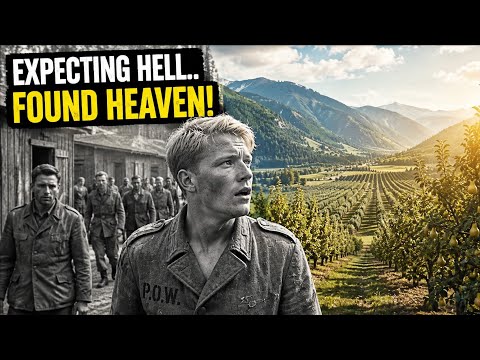
He had spent 16 months as a prisoner of the United States Army, and every mile of the journey across America had been an argument against everything he believed. The soft bread. The clean sheets. The passenger train with upholstered seats. The men around him whispered that it was all a trick—that the kindness was bait, and somewhere ahead waited the real America, the one that would finally show its teeth.
But the camp they arrived at had windows with glass in them. Coal stoves. Mattresses that gave under his palm and came back. Vogel sat on his cot and pushed down again, just to be sure. He had been sleeping on sand or boards for 19 months.
Then came the mess hall. The smell of onions frying in fat. Roasting meat. Beef and gravy, potatoes, green beans, bread with butter, and a wedge of apple pie. Eighty-four men sat in front of the largest meal most of them had seen since 1941—and nobody touched it.
“They fatten a pig before they kill it,” said Kurt Lindemann, a sergeant from Breslau, staring at his tray like it might bite him.
Vogel picked up his fork. He was 20 years old, hungry for two years, and tired in a way he could not describe. “Then I will be a fat pig,” he said. He ate all of it, saving the pie for last. He had not tasted anything sweet since a Christmas parcel in 1942.
Two men were crying while they ate. A Bavarian in his forties kept apologizing between mouthfuls.
The next morning, 36 prisoners were loaded onto a flatbed truck and driven south into the Rogue Valley. Farms with painted barns. Cattle standing in grass. A woman hanging washing who looked up at the truck full of German soldiers—and went back to hanging washing. A boy on a bicycle who rode alongside them for a hundred yards, waving, until his mother shouted at him.
No refugees. No ruins. No fear.
The truck stopped in a pear orchard outside the town of Talent. And there, standing at the end of row one in a man’s coat, was a 58-year-old widow named Ruth Callaway. She looked at the enemy soldiers climbing down into her orchard the way you would look at a delivery of equipment you had not fully agreed to.
She spoke through a guard, and the translation took four exhausting minutes. Pick with a lifting twist, not a pull, or the spur breaks and there is no fruit on that wood next year. Do not drop the fruit into the bag. A bruised pear is worth nothing.
Then she said something the guard translated as: “She says these trees are older than her and she wants them alive after you are gone.”
Lindemann, standing at the back with his arms folded, muttered in German, “Tell her we are soldiers, not farmhands.” The guard did not translate it. Ruth Callaway looked at Lindemann for two seconds, then walked off to the packing shed.
They picked. And around ten in the morning, Vogel noticed something that took him another hour to fully believe. There was one guard. One. Corporal Gigich was sitting on an upturned crate at the end of row nine, rifle across his knees, newspaper over his face, asleep.
Thirty-six trained German soldiers. One sleeping American.
Vogel stood on a ladder with a pear in his hand and did the arithmetic every prisoner in that valley did within their first week. Where exactly would he go? He was 280 miles from the Canadian border with a mountain range in between. No money. No civilian clothes. No documents. His trousers had PW stenciled on them in white paint eight inches high. The valley was ringed by mountains with exactly two decent roads out.
The fence, he realized, was not made of wire.
At noon, Ruth Callaway came out of the packing shed with a milk crate. Inside were 36 sandwiches wrapped in wax paper and a tin bucket of water with a dipper. Vogel unwrapped his—ham and butter and a slice of tomato on thick-cut bread—and sat down in the grass under a pear tree in the sun of a foreign country. He ate a sandwich made for him by a woman whose government he had been trying to kill.
He could not finish it. Not because he was full.
That evening, back in camp, he lay on his cot and stared at the ceiling. The war was still raging. His mother was queuing two hours for bread in Wolfenbüttel. His father was dead in a bombing raid he did not yet know about. And here he was, in an American orchard, being fed by a woman who had every reason to hate him.
Something was shifting inside him, something he could not name. And it would take a telegram, a film reel, and a wooden box to finish the job.
The routine set in fast, the way routine does. Within a month, the extraordinary had become Tuesday. Up at six, roll call, breakfast—eggs, which Emil Kastner never stopped commenting on—then trucks out to whatever farm had requisitioned them, six days a week. Pears until the pears were finished, then apples, then potatoes and onions and sugar beets. In winter, pruning and hauling brush and mending fence. Back to camp by five, wash, eat.
And then the evenings, which were long and quiet, and which turned out to be the part that actually changed men.
Vogel spent his eighty cents a day carefully. Cigarettes he traded away because he did not smoke, and a non-smoker in a prison camp is a wealthy man. He bought writing paper. He bought a razor. And around November, he started buying magazines—which is where the second crack opened, and this one went deeper than the food.
He bought an issue of Life. Then a magazine about automobiles. Then, because it was cheap and had pictures, a trade publication about industrial machinery that he could barely read.
What he found in those pages was not propaganda. Propaganda he could recognize—he had grown up inside a state that produced nothing else. What he found was advertising, which is a different animal entirely. Advertising is not trying to convince you that your country is strong. Advertising is trying to sell you a refrigerator, and it assumes, without needing to say so, that you are the sort of person who might buy one.
Page after page of factories. Assembly lines a quarter mile long. A photograph of a shipyard where they were finishing a cargo ship every few days. Aluminum, rubber, steel—all of it in quantities that had no relationship to anything Vogel had experienced. And in among it, small advertisements for washing machines and vacuum cleaners and holiday resorts. Because the American economy was building the largest war machine in human history and had spare capacity left over to sell people vacations.
He thought about the three half-tracks his battalion had pushed into a wadi and burned because there was no fuel to move them.
He was not converted by a lecture. Nobody in that camp was converted by a lecture. He was converted by a magazine advertisement for a refrigerator, and by the arithmetic that followed from it. The arithmetic said the war had been decided before he ever set foot in Africa—in factories in Michigan, by people who had never heard of him.
The English classes were the other thing. Three evenings a week, taught by a first lieutenant who spoke German with a Berlin accent so precise that the prisoners assumed for a while he was an American of German descent.
He was not. His name was Aaron Weissman, born in Charlottenburg in 1915, and his family had gotten him out to New York in 1937 on a visa that had taken two years and most of what they owned. He had gone back to Europe in an American uniform because the army had discovered it had a large supply of young men who spoke perfect native German and an urgent need for them.
He taught the class the way a good teacher teaches anything—without visible agenda. Practical English. How to ask for something in a shop. How to read a timetable. How to write a business letter. And in between, because the prisoners asked, he answered questions about the United States, flatly, without decoration.
They asked whether it was true that an American could criticize the president.
Weissman brought in four newspapers the following week. One of them was savage about Roosevelt. He read three paragraphs aloud, translating as he went, then set the paper down and waited.
Somebody said the paper was a fake, printed for their benefit. So the next week he brought in two civilians from Medford—an older couple who had volunteered through their church—and they sat in front of forty German soldiers and disagreed with each other about the New Deal for twenty minutes, cheerfully, in front of a US Army officer. Nothing whatsoever happened to them.
Vogel said afterward that this was the single hardest thing he ever had to accept. Harder than the food. Harder than the mattresses. He had grown up in a country where his father lowered his voice indoors. He had watched a neighbor stop existing. There was an arithmetic to speech that every German of his generation carried in their body—and here were two elderly Americans doing the impossible in a room full of witnesses and then going home to dinner.
Not everyone in that room was taking notes with an open mind.
This is the part of the story the pleasant version leaves out, and leaving it out makes the whole thing sentimental instead of true. The German prisoner of war camps in the United States were not safe places, and the danger did not come from the guards.
Every large compound had a core of committed men—usually senior NCOs, usually from units with a heavy political flavor—who understood exactly what the Americans were doing and considered it an attack. They ran an unofficial parallel authority inside the wire. They kept lists. They held what they called courts of honor. And men who attended English classes too enthusiastically, or who were seen accepting favors from a farmer, or who said the wrong thing in a barracks after lights out, were dealt with.
Sometimes it was a beating. Across the American camp system, there were at least a handful of killings—prisoners hanged or beaten to death by other prisoners for treason against a regime seven thousand miles away. Several of the men responsible were tried by US courts and executed for it.
Camp White never saw anything that extreme. What it saw was Kurt Lindemann.
Lindemann stopped being merely sour sometime in the autumn and became organized. He kept a notebook. He held forth at the end of the barracks, telling the younger men that every hour in an American classroom was an hour of collaboration, that the war was not over, and that when they got home there would be an accounting of who had behaved like a German and who had not.
Emil Kastner stopped coming to English class in October. When Vogel asked why, he looked at the floor and said his English was bad anyway.
Vogel kept going. He was not brave in any dramatic sense. He was a nineteen-year-old apprentice who had been given a magazine and a classroom and a mattress, and something in him had already quietly changed sides on a question he could not yet name.
In January, after an incident nobody at Camp White ever wrote down in detail, Lindemann and four other men were put on a truck at six in the morning. Vogel watched from the barracks steps. Lindemann saw him and said, across thirty feet of frozen gravel, “You will remember that I said this.”
He was wrong about most things. He was right that Vogel remembered.
But the thing that broke the last of Heinrich Vogel’s war did not happen in a classroom or a barracks. It happened in a pear orchard outside Talent in the last week of November 1944, and it involved a telegram he never saw.
Ruth Callaway had a son. His name was Daniel. He was twenty-four, a rifleman in the 28th Infantry Division, and in November the 28th was fed into the Hürtgen Forest. Daniel was killed on the sixteenth, by German infantry defending German ground.
The prisoners knew none of this. What they knew was that Mrs. Callaway was not at the orchard on Monday, or Tuesday, or for the rest of that week. The foreman ran the crew and said nothing. Corporal Gigich knew, and told them on Thursday in his forty words of German, then gave up and just made a gesture. Everyone understood.
Nobody spoke on the truck back to camp.
Vogel lay in his bunk that night and understood something with total clarity: they would not be coming back to that orchard. That was not resentment. It was simple fairness. He had done the same arithmetic himself a hundred times about men who wore the other uniform.
On the following Monday, the truck went out as usual, because the army had a contract and the pruning had to be done. And Ruth Callaway was standing at the end of row one in her husband’s coat.
She had lost weight. She looked at the thirty-six of them climbing down off the truck, and there was a moment—maybe four or five seconds—that Vogel described sixty years later as the longest of his life.
Then she said something to Gigich, and Gigich, who was twenty-two and out of his depth, translated it as: “She says the wood has to be cut before the frost gets hard. She says start at the top of the block.”
And they went and cut the wood.
She never mentioned her son to them. Not once, in the fourteen months that followed. The sandwiches kept coming at noon.
In March, a pear tree at the bottom of the block came down in a windstorm, and Vogel asked, through Gigich, whether he could have a section of the trunk. Pear is a beautiful wood—dense and pale, and it takes a fine edge, and cabinetmakers have prized it for four hundred years.
He dried it through the spring under the barracks and worked it in the evenings with tools borrowed from the camp shop. And in June, he gave Ruth Callaway a small box with a fitted lid and a mitered corner joint that he had learned from his father, who had learned it from his.
She turned it over twice, the way she checked fruit. Then she put it in her coat pocket and went back to the packing shed.
That box is still in the family. Her granddaughter has it.
Between those two things, in the third week of April 1945, the war came into the camp and took the heaven away.
The army had made a decision at the highest level. As the Western Allies overran Ohrdruf and Buchenwald and Bergen-Belsen, the footage the combat cameramen shot was to be screened for German prisoners of war in the United States. Attendance was compulsory. There was no commentary and no argument.
They ran the film.
At Camp White, the prisoners sat in the recreation hall and watched the reels. Every camp that did this reported roughly the same three stages in the same order. First, laughter—nervous, disbelieving, angry laughter, and shouting that it was fake, that it was actors, that Hollywood had built it, that this was the trick they had all been waiting sixteen months for. Second, silence as the film kept going and did not stop and kept not stopping. Third, in the days afterward, a kind of collapse the American staff were not trained for and did not know how to handle.
Men who would not eat. Men who would not speak to each other. Men who insisted with real desperation that the ordinary German soldier had known nothing—which was true for some of them and not true for others and impossible to sort out from the outside.
There were suicides in the camp system that spring, though not at Camp White. Chaplains at several camps reported that prisoners came to them wanting to confess things they had seen at railway sidings in Poland in 1941 and had told themselves for four years they had not really seen.
Lieutenant Aaron Weissman was in the room. He had family in Berlin who had not gotten out. He never discussed with the prisoners what he was looking for in that footage, and he was at the front of the class the following week teaching the past perfect tense.
Vogel, who was twenty-one, walked out of that hall into the Oregon evening with the mountains going blue behind the wire, and he thought about the two elderly people from Medford who had argued about Roosevelt in front of him, and about his father lowering his voice in his own kitchen, and he understood at last exactly and permanently what the difference between those two facts had cost.
On the eighth of May, the loudspeakers announced the surrender.
The commandant expected something. Grief, refusal, a demonstration, something. He got nothing. The prisoners stood in the yard, heard it translated, and went back to their barracks, and the camp was quieter that night than it had ever been. There was nothing left to react to. The thing they had been asked to die for had turned out on film in the third week of April to be indefensible, and there was no speech anyone could have made in that yard that would have improved on silence.
Then that summer, the food got worse.
When the newsreels and the reporters brought the camps home to the American public, the American public looked at its own prisoner of war program and became extremely angry about steak. Congressmen used the word coddling. Newspapers ran photographs. In the spring and summer of 1945, the War Department cut prisoner rations hard—dropping meat, cutting portions, leaning on surplus and on vegetables the prisoners grew themselves.
Vogel’s view on this, expressed later without any bitterness at all, was that it was the most reasonable thing that happened to him during the entire war. He had seen the same film they had.
They stayed through the 1945 harvest because the fruit still had to come off the trees and the American soldiers were still coming home from the Pacific. He picked his third pear crop in that valley in September. The wire was still up, but nobody was thinking about it anymore.
His orders came in December. Report to the main gate at six in the morning, all possessions.
Ruth Callaway drove up to the camp the day before and asked to see him, and they talked through a mesh screen for about ten minutes with Gigich standing well back. She gave him an envelope. He tried to give it back. She told him not to be stupid, that it was wages the government had kept, and she had a fairly firm opinion about that arrangement.
What she said last, he wrote down that night so he would have it exactly: “If it comes to nothing over there, you write to me. I have got trees and no one to leave them to.”
Going home took him another eighteen months, because the story does not end tidily. Like a large number of German prisoners in American hands, Vogel was not shipped to Germany. He was shipped to France and handed over, and spent a year and a half doing labor in a country that had been occupied by his army and had no interest at all in the Geneva Convention as a lifestyle.
He was thin again by the time he crossed the German border in the summer of 1947, and he was, by his own account, unsurprised. Braunschweig had been burned out in an October 1944 raid. His father had died in it. His mother was alive in two rooms in Wolfenbüttel with a stove that did not draw.
He found work in a furniture shop that had no glue, no varnish, and a waiting list two hundred names long, because everybody needed a bed.
He wrote to Oregon in 1948. She wrote back. Then the parcels started—coffee and sugar and lard and a pair of boots, arriving every few months for four years. And if you want to know what actually rebuilt West Germany, a very large part of it came in cardboard boxes like those.
In 1952, the letter came with the offer in it. She would sponsor him. Immigration law had opened enough by then for former prisoners who could produce an American who would vouch for them. And Ruth Callaway was seventy years old and had thirty acres of Comice pears and a lawyer in Medford with instructions.
He arrived in February 1954 with a wife, two daughters, and one trunk. He worked for her for four years. She sold him the north block at a price her lawyer described in writing as indefensible. And when she died in 1961, she left him the rest.
He became an American citizen the same year, in a courthouse in Medford, in front of a judge who had landed at Salerno.
He grew pears in the Rogue Valley for thirty-seven years. His daughters went to school in Phoenix, Oregon, and lost their accents in a year and a half. He went back to Germany exactly once, in 1969, for a funeral, and did not care for it.
When he was old, one of his granddaughters asked him the obvious question: why come back to the country that had put him behind wire?
He told her it was the wrong question, and that people always got it backwards. Nobody sent him to heaven. Heaven is a thing you are given after you die, and he had been given nothing. Some Americans he never met wrote down that a prisoner gets fed and paid and taught. And then—this is the part he thought people missed—they actually did it. For four hundred thousand men, for four years, while their own sons were dying.
And one of them was a woman in a dead man’s coat who stood at the end of row one on a Monday morning and told a truckload of Germans to start at the top of the block.
He said he did not come to America for the mountains or the food or the work. He came back because of what he watched people do in November 1944, when there was nothing in it for them and nobody was making them.
The orchard is still there. His grandson runs it. The trees Ruth Callaway wanted alive after they were all gone are still bearing fruit, and every autumn somebody picks them with a lifting twist, not a pull, because that is how you are supposed to do it.
So here is the question I keep turning over: if a single act of decency can outlive the war that tried to destroy it, what would it take for us to offer that same decency to the strangers standing in our own orchards today? Tell me what you think in the comments.
Report this article
Select a reason for reporting:






