April 23, 1951. The valley below was a black throat swallowing men whole. On the ridges above the Kapyong River, north of Seoul, an Australian battalion waited—and then the Chinese infantry came pouring through the darkness, flanking the forward companies, cutting the withdrawal routes behind them. For two days, the 3rd Battalion, Royal Australian Regiment, was completely surrounded. They held with mortars fired almost vertically and Vickers machine guns sweeping the slopes. Thirty-two men never came back down. The battalion’s stand became a legend in Australian military history—read every April, a story of a tough unit on a hard hill in a war most Australians have half-forgotten.
But what makes Kapyong different from any other Australian defensive action in that war happened seven months later, in a Washington office, 9,000 kilometers from the valley where no one heard a shot fired. The U.S. Army wrote the battle into its own official record. The 3rd Battalion was awarded the United States Presidential Unit Citation—the highest honor the American government can bestow on a military unit rather than an individual soldier. The award was presented on December 4, 1951. The citation speaks of extraordinary heroism and outstanding performance of duty in combat against an armed enemy. It states plainly that the forward elements were completely surrounded, and that the men repelled attack after attack as the enemy drove wave after wave against them.
This honor exists because an American staff officer sat down and typed, in American language on an American form, that a foreign battalion had done something the U.S. Army wanted permanently documented. It carries the authority of the President of the United States. The citation enters the American record of awards, is preserved in an American archive, and is filed under American operations. Once signed, no Australian can be accused of exaggerating his side of the story, because the assessment came from another nation’s army—an army with nothing to gain from it.
Over the next 51 years, this pattern repeated itself across three wars and four American administrations. Only two Australian units have ever received this specific award in the entire history of the decoration. There are other instances where American commanders went beyond their own soldiers to pin their own medals on Australian troops, and each one left behind a document that dates it. This is the record of the times the Americans put it in writing—from a hill in Korea to an airstrip in eastern Afghanistan.
The Kapyong battle was a defensive stand no one had planned for that morning. The Chinese spring offensive of 1951 was driving straight down the valley toward Seoul, and the units in its path had been shoved aside overnight. The 27th British Commonwealth Brigade was ordered to advance and plug the gap with whatever it could scrape together on the ground before dark. The Australians, under Lieutenant Colonel Bruce Ferguson, dug in on the right on the high ground north of the Kapyong River, while the 2nd Battalion, Princess Patricia’s Canadian Light Infantry, took the left. That pairing matters more than most Australian accounts admit. The Presidential Unit Citation for Kapyong was not an Australian award alone. Three units received it for that action: the Australian battalion, the Canadian battalion, and an American unit fighting in the same valley.
The Canadians were surrounded on their own hill, Hill 677, and at one point they called artillery fire onto their own position to clear the Chinese infantry that had breached the wire. When Australians tell the Kapyong story in the clubs, they sometimes leave out the Canadians. But the American document does not. Three names appear on the same military order. What the citation was really acknowledging was the arithmetic: a Commonwealth brigade of a few thousand men delayed a Chinese offensive that relied on full divisions long enough for the American forces behind them to rebuild a defensive line across the mouth of the valley. Seoul remained in United Nations hands. The Australian battalion came off the hills with tolerable casualties and a reputation among American commanders that it never lost for the rest of the war. The Americans understood exactly what that delay had bought them in ground and time, and they expressed it in the only way the army has to document anything permanently.
Fifteen years later and 4,000 kilometers to the south, the same award was given to a single Australian infantry company stationed on a rubber plantation in South Vietnam. That case is stranger than Kapyong because the unit involved was so small its members could have fit into three buses—and a large portion of its men had not chosen to be soldiers at all. Korea had been a conventional war with a front line, where a battalion held a position and an enemy division attacked it. Vietnam was a war without lines on the map, fought in secret patrols across provinces where the enemy set the timing and size of the fight.
On August 18, 1966, D Company of the 6th Battalion, Royal Australian Regiment, moved east from the Australian task force base at Nui Dat in Phuoc Tuy Province toward the Long Tan rubber plantation. They numbered about 108 soldiers under Major Harry Smith. They walked into a direct confrontation with a North Vietnamese and Viet Cong force of several thousand already positioned to attack the base itself. The fighting lasted nearly three and a half hours in heavy monsoon rain that cut visibility to 30 meters, with the company scattered in separate platoon positions and gradually squeezed into a single perimeter among the rubber trees. They could not have survived that evening alone, and no Australian who was there says otherwise. New Zealand artillery from 161 Battery fired to prevent their perimeter from being overrun, directing shells so precisely that fragments fell among the Australian soldiers themselves. The relief force that finally broke the attack arrived on armored personnel carriers of the 3rd Troop, crossing flooded ground at dusk and crashing into the rear of the enemy formations. Eighteen Australians were lost in the plantation, most from one platoon.
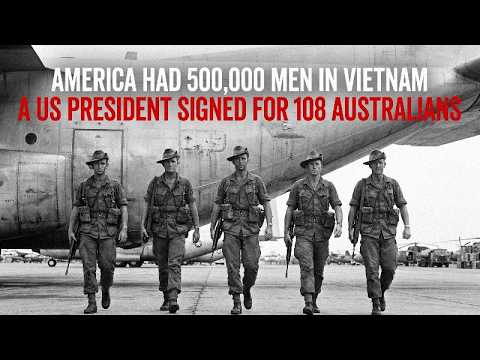
The Americans, watching from outside as allies with half a million troops in the same country, saw 108 infantrymen stop a force roughly 20 times their size. In May 1968, President Lyndon Baines Johnson awarded D Company, 6th Battalion, the Presidential Unit Citation for extraordinary heroism. The document is short and direct and admits no interpretation. Johnson states that under the authority vested in him as President of the United States and Commander in Chief, he has that day awarded the Presidential Unit Citation to D Company, 6th Battalion, Royal Australian Regiment, Australian Army. Read the size of the formation in that document again—that is the part that gets overlooked. It is one company, not a division, not a brigade, not even a full battalion. About 100 infantrymen, most in their early twenties, and a large portion of them national servicemen who were in Vietnam because their birth dates had been drawn in a lottery at home. A sitting American president signed a proclamation for them in his own hand and ordered a document prepared that named the Australian Army as their employer.
That gives you the number at the heart of the whole story. Only two Australian units have ever received the United States Presidential Unit Citation. The 3rd Battalion for Kapyong in Korea, and D Company, 6th Battalion, for Long Tan in Vietnam. Fifteen years apart, two different wars, two different presidents—and nothing like it in the sixty years that followed. Every other Australian unit that served alongside the Americans in every theater since 1966 came home without this award.
The Presidential Unit Citation is the highest American decoration that can be given to a military unit. Directly below it sits the Meritorious Unit Commendation, and Australians have received that one too, in circumstances that had nothing to do with a major battle on a well-known piece of ground. The first unit to earn it was the smallest Australian formation in the war—and by any measure of awards per man, the most successful military unit this country has ever sent abroad. It had no fixed base, no artillery, and for most of its existence its Australian leadership was a day’s travel from where its men worked. What it had instead was a few dozen highly experienced soldiers scattered across a country at war, each attached to somebody else’s unit.
The Australian Army Training Team Vietnam arrived in 1962, three years before the infantry battalions, and stayed until the last Australians left. Its numbers never exceeded 100 men, and were often far fewer. Its members were sergeants and officers, most of them long-service infantrymen who had fought in Malaya or Korea, pushed out into the provinces to work with South Vietnamese units, with Montagnard militia in the central highlands, and with American Special Forces camps along the border. They fought inside other people’s units and under other people’s command, with no Australian battalion behind them and no Australian guns on call.
The Americans gave the training team the Meritorious Unit Commendation. It is the kind of award that can look administrative until you examine what the unit did to earn it. The training team finished the war as the most decorated Australian unit in Vietnam, with more than 100 awards shared among the few hundred men who passed through it over ten years. Four of those awards were Victoria Crosses—to Kevin Wheatley, Peter Badcoe, Ray Simpson, and Keith Payne. Four Victoria Crosses came from a unit that on most days could not have filled a single infantry company. Australian formations in two world wars fought entire campaigns without matching that number.
Each of those four men earned his honor while working inside a foreign command structure, far from any Australian officer who might have recommended him out of national loyalty—which is precisely why the American recognition sits on top of it. The Americans were not handing out medals to an ally as diplomatic courtesy. They were honoring men who stood in their camps beside their soldiers, doing the same work under the same fire.
The training team was not the only Australian unit in Vietnam to earn American recognition. The second spent its entire tour in an argument with them about how the war should be fought. The 1st Battalion, Royal Australian Regiment, was the first Australian infantry battalion sent to Vietnam in 1965, arriving before any Australian task force existed to join it. Nui Dat and the Australian base at Phuoc Tuy were still two years from being established, so the battalion was attached directly to an American formation—meaning an Australian infantry unit was part of the United States Army for its first tour, rather than an ally camped nearby.
For a full year, the 1st Battalion worked as part of the U.S. 173rd Airborne Brigade, based at Bien Hoa, northeast of Saigon. The Australians took American orders, flew on American helicopters, and operated inside the American brigade’s area of responsibility, including operations into the tunnel systems and base areas northwest of the capital, where men went underground with a flashlight and a pistol. That produced exactly the friction anyone would have predicted. Australian patrols were slow, quiet, and built on the jungle warfare doctrine developed in Malaya—which did not match the American approach of firepower and speed. The Australians kept doing it their own way for twelve months, and the disagreement was never actually resolved.
At the end of the tour, the 1st Battalion received the American Meritorious Unit Commendation for its service in Vietnam. The American brigade, which had spent a year disagreeing with the Australians, put its opinion of them in writing anyway and sent it up its own chain of command, where it stayed. This is the pattern that repeated for the third time in fifteen years—and each time, the larger partner in the alliance wrote the recommendation.
After that, the shape of the wars changed entirely. Australia left Vietnam in 1972 and spent the next two decades sending small numbers of individuals on peacekeeping missions, where no one was decorating anyone. The formations deployed afterward were smaller and quieter. And when American recognition surfaced again, it came this time for a single officer rather than a military unit. It took 36 years, a mountain range in eastern Afghanistan, and an American operation that collapsed in its first hours.
In early March 2002, Operation Anaconda unfolded in the Shahi-Kot valley of Paktia Province. It went wrong immediately—enemy strength had been badly underestimated, and American infantry landed under fire from higher ground. What held the operation together were the small observation teams on the peaks above the valley, calling in airstrikes.
Among them were patrols of the Australian Special Air Service Regiment, on those ridgelines above 2,500 meters in freezing conditions for days without resupply. Lieutenant Colonel Rowan Tink, 47, commanded the Australian tactical group at Bagram. In July 2002, the U.S. government awarded him the Bronze Star for his leadership in planning and executing Anaconda.
Major General Franklin Hagenbeck, the American commander, presented it at a farewell ceremony at Bagram—an American general pinning an American medal on an Australian uniform in front of American soldiers, at the end of an operation he had nearly lost in its first hours. There was no press conference in Canberra. Tink went home soon after, and the Australian public heard almost nothing.
Five cases. Fifty-one years. Three wars. Four American administrations. In every one, the Australians were the smaller partner by a massive margin. The larger partner wrote the recommendation.
The 3rd Battalion still carries Kapyong’s citation, and the soldiers who wear it now were born decades after the last Chinese attack climbed that valley in the dark. It remains with the unit, not with any individual—in the original American phrasing, exactly as it was typed in 1951 by someone who never visited Korea and never met an Australian.
So here is the question worth asking: if these documents had never been written, how much of this would we still believe—and how much of our history rests on the simple fact that someone else bothered to type it out?
Report this article
Select a reason for reporting:






