The name you inherit can be a blessing or a curse. For the descendants of the Third Reich’s most notorious figures, it is a lifelong sentence—a shadow that never lifts. “Once a Höss, always a Höss,” they told him. The words cut deeper than any blade.
More than seventy years after the fall of Nazi Germany, the children and grandchildren of its architects still walk the earth, carrying a legacy they never chose. Some changed their names. Others changed their identities. A few changed their religion. But none could escape the truth.
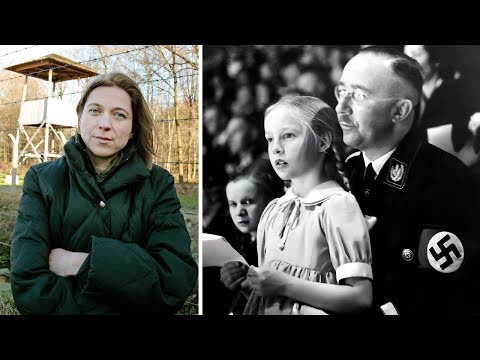
Rainer Höss was fifteen when he learned that his grandfather, Rudolf Höss, was the commandant of Auschwitz—the man who orchestrated the murder of over one million people. The revelation shattered him. He left home, severed ties with his entire family, and never looked back. At boarding school, a gardener who had survived the Holocaust beat him upon learning his surname. For many, the name Höss evoked not just a past, but an inseparable guilt.
His family did not share his rejection. They glorified the grandfather, denied the extermination, and called Auschwitz a “detention camp where prisoners lived well.” His grandmother called it paradise. His father insisted Jews were the true culprits. For them, Rainer became a traitor—the black sheep.
Jennifer Teege was thirty-eight when her past ambushed her in a Hamburg library. A book with a red cover caught her eye. She flipped through it casually until a photograph stopped her cold. She recognized her biological mother. And then she saw the name: Amon Göth, commandant of the Płaszów concentration camp—her grandfather.
She had lived in Israel, learned Hebrew, built friendships within the Jewish community. Discovering she was the granddaughter of a man who shot prisoners from his balcony shattered her identity. “To him, I would have been a disgrace. He probably would have executed me,” she would later say.
The shock triggered acute depression. She cried without reason, felt an emptiness she couldn’t explain. Her therapist guided her step by step. Writing became her refuge. “I have changed, but I am still me, and I know who I am,” she now says.
But not all families chose to break the silence. Some protected it with discretion, even when the surname carried an inescapable burden.
Colleen-Bettina Quant was sixteen when she discovered that her grandmother was Magda Goebbels—the woman who poisoned her six children with cyanide in Hitler’s bunker. Until then, she had lived as the heir to one of Germany’s largest industrial fortunes. The revelation shook her to her core. She converted to Judaism and married a Jewish businessman, a descendant of Holocaust survivors.
Her sisters took different paths. None use the Goebbels surname. None give interviews. They manage their inherited fortune from a holding company in Bad Hamburg, meeting several times a year to coordinate their assets. The fortune remains intact, protected by robust legal structures. But the shadow is ever present.
While some families inherit fortunes tainted by silence, others live with surnames that marked history with blood.
Katrin Himmler was fifteen when a classmate asked, in front of the entire class, whether she was related to Heinrich Himmler. The silence that followed was louder than any answer. Not even the teacher reacted. The topic was never raised again—not at school, not at home.
Years later, after earning a degree in political science, her father asked her to investigate the past of her grandfather Ernst. In the archives of Koblenz, Katrin confirmed what the family had long buried: not only Heinrich, but Ernst and another brother, Gebhard, had also joined the SS. They were not coerced. They saw the family connection as a path to power.
Her research uncovered concrete facts. Her grandfather had denounced an acquaintance for having Jewish ancestry, contributing directly to their persecution. Her grandmother, after the war, sent packages to Nazis convicted of crimes against humanity. None of this had been part of the family narrative.
In her home, Heinrich Himmler was spoken of as a respected figure—not the primary orchestrator of genocide. The gap between official history and private memory became unsustainable.
The result was The Himmler Brothers, a work built on primary sources, family correspondence, and official records. Through the book, Katrin reconstructed not only her family’s political biography but also the gray zones of postwar Germany—families that publicly acknowledged the Holocaust while privately downplaying it.
The publication provoked immediate reactions. Some relatives accused her of betraying the surname. Neo-Nazi groups threatened her for dishonoring the memory of national socialism. But she also received letters from readers seeking tools to interpret a silenced past.
Married to an Israeli citizen and mother to a son who carries both legacies, Katrin chose gradual honesty with her child—explaining not only what happened, but also the role her family played. “There is no inherited guilt,” she insists, “but there is responsibility toward the legacy.”
Her work marks a distinction between acknowledging the crime as a historical fact and understanding how that crime was rooted in family structures that even today resist the truth.
While some heirs of the Nazi elite lived under silence, Bettina Göring grew up with a surname that offered no escape. Her great-uncle Hermann Göring’s name filled entire pages in history books. For many, he was the very face of the Third Reich’s unrestrained power.
Göring was not only one of the first to join the Nazi Party but also the founder of the Gestapo in 1933, before handing it over to Himmler. As head of the Four-Year Plan, he controlled vast sectors of the economy. Hitler granted him a unique rank—Reichsmarschall—above all other military commanders.
Beyond his political roles, he was one of the twentieth century’s greatest cultural looters. During the occupation of France, he personally oversaw the theft of artworks. His name appears more than 130 times in Allied archives on art theft. His collection was estimated to be worth over $200 million.
At Nuremberg, the tribunal declared him guilty of all major charges: war crimes, crimes against humanity, conspiracy, and waging aggressive war. Sentenced to death, he avoided the gallows by ingesting a cyanide capsule the night before his execution. His signature appears on the order that initiated the Final Solution.
Bettina grew up knowing her surname was tied to extermination. From an early age, her life revolved around that inescapable legacy. At ten, when her gravely ill paternal grandmother moved into their home, tensions escalated. That woman, close to Hermann Göring during the regime, denied any crimes of national socialism.
When a documentary about Auschwitz appeared on television, her grandmother’s reaction was neither guilt nor grief. It was denial. For Bettina, this was unbearable. Soon after, she decided to leave home. She was thirteen.
She fled without a plan, driven only by the desire to escape the burden of a name she never chose. She took refuge in communes, lived in countercultural communities, and explored radical ways to break free from anything that reminded her of her history.
One experience profoundly marked her. It was with an older Jewish man with whom she shared a brief but revealing relationship. When she told him her surname, he froze and showed her his forearm. It bore the tattooed number of a concentration camp. He was a survivor. Bettina felt an indescribable guilt, but he did not reject her. From that moment, she understood that not everything had to be repeated.
During the 1970s, she lived in spaces where children of Germans, Jews, and Japanese shared experiences shaped by the postwar era. In some encounters, they simulated extreme dynamics to confront inherited traumas. Bettina recalls one in particular. She had to march like a soldier while others insulted her with rage. “I felt a collective guilt I didn’t know existed in me,” she confessed.
After years of internal flight, Bettina decided to sever her heritage in a literal way. At thirty, she chose to undergo sterilization. It was not just a personal decision but a symbolic gesture—she feared, in her own words, carrying the wrong seed in her blood. Her brother also sterilized expressed it with a phrase Bettina never forgot: “I have cut the line.”
Bettina rebuilt her life in Santa Fe, New Mexico, far from Germany and her family’s silence. There, among Jewish neighbors and open conversations, she found a space for reconciliation she had never had in her homeland. “I, a descendant of Nazi exterminators, mediating between two Jewish families,” she said with irony.
She spent years grappling with a guilt that wasn’t hers but that she felt nonetheless. Speaking, writing, and exposing herself were her ways of stripping power from that legacy. In her encounters with children of Holocaust survivors, she didn’t seek absolution but understanding. She maintained that it wasn’t about erasing the past, but looking at it with awareness so it would cease to hold dominion.
Sometimes she still wonders if that burden is inscribed in her DNA—if historical memory can be transmitted through the body. But over the years, she has learned not to fear that possibility, to view her family with less anger and more complexity, and to take control of her story from a radically different place: that of someone who chooses not to repeat it.
While Bettina Göring chose sterilization to sever her bloodline, another family bore a legacy even more directly tied to the extermination. Adolf Eichmann, captured in Argentina and executed in Jerusalem in 1962, was not just a bureaucrat of horror. He was one of the Holocaust’s primary logistical organizers.
His son Ricardo was only five when his father was captured. At home, no one spoke his name. “Let it be,” his mother would say. But under the sofa, among hidden newspaper clippings, Ricardo began to understand. The surname he carried was not just a detail—it was an inescapable legacy.
Unlike his brothers, who founded neo-Nazi organizations and defended their father’s memory, Ricardo never justified or defended him. “Change my name? For what? You can’t escape yourself or the past,” he would say. He traveled to archives, read orders signed by his father, reviewed deportation records. He wanted no one to be able to say he didn’t know what his father had done.
At a conference in London, he shook hands with one of the Mossad agents who had captured his father. He did so calmly, without hatred, like someone who has decided to close a circle without denying the horror that precedes it. “If I dare to say Eichmann was my father, perhaps my children will never have to say Eichmann was my grandfather.”
These stories are not about the guilty but about those who grew up in the shadow of others’ decisions. They did not inherit the acts, but they did inherit their consequences. Denying, idealizing, concealing—these are different ways of living with an uncomfortable legacy. But so are confrontation, investigation, and distancing.
There is no single way to respond to a history that was not chosen. But there is an inevitable question: what do you do with a name that carries the weight of unspeakable crimes? What would you have done in their place? Share your thoughts below.
Report this article
Select a reason for reporting:






