Laura Bennett had restored thousands of photographs in her fifteen-year career, but nothing could have prepared her for the water-damaged album discovered in a Boston attic in October 2024. The estate belonged to the recently deceased Elellanar Whitmore, a 93-year-old woman whose family was clearing out her Victorian townhouse in Beacon Hill. Among the crumbling tissue paper and faded memories, one photograph stood out—a portrait of two young women, perhaps nineteen or twenty, standing on a wraparound porch with ornate columns and decorative railings, typical of late 19th-century architecture.
At first glance, the image seemed cheerful, capturing a moment of friendship frozen in time. But as Laura examined the photograph more closely, she noticed something odd. In the hand of the woman on the right, partially obscured by the shadows, was a small, dark object. It was barely visible, but Laura’s trained eye caught it immediately. “What is that?” she murmured, zooming in on the digital scan. The object was clutched tightly, as if the woman was hiding it from the camera.
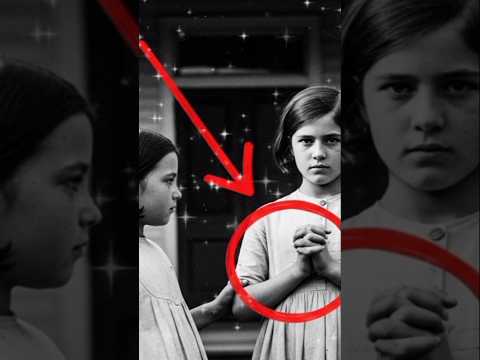
Laura’s heart raced. She had seen many strange things in old photos—a misplaced hand, a double exposure, a ghostly figure in the background—but this felt different. The woman’s expression was serene, her smile gentle, but her grip on the object suggested secrecy. Laura wondered if it was a locket, a key, or something else entirely. “Could it be a message?” she thought, recalling the stories of hidden codes in Victorian photography.
She decided to dig deeper. The album belonged to Elellanar Whitmore, a woman who had lived a long life but left behind few answers. Laura contacted the family, hoping to learn more about the two friends in the photo. “We don’t know much,” admitted Elellanar’s granddaughter, Sarah. “Grandma never spoke about her past. She was very private.” But Sarah mentioned that Elellanar had kept a diary, though it was lost years ago.
Determined to uncover the truth, Laura began researching the photographer and the location. The porch’s distinctive columns matched those of a historic house in Newport, Rhode Island, once owned by a wealthy industrialist. Could the two women be connected to that family? Laura’s investigation led her to a local historian, who recognized the women as Emily and Charlotte, cousins who vanished from society in the early 1900s. “They were rumored to be involved in a scandal,” the historian said, lowering his voice. “Something about a stolen inheritance.”
Laura’s pulse quickened. She returned to the photograph, now more convinced than ever that the object in the woman’s hand was a clue. She enhanced the image, using the latest software to sharpen the blurry details. Slowly, the object took shape—it was a small, ornate key. “A key to what?” Laura whispered. The question hung in the air, unanswered. She knew she had to find out, even if it meant unraveling a century-old mystery that someone had tried very hard to keep buried.
Laura photographed the enhanced image from every angle, then printed it at full resolution and pinned it to her studio wall. The key was unmistakable now—a delicate bow shaped like a fleur-de-lis, its bit cut with an unusual double notch. “That’s not a house key,” she said aloud. “That’s a lockbox key. Or a safety deposit key.” Either way, it was the kind of object someone would only clutch so tightly if it guarded something worth hiding.
She called the historian back the next morning. His name was Theodore Marsh, and he sounded both intrigued and uneasy. “Emily and Charlotte,” he repeated slowly. “The cousins who vanished. There was talk they fled to Europe, but no one ever confirmed it. The family burned most of their papers in 1912.” He paused. “But there’s one thing I didn’t mention. The industrialist who owned that Newport house—his name was Alistair Crane. He died the same year the cousins disappeared.”
Laura wrote the name down. Alistair Crane. She searched the Boston public archives that afternoon, cross-referencing Crane with the Whitmore name, and found something that made her sit back in her chair. Elellanar Whitmore’s maiden name had been Crane. She was Alistair’s great-granddaughter.
That night, Sarah called her back, her voice hushed and hurried. “I found something in Grandma’s closet,” she said. “A tin box. It was behind the winter coats, taped to the wall. There’s a key inside it—and a letter addressed to no one.” Laura’s hand tightened on the phone. “Don’t open the letter yet,” she said. “I want to see the key first. Can you send me a photo?”
The photo arrived minutes later. Laura opened it and felt the floor tilt beneath her. The key in Sarah’s hand was identical to the one in the photograph—the same fleur-de-lis bow, the same double-notched bit. “It’s the same key,” she typed back, her fingers trembling. “Or its twin. Sarah, where is that tin box now?”
Sarah’s reply came fast. “Still in the closet. I didn’t want to move it. But there’s something else. The letter—it’s dated 1904. And it’s signed by both Emily and Charlotte.” Laura stared at the screen, the old photograph propped beside her monitor. The two smiling women seemed to be watching her now, their secret finally surfacing after more than a century.
Laura arrived at the Beacon Hill townhouse the next morning, her satchel heavy with scanning equipment and a growing sense of urgency. Sarah met her at the door, pale and sleepless, and led her up the narrow servant’s staircase to the closet where the tin box had waited in darkness for over a hundred years. “I haven’t touched it since I called you,” Sarah said. “I keep thinking—what if Grandma knew? What if she spent her whole life guarding this?”
The box was small, no larger than a hardcover book, its paint worn to bare metal at the corners. Laura photographed it in place before lifting it down, then set it on a folding table beneath the window’s gray November light. The key from the photograph lay beside it, and when she tried the lock, it turned with a dry, reluctant click.
Inside was the letter, folded into thirds, its paper browned but legible. Beside it lay a second key—larger, heavier, stamped with the name of a Providence bank that had closed its doors in 1929. Laura read the letter aloud, her voice steady despite the pounding in her chest.
“To whoever finds this,” it began. “We are not what they say we are. Alistair Crane was our uncle, and he kept in his study a strongbox that held the true will of our grandfather—the will that left everything to our mother, whom he disowned for marrying beneath him. When Alistair died, we took the key and the box before the lawyers could. We meant only to see justice done, but the family named us thieves and we fled before they could take us to court.”
Laura paused, the paper trembling in her hand. Sarah had gone very still. “The box,” Laura continued, “we left with a friend in Providence, at the bank whose name is on this key. If it still stands, so does the truth. We are innocent. We always were. — Emily and Charlotte, March 1904.”
Sarah sank onto a stack of stored linens. “So they weren’t thieves,” she whispered. “They were trying to protect their mother’s inheritance.” Laura nodded slowly, turning the bank key over in her palm. The Providence bank had closed nearly a century ago—but its building still stood on Westminster Street, converted years back into a boutique hotel. She had walked past it a dozen times without knowing.
She pulled out her phone and searched for the hotel’s contact number, her mind already racing through the next steps. “If the strongbox was left in a safe deposit vault,” she said, “and the bank failed, the contents would have been catalogued and stored. Sometimes those records survive. Sometimes the boxes themselves do.” Sarah looked up, a flicker of hope breaking through her exhaustion.
Before Laura could dial, her phone buzzed with a message from Theodore Marsh. She read it twice, the words landing like stones in still water. “I found something in the Crane family papers,” he had written. “A photograph of the study, taken in 1901. There’s a safe in the wall behind the portrait of Alistair. And Laura—the portrait is still hanging. It’s in the townhouse. It’s in Elellanar’s parlor.”
Laura and Sarah exchanged a look, then moved together toward the parlor without a word. The portrait hung exactly where Theodore had described it—a stern, bearded man in a black frock coat, his eyes following them across the room. “If there’s a safe behind this,” Sarah said, “Grandma must have known. She must have stood in this room a thousand times.”
They lifted the painting down and found a shallow recess cut into the plaster, sealed with a rusted iron door no bigger than a hatbox. The heavy Providence key didn’t fit—but the fleur-de-lis key from the photograph did, sliding home with a click that echoed through the empty house.
Inside lay a single oilcloth packet: the true will of Elias Crane, dated 1898, leaving the entire estate to his daughter Margaret—Emily and Charlotte’s mother. “It’s all here,” Laura breathed. “The signatures, the witnesses, everything. They weren’t thieves. They were telling the truth.”
Sarah pressed a hand to her mouth. “Grandma spent her whole life guarding a secret she never understood,” she said. “She kept the photo, kept the box, kept the portrait hanging—and never knew what any of it meant.”
Laura looked at the two smiling women in the photograph one last time. “I think she did know,” she said softly. “She just didn’t have the key to prove it. Now we do.”
The will was authenticated within the month, and the Crane estate—what little remained of it—passed to the descendants of Margaret Crane, including Sarah and her cousins. Emily and Charlotte were formally cleared of wrongdoing in a small ceremony at the Newport Historical Society, their names restored after a century of silence.
As for the photograph, Laura framed it for Sarah with a small brass plaque beneath it: Cousins, vindicated at last.
But one question still nags at her late at night. The letter said the cousins left the strongbox with a friend in Providence—and yet the key never left the family. Who, then, was the friend? And why did Elellanar never open the tin box herself?
What do you think—was Elellanar protecting the secret, or was she waiting for someone like Laura to finally ask the question?
Report this article
Select a reason for reporting:






