Hollywood has always sold the same comfortable lie: that its biggest stars rose to the top because they were the most gifted performers of their generation. But the real history of the studio system tells a far messier story—one where a contract player’s box office draw was decided in a boardroom long before anyone checked whether the person could actually hold a scene.
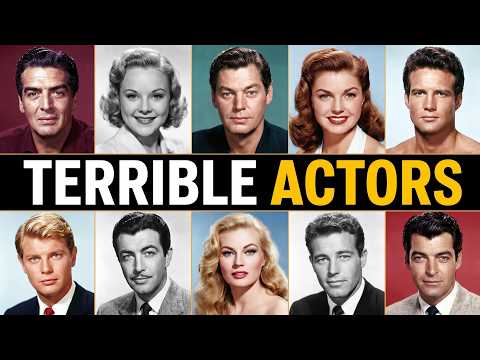
A surprising number of the era’s most bankable names spent entire careers being openly mocked by critics, sometimes even mocking themselves, and still walked away as the biggest draws of their time. These are ten Golden Age stars who were considered genuinely bad at acting—yet became some of the most famous faces in the industry anyway.
Victor Mature spent nearly three decades as one of Hollywood’s most bankable leading men, appearing in over 70 films and earning close to $18 million—an enormous sum for the era. Critics rarely had a kind word, describing his performances as stiff and self-satisfied, more concerned with his physique than genuine emotional range.
And Mature himself seemed to agree. When a country club rejected his application because actors weren’t welcome, he famously fired back, “I’m not an actor and I’ve got 64 films to prove it.” A line that became one of the most quoted self-deprecating jokes in Hollywood history. He kept the bit going for decades, telling an interviewer in 1968 that he was really a golfer by trade and had never actually been an actor at all. “Ask anybody, particularly the critics.”
That easy-going reputation reportedly made directors more willing to keep hiring him, even when reviews of his previous picture had been harsh. Biographers have since pointed out that his self-deprecation was itself a kind of shrewd showmanship—a way of disarming critics before they could land a punch.
Sonja Henie arrived in Hollywood already a three-time Olympic gold medalist in figure skating, and 20th Century Fox signed her in 1936 hoping to turn her championship skating into box office gold. From 1937 to 1945, she ranked among the biggest box office draws in the industry, landing as high as third place on the annual list of top stars in 1938.
Her acting, though, was a different story. Even sympathetic critics acknowledged that her line readings and dramatic scenes were the weakest part of every picture—filler between the skating numbers audiences had actually come to see. By the early 1940s, the reviews had turned openly unkind. The New York Times critic Bosley Crowther described her later work in Wintertime as suffering from an almost insufferable monotony of pattern and style.
Her film career was effectively over by 1945, even as she continued packing arenas with her live Hollywood Ice Reviews for years afterward—proof that audiences were there for the skating and the spectacle, far more than for anything she did with dialogue.
Johnny Weissmuller had already won five Olympic gold medals in swimming before he ever set foot on a film set. It was that athletic background—not any acting experience—that got him cast as Tarzan in 1932 after a producer spotted him swimming laps at a hotel pool.
Weissmuller went on to play the character in 12 films across nearly two decades, becoming by far the most iconic Tarzan of all time. But the role required almost nothing of him as an actor beyond grunting a handful of monosyllabic lines and swinging through the trees. He was open about his own limitations, telling interviewers plainly that he was no great actor, but that his fans liked him anyway.
The original Tarzan author, Edgar Rice Burroughs, was reportedly so unhappy with how little his character was allowed to speak that he launched a competing, more articulate version starring a different actor. That rival production never came close to matching the popularity of the Weissmuller films—an outcome that only reinforced how strongly audiences had come to associate the character with Weissmuller’s particular, mostly wordless take.
Rather than attempt a dramatic reinvention late in life, Weissmuller simply moved on to another physically demanding, dialogue-light franchise, playing Jungle Jim through the 1950s. Later Tarzan actors who followed him were often measured directly against his performance—not because critics considered his acting a high bar, but because his blend of physical presence and minimal dialogue had become, for better or worse, the template audiences expected.
Esther Williams was a championship swimmer with her sights set on the 1940 Olympics before the games were canceled by the outbreak of war. MGM scooped her up instead, building an entirely new film genre around her called the aqua musical—pictures designed to let her spend most of every scene performing elaborate synchronized swimming numbers rather than delivering dramatic dialogue.
Williams herself was famously blunt about her own ability, once telling an interviewer flatly, “I can’t act, I can’t sing, I can’t dance.” Critics tended to agree with her self-assessment more than she probably wanted, frequently describing her as pretty but wooden whenever she was out of the water—with one widely repeated observation noting that she transformed from a stiff, unremarkable actress on land into a genuinely magnetic movie star the moment she got wet.
That contrast became the entire commercial formula for her films throughout the 1940s and into the 1950s. MGM reportedly spent enormous sums building custom pools and elaborate underwater camera rigs specifically to support these sequences, with engineers on the lot assigned to design and maintain the equipment—a level of technical investment rarely devoted to dramatic scenes in any of the studio’s other productions.
Williams eventually softened her own harsh self-assessment decades later, saying after rewatching her old films that she could finally see why audiences had liked the girl on screen, even if she still did not think much of her own line readings.
Steve Reeves had already built one of the most famous physiques in the world as a champion bodybuilder, winning titles like Mr. America and Mr. Universe, before an Italian producer cast him in the title role of Hercules in 1958—largely because of how he looked without a shirt on.
The film became a massive international hit, and by 1960, Reeves was ranked the number one box office draw in 25 different countries, launching an entire genre of Italian muscle-man films that critics dismissively nicknamed peplum, after the short tunics the actors wore. French and American critics alike tore into these films as cheaply made and badly dubbed, and Reeves personally absorbed plenty of criticism for what reviewers described as a stiff, wooden delivery.
A handful of more generous critics pointed out that his stiffness actually worked in the film’s favor, giving Hercules a kind of stone-carved, larger-than-life quality a more conventionally skilled actor might not have pulled off. Modern critics revisiting the genre have occasionally sided with that reading, and later academic writing has gone even further, suggesting his physical stillness gave the character an almost sculptural quality that a more animated performance might have undercut.
Reeves rode the wave to genuine international stardom before retiring from acting in the mid-1960s, having built an entire career out of a physique that spoke louder than any of his line readings ever did—a path several later action stars publicly credited as a direct influence on their own early career choices.
Troy Donahue shot to fame almost overnight after starring in the 1959 hit A Summer Place, a success that briefly put him on nearly equal footing with teen idols like Elvis Presley and Pat Boone. Warner Bros. signed him to a lucrative multi-year contract specifically because he could reliably sell tickets at drive-in theaters, leaning hard into his boyish good looks in a run of youth-oriented pictures.
Critics were consistently unimpressed, describing his performances as wooden and emotionally flat. Some reviewers went so far as to suggest the studio itself seemed aware of the gap, routinely surrounding him with stronger supporting casts capable of carrying the more demanding emotional scenes—a casting pattern so consistent that some critics began treating it almost as an open acknowledgement of exactly where his limitations lay.
His stardom faded almost as quickly as it had arrived once tastes shifted later in the decade, and Donahue himself later reflected candidly on how much of his early fame had rested on manufactured teen appeal rather than any genuine acting talent.
Robert Taylor became one of MGM’s biggest male stars of the 1930s largely on the strength of his looks, earning the nickname The Man with the Perfect Profile after his breakout role in Magnificent Obsession in 1935. For years afterward, critics routinely dismissed him as little more than a pretty face, with one particularly cutting review of his work in Her Cardboard Lover suggesting that his stiff performance was itself an unintentional joke on the film’s own title.
To his credit, Taylor spent the following decades gradually working to prove his critics wrong, taking on grittier, more demanding roles in Westerns and war pictures through the 1940s and 1950s that slowly won over reviewers who had once written him off entirely. Even so, decades after his death, the nickname still shows up in nearly every retrospective written about him—a permanent reminder that his stardom had first been built on his looks rather than on any acting talent critics initially recognized.
Anita Ekberg arrived in Hollywood as a former Miss Sweden with striking looks studios were eager to put on camera long before anyone paid much attention to what she could do as a performer. Even her most famous role—Sylvia in Fellini’s La Dolce Vita—has been described by critics and biographers alike as a part built around her image and screen presence rather than any demonstrated dramatic range.
Ekberg herself seemed to understand exactly how the industry saw her, once remarking that being born beautiful helped a person get started in show business, but eventually became a handicap once people stopped looking for anything beyond the surface. She remained best known to the end of her life for a single iconic scene wading through a Roman fountain—an image so enduring it eclipsed the rest of her filmography almost entirely.
Guy Madison was a young navy sailor with almost no acting experience when producer David O. Selznick spotted him and decided his boyish good looks alone were enough to build a career around. That instinct paid off commercially, and Madison eventually landed his signature role as Wild Bill Hickok in The Adventures of Wild Bill Hickok, which ran from 1951 to 1958 and made him a hero to an entire generation of baby boomer kids.
Television turned out to be especially forgiving of exactly the kind of limited range critics kept pointing to in his feature film work. Weekly episodic westerns rarely demanded the same sustained emotional arc a feature film might require, giving Madison a format that let his straightforward, dependable presence work in his favor. He won a Golden Globe in 1954 for best Western star—an award that recognized his popularity far more than any particular acting achievement.
Rory Calhoun built a long career as a tall, dark, brooding leading man in 1950s westerns, a genre that rewarded his rugged looks far more than it demanded any nuanced acting. He worked steadily for decades, but Calhoun himself was refreshingly candid, telling an interviewer in 1959 that out of everything he had made, only two films were genuinely good, and the rest were terrible.
Calhoun also built a side career as a rancher and outdoorsman that fed directly into his on-screen image, blurring the line between his real life and the roles he was consistently cast in. That honesty, in hindsight, only made audiences like him more rather than less.
Ten stars, and ten reminders that being famous in Hollywood’s golden age never actually required being good at the thing the industry claimed to be selling—a pattern that shaped an entire era of casting decisions built more around image, athleticism, and marketability than around anything resembling classical acting training.
So here’s the question worth arguing over: if a performer’s face, physique, or sheer presence sold millions of tickets, did the critics simply miss the point of what those stars were actually hired to do—or were audiences being sold something they mistook for talent all along? Let us know in the comments which of these ten you find hardest to believe ever became a star.
Report this article
Select a reason for reporting:






