On August 23, 1914, the fields near Mons, Belgium, were about to become a graveyard of empires. Hundreds of German soldiers, hardened and confident, converged from all directions on a single, bullet-riddled machine gun. Behind it lay a bruised and bleeding soldier, the last of the rear guard: Private Sydney Godley. Around him, fallen comrades bore silent witness to the impossible. They had checked the mighty Schlieffen Plan, if only for a moment.
The British Expeditionary Force, a small but professional army, had crossed the Channel to stand with France. They were outnumbered, but not outmatched. At the Nimy Salient, two battalions—the 4th Middlesex and the 4th Royal Fusiliers—held the line. Among them, Lieutenant Maurice Dease and Private Godley manned the crucial machine guns at the Nimy rail bridge.
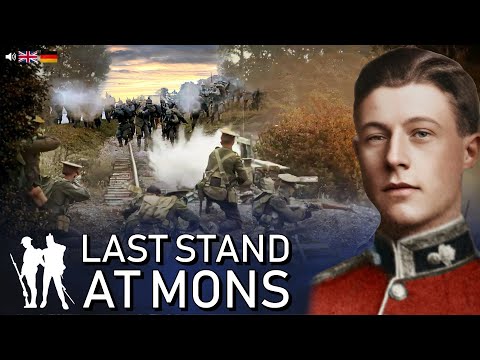
The German advance began at 8 a.m., a solid wall of field grey. The British held their fire until the enemy was 50 yards from the canal bank. Then, all hell broke loose. A hail of bullets tore through the German ranks, shattering their formation. The first attack was repulsed with huge losses. But the Germans regrouped, and with artillery support, they came again and again.
By midday, the Middlesex position at Obourg was desperate. A lone marksman on the station roof volunteered to stay behind, holding the Germans at bay for vital minutes as his comrades withdrew. His accurate fire bought time, but eventually, a salvo of artillery destroyed the building and the unknown soldier within.
Two miles away at Nimy, Lieutenant Dease and Private Godley were in the thick of it. Dease’s two machine guns were well-placed but exposed. The Germans attacked just before 11 a.m., and Dease put his guns to deadly use. For 90 minutes, a fierce duel raged. But one gun was eventually silenced, and ammunition ran low. Dease and Godley volunteered to cover the withdrawal.
Dease, already wounded multiple times, kept firing until a bullet struck his chest. He slumped dead over his gun. Godley took over, traversing the gun and pouring fire into the attackers. Wounded in the head and with shrapnel in his back, he fired his final rounds, then removed the firing pins and threw them into the canal before collapsing.
Their bravery allowed the Fusiliers to live and fight another day. The Battle of Mons was over, but the legend of Dease and Godley had just begun.
But the story did not end on that canal bank. As the remnants of the Royal Fusiliers slipped south through the smoke, the Germans swept over the abandoned bridge. They found Lieutenant Dease slumped across his gun, lifeless, and Private Godley barely clinging to consciousness. They assumed he was dying and carried him to a dressing station behind their own lines.
For days, Godley hovered between life and death. German doctors removed shrapnel from his back, stitched his head wound, and treated the bullet grazes that had torn through his body. When he finally opened his eyes, he was a prisoner of war.
Back in Britain, the news of the action at Nimy travelled faster than the retreating BEF. On 16 November 1914, the London Gazette announced that Lieutenant Maurice Dease and Private Sydney Godley had been awarded the Victoria Cross. Dease’s medal was sent to his grieving family. Godley’s would have to wait.
He spent the next four years in German hands, moved between camps, recovering slowly. By the time the armistice came in November 1918, he was a shadow of the strong young soldier who had manned that gun.
In February 1919, a quiet, unassuming man in a borrowed uniform stood before King George V at Buckingham Palace. When the King pinned the Victoria Cross to his chest, Godley reportedly said little. He had never sought glory, only done his duty when everything else had fallen apart.
He returned to civilian life, working as a draper’s assistant and later a factory hand. He married, raised a family, and rarely spoke of the war. Neighbours in his quiet London suburb had no idea the man next door had been one of the first heroes of the Great War.
Sydney Godley died in June 1957, aged 67. His funeral was modest, but his name lives on, carved into the stone at Nimy and remembered by every soldier who has ever held a line against impossible odds.
Yet the fields around Mons hold more stories than one. In the same cemetery where Dease lies, a strange twist of fate had placed another man.
Oscar Niemeyer was not a soldier by trade. In civilian life, he had been a gardener from Schleswig-Holstein, a quiet man who tended roses and trimmed hedges. But in August 1914, he wore the field grey of the German Army, and on the banks of the Mons canal, he performed an act that would echo through history.
The swing bridge at Nimy had been closed by the British defenders, its controls on their side of the water. Without it, the German advance was stalled at a critical point. Niemeyer, under constant rifle fire, plunged into the canal and swam to the far side. He climbed up, single-handedly wound the bridge round, and locked it open. A new route across the canal was secured. Moments later, he fell dead, struck down at the very moment of his triumph.
For his bravery, Oscar Niemeyer was awarded the Iron Cross, First Class. His comrades buried him near the canal he had helped to cross. But the story of the cemetery at Saint-Symphorien was only beginning.
In the years that followed, the fields around Mons were cleared of the fallen. British and German dead alike were gathered and laid to rest in the same ground. It was a decision born of practicality, but it carried a deeper meaning: even in war, even in death, the lines between enemies could blur.
And so it was that Maurice Dease, the first Victoria Cross recipient of the Great War, found his final resting place in that quiet cemetery. Directly behind him lay Oscar Niemeyer, the German soldier whose courage had helped to overwhelm Dease’s position. Two men who had fought on opposite sides of the canal, now united in the same earth.
But fate had one more twist to deliver. In the same cemetery, another grave would come to symbolize the very end of the war that had begun at Mons.
George Leonard Price was a Canadian soldier, a private in the 28th Battalion. He had survived the mud of Passchendaele, the gas at Ypres, and the grinding advance across the Somme. By November 1918, he was fighting near Mons once more, pushing the Germans back through the same fields where the BEF had made its first stand four years earlier.
On the morning of 11 November 1918, the armistice was hours away. At 10:55 a.m., just five minutes before the guns would fall silent, George Price was shot by a German sniper. He died instantly, the last Commonwealth soldier to fall on the Western Front.
He was buried at Saint-Symphorien, not far from Dease and Niemeyer. The first hero of the war and the last victim of the war, separated by a few yards of Belgian soil.
The cemetery today is a place of pilgrimage for those who understand what it represents. British and German graves stand side by side, their headstones weathered by a century of rain and sun. It is perhaps the only place in the world where the first and last casualties of a war lie so close together.
But the story of Mons does not end with the dead. It continues with the living, with the men who survived that desperate day and carried the memory of it for the rest of their lives.
Private Sydney Godley returned to England in 1919 to a hero’s welcome he never sought. He went back to work, raised his family, and lived quietly until his death in 1957. For decades, his neighbours had no idea the man next door had been one of the first heroes of the Great War.
Today, beneath the rail bridge at Nimy, a plaque commemorates Dease and Godley. Visitors stand in the shadow of the bridge, reading the words, imagining the roar of the guns and the desperate last stand. The canal is wider now, but the courage it witnessed remains unchanged.
At Saint-Symphorien, the headstones tell their own story. Dease and Niemeyer, enemies in life, neighbours in death. And behind them, George Price, who fell just five minutes before the guns fell silent. The first, the last, and the many in between—all resting in the same quiet ground.
The Battle of Mons was a small engagement in a vast war, but it set the tone for everything that followed. It showed that the BEF, though small, could fight. It showed that courage knows no uniform. And it showed that even in the darkest hours, men would hold the line.
Sid Godley never forgot his officer. In his later years, he would speak of Dease with quiet reverence. “He kept firing until he couldn’t,” he once said. “That’s all any of us can do.”
Today, the fields around Mons are peaceful. The canal flows quietly. The bridge is gone, replaced by a new one, but the memory remains. Every August, a small ceremony is held at the cemetery. Soldiers from Britain and Germany stand together, laying wreaths. The old enmities have faded, but the lessons remain.
The Great War began with a shot in Sarajevo and ended with a sniper’s bullet near Mons. In between, millions fell. But at Saint-Symphorien, the first and last lie close together, a reminder of the cost and the courage.
What do you think? Was the stand at Mons a futile gesture or a necessary one? And what does it mean that enemies now rest side by side?
Report this article
Select a reason for reporting:






