What if the funniest faces on television were fighting battles their audiences never saw? Behind the laughter, the applause, and the famous catchphrases, some of the most beloved sitcom legends faced devastating illnesses—often in secret, sometimes for decades. A few received shocking diagnoses only months before the end. Others kept working while their health quietly collapsed, delivering punchlines while their bodies betrayed them.
From Suzanne Somers, who battled breast cancer for more than 20 years while America watched her play the bubbly Chrissy Snow, to Alice Pearce, the neighbor on Bewitched who hid terminal ovarian cancer from the entire cast, these are the stories of the men and women who made us laugh while their own lives were falling apart. You’ll never watch these classic shows the same way again.
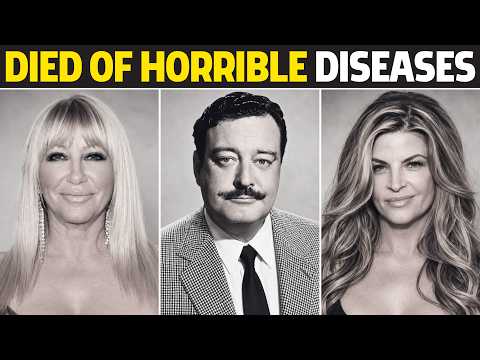
Take Kirstie Alley. Replacing a beloved character on a massive sitcom is nearly impossible, yet she turned Rebecca Howe on Cheers into an Emmy-winning icon. Her final illness, however, moved with terrifying speed. In December 2022, her children announced she had died from cancer—later confirmed as colon cancer—diagnosed only a short time before her death. She was 71.
Then there’s Bea Arthur, whose cutting stare as Dorothy Zbornak could silence a room. Off-screen, she faced lung cancer quietly, dying at home in 2009 at 86. And Elizabeth Montgomery—Samantha Stephens herself—was diagnosed with colorectal cancer just two months before she passed away in 1995 at only 62. The woman who could twitch her nose and solve any problem had no magic to save herself.
Some fought for years in silence. David Lander (Squiggy on Laverne & Shirley) was diagnosed with multiple sclerosis in 1984 and kept it private for years, fearing it would end his career. He lived with the disease for 37 years, continuing to act and even work as a baseball scout. Valerie Harper was given months to live after a rare brain cancer diagnosis in 2013—then defied the odds for six more years, competing on Dancing with the Stars and becoming a vocal advocate.
And then there are the ones who didn’t get that time. Dustin Diamond, forever Screech, was diagnosed with stage four lung cancer in January 2021 and died just three weeks later at 44. Bernie Mac, seemingly invincible, died from pneumonia complications at 50 after years of living with sarcoidosis. James Michael Tyler—Gunther on Friends—revealed his advanced prostate cancer only when he appeared remotely at the reunion, too ill to attend in person.
The list goes on: Norm Macdonald hid a years-long cancer battle from the public because he didn’t want anyone to judge his comedy through the lens of illness. Mary Tyler Moore lived with type 1 diabetes for most of her adult life, turning her diagnosis into a public crusade. Andy Kaufman was so famous for elaborate hoaxes that when he died of lung cancer at 35, some fans refused to believe it was real.
These are the untold stories of the people who gave us decades of laughter—and the shocking, often heartbreaking medical battles they fought when the cameras stopped rolling. Some kept their diagnoses secret until the very end. Others worked through treatment, hiding their pain behind perfect timing and a brave face.
What emerges is a portrait of resilience, denial, courage, and sometimes tragedy—a reminder that the people who make us laugh are often carrying burdens we can’t imagine. And for some, the final curtain came far too soon.
Consider John Mahoney, who spent eleven seasons as Martin Crane, the beer-drinking, dog-loving father who grounded Frasier in something real. What viewers never saw was a man who had already survived colon cancer years before the show began, and who later faced other cancers as well. His final battle was throat cancer. By early 2018, he was in hospice care in Chicago—the city where he had built his stage career long before television found him. He died on February 4th at 77.
There was something quietly fitting about that. Martin Crane was the character who cut through Frasier and Niles’s pretensions with blunt common sense. Mahoney brought that same unpretentious warmth to every scene, which made his private struggle all the more poignant. He had found his calling late in life, and cancer arrived just as he was finally enjoying it.
Then there’s Peter Boyle, whose Frank Barone on Everybody Loves Raymond could complain about anything—the food, the temperature, his sons, Marie’s cooking. Boyle made irritation hilarious. But behind the performance, he carried a history of serious health problems: a stroke in 1990, a heart attack while working on the sitcom, and eventually multiple myeloma alongside heart disease. He died on December 12th, 2006, at 71.
Colleagues described Boyle as gentle, thoughtful, and nothing like Frank. That contrast is what made the role so brilliant. He could walk into a kitchen, insult half the family, and still earn one of the episode’s biggest laughs. Off-screen, cancer and cardiovascular disease were closing in.
Perhaps the most haunting case belongs to Alice Pearce, the original Gladys Kravitz on Bewitched. Every week, she rushed to her window, spotted Samantha’s magic, and frantically called for her husband Abner—who always arrived too late to see anything. The audience knew Gladys was right. Abner never did.
What no one in that audience knew was that Pearce had reportedly received a terminal ovarian cancer diagnosis before the series even began. She kept working as the disease progressed, her weight loss becoming increasingly visible on screen. Her final episode was filmed in January 1966. Less than two months later, on March 3rd, she died at only 48.
Later that year, she won the Emmy for outstanding supporting actress in a comedy. The award was presented posthumously. She never lived to accept it. Watching those old episodes now, there’s a heartbreaking double layer—Gladys rushing through another hilarious scene, while the actress playing her knew her time was running out.
And then there’s Agnes Moorehead, the magnificent Endora, who could transform Darrin into anything whenever she felt insulted. Moorehead brought decades of serious acting experience—Orson Welles, Citizen Kane, multiple Oscar nominations—to a sitcom role, and made it unforgettable. She died of uterine cancer on April 30th, 1974, at 73, only two years after Bewitched ended.
Her death later became tangled in an unsettling Hollywood legend: she had appeared in The Conqueror, filmed near nuclear test sites in Utah, and an unusual number of cast and crew later developed cancer. Researchers have debated the connection for years. It has never been scientifically proven—but the shadow of that question lingers over her story.
What remains undeniable is the loss. Bewitched lost two of its most distinctive performers—Pearce and Moorehead—within eight years of each other. The show’s magic depended on them: Gladys’s frantic certainty and Endora’s elegant contempt. Both women gave television some of its funniest moments while privately facing the cruelest realities.
And then there are the ones whose battles remained hidden until the very end. Larry Hagman was still playing J.R. Ewing on the Dallas revival when acute myeloid leukemia was quietly taking his life. Audiences watched the scheming oil baron manipulate his family week after week, never knowing the man behind him was seriously ill. He died on November 23rd, 2012, at 81, and production had to write J.R.’s death into the series itself.
Before Dallas, of course, Hagman had been Major Nelson on I Dream of Jeannie, forever bewildered by Barbara Eden’s magic. He had already survived liver disease severe enough to require a transplant in 1995. Cancer was simply the last opponent in a career that spanned more than half a century.
Richard Dawson offers a similar double image. Sitcom fans remember him as Corporal Newkirk on Hogan’s Heroes, performing impressions and helping Hogan’s schemes inside a German prison camp. Game show audiences remember the smiling host of Family Feud, kissing contestants and turning unscripted conversation into comedy. He died on June 2nd, 2012, at 79 from complications of esophageal cancer, surrounded by family. The illness was barely publicized beforehand, so the announcement arrived as a shock.
Esophageal cancer is notoriously difficult to catch early, and symptoms often appear only after the disease has advanced. For a man who had spent decades speaking for a living—acting, joking, interviewing, hosting—it was a cruel irony that the disease struck the very passage that made his voice possible.
Some stories are defined by how long the fight lasted. Charlotte Rae, the beloved Mrs. Garrett of The Facts of Life, faced cancer twice. In 2009, she revealed that pancreatic cancer had been discovered early and treated successfully through surgery. Then, at 91, she announced a bone cancer diagnosis and spoke openly about choosing how aggressively to pursue treatment, saying she intended to enjoy the life she still had. She died at home on August 5th, 2018, at 92.
Few performers spent so many decades comforting fictional families on screen while privately surviving one of the most feared cancers of all—and then facing the disease again in her nineties. Mrs. Garrett always seemed to know what to say. Rae, it turns out, knew exactly how to live.
Then there’s Robert Guillaume, whose Benson DuBois began as a sarcastic butler on Soap and became the star of his own series—one of the most important sitcom roles for a Black actor of that era. He later voiced Rafiki in The Lion King and worked steadily for decades, even after a stroke in 1999. He died at his Los Angeles home on October 24th, 2017, at 89, from complications of prostate cancer.
There was something fitting about Guillaume’s resilience. Benson survived by being sharper and calmer than everyone around him. Guillaume brought that same quiet authority to everything he did, and cancer never managed to take it from him.
And Ted Knight—Ted Baxter himself—was diagnosed with colon cancer not long after The Mary Tyler Moore Show ended. He was treated and kept working on Too Close for Comfort, but the disease returned and spread. He died on August 26th, 1986, at only 62. The booming voice and perfectly controlled stupidity of Ted Baxter had made him an Emmy winner. Cancer took him while his final sitcom was still on the air, leaving audiences almost no distance between the laughter and the loss.
What connects these performers is not just illness, but timing—the way diagnoses arrived mid-career, mid-season, mid-laugh. The cameras kept rolling. The audiences kept watching. And behind the fence, behind the makeup, behind the perfect timing, these legends were fighting battles no script ever acknowledged.
And some battles were measured in decades, not months. David Lander kept his multiple sclerosis secret for years, terrified it would end his career, yet he kept performing as Squiggy and later became an ambassador for the National MS Society. Thirty-seven years. He died in 2020 at 73.
Valerie Harper received a rare brain cancer diagnosis in 2013 with a prognosis of months. She lived six more years, danced on national television, and refused to let a timeline define her. When she died in 2019 at 80, she had outlived every expectation.
Others had almost no time at all. Dustin Diamond went from diagnosis to death in three weeks. Elizabeth Montgomery had roughly two months. Kirstie Alley‘s colon cancer was discovered only shortly before she died.
What remains is the work—the reruns, the catchphrases, the laughter that outlived them all. These stars gave us their best while carrying their worst, and the cameras never caught it.
Which of these stories surprised you the most—and which sitcom legend do you wish we had covered? Tell us in the comments below.
Report this article
Select a reason for reporting:






