On April 15th, 1945, British troops of the 63rd Anti-Tank Regiment pushed through the wire fences of Bergen-Belsen and stepped into a nightmare that would break the strongest men. Before them lay 60,000 survivors, hollowed out by typhus and hunger, and more than 10,000 unburied corpses scattered like discarded refuse among the barracks and open pits. BBC correspondent Richard Dimbleby, who accompanied the troops, broke down crying live on air during the broadcast. The world listened in horror.
Among the personnel detained that day were three women who had also served at Auschwitz-Birkenau. Their names would become synonymous with a cruelty so systematic it defied belief.
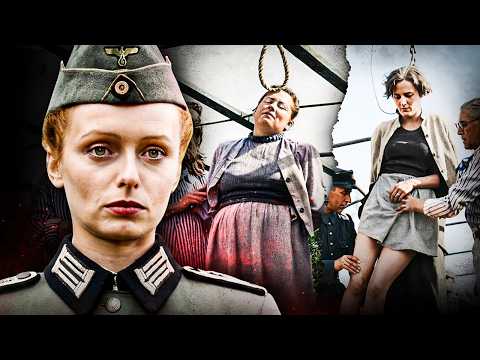
Irma Grese, just 21 years old, had patrolled the camp with a braided cellophane whip, participating in the platform selections, pointing with her finger who would go to the gas chambers. Elisabeth Volkenrath, 25, the Oberaufseherin, coordinated hundreds of guards, ordered collective food ration suspensions, and managed the Selektion with a coldness that witnesses would describe years later as more disturbing than the violence itself. And Johanna Bormann, 51, nicknamed die Frau mit den Hunden—the woman with the dogs—for systematically setting her German Shepherd on prisoners, whose bites in bodies ravaged by malnutrition caused sepsis and death in less than a week.
This is the story of the brutal end of the Bergen-Belsen guards. But to understand them, we must go back to where it all began—to the SS Ravensbrück and the making of Nazi female guards.
In March 1933, when the first strands of wire began to encircle the repurposed stables of Dachau, southeast of Munich, Heinrich Himmler held a press conference to announce the opening of the Third Reich’s first concentration camp. He spoke of order and state security. He did not mention deliberate hunger, sticks, or dogs. The model built in those stables—the command hierarchies, the punishment codes, the meticulous records, the forced labor quotas—would be replicated for 12 years in facilities stretching from Norway to North Africa, from France to occupied Ukraine. Every act of violence had its form, its signature, and its file. It was the architecture of a system designed to transform cruelty into procedure and crime into administration.
The Wannsee Conference, held on January 20th, 1942, in a villa on the shore of the lake of the same name in Berlin, lasted 90 minutes. The 15 high-ranking officials gathered there consumed cognac and sandwiches while Reinhard Heydrich presented the plan for the systematic extermination of 11 million European Jews. What was decided had an official name: die Endlösung der Judenfrage—the final solution to the Jewish question. The gas chambers at Auschwitz-Birkenau could kill 2,000 people in 20 minutes. Between May and July 1944, during the extermination of Hungarian Jews, between 10,000 and 12,000 people arrived at the complex daily. Most died within hours, unregistered, leaving no administrative trace except smoke over Polish Silesia.
It was in this context that the system needed to solve a practical problem. SS internal rules prohibited men from directly supervising female prisoners, and camps required their own staff for women’s sections. The solution was the core of the Aufseherinnen—the female auxiliary guards. They were not technically SS members, whose statute was exclusively male, but they worked under SS command, wore a gray-blue uniform of similar design, and had full authority over the prisoners. Their training center was Ravensbrück, the largest concentration camp for women in the Reich, located 90 km north of Berlin. There they received four to six weeks of instruction: counting protocols, handling guard dogs, procedures for physical punishment, and the ideological framework that justified everything else. Prisoners were not women in the sense that they themselves were. They were enemies of the state, representatives of inferior races and racial parasites. This distinction was not a rhetorical accessory. It was the psychological condition that made the system’s operation possible.
Recruitment followed various paths: newspaper advertisements, referrals from armaments factories, and recommendations from acquaintances already enlisted. For women of humble origin with limited prospects for social advancement, the uniform represented authority, salary, lodging, and food. The total number of Aufseherinnen who served between 1939 and 1945 is estimated at approximately 3,700.
Bergen-Belsen, the camp where three of these women would commit the crimes documented in this film, was not conceived as an instrument of extermination. Established in 1940 in Lower Saxony, Germany, it initially operated as a camp for Soviet prisoners of war, more than 14,000 of whom died between 1941 and 1942. From late 1944, as the Allied advance began to shrink the Reich’s territory, Bergen-Belsen received mass evacuations from Auschwitz, Dora-Mittelbau, and Neuengamme. By March 1945, 60,000 people inhabited a facility designed for a fraction of that number. Barracks built for 80 people housed 400. Typhus spread with no possibility of containment. When British soldiers crossed the wire fences on April 15th, 1945, they found more than 10,000 unburied corpses.
Among the personnel detained that day were three women who had also served at Auschwitz-Birkenau: Irma Grese, Elisabeth Volkenrath, and Johanna Bormann. But this story is not about the camp. It is about them. Three ordinary women who chose to become executioners.
Irma Erna Ilse Grese was born on October 7th, 1923, in Rekken, a small village in Mecklenburg in northeastern Germany. Her father, Alfred Grese, was a farm worker and a member of the Nazi party. She was the third of five children in a family marked, when Irma was 13, by an event that no official record fully explains. Her mother, Berta Grese, ingested acid and died. The precise reasons were never completely clarified, although some researchers have linked them to tensions within a household steeped in the dominant ideology and subjected to the economic pressures of rural Germany in the 1930s.
Alfred Grese continued family life with his five children and his party membership. The absence of the mother, the presence of the ideologized father, and the poverty of the environment created the soil on which the regime would build—with an efficiency that in Irma’s case would be extraordinary—the type of person it needed.
Irma, like all young Germans of her generation, went through the regime’s youth organizations. She joined the Jungmädel at 10 years old and later the Bund Deutscher Mädel, the League of German Girls. These organizations were not extracurricular activities. They were indoctrination mechanisms that transmitted a specific worldview: racism as biology, nationalism as sacred duty, obedience to the state as the highest virtue, and the role of women as servants of the nation and the race.
At 16, she left school. She worked in a dairy and later attempted to join a nursing training program, but she was not admitted. It was at this moment of closed doors that she responded to a job advertisement for SS Auxiliary Service. In 1942, at 18, she submitted her application. Her father, according to secondary sources collected during subsequent judicial investigations, opposed this decision and cut off communication with her. Alfred Grese, a party member who had raised his children in Nazi ideology, did not want his daughter to wear that uniform. What this reveals about what the uniform represented even to its own wearers is something historians have noted without reaching a single answer.
In October 1942, Grese joined Ravensbrück to receive standard training. In March 1943, at 19, she was transferred to Auschwitz-Birkenau. She arrived at a camp that at that time housed between 20,000 and 30,000 women in the Frauenlager, the female sector—barracks originally designed as army horse stables without heating, with triple-decker bunks where two or three women shared the space designed for one, and with communal toilets allowed for use only twice a day during fixed periods. The smell was constant and total. Gastrointestinal diseases spread uncontrollably. Prisoners who did not reach the toilets in time due to weakness or illness were beaten for soiling themselves. Punishment overlapped with illness and illness with punishment in a loop of degradation that the system had deliberately designed to destroy any remaining individual dignity.
Grese’s progression within the camp’s female hierarchy was rapid. In 1944, at 20 years old, she held the position of Lagerführerin of the female sector—the chief officer of the guards in that sector. She was the second highest ranking figure among all female staff in the entire Auschwitz-Birkenau complex.
Survivor testimonies collected during the British military investigation and at the Lüneburg trial described her with a consistency that proved decisively evidentiary. Zofia Litwinska, a Polish Jewish survivor who had been in the camp during the same period, described Grese’s physical appearance to the court with a precision that left no room for confusion: young, blond, athletic, patrolling the camp with a braided leather whip in her right hand and a Walther revolver at her left hip. She wore polished high boots. She walked with a confidence witnesses described with different words, all converging on the same reality—that of someone who knew her presence generated terror and did nothing to mitigate it, but rather cultivated it.
Testimonies regarding Grese’s specific activities at Auschwitz are numerous and detailed. Ada Bimko, a Polish Jewish doctor who arrived at the camp in August 1943 and became one of the most decisive witnesses in the Lüneburg trial, testified to witnessing selections on the Birkenau platform in which Grese participated with an indifference Bimko described as the most disturbing feature of her behavior. Not the violence itself, but the total absence of any sign of internal conflict. The same expression someone might have when choosing between two objects of equivalent value. Grese pointed with her finger: left, labor; right, gas chambers. Several survivors stated they had seen her make these decisions independently, without consulting any SS doctor, on the platform illuminated by spotlights while trains unloaded their occupants in the darkness of the Polish night.
The beatings Grese administered with her braided whip are documented in testimonies from people who independently declared having witnessed the same episodes or having been direct victims. The whip was not only a symbol of authority. It was an everyday tool carried in the hand with the same naturalness that someone else might carry a pen or notebook. Testimonies describe Grese striking prisoners during the morning roll calls—the Appell—which could last between two and five hours outdoors regardless of the temperature, for moving, staggering, or failing to maintain the perfect alignment demanded by regulations. Several witnesses testified to seeing her beat women who had fallen to the ground from exhaustion or illness, striking with the whip and her foot on the bodies while they lay unable to rise.
Survivors who stated they were beaten directly by her described the blows as delivered with considerable force and a regularity that excluded the possibility of a spontaneous outburst. She was someone who struck methodically, with the same rhythm another person might perform any routine task of their day. Litwinska testified at Lüneburg about a specific episode that was recorded in the trial transcripts. One morning during an Appell, when a prisoner collapsed during the roll call, Grese approached, looked at her for a moment, and began striking her with the whip without saying a word, with an expression Litwinska described as completely neutral, as if conducting a routine inspection. The woman did not get up. Grese continued her patrol of the formation.
This type of episode, repeated in multiple testimonies with variations in detail but following the same behavioral pattern, convinced prosecutors that Grese’s violence was not reactive but constitutive of the way she exercised her position.
The use of trained dogs was another documented aspect of her conduct at Auschwitz. Grese kept guard dogs, and several testimonies described her setting them on prisoners—a practice she shared with Johanna Bormann, though with slightly less systematic frequency. The consequences of bites on bodies with immune systems devastated by malnutrition were predictable and documented. Wounds became infected within two to three days. The infection spread without possibility of medical care, and sepsis caused death within a week. Several survivors testified to witnessing the deaths of companions in the days following dog attacks without any observable response from the guard who had ordered them.
There is one aspect of Grese’s behavior at Auschwitz that historians have highlighted because it complicates purely situational explanations of her conduct. Multiple testimonies described her inflicting violence in the absence of male SS officers who might have observed her—at times when no superior authority was present to give orders or witness her actions. This makes it difficult to argue that she acted solely under immediate environmental pressure or fear of consequences for not doing so. The violence she exercised did not need to be justified to anyone at those moments. According to the accumulation of available testimonies, it was an autonomous initiative, enabled by the system but not requiring any external supervisory mechanism to remain active.
In January 1945, when the advance of the Red Army from the East made the maintenance of Auschwitz unviable, Grese was transferred to Bergen-Belsen. She was 21 years old. The camp she arrived at was in a state of collapse that even Auschwitz, in all its organized brutality, had not reached. Bergen-Belsen in January 1945 was the end of the line—without extermination facilities but with a capacity to produce death by accumulation that is difficult to comprehend in conventional terms. Prisoners died of typhus, dysentery, tuberculosis, and pure starvation. They died on the bunks, in the barracks corridors, and outside during roll calls. Bodies remained where they fell for periods survivors measured in days.
Grese’s behavior at Bergen-Belsen followed, according to testimonies, the pattern she had established at Auschwitz. The whip beatings continued. Indifference to the deaths occurring in her direct presence continued. The testimonies from Bergen-Belsen do not introduce methods that were not already present at Auschwitz. They confirm them. And in that confirmation lies something more disturbing than any novelty: consistency.
The trial at Lüneburg ended with verdicts that stunned those who had expected leniency for women. Eleven death sentences. Six of them female. On December 13th, 1945, at Hameln Prison, Albert Pierrepoint carried out the executions with the same technical precision he applied to every assignment. Irma Grese walked to the scaffold without trembling. Her last word was “Schnell”—fast. She was twenty-two.
Elisabeth Volkenrath followed, composed and silent, her calculated coldness intact until the end. Johanna Bormann, the woman with the dogs, showed visible fear—the only one of the three whose composure cracked.
Their bodies were buried in unmarked graves, later exhumed and scattered in the Weser. No shrine. No pilgrimage. Only the record remains—the testimonies, the transcripts, the pointing fingers of survivors who spoke so the dead would not vanish.
What does it mean that ordinary women became executioners—and that justice, however swift, could never restore what was taken?
Report this article
Select a reason for reporting:






