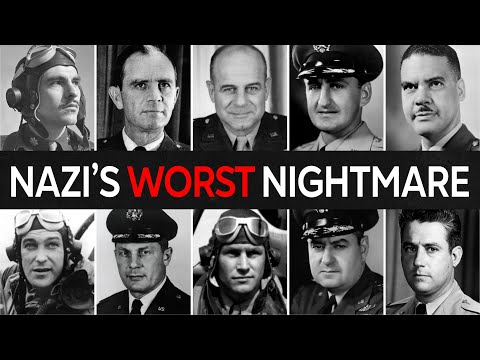
The skies over Europe were once a German sanctuary—a realm where veteran Luftwaffe pilots believed themselves untouchable. They had experience, superior aircraft, and a doctrine that had crushed opposition for years. But one by one, that confidence began to crack. Not because of numbers alone, but because of names. Names whispered in briefings, cursed over radios, and remembered long after the engines went silent.
These were not just pilots. They were warnings. From relentless fighter aces to commanders who reshaped the air war itself, this is the story of 17 American pilots the Nazis feared the most—and how they turned the sky into a battlefield Germany could no longer control.
Among all American fighter pilots in Europe, one name consistently surfaced in Luftwaffe intelligence briefings with reluctant respect: Francis Gabreski. To German pilots flying interceptor missions over the Reich, Gabreski was not just another enemy ace. He was a problem that refused to go away.
By late 1943, the 56th Fighter Group had already earned a fearsome reputation, but Gabreski stood at its sharpest edge. Flying the massive P-47 Thunderbolt, he embodied a style of combat that ran counter to German expectations. Where many pilots fired early and broke away, Gabreski closed in. He waited. He stalked. Then he fired at distances so close that escape was nearly impossible.
With 28 confirmed aerial victories, Gabreski became the top American ace in the European theater. German pilots quickly learned that if a Thunderbolt stayed on their tail instead of disengaging, it was likely Gabreski or someone trained in his exact methods. Captured German intelligence reports listed him as a high-value target—not because of propaganda value, but because his continued presence directly correlated with lost aircraft and shattered formations.
What made Gabreski especially dangerous was not recklessness, but control. He understood energy, angles, and timing with near clinical precision. German pilots later admitted that facing him felt different. There was no frantic spray of gunfire, no desperate chase—just a steady approach, then sudden destruction. The Luftwaffe thrived on confidence and initiative. Gabreski stripped both away.
Yet Gabreski was not operating alone. The Luftwaffe soon realized that he was part of something larger—a leadership core that shaped the entire 56th Fighter Group into a relentless hunting force. German interrogations began to reference not just one name, but three. If Gabreski was the blade, then the men beside him were the hands guiding it. And at the center of that triad stood a commander whose influence reached far beyond his own cockpit.
If Gabreski represented lethal precision in the air, Hubert “Hub” Zemke represented something far more alarming to the German High Command: transformation. Zemke was not merely an ace or a squadron leader. He was a tactician who dismantled assumptions the Luftwaffe had relied on since the early days of the war.
As commander of the 56th Fighter Group, Zemke understood that American pilots did not need to mimic German doctrine to defeat it. They needed to break it. His most influential contribution became known as the Zemke Fan—a tactic that deliberately shattered rigid escort formations. Instead of flying predictably alongside bombers, fighters spread outward, overlapping fields of attack that allowed them to swarm German interceptors from multiple directions.
To the Luftwaffe, this was chaos—but controlled chaos executed with intent. German attempts to organize mass interceptions began to fail not because of inferior skill, but because the Americans refused to fight on expected terms. Zemke’s impact was so pronounced that it followed him even after he was removed from combat. When he was captured and sent to Stalag Luft III, the camp commandant reportedly treated him with notable deference. This was not courtesy—it was recognition.
What made Zemke particularly feared was his ability to produce results through others. Pilots trained under him adopted his aggressive flexibility. They learned to think independently while acting collectively—a combination that repeatedly caught German units off guard. Luftwaffe reports increasingly described American fighters as unpredictable, a word that, in military terms, signals danger.
German pilots soon realized that encountering the 56th Fighter Group meant facing more than individual skill. It meant confronting a doctrine designed to hunt them wherever they appeared—above the bombers, between bases, and even on climb-out. Zemke had turned American fighter escort into an offensive weapon. But even within this fearsome structure, there was one more figure whose methods pushed the Luftwaffe into a defensive crouch before the fight even began.
David Schilling completed what German pilots came to call the terrible three, and his contribution to that reputation came from an entirely different direction. While Gabreski dominated the air and Zemke reshaped tactics, Schilling focused on denial. His philosophy was simple and devastating: destroy the Luftwaffe before it could fight back.
To Schilling, air superiority did not begin at altitude. It began on the ground. Flying the P-47 Thunderbolt, he became infamous for aggressive low-level attacks on German airfields. These were not symbolic strafing runs. They were calculated assaults aimed at aircraft during their most vulnerable moments—parked, refueling, or attempting to take off.
Luftwaffe airfield commanders soon found themselves under constant pressure, forced to divert resources toward flak defenses specifically designed to counter Thunderbolt attacks at treetop height. Even then, losses mounted. Aircraft destroyed on the ground never entered the battle. Pilots killed or wounded during scramble attempts were losses the Luftwaffe could not easily replace.
Over time, German units began dispersing aircraft, delaying launches, and altering schedules—all reactions to a threat Schilling had helped normalize. This defensive mindset slowed response times and fractured coordination across entire regions. German intelligence reports began referencing low-level Thunderbolt doctrine, a clear acknowledgement that this was not isolated aggression, but a repeatable method.
Together with Gabreski and Zemke, Schilling formed a triad that attacked the Luftwaffe’s body, mind, and infrastructure simultaneously. By the time German commanders fully grasped the scope of the threat, the damage was already done. Yet even as the Wolfpack tore holes through Germany’s air defenses, a different kind of fear was taking shape—one born not from dogfights or airfields, but from a single decision that unleashed American fighters across the Reich with no intention of turning back.
By the time German commanders fully understood what James “Jimmy” Doolittle represented, it was already too late to stop him. Unlike the fighter aces they tracked by aircraft markings and kill tallies, Doolittle was feared for something far more dangerous: his ability to change the entire nature of the air war. To the Luftwaffe, he was not just a pilot. He was the man who removed the rules that had once given them a fighting chance.
Doolittle was already famous for the audacity of the Tokyo raid, a mission that proved American air power could strike the heart of an enemy thought untouchable. But it was in Europe, as commander of the Eighth Air Force, that his most devastating decision emerged. Until then, American fighters were largely tethered to bombers, forced into predictable escort patterns that German interceptors learned to exploit. Doolittle saw this as a strategic failure.
His order was blunt and transformative: fighters were no longer there just to escort. They were there to hunt. With that single shift, American P-51 Mustangs were unleashed across German airspace. Instead of turning back at the bomber stream, they roamed freely—diving on airfields, ambushing climbing fighters, and pursuing damaged aircraft all the way to their bases.
Luftwaffe pilots who once believed they could disengage and recover now discovered there was no safe direction to flee. German ace Adolf Galland later identified this moment as the true turning point of the air war, when Germany lost not just planes, but initiative. The psychological impact was crushing. Pilots took off knowing American fighters might already be waiting above them. Landing offered no relief. Airfields became traps.
Doolittle never needed a personal kill count in Europe. His strategy multiplied American effectiveness on a scale the Luftwaffe could not counter. Yet fear did not always come from overwhelming force. Sometimes it came from something far quieter—an act of restraint so unexpected that it shattered assumptions on both sides of the war. And that moment would unfold not through command orders, but through a battered bomber limping home through enemy skies.
Charles “Charlie” Brown was not feared by the Luftwaffe in the traditional sense. He did not rack up victories or lead formations into battle. Yet his name became embedded in German memory for a reason that ran deeper than tactics or firepower. Brown represented a kind of courage that forced even enemy pilots to confront the moral boundaries of war.
Flying a B-17 Flying Fortress named Ye Olde Pub, Brown found himself isolated after a bombing run over Germany. His aircraft was shredded—engines damaged, guns knocked out, crew wounded. Under normal circumstances, a lone crippled bomber was an easy kill. German pilots were trained to finish such targets without hesitation.
When Luftwaffe ace Franz Stigler approached Brown’s B-17, everything about the situation pointed toward destruction. But what Stigler saw stopped him. The bomber was barely holding together, yet it stayed airborne. The crew did not bail out. The aircraft did not surrender. It simply endured.
Instead of attacking, Stigler escorted Brown’s bomber out of German airspace, shielding it from further harm. To German pilots, this act was shocking—not because it showed weakness, but because it reflected an unspoken respect. Stigler later explained that shooting Brown down would have felt like crossing a line even war could not justify.
For the Luftwaffe, this incident spread quietly but powerfully. Brown’s survival became a reminder that American crews were not faceless machines, but determined adversaries who refused to break even when defeat seemed inevitable. Bomber crews like Brown’s continued flying mission after mission, absorbing losses that would have shattered morale in other air forces. German pilots understood that they were facing an enemy whose resolve could not be measured solely in numbers.
Brown did not terrify them with aggression, but with endurance. And that endurance, multiplied across thousands of crews, was something Germany could not exhaust. Still, there were leaders who transformed that resilience into disciplined combat power—commanders whose very presence forced German pilots into disadvantage before the fight even began.
Benjamin O. Davis, Jr. was feared not because of a single battle or dramatic duel, but because he proved something the Luftwaffe desperately hoped was untrue: that American fighter escorts could be relentless, disciplined, and impossible to shake. As commander of the Tuskegee Airmen, Davis led a unit that German intelligence came to recognize by sight alone.
The red tails of their P-51 Mustangs were unmistakable, and once seen, they carried an unsettling implication. These fighters were not going anywhere. German pilots nicknamed them schwarze Vogelmänner—the blackbird men—a label that reflected both novelty and respect. What truly set Davis’s unit apart was escort discipline. While some fighter groups chased kills, the Tuskegee Airmen stayed with their bombers.
They forced German interceptors to engage on unfavorable terms, drawing them into prolonged fights where numbers and positioning favored the Americans. Luftwaffe pilots accustomed to scattering escorts and isolating bombers found themselves repeatedly frustrated. Davis understood that victory did not always require spectacle. His leadership emphasized consistency, protection, and pressure.
Over time, German pilots began to associate red-tailed fighters with failed attacks and wasted fuel. Bombers escorted by Davis’s men returned more often, mission after mission, reinforcing the sense that American air power was not only strong, but dependable. German intelligence reports noted the unit’s cohesion and refusal to abandon their charges. That reliability mattered. It meant fewer successful interceptions and more bombers reaching their targets.
In an air war already tilting against Germany, Davis represented a kind of threat that could not be countered by skill alone. He embodied an organized inevitability. As bomber streams continued to darken the skies, the Luftwaffe realized that fear no longer came solely from fighters overhead, but from the growing realization that the Americans would keep coming—escorted by pilots who refused to break formation, refused to disengage, and refused to let the pressure ease. And among those bombers flew men who would become symbols of defiance in their own right, facing impossible odds again and again without turning back.
Robert “Rosie” Rosenthal was the bomber pilot the Luftwaffe could not break. Flying with the 100th Bomb Group—the “Bloody 100th”—he completed 52 missions, double his required tour. Shot down twice, he evaded capture both times and returned to the fight.
To German pilots, his survival was demoralizing. “The endless American stream” became a phrase of despair in their accounts. Rosenthal was Jewish, and every mission he flew struck directly at Nazi ideology itself.
Then came the hunters: George Preddy, whose Mustang packs pursued to the deck; Chuck Yeager, who proved even Me 262 jets were vulnerable; Don Blakeslee, who never rotated home; Robin Olds, the fork-tailed devil; John Meyer, striking before Germans reached altitude; Curtis LeMay, whose combat boxes became flying fortresses; Robert Johnson, whose P-47 survived Egon Mayer’s salute; Bud Mahurin, the first double ace; Don Gentile, the ace of aces; and Glenn Eagleston, relentless at treetop height.
By war’s end, the message was unmistakable: American airpower was defined by depth, endurance, and an unrelenting ability to contest every layer of the sky. For German pilots, there was no longer any place where that pressure did not follow them.
Which of these 17 pilots do you think struck the most fear into the Luftwaffe—and why? Tell us in the comments below.
Report this article
Select a reason for reporting:






