At 6:00 AM on October 25, 1944, more than a hundred American aircraft launched from their carriers into the gray Pacific sky, and at the front were the Grumman Hellcats. This was the plan. Fighters first, always first, climbing high and fast to break through enemy defenses so the bombers behind could do their work. Every man in those cockpits had done it before. Every man knew what awaited at the end of such a mission: anti-aircraft fire so thick you could walk on it, Zeroes dropping from the sun with its light behind them.
Two hours later, they arrived above four Japanese carriers. The sky over those carriers was empty—no light defenses, no scattered sky, empty. A handful of fighters, scattered, desperate, finished in minutes. The most powerful naval air force ever assembled carved an unimpeded path toward a target that could barely resist, while 300 miles south, sailors were dying at that same hour, begging for help over an open radio channel the entire fleet could hear.
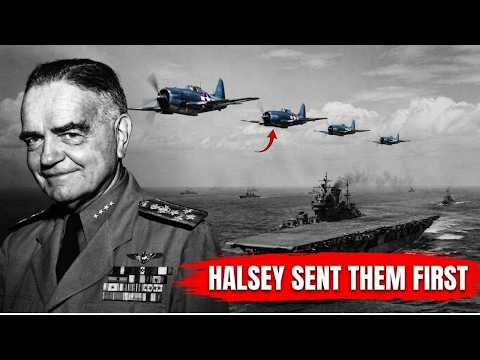
Admiral William Halsey had made his decision the night before. He took everything he had and headed north. He headed north for one reason: he intended to sink the carrier that lit the fuse of the war. He would sink it, and he would spend the rest of his life accounting for what he did that morning.
Take a moment to relax with a warm drink. Before we begin, tell us how much time you have.
At 4:00 AM on the deck of an American carrier, a special kind of darkness reigns. Not the darkness of an empty field or a country road, but the working darkness teeming with men who cannot see each other yet move by memory and by the shapes of machines they have touched a thousand times. Deck crews wear colored vests no one can read at that hour. The smell of aviation fuel, salt, and hot metal. In the midst of it, a young man sits in the cockpit of a Grumman F6F Hellcat, canopy open, the cold creeping in from the sea, waiting for the signal to launch.
He did not know where he was going. Almost none of them did. The briefing was brief, and the target had a name that meant nothing to most pilots in the operations room: an stretch of empty ocean off the northern tip of Luzon in the Philippines. What they were told was simple enough. Japanese carriers had been found. The fleet would pursue them. The fighters would go in first. That last part was not a suggestion. It was the essence of the operation.
By the fall of 1944, the U.S. Navy had turned carrier air strikes into something like a science. At the heart of this science lay one unbreakable rule: never send bombers without fighters. A Curtiss Helldiver carrying a 1,000-pound bomb is a heavy, lumbering creature in the air. A Grumman Avenger dragging a torpedo toward the water flies low, slow, and perfectly straight. That means it flies like a target painted on the sky. Sending these two aircraft into protected airspace without help would mean losing them—not some of them, most of them.
So the fighters went ahead. They climbed above the strike group, reached the enemy 10 or 15 minutes early, and their job was to control the air, break up combat air patrols, and scatter interceptors before they could reach the bombers. Then they would swoop down on the deck and roam the length of enemy ships with all six guns blazing—not to sink anything, but to force the men standing on anti-aircraft platforms to duck their heads for 30 seconds, the time the torpedo planes needed to survive. The Navy had a term for it: “clearing the way.” And the plane they used to do it was the ugliest and most beautiful aircraft of the war.
The Grumman F6F Hellcat looked odd. Too big, too heavy in the front. A massive plane with a high cockpit set back as if added later. Pilots who had trained on the small, elegant pre-war fighters took one look and laughed. Then they flew it. A 2,000-horsepower Pratt & Whitney radial engine buried in the front. Six .50-caliber machine guns in the wings, three on each side, firing a stream of lead capable of cutting a Japanese fighter’s wing off in less than two seconds. Armor plate behind the pilot’s seat. Self-sealing fuel tanks. It climbed like a rocket, dove like a falling hammer, absorbed tremendous damage, and carried one pilot home. The Hellcat was not designed to be elegant. It was designed to kill the Mitsubishi Zero and keep American pilots alive while doing it. And by October 1944, it had accomplished both tasks with such precision that the outcome of the Pacific air war had already been decided. Only those not flying that morning realized how true that was.
Three hundred meters from the flight deck, on the bridge of the battleship New Jersey, stood the man who had sent them. Admiral William Frederick Halsey was 61 years old, five days shy of his 62nd birthday, and his reputation had long preceded him. The press called him “Bull,” but his officers never did. He was massive, thick-browed, with a face set like it was carved in permanent stormy weather. He had built his entire career on one unshakable conviction: when you find the enemy fleet, you attack it. No waiting, no hesitating—go.
He carried two wounds that had nothing to do with combat. The first was in the middle of the war. In the spring of 1942, as the decisive carrier battle of the Pacific approached, Halsey was bedridden in a hospital, suffering from a severe skin condition that had been eating at his body for weeks. He could not command, barely could wear his uniform. He gave up his carriers and recommended Raymond Spruance to take over, and Spruance did. Spruance achieved the greatest naval victory in American history. And while Halsey lay in Pearl Harbor listening to radio traffic, he did not talk about it much afterward. Men who served close to him said he never entirely got over it. The second wound was fresher, and it belonged to Spruance as well. In June 1944 in the Philippine Sea, Spruance faced the same choice Halsey would face in October. Japanese carriers were somewhere to the west. Spruance had a landing beachhead behind him to protect. He chose to stay. He kept his fleet close to the landing force and let the Japanese come to him, destroying nearly 400 enemy aircraft in a single day—a slaughter the pilots themselves called “the Great Marianas Turkey Shoot.” By any measure, it was a crushing victory. But the Navy split over it, and the debate continued because the Japanese carriers survived—damaged, stripped of their aircrews, but afloat. Spruance won the air battle and let the fleet go, and the pilots never forgave him for it.
In officers’ quarters across the Pacific that summer, officers repeated the same sentence over and over: He should have chased them. Halsey said it out loud, too. Then in October, the Navy handed him a written order that seemed written with that very argument in mind. His operational instructions from Admiral Chester Nimitz contained a clause Spruance’s orders never had: If an opportunity exists to destroy a major part of the enemy fleet, that destruction will be his primary task—not just permission, but priority. Halsey read that sentence, and every man on his staff understood its meaning. Somewhere out there was a Japanese carrier force, and if it ever appeared, nothing on earth would be more important than killing it.
Fifteen hundred meters north, a Japanese admiral was preparing to reveal himself deliberately. Vice Admiral Jisaburo Ozawa was 58, unusually tall for an officer of his generation. A thin, serious man, known as the finest carrier tactician in the Imperial Navy. He had commanded the Japanese fleet in the Philippine Sea. He watched his squadrons take off that June morning and not return. He understood, faster and more honestly than most of his superiors, exactly what that meant. The Japanese naval air arm was not damaged; it was crippled. What remained was airframes and young men forced through training in a few months, barely able to find their own carrier in broad daylight.
In October, Imperial Headquarters ordered him to defend the Philippines. Those orders were unprecedented in the history of naval warfare. Ozawa was to take his carriers to sea and lose them. The plan was logical, cold, and tight. The real striking force, a battleship fleet led by Admiral Takeo Kurita, including the giants Yamato and Musashi, would cut through the central Philippines and fall upon the American invasion beaches at Leyte. But that force could not survive if American carriers remained off the coast with hundreds of aircraft ready to launch. Those carriers had to be drawn away. So Ozawa sailed south with four carriers, two hybrid battleships with short flight decks welded to their sterns, three light cruisers, and a screen of destroyers. His primary mission was to be seen, to be found, to be chased. Every mile the American fleet moved north after him was a mile of open water for Kurita’s guns.
He did not object. He did not ask for a different assignment. Men who worked with him said he received the order like a man receiving a medical diagnosis he had already given himself. And at the front of his column sailed the ship that made the entire deception possible. Zuikaku was the last one left. On the morning of December 7, 1941, six Japanese carriers turned north of Hawaii into the wind and launched the attack that brought the United States into the war. Their names were Akagi, Kaga, Soryu, Hiryu, Shokaku, and Zuikaku. Within three years, the first four were sunk, and Shokaku was torpedoed in the Philippine Sea. Zuikaku was the only one that survived. Her crew called her “the Lucky Crane,” and they meant it, because she had participated in Pearl Harbor, the Coral Sea, Santa Cruz, and the Philippine Sea, and returned from all of them. She was fast, beautiful, superbly built, and carried more than 1,600 men. But she carried almost no aircraft.
On board the four carriers of Ozawa’s fleet, there were 108 aircraft—a number that seems large at first glance, but if we remember that Zuikaku alone had once operated more than 70 aircraft by herself. The pilots were children. The flight deck of the most famous carrier in the Imperial Japanese Navy was mostly bare steel. She was not heading to fight; she was heading to be a picture on an American radar screen, a shadow in a scout plane’s report, a name in a message capable of making an American admiral change the course of his entire fleet and rush toward her. And on the night of October 24, that is exactly what happened.
Here is the part of the story that is almost never told, the strangest of that day. For most of October 24, Ozawa could not attract attention. Imagine what that means for the men on those ships. A warship’s entire life is dedicated to learning how to hide. You maintain radio silence, you zigzag, you post lookouts who stare at the horizon until their eyes water. Every instinct, every training, every rule in the book is about remaining invisible. Now the orders were reversed. Ozawa put his ships on a straight course. He broke radio silence and sent his communications openly, hour after hour, telling anyone listening exactly where the Japanese carrier fleet was. He detached his two hybrid battleships and sent them south alone to increase the chance that someone would see something. No one came. The Americans were busy. They had spent the day destroying Kurita’s battleships in the Sibuyan Sea, sinking Musashi, the largest battleship ever built. The pilots returned convinced they had stopped the Japanese attack for good. The entire attention of the Third Fleet was directed west toward a battle it had already won.
So, early in the afternoon, Ozawa did the last thing he had left. He emptied his flight decks. About 76 aircraft, most of what he had, took off from the four carriers and flew south to attack the American task force. It was not a real strike, and Ozawa knew it was not a real strike. His pilots had a few dozen hours in their logbooks. They did not have enough training to find a moving fleet, let alone launch an attack through a wall of Hellcats. They found it, some of them, and then the Hellcats found them. Almost nothing got through. A handful of aircraft returned, straggling back toward the carriers. Others headed for airfields in Luzon because their pilots could not locate their ships at sea. Ozawa had disposed of his air group to buy a sighting report, and for hours he did not know if he had bought it or not.
Then, late in the afternoon, an American scout plane finally looked north and saw ships. The message reached Mitscher, and Mitscher’s staff sent it to the New Jersey and to the flag bridge of that battleship. The reaction was not caution; it was relief. The carriers, the last Japanese carriers in the world, the ones Spruance had let escape in June, were out there in the open sea with no land to hide behind. At about 8:00 PM on October 24, Halsey issued the order. The entire Third Fleet would head north. Every fast carrier, every fast battleship, every cruiser and destroyer in the striking force. All of them. And one thing was left behind: the San Bernardino Strait. That narrow passage through the central Philippines was the gateway Kurita’s battleships had to pass through to reach the landing beaches. And there was no one in the strait. Not a picket destroyer, not a submarine, nothing but dark water.
And here, the balance of war turned on a piece of paper. Earlier that day, Halsey had sent a message describing a battle plan. The message mentioned that a new force, Task Force 34, would be formed, composed of his fast battleships, and would engage the enemy. It was a contingency plan, a plan for something that might happen. But the message was widely distributed. Admiral Nimitz in Hawaii and Admiral Kinkaid, who commanded the landing fleet at Leyte, whose old battleships were about to fight their night battle miles to the south, both read it. Both men read the message the same way. Both men misread the order. They thought Task Force 34 existed. They thought those battleships were anchored off the San Bernardino Strait, guarding the entrance. But they were not. They were steaming north at high speed while Halsey chased the carriers. No one noticed the misunderstanding. No one asked. Three separate American commands slept that night believing a fleet was somewhere it was not, and the Japanese battleships slipped through the empty strait shortly after midnight and headed south along the coast of Samar toward a landing beach almost entirely unprotected.
Because that is how a carrier is killed. Fighters first to clear the sky, then bombs and torpedoes on the flight deck. It was the correct doctrine, executed by the best-trained carrier pilots in the world, in a plane built for exactly this, against the target America had spent three years trying to reach on its own terms. October 25 was a flawless naval air maneuver. Four Japanese carriers entered those waters and none left, and the Imperial Japanese Navy never again operated a carrier force at sea.
But the strategic answer is more complicated, and Halsey lived in its shadow. He cleared the way for a ship placed there to receive him. Ozawa’s fleet was not a threat; it was an invitation. Every hour a Hellcat spent in that empty sky was an hour the American battle line was not standing in the San Bernardino Strait. The men who paid for those hours were the sailors in Samar’s waters and the destroyer squadron that charged a battleship force with five-inch guns.
Ozawa lost four carriers and completed his mission exactly as ordered. Halsey sank the carrier that lit the fuse, and was questioned about that morning for the rest of his life. He never showed regret.
The sky over those carriers was empty, and it was not the Hellcats of October 25 who emptied it. It was emptied months and years earlier over Guadalcanal, the Solomons, and the Marianas, in hundreds of fights no film was ever made about, by pilots flying the same ugly square Grumman.
If your father or grandfather or uncle served in the Pacific, I would be honored to read his name and unit below. And if you have ever argued about Halsey at the kitchen table, tell me plainly: was he right to go north after the carriers, or should he have stayed in the strait?
Report this article
Select a reason for reporting:






