In the final, desperate months of World War II, the skies over Germany became a deadly chessboard. Allied bombers, escorted by sleek P-51 Mustangs, pounded the Reich around the clock, while the Luftwaffe scrambled to find an answer. The air war had shifted decisively, and Germany’s survival hinged on a technological miracle. That miracle, many hoped, would come in the form of a radical new interceptor: the Focke-Wulf Ta 152.
But this is not just a story of engineering brilliance—it’s a tale of chaos, desperation, and the thin line between genius and catastrophe. As the Luftwaffe’s back was against the wall, one man, Kurt Tank, dared to push the boundaries of aviation. His creation would become one of the fastest piston-engine fighters of the war, capable of reaching altitudes where Allied bombers thought they were safe. Yet, as with many late-war German projects, the Ta 152 was born into a world of crumbling infrastructure, scarce resources, and impossible deadlines.
The roots of the Ta 152 lie in the brutal lessons of the Battle of Britain. In 1940, the Luftwaffe had nearly broken the RAF, but a fateful navigational error—a bomber crew accidentally hitting London instead of a military target—sparked a retaliatory strike on Berlin. Hitler, enraged, ordered the Blitz, shifting the Luftwaffe’s focus from airfields to cities. This fateful decision gave the RAF breathing room to rebuild and ultimately prevail. The lesson was clear: to dominate the air, you needed to strike fast, high, and with precision. By 1944, the Allies were applying that lesson to Germany itself, and the Luftwaffe was struggling to respond.
The main threats were the high-flying B-17 Flying Fortresses, capable of cruising above 35,000 feet, and their nimble P-51 escorts. Existing German fighters like the Bf 109 and Fw 190 struggled at such altitudes, their engines gasping for air in the thin atmosphere. Jet aircraft like the Me 262 showed promise but were unreliable and maintenance-heavy. The Luftwaffe needed a dedicated high-altitude interceptor—a propeller-driven aircraft that could climb quickly, fight at extreme altitudes, and pack enough firepower to bring down heavy bombers.
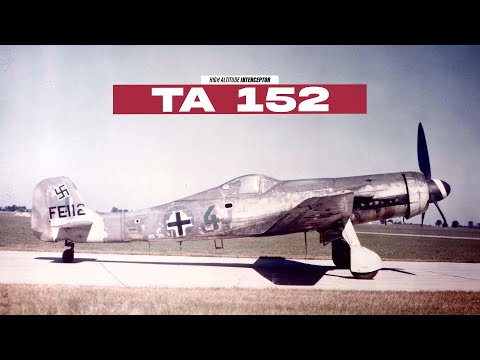
Focke-Wulf, led by the visionary Kurt Tank, stepped up to the challenge. Tank’s team took the proven Fw 190 and transformed it. They extended the fuselage, added a more powerful engine—the Jumo 213E with a two-stage supercharger—and redesigned the wings for better performance in thin air. The result was the Ta 152, an aircraft that looked like a shark and promised to be just as deadly.
But the road to production was anything but smooth. The R&D process was rushed, and quality control suffered. Critical systems like the forced induction, cockpit pressurization, and hydraulics malfunctioned. Prototypes crashed, and time was running out. By the time production began in January 1945, only about 30 hours of flight testing had been completed. Tank himself, in a moment of bravado, flew an unarmed Ta 152 to a meeting and famously outran two P-51 Mustangs, showcasing the aircraft’s potential.
Yet, potential was not enough. The Ta 152 entered service with JG 301, a unit tasked with defending the Reich. With fewer than 15 aircraft on hand and no spare parts, the odds were stacked against it. Pilots like Willi Reschke would take the fighter into combat, discovering both its brilliance and its flaws. In one engagement, Reschke’s Ta 152 chased down a Tempest, only for his cannons to jam after a few rounds. Despite this, he managed to force the enemy aircraft to crash. Such encounters were rare, and the Ta 152 never had the chance to prove itself in large numbers.
The story of the Ta 152 is one of what-ifs. What if Germany had more time? What if resources weren’t scarce? What if the aircraft had been fully developed? As the war drew to a close, these questions would linger, unanswered, in the annals of aviation history.
To understand why the Ta 152 mattered so much, you have to picture the sheer scale of the Allied bombing campaign by early 1945. Missions involving a thousand bombers were no longer exceptional—they were routine. Each raid was a rolling wall of destruction, and the Luftwaffe had to throw everything it had into the air just to contest the sky. The B-17s flew in tight, heavily armed boxes, and the P-51s ranged far ahead and above, hunting any German fighter bold enough to climb.
The Ta 152 was designed for exactly this environment. Its H model, stripped down and lightened, could claw its way to nearly 50,000 feet with the GM 1 nitrous oxide system engaged. At that altitude, the air is so thin that most fighters feel like they’re flying through molasses. But the Ta 152 was built to thrive where others suffocated. It could dive on a bomber formation at over 400 knots, fire a burst from its 30mm cannon, and vanish before the escorts could react.
That was the theory, at least. In practice, the aircraft was a maintenance nightmare. The Jumo 213E engine was a marvel of engineering, but it demanded constant care—care that was impossible to provide in bombed-out hangars with supply lines collapsing. Mechanics often cannibalized one Ta 152 to keep another flying. Hydraulic systems leaked, pressurization failed at altitude, and the GM 1 and MW 50 systems required precise tuning that frontline crews rarely had time for.
Then there was the human factor. The pilots of JG 301 were brave, but many were inexperienced—thrown into combat after minimal training as fuel shortages grounded entire squadrons. Willi Reschke was an exception, a seasoned ace who understood the Ta 152’s quirks. In his memoirs, he described the fighter as “a thoroughbred that demanded a firm hand.” Push it too hard, and it would bite. Treat it with respect, and it could outfly almost anything in the sky.
One of the most revealing episodes came on March 2, 1945, when a flight of Ta 152s was scrambled to intercept American bombers. Before they could reach the formation, they were jumped by a group of Bf 109s—German fighters whose pilots had never seen the Ta 152’s unfamiliar silhouette. In the chaotic dogfight that followed, the Ta 152s used their speed and agility to dodge the friendly fire without losing a single aircraft. By the time the confusion was sorted out, the bombers were gone.
Incidents like this highlighted both the aircraft’s capability and the dysfunction of the collapsing Luftwaffe. Radio communications were unreliable, command structures were fractured, and even the most advanced fighter in the world couldn’t fix a system that was already broken. The Ta 152 was a scalpel in a war that had become a blunt instrument.
By April 1945, the end was clearly near. Soviet forces were closing in on Berlin, and Allied bombers roamed the skies almost unopposed. The few Ta 152s still airworthy flew sporadic missions, more out of defiance than strategy. Some historians argue that the aircraft scored fewer than ten confirmed kills—a tragically small tally for a design with so much promise. Others point out that in a war of attrition, individual brilliance rarely matters.
What remains undeniable is the Ta 152’s place in aviation history. It was the pinnacle of piston-engine fighter design—a machine that combined speed, altitude performance, and firepower in a way no other propeller-driven aircraft could match. Had it entered service a year earlier, with reliable systems and trained pilots, it might have altered the air war over Germany. Instead, it became a symbol of wasted potential, a glimpse of what German engineering could achieve when unshackled from the chaos of war.
To grasp just how radical the Ta 152 was, you have to look at what it was built to kill. The B-17 Flying Fortress was a flying fortress in every sense—rugged, heavily armed, and capable of absorbing tremendous punishment. Its service ceiling of 35,000 feet put it above most German fighters, and its defensive guns made head-on attacks suicidal. The Ta 152’s answer was brutal simplicity: a 30mm MK 108 cannon firing explosive shells that could tear a bomber apart in a single burst. Combined with two wing-mounted 20mm cannons, the H model packed enough firepower to bring down even the heaviest Allied aircraft.
But firepower meant nothing if the interceptor couldn’t reach the bombers in time. This was the Ta 152’s true genius. The Jumo 213E engine, with its two-stage supercharger, delivered consistent power from sea level to over 30,000 feet. While Allied escorts like the P-51 had to fight for every ounce of performance in the thin air, the Ta 152 climbed and maneuvered as if the atmosphere were its ally. The GM 1 nitrous oxide system pushed the ceiling even higher, allowing the fighter to strike at altitudes where bomber crews believed they were untouchable.
Yet for all its technical brilliance, the Ta 152 was a machine born into a dying empire. The factories that produced it were scattered and bombed, the supply lines that fed them were severed, and the pilots who flew it were often undertrained. In the final weeks of the war, some Ta 152s sat idle on airfields, grounded not by enemy action but by a lack of fuel and spare parts. The aircraft that was supposed to save Germany instead became a monument to what might have been.
Kurt Tank, the man behind the machine, understood this better than anyone. He had designed the Ta 152 to be the ultimate high-altitude interceptor, but he had also watched his creation fall victim to the same chaos that was consuming the entire Reich. In his memoirs, Tank wrote of the frustration of seeing a brilliant design hamstrung by circumstances beyond his control. “We had built an aircraft that could outfly anything the Allies had,” he reflected, “but we could not build enough of them, and we could not keep them flying.”
The men of JG 301 who flew the Ta 152 into combat knew this reality intimately. They were among the last defenders of a crumbling sky, sent up in small numbers against overwhelming odds. Willi Reschke and a handful of other aces scored what victories they could, but the tide had long since turned. Each mission was a gamble against mechanical failure as much as enemy fire. The Ta 152’s advanced systems—the pressurized cockpit, the MW 50 injection, the hydraulic undercarriage—were marvels of engineering, but they demanded a level of maintenance that no longer existed.
By the time the war ended in May 1945, the Ta 152 had written only a brief chapter in the history of aerial warfare. Fewer than 150 aircraft had been completed, and most never saw combat. The Allies, who had captured examples of the fighter in the war’s final days, were stunned by its performance. Test pilots who flew the Ta 152 after the war reported that it was every bit as capable as Tank had promised—a fitting epitaph for a design that had been denied its moment in the sun.
In the decades since, aviation historians have debated the Ta 152’s legacy. Some see it as a tragic waste of resources, a fighter produced too late and in too few numbers to matter. Others view it as the ultimate expression of piston-engine fighter design—a machine that represented the peak of what was possible before the jet age swept it aside. What no one disputes is that the Ta 152 was a remarkable achievement, a testament to the ingenuity of its designers and the courage of the men who flew it.
The story of the Ta 152 is not just about an aircraft. It is about the collision of genius and circumstance, of ambition and reality. It is a reminder that even the most brilliant creations can be undone by forces beyond their control. And it is a warning that in war, the best technology is only as good as the system that supports it. As Kurt Tank himself once said, “An aircraft is only as good as the ground crew that keeps it flying and the pilot who understands its soul.”
In the end, the Ta 152 was a machine out of time. The war it was built for had already been lost, and no fighter, however brilliant, could turn the tide. Its few victories were flashes of what might have been, and its failures were the product of a collapsing regime. The men who flew it knew they were fighting a losing battle, but they flew anyway.
Today, the Ta 152 is remembered as a footnote, a curious footnote in the history of aviation. But for those who understand its story, it remains a symbol of ingenuity and tragedy. It was the last, best hope of the Luftwaffe, and it was never given a fair chance.
What do you think? Could the Ta 152 have changed the course of the air war if it had been available earlier and in greater numbers? Share your thoughts in the comments below.
Report this article
Select a reason for reporting:






