Winston Churchill didn’t suffer fools gladly. In fact, he barely suffered them at all. Imagine running a World War with a cabinet full of experts—men who fancied themselves the smartest in the room. Churchill, with his bulldog scowl and razor-sharp tongue, had a unique way of dealing with the dim bulbs of the 20th century. He didn’t just disagree with you; he’d dismantle your entire family tree with one sentence. His wit was a weapon, and he wielded it with the precision of a surgeon and the ruthlessness of a general.
In the corridors of power, where sycophants and incompetents lurked, Churchill stood as a beacon of unapologetic brilliance. He once remarked, “The best argument against democracy is a five-minute conversation with the average voter.” It was a line that stung because it rang true. But Churchill wasn’t just a critic of the masses; he saved his most venomous barbs for those who should have known better—the politicians, the appeasers, the fanatics.
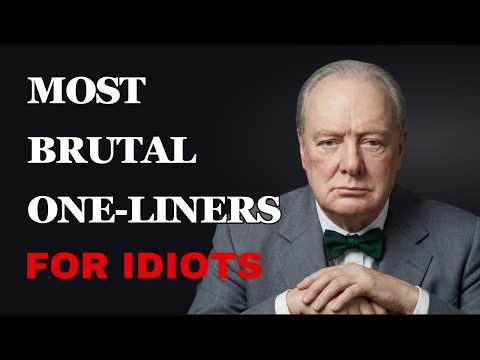
Take, for instance, his encounter with Bessie Braddock, a Labour MP who accused him of being drunk. Without missing a beat, Churchill replied, “And you, Bessie, are ugly, but I shall be sober in the morning.” The room fell silent. It was a classic Churchillian counterpunch—swift, brutal, and impossible to forget. He didn’t just win the argument; he left a scar.
But Churchill’s disdain for fools wasn’t mere entertainment. It was a survival mechanism. In a world where “a lie gets halfway around the world before the truth has a chance to get its pants on,” he understood that clarity and conviction were paramount. He saw through the empty rhetoric of his opponents, labeling one as “a sheep in sheep’s clothing” and another as “a modest man who has much to be modest about.” Each quip was a dagger, carefully aimed.
Yet, for all his contempt, Churchill knew that even fools could stumble upon the truth. “The greatest lesson in life is to know that even fools are right sometimes,” he admitted. It was a rare concession from a man who rarely conceded anything. But it revealed a deeper wisdom: that folly is universal, and even the sharpest minds must occasionally bow to the absurd.
As the war raged and the fate of nations hung in the balance, Churchill’s wit became a source of morale. He could rally a nation with a single phrase, but he could also eviscerate a rival with a single word. “When the eagles are silent, the parrots begin to jabber,” he said, a nod to the noisy incompetents who filled the airwaves with nonsense. And when asked about socialism, he didn’t mince words: “Socialism is a philosophy of failure, the creed of ignorance, and the gospel of envy.”
But the true test of Churchill’s mettle came not in the quips, but in the quiet moments of decision. He knew that “in war, resolution; in defeat, defiance; in victory, magnanimity; in peace, goodwill.” These were the principles that guided him, even as he skewered the fools around him. And as he prepared to meet his maker, he couldn’t resist one final jab: “I am prepared to meet my maker. Whether my maker is prepared for the great ordeal of meeting me is another matter.”
The room erupted in laughter. But beneath the humor lay a steely truth: Winston Churchill had faced down tyrants and fools alike, and he had done so with a wit that cut deeper than any sword. Now, as the evening wore on and the glasses emptied, one couldn’t help but wonder—what would Churchill say about the idiots of today? The answer, no doubt, would be as sharp and unforgettable as the man himself.
He would likely start with the parrots. The ones who mistake volume for wisdom, who confuse a trending hashtag with a moral crusade. “A fanatic is one who can’t change his mind and won’t change the subject,” he’d say, eyeing the endless scroll of outrage with the weary disdain of a man who’d seen real crises. The modern jabberers, he’d note, have simply traded the soapbox for the smartphone—same empty noise, faster delivery.
And what of the appeasers? Churchill had fed crocodiles before, and he knew their appetites never dulled. He’d watch today’s leaders bow and scrape before tyrants and bullies, and he’d reach for his whisky. “An appeaser is one who feeds a crocodile hoping it will eat him last,” he’d mutter, and the room would go quiet, because everyone knew exactly which crocodiles he meant.
But here was the thing about Churchill’s contempt: it was never idle. Every barb had a purpose—to puncture pretension, to expose folly, to force a flustered opponent to think. “Continuous effort, not strength or intelligence, is the key to unlocking our potential,” he’d remind the young and the restless, the ones who wanted glory without grit. He had no patience for shortcuts, no tolerance for the lazy-minded who expected the world to hand them a victory.
There was one story from the war years that his aides still whispered about. A junior minister, fresh from Oxford and brimming with theories, had cornered Churchill in the map room and lectured him—at length—on the proper strategy for North Africa. Churchill listened, puffing his cigar, his eyes half-closed. When the man finally ran out of breath, Churchill tapped the ash from his cigar and said, “Young man, you have all the virtues I dislike and none of the vices I admire. Now get out of my map room.” The minister never lectured anyone again.
That was the Churchillian method in miniature: let them talk, let them expose the shallows of their own minds, then strike with a single sentence that ended the conversation forever. “He has the gift of compressing the largest amount of words into the smallest amount of thought,” he’d said of one rival—and the description stuck like a burr for the rest of the man’s career.
Yet for all his savagery, Churchill reserved a peculiar tenderness for the honest fool—the man who knew he was out of his depth and said so. “I am fond of pigs,” he once told a startled dinner guest. “Dogs look up to us. Cats look down on us. Pigs treat us as equals.” It was his way of saying that he could respect a man who didn’t pretend to be something he wasn’t. Pretension was the sin; ignorance, at least, could be cured.
The evening was growing late, and the old man’s eyes had that faraway look—the one that meant he was somewhere else entirely, perhaps back in the bunkers of 1940, listening to the bombs fall and the parrots jabber. He reached for his glass, found it empty, and smiled a thin, knowing smile. “Kites rise highest against the wind, not with it,” he said softly, almost to himself. Then he looked up, and the glint returned to his eye. There was still work to be done, still fools to be suffered—barely—and still a world to be saved from its own worst instincts.
The old man set the empty glass down with a click that sounded louder than it should have. Somewhere down the corridor, a young aide was rehearsing a speech, his voice rising and falling in that earnest, cadenced way that Churchill had come to recognize as the sound of a man who had nothing to say and was determined to say it at length.
“Listen to that,” Churchill said, tilting his head toward the door. “He’s been at it for an hour. I do believe he’s practicing the art of saying nothing with tremendous conviction.” He reached for the decanter, thought better of it, and folded his hands across his waistcoat instead. “You know, there was a time when a man had to earn the right to bore a room. Now they simply assume it.”
The aide appeared in the doorway, papers clutched to his chest, and Churchill waved him in with the resigned air of a man granting an audience he already regretted. The young man launched into his proposal—something about a committee, a subcommittee, and a working group to oversee the subcommittee’s findings. Churchill’s eyelids drooped. His cigar had gone out.
When the aide finally paused for breath, Churchill opened one eye. “Tell me, young man, do you know what a committee is?” The aide blinked. “A committee is a group of men who individually can do nothing but collectively decide that nothing can be done. And you, sir, have just proposed three of them.” The aide opened his mouth, closed it, and retreated with his papers, the tips of his ears a brilliant scarlet.
Churchill watched him go and permitted himself a small, satisfied sigh. “There is no such thing as a good tax,” he murmured, apropos of nothing, “but there is such a thing as a well-placed word. It saves one the trouble of a second sentence.” He had always believed that brevity was the soul of both wit and warfare—strike once, strike clean, and let the silence do the rest.
But the night was not yet done with him. A telegram arrived, borne by a breathless messenger, and Churchill read it with the flat, unreadable expression he reserved for news that could go either way. He set it down, tapped his fingers twice against the table, and looked up with something that might have been amusement.
“Well,” he said, “it appears the parrots have found a new perch. They wish to debate me on the wireless—three of them against one of me, and they’ve promised to be ‘fair.'” He snorted. “Fair, they call it. Three men who couldn’t agree on the time of day, united only in their conviction that I am the problem.” He rose, straightened his waistcoat, and reached for his hat.
“Shall I decline?” the aide asked, hovering at the threshold.
Churchill paused, hat in hand, and the ghost of a grin crossed his face. “Decline? My dear boy, a man who declines a fight has already lost it. No—I shall go, and I shall let them talk until they’ve hung themselves with their own words. Then I shall say one sentence, and it will be the last word anyone remembers.” He settled the hat on his head and nodded toward the door. “Fetch my coat. The eagles are silent tonight, but I’ve a mind to make the parrots sing.”
The wireless studio was hot and smelled of dust and nervous sweat. The three parrots sat in a row, shuffling papers, while Churchill settled into his chair like a man lowering himself into a warm bath. The producer counted down, the red light blinked, and the jabbering began.
They talked over one another, quoted statistics they’d invented that morning, and accused him of everything short of burning down London himself. Churchill puffed his cigar, examined his fingernails, and let the tide wash over him. When the moderator finally turned to him, breathless, he leaned into the microphone.
“Gentlemen,” he said, “you have all the virtues I dislike and none of the vices I admire. I wish you good night and a long silence.” Then he stood, tipped his hat to the stunned producer, and walked out into the cool dark street.
The next morning, the newspapers carried the whole exchange, but only one line was quoted. The parrots had sung for an hour and were forgotten by breakfast. “When the eagles are silent,” Churchill had written in the margin of his own script, “the parrots begin to jabber—but the eagles still decide where the wind blows.”
He went home, poured a whisky, and took the nap he’d promised himself. The world could wait an hour. It usually did.
So here’s the question for you: if Churchill were alive today, which modern parrot would he silence first—and what one sentence would he use?
Report this article
Select a reason for reporting:






