May 9, 1943. Horanda, New Guinea. The air hangs thick with humidity and the acrid smell of hot metal. Inside a cramped mobile machine shop truck, two men are locked in a race against time. Private First Class George Chapman and Sergeant John Epard of the 741st Ordnance Company, 41st Infantry Division, are not on the front lines, but their battle is just as critical. Every weapon repaired, every vehicle fixed, every piece of equipment restored means one more chance for their comrades to survive.
The Pacific campaign is a brutal test of endurance. Mud, rust, and relentless enemy fire wear down men and machines alike. But here, in the dim light of a workshop on wheels, Chapman and Epard fight back with wrenches and welding torches. “We keep them moving,” Epard might say, his voice barely audible over the hum of the generator. “Without us, the division stops.” Their work is unglamorous, unseen by most, but it is the backbone of the entire operation.
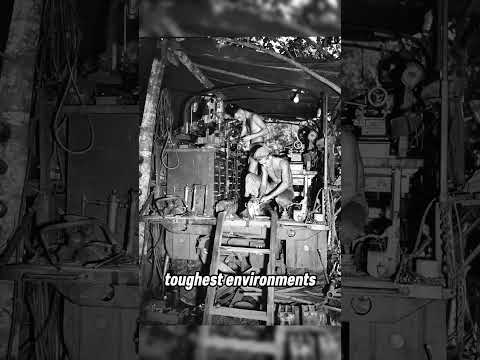
The image captures a moment frozen in history: Chapman bent over a lathe, Epard inspecting a damaged part. Outside, the jungle pulses with heat and danger. Inside, it’s a different kind of heat—the intense focus of men who know that a single mistake could cost lives. They are the mechanics of war, the fixers of broken things, and their story is one of quiet heroism.
But this is just one snapshot of a much larger struggle. The 41st Infantry Division, known as the Jungleers, would go on to face some of the fiercest fighting of the Pacific theater. And through it all, the mobile machine shops would roll on, setting up wherever needed, turning chaos into order one repair at a time.
As the sun sets over Horanda, Chapman wipes grease from his brow and glances at Epard. “Tomorrow we’ll have another batch,” he says. Epard nods. There is no time to rest. The war waits for no one, and the machines must be ready. Little do they know, the toughest battles are yet to come—and their skills will be tested in ways they never imagined.
The next morning arrives with a crack of thunder that rattles the tin walls of the truck. Rain hammers the canvas roof, and the floor becomes a shallow river of mud and oil. Chapman is already at the bench, a disassembled Browning automatic rifle spread before him like a patient on an operating table. Epard ducks in through the flap, water streaming off his helmet, carrying a crate of fouled carbines.
“Straight from the line,” Epard says, setting the crate down with a grunt. “Salt water got into half of them. The boys swear the surf ate their rifles alive.” Chapman picks one up, turns it in the lamplight, and frowns at the orange bloom of rust creeping along the receiver.
Outside, the jungle is a wall of green and noise. Somewhere beyond the palms, artillery thuds in a slow, distant rhythm—the front reminding them it hasn’t forgotten. The two men work without speaking, falling into the old rhythm: strip, clean, oil, reassemble, test. Each rifle that passes inspection earns a small chalk mark on the crate’s lid.
By midday, the heat inside the truck has climbed to something close to unbearable. Chapman pauses to wipe his hands on a rag that is more grease than cloth. “Epard,” he says quietly, “how many is that now?” Epard checks the marks. “Twenty-three. And more coming.”
It is then that a jeep skids to a halt outside, its engine coughing and sputtering. A young lieutenant jumps out, his uniform dark with rain. “Sergeant! We’ve got a problem—the radio truck’s generator is dead, and we’ve got a convoy moving at dawn. No radio, no coordination.” Epard exchanges a look with Chapman. The generator isn’t their assignment. But out here, assignments have a way of blurring.
“Give us an hour,” Epard says. The lieutenant blinks. “An hour?” “Maybe two,” Chapman adds, already reaching for his tool roll. “Depends how dead it is.” The lieutenant nods, relief breaking through the worry on his face, and runs back to the jeep.
The generator sits in the back of the radio truck like a stubborn, oil-caked heart. Chapman kneels beside it, listening, tapping, tracing fuel lines with his fingers. Epard stands over him, holding a flashlight against the fading light. “Carburetor?” Epard asks. Chapman shakes his head slowly. “Worse. Bearings. Sand got in.” He looks up, jaw tight. “We’ll have to pull it apart and hope the spares box has what we need.”
The rain returns as they work, drumming a steady beat on the truck’s roof, and the jungle darkens around them. Chapman’s hands move with a surgeon’s certainty, each bolt and washer laid out in careful rows on an oilcloth. Epard watches the perimeter, one eye on the treeline, because out here the enemy is never far and the sound of engines carries.
Somewhere in the dark, a soldier is waiting for a radio that doesn’t work, for a convoy that must roll at dawn. And in the cramped glow of a flashlight, two mechanics refuse to let the machine win.
The spares box yields a set of bearings that are close, but not exact—salvaged from a wrecked jeep months ago and kept against a day exactly like this one. Chapman holds them to the light, measuring with a caliper, and grunts. “They’ll do. Not perfect, but they’ll do.” Epard nods and hands him the grease gun. The work goes faster now, urgency sharpening their focus.
An hour past midnight, the generator coughs, sputters, and then roars to life—a deep, steady thrum that fills the radio truck with sound. The lieutenant appears at the flap, his face lit up like a man who has just heard his own reprieve. “You did it. I don’t know how, but you did it.” Epard just wipes his hands on his trousers. “Keep the sand out of it, Lieutenant. That’s all we ask.”
They stagger back to their own truck through the mud, boots sinking with every step. Chapman is asleep before his head hits the cot, still wearing one glove. Epard sits up a while longer, listening to the rain and the distant guns, and thinks about the convoy that will roll at dawn because of a pair of bearings and a stubborn refusal to quit.
The morning brings new orders, and they are not the kind anyone wants. A runner arrives soaked to the bone, handing Epard a folded slip of paper. He reads it twice, then passes it to Chapman without a word. “Forward repair unit,” Chapman reads aloud. “Attach to Second Battalion. Immediate.” He looks up. “That’s the front, Epard. That’s not behind the lines anymore.”
Epard is already pulling down crates, sorting tools into canvas rolls. “Then we’d better pack light and pack fast. The front needs fixing too.” There is no argument in his voice, only the flat certainty of a man who has long since stopped asking whether a job is safe and started asking only whether it is necessary.
They load the truck in silence, each tool placed with the care of a man who knows he may not see it again. The mobile shop will roll toward the sound of the guns, and whatever waits out there in the green tangle of New Guinea, Chapman and Epard will meet it the only way they know how—with steady hands and a stubborn heart.
The road to the front is a churned ribbon of mud, and the truck lurches through it like a wounded animal. Chapman drives while Epard watches the treeline, both of them silent, both of them thinking the same thing. “If the shop takes a hit,” Chapman finally says, “we lose everything. Every tool, every spare.” Epard doesn’t look at him. “Then we don’t let it take a hit.”
Second Battalion is dug in along a low ridge, and the men there greet the truck with hollow eyes and open hands. A mortar has cracked a machine gun’s mount, a jeep’s axle is snapped clean, and the battalion’s only working radio is spitting static into the mud. Chapman and Epard set up beneath a camo net and go to work before their boots have even dried.
For three days the guns never stop. They weld, they file, they hammer, they coax dead engines back to coughing life. “You two are worth a whole company,” a major tells them, and Epard just shrugs. “We’re worth one working gun at a time, sir. That’s all.”
On the fourth night, the shelling finds them. The blast throws Chapman against the truck’s wheel and knocks the breath from his lungs. When the ringing fades, he crawls through the smoke and finds Epard pinned beneath a fallen crate, blood on his temple, but breathing. “Still here,” Epard mutters. “Told you. We don’t let it take a hit.”
They patch each other up the same way they patch the machines—rough, quick, and without complaint. By dawn the truck is rolling again, and the division moves forward, and somewhere in the green hell of New Guinea two mechanics keep the war machine alive one repair at a time.
Years later, long after the guns fall silent, the photograph from Horanda will hang in a small museum, and visitors will pause before it and wonder who these men were. They were the ones who fixed what was broken, who asked for nothing and gave everything, who understood that victory is built as much from wrenches as from rifles.
What would you have asked George Chapman or John Epard if you could sit beside them in that cramped, oil-stained truck and hear their story in their own words?
Report this article
Select a reason for reporting:






