The sky over Europe belonged to the enemy. In the summer of 1941, a new German fighter, the Focke-Wulf Fw 190, tore through British formations with brutal efficiency. RAF pilots, accustomed to the legendary Spitfire, suddenly found themselves outclassed. “They were faster, they could climb better, and they could dive away at will,” recalled one surviving pilot. The Butcher Bird had arrived, and Britain’s air superiority was shattered.
Desperation gripped the Air Ministry. They needed a miracle—or a machine—to turn the tide. That miracle would come from an unlikely alliance: an American airframe and a British engine, born of pride, genius, and a twist of fate.
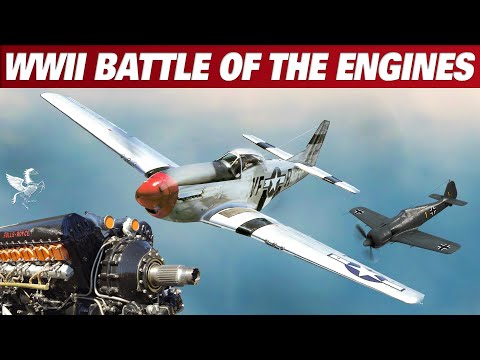
Across the Atlantic, North American Aviation had designed the P-51 Mustang to satisfy a British order. But the early Mustangs, powered by the Allison V-1710, performed poorly above 15,000 feet. The RAF’s test pilot, Ronald Harker, saw the flaw immediately. The Mustang was a thoroughbred hitched to a plow horse.
Then came a radical idea. What if they married the Mustang to the Rolls-Royce Merlin, the same engine that powered the Spitfire? On paper, the combination was explosive: a fighter that could outrun anything in the sky, with range to escort bombers all the way to Berlin.
But national pride stood in the way. The Americans balked at using a British engine. The British doubted the American airframe. Yet the Fw 190 left them no choice. As the Luftwaffe’s butcher birds ranged freely over France, engineers on both sides swallowed their pride. The marriage was arranged.
The result was the P-51B, a fighter that could “climb like a homesick angel and run like a scalded cat,” as one pilot put it. With drop tanks and a new two-stage supercharged Merlin, the Mustang now had the legs to go the distance. The tide was about to turn.
But the story of how this union came to be—and the men who fought to make it happen—is a tale of genius, stubbornness, and a race against time. It began not in the halls of power, but in the mind of a young British engineer named Frank Whittle, whose invention would one day render the piston engine obsolete.
While the Mustang and Merlin were being wedded in Britain, another revolution was brewing across the Atlantic. In October 1941, a top-secret crate arrived in Boston, carrying the future of aviation inside it. The Whittle W.1X turbojet, packed in pieces, had crossed the ocean under armed guard. General Electric engineers unboxed it with trembling hands.
They had six months to build their own version. They did it in five. “The Americans didn’t just copy it—they industrialized it,” one observer noted. Bell Aircraft, meanwhile, was designing an airframe to house two of these strange, propeller-less engines.
The result was the Bell XP-59A Airacomet. On October 1, 1942, it lifted off from a dry lake bed in California. The pilot, Robert Stanley, later admitted he was terrified. “It flew like a truck with wings,” he said. But it flew. America had entered the jet age.
Back in Britain, Frank Whittle watched from the sidelines as others reaped the rewards of his genius. The Air Ministry had nationalized Power Jets, stripping him of his company. “They took the engine from my hands and gave it to men who had never believed in it,” he wrote bitterly.
Yet Whittle’s mind never stopped racing. He sketched designs for a turbofan—an engine that could push air both through the core and around it, promising far greater efficiency. He filed patents. He wrote proposals. The Ministry filed them away, unread.
Meanwhile, the Gloster Meteor finally entered service in July 1944. It was fast, deadly, and—most importantly—British. But it never met the Messerschmitt Me 262 in decisive combat. The war in Europe was ending, and the jet age was arriving too late to change its outcome.
Whittle, exhausted and ill, was pushed aside. “I paid a terrible price for my work,” he later reflected. “The race against time dominated my life—and it took everything from me.” But his invention had changed the world forever, and the men who flew it knew the debt they owed.
Yet the jet engine was not the only revolution in the air. As Whittle’s turbines spun in secret workshops, another kind of genius was at work in the design halls of North American Aviation. The Mustang’s transformation was complete, but the men who built it knew the fight was far from over.
By early 1944, the P-51B and C models were arriving in England in growing numbers. The pilots who climbed into their cockpits found a machine that felt almost too good to be true. It was fast, agile, and—with its drop tanks—capable of flying deep into the heart of Germany and back.
The Luftwaffe noticed. German pilots, who had once laughed at the Mustang’s poor high-altitude performance, now faced a fighter that could match their Fw 190s and Bf 109s at any altitude. “The Mustang was everywhere,” recalled one German ace. “You could not shake it, and you could not outrun it.”
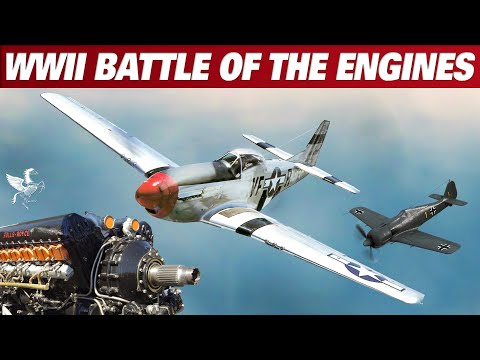
But the Mustang’s greatest triumph was not in dogfights—it was in the bomber escort role. American B-17s and B-24s had been suffering catastrophic losses over Germany. Without long-range escort, the bombing campaign was unsustainable. The Mustang changed everything.
On March 6, 1944, the Eighth Air Force launched its first major raid on Berlin with Mustang escorts. The bombers reached their targets and returned with minimal losses. The Luftwaffe, caught off guard, scrambled to respond. For the first time, American fighters were waiting for them over the Reich’s capital.
Hermann Göring, commander of the Luftwaffe, saw the reports and understood. The Mustangs over Berlin were not just an escort—they were a declaration of defeat. “When I saw the Mustangs over Berlin, I knew the jig was up,” he later admitted. The war in the air had turned decisively in the Allies’ favor.
Yet even as the Mustang dominated European skies, Frank Whittle’s jet engines were being fitted to the Gloster Meteor, and the first operational jet squadrons were forming. The two technologies—piston and jet—would briefly overlap, each pushing the other to its limits.
In the Pacific, the Mustang faced a different challenge. The vast distances of the ocean made even its impressive range insufficient for escorting B-29s over Japan. North American engineers responded with a radical solution: the twin Mustang, two fuselages joined by a shared wing and tailplane.
The F-82 Twin Mustang was a strange-looking beast, but it had range to spare. With two pilots sharing the workload on long missions, it could fly over 2,000 miles. It arrived too late for World War II, but it would find its place in the Korean War, serving as a night fighter and ground-attack aircraft.
Whittle, meanwhile, watched from the sidelines as his invention reshaped the world. He had been pushed out of Power Jets, his health broken, his contributions half-forgotten. But history would remember him—even if Britain, for a time, chose not to.
In 1948, a knighthood finally came, but no company would hire the man who had invented the jet engine. “I paid a terrible price for my work,” Whittle reflected. “The race against time dominated my life—and it took everything from me.” He retreated to America, where von Ohain—his former rival—became his closest friend. Together, they watched their creations shrink the world.
The Mustang, meanwhile, fought on in Korea, its Merlin roaring over new battlefields. By then, the jet age had dawned, and the piston fighters were fading into memory. But the marriage of American airframe and British engine had done its work: it had broken the Luftwaffe and opened the road to Berlin.
Frank Whittle died in August 1996. His ashes were flown to Cranwell, where a Meteor and a Vampire dipped their wings in salute. The boy who had dreamed of flight had given the world its wings—and asked for so little in return.
So here is the question: When genius is ignored, who pays the greater price—the inventor, or the nation that turns him away?
Report this article
Select a reason for reporting:






