The rain hammered against the windows of Harrison’s Auction House in Richmond, Virginia, as Dr. Amelia Grant examined a collection of Civil War–era photographs. She had spent twenty years studying American history at Howard University, but nothing had prepared her for what she was about to find.
Most of the lot was ordinary: stiff portraits of wealthy families, plantation homes, formal gatherings frozen in silver and glass. Then her fingers stopped on a single image.
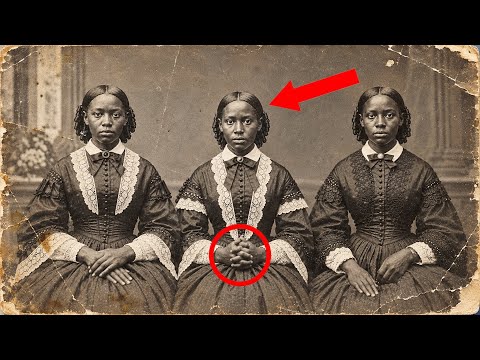
Three young Black women seated in an ornate parlor, wearing silk dresses that would have been expensive even by the standards of wealthy white families. Their hair was elegantly styled, their postures flawless. But it was their hands that made Amelia’s breath catch in her throat.
Each sister held her hands in a distinctive position on her lap. The eldest had her right hand over her left, fingers slightly splayed. The middle sister’s hands were clasped, but her thumbs crossed in an unusual pattern. The youngest rested one hand flat while the other formed a subtle shape against the dark fabric of her skirt.
Amelia had seen hand positions in Victorian photographs before—often dictated by photographers seeking aesthetic balance. But these felt deliberate, encoded, intentional.
She turned the photograph over. On the back, in faded script: “The Kingsley Sisters, Charleston, 1863.”
“Find something interesting?” asked Marcus Webb, the auction house manager, appearing beside her.
“These women,” Amelia said, not lifting her eyes from the image. “Do you know anything about them?”
Marcus shrugged. “The previous owner left no documentation. We assume they were free women of color, perhaps from a wealthy family. The dresses alone suggest significant means.”
Amelia studied the photograph again. Something was wrong. In 1863, Charleston was deep in Confederate territory. The idea of three Black women sitting for such an elaborate portrait in luxurious clothing at the height of the Civil War seemed nearly impossible.
“I’d like to purchase this photograph,” she said quietly.
“The entire collection is being sold as a single lot.”
She raised her eyes to his. “Then I’ll take the entire collection.”
Back at her office at Howard University, Amelia pinned the photograph to her research board and began her investigation. The first question was simple: who were the Kingsley sisters?
She started with Charleston census records from the 1860s. Free Black families were rare in South Carolina; those with significant wealth were rarer still. After three days of searching, she found nothing. No family named Kingsley appeared in any record she could locate. She expanded her search to church records, property transactions, tax documents. Nothing.
It was as if they had never existed.
“Maybe Kingsley wasn’t their real name,” suggested her graduate assistant David, who had become as obsessed with the mystery as she was. “If they were hiding something, maybe they used an alias.”
Amelia considered this. It made sense. But why would three Black women need to hide their identities in a photograph? And who had taken the picture in the first place?
She examined the photograph under magnification, searching for any identifying marks. Victorian photographers often stamped their work, leaving signatures or studio names prominently on the paper. Then she found it. In the bottom right corner, nearly invisible to the naked eye, was a small embossed stamp: J.R. Whitmore, Charleston.
A quick search revealed that Jonathan Whitmore had operated a photography studio in Charleston from 1858 to 1867. He was white, from a prominent family, and had documented much of Charleston’s elite society during the war years. But why would a white photographer from a Confederate family take such an elaborate portrait of three Black women?
Amelia dug deeper into Whitmore’s history and discovered something unexpected. After the war, Whitmore moved north to Boston, where he became involved in abolitionist causes and donated substantial sums to freedmen’s schools.
“He changed his loyalties,” Amelia murmured, staring at the screen. Or perhaps he had never been on the side they thought.
The next morning, she booked a flight to Charleston. The answers she needed weren’t in databases or archives. They were in the city where the photograph had been taken, buried in a history Charleston had preferred to forget.
Charleston in October still carried the weight of summer, the air thick with humidity and the scent of magnolias. Amelia checked into a small hotel near the historic district and made her way to the South Carolina Room of the Charleston County Public Library.
The archive librarian, an elderly woman named Dorothy, listened carefully as Amelia explained her research. “Jonathan Whitmore,” Dorothy repeated, narrowing her eyes. “That’s a name I haven’t heard in years. My grandmother used to talk about him.”
Amelia leaned forward. “Your grandmother knew him?”
“She knew of him. She was a child during Reconstruction, but she remembered the stories. Whitmore wasn’t just a photographer. According to family legend, he was something far more dangerous to the Confederacy.”
Dorothy led Amelia to a restricted section of the archive where fragile documents were kept in climate-controlled cabinets. She retrieved a small leather-bound notebook, its pages yellowed with age. “This was donated anonymously in 1952,” Dorothy explained. “We didn’t know who it belonged to until a researcher in the 1980s identified the handwriting as Whitmore’s.”
Amelia opened the notebook carefully. The entries were cryptic, filled with references to packages delivered and routes confirmed. Then she found an entry dated March 1863.
“The three sisters sat for their portrait today. The message is embedded within. If our friends in the North understand the code, the next crossing will proceed as planned. God protect them all.”
Amelia’s hands trembled. He had been using photographs to send coded messages.
Dorothy nodded slowly. “The Underground Railroad didn’t end when the war began. It evolved, and Whitmore was part of it.”
Amelia photographed the notebook entry and read on. Whitmore wrote that the sisters’ real names were not Kingsley at all. They were Clara, Ruth, and Viola. They had escaped a plantation in Georgia three years earlier and were living under assumed identities in Charleston, working as seamstresses for a sympathetic white family. But they were not merely survivors—they were conductors.
Over the following week, Amelia traced every reference to Clara, Ruth, and Viola in Whitmore’s notebook. The photographer was meticulous, recording not only his subjects but the system they had developed together.
The hand positions in the photographs were not random—they were a language. According to Whitmore’s notes, the sisters had devised a visual code using hand placements, finger positions, and the arrangement of objects within the frame. Each combination conveyed specific information: safe houses, dangerous routes, crossing times, names of allies and enemies.
The photographs were then distributed through a network of abolitionists disguised as art collectors, traveling merchants, even Confederate sympathizers who had secretly changed their allegiance. The images passed through checkpoints and inspections without raising suspicion because they looked like nothing more than ordinary portraits.
“They were hiding in plain sight,” Amelia explained to David over a video call. “The Confederates saw what they expected to see—Black women in fine clothes, probably servants dressed up by their owners for a vanity portrait. They never imagined these women were transmitting military intelligence right under their noses.”
David was silent for a moment. “How many photographs are we talking about?”
Amelia reviewed her notes. “Whitmore’s diary mentions at least forty portraits taken between 1862 and 1865. Most featured the sisters, but some included other members of the network. Each photograph carried different information.”
“And the one you found at the auction?”
Amelia looked at the photograph pinned to her board. According to the diary entry from March 1863, this image confirmed that the Combahee River route was safe for passage. Three months later, Harriet Tubman led the Combahee River Raid, liberating more than 750 enslaved people.
David grasped the implication immediately. “Are you saying the sisters helped plan the raid?”
“I’m saying their photograph may have been part of the intelligence that made it possible.”
Amelia’s research led her to descendants of the White family who had sheltered the sisters in Charleston. The great-great-granddaughter, Helen, kept family records and lived in a restored antebellum home on the outskirts of the city. Helen was in her seventies, sharp-eyed and guarded. She had spent years protecting her family’s complicated history and was reluctant to share it with outsiders.
“My ancestors were Confederates,” Helen said as she poured tea in her formal parlor. “At least, that’s what their neighbors believed. The truth was more complicated.”
She explained that her great-great-grandmother Elizabeth had run a sewing business that employed free Black women. On the surface, it was a respectable enterprise. In reality, it was a cover for one of the most sophisticated intelligence operations of the Civil War.
“Elizabeth’s husband was a Confederate officer,” Helen continued. “He had access to troop movements, supply routes, military plans. He passed that information to Elizabeth, who encoded it into dress patterns and fabric designs. The seamstresses then incorporated those patterns into the clothing they made.”
“And the photographs?” Amelia asked.
Helen nodded. “The dresses in Whitmore’s portraits weren’t just beautiful. They were messages. The lace pattern on a collar, the number of buttons on a sleeve, the arrangement of ribbons—all of it meant something.”
Amelia’s mind raced. The sisters hadn’t just been using coded hand positions. Their entire clothing had been part of the message.
“How was this information decoded?”
Helen rose and walked to an antique desk. She withdrew a small, worn booklet and handed it to Amelia. “This was my great-great-grandmother’s codebook. It explains how to read the patterns.”
Amelia opened the booklet with trembling hands. Inside were precise drawings of clothing elements paired with their meanings. A rose pattern meant safe passage. Vertical stripes indicated danger. A particular arrangement of lace specified the number of people waiting for transport.
The sisters weren’t just sending messages. They were relaying entire escape plans.
Armed with the codebook, Amelia returned to the photograph of the three sisters and began decoding every element. It took days of meticulous analysis, cross-referencing Whitmore’s diary with Elizabeth’s cipher and the historical records of the period.
The message embedded in the March 1863 photograph was more detailed than Amelia had imagined. Clara’s hand position specified a time frame—the first week of June. Ruth’s clasped hands with crossed thumbs indicated a location: the Combahee River crossing. Viola’s flat palm and curved fingers pointed to a number: approximately 700.
The dress patterns added layers of detail. The lace on Clara’s collar indicated that Union gunboats would provide cover. The buttons on Ruth’s sleeves confirmed the securing of local guides. The arrangement of ribbons on Viola’s bodice identified the operation’s leader, a woman known by the code name “Moses.”
Harriet Tubman.
Amelia leaned back in her chair, stunned by the implications. The Combahee River Raid was one of the most successful military operations led by a woman in American history. Tubman had guided Union forces through the river, liberating more than 750 enslaved people in a single night. Historians had always wondered how Tubman obtained such precise intelligence about Confederate positions, mine placements, and the locations of enslaved quarters on the plantations.
Now Amelia had found the answer. The information had been gathered by a network of Black women who worked in plain sight, encoded in photographs and dress patterns, and relayed through a system so ingenious that the Confederacy never suspected its existence.
“They were spies,” Amelia whispered. The most effective spies of the Civil War, and history had forgotten them entirely.
She thought of all the monuments to Confederate generals, all the textbooks celebrating military strategists, all the museums preserving weapons and uniforms. Yet these three women, whose courage and intelligence had helped liberate hundreds, had faded into obscurity—until now.
The question that haunted Amelia was what happened to Clara, Ruth, and Viola after the war. Whitmore’s diary ended in 1865, and Elizabeth’s records went silent after Richmond fell.
Then, after weeks in Freedmen’s Bureau archives, she found it: a Savannah registration document from November 1865, listing three sisters applying for marriage licenses on the same day—all described as teachers.
Teachers. Amelia traced them to a freedmen’s school, where Clara taught literacy, Ruth taught mathematics, and Viola taught music—and, according to one report, used her gift for ciphers to teach children to read.
She found a letter Clara wrote in 1867: “We were never mentioned in the history of the war. But we knew freedom required more than battles. It required intelligence, patience, and the courage to hide in plain sight.”
Amelia tracked their descendants across Chicago, Detroit, and Atlanta—and in 2021, the Smithsonian opened Hidden in Plain Sight: The Secret War of the Spy Seamstresses. At the opening, eighteen descendants stood before the portrait.
Later, at the Charleston waterfront, Amelia photographed a small plaque and sent it to them: “They are remembered. They will not be forgotten again.”
But how many other photographs still sit in archives, their silent messages waiting for someone to finally look closely enough?
Report this article
Select a reason for reporting:






