The first thing you learn in Vietnam is that the jungle has teeth, not metaphorical teeth. Real ones: leeches that latch and swell, ants that stitch fire into your skin, bamboo that slices like a hidden blade, and heat that doesn’t sit on you like a blanket. It crawls inside you, thick as steam, and starts turning decisions into mistakes.
And the second thing you learn, if you survive long enough, is that the jungle listens. It listens to metal. It listens to breath. It listens to the click of a safety, the whisper of nylon, the crack of a twig you didn’t know you stepped on until the sound is already gone and the damage is already done.
So here’s the question that doesn’t get asked in the clean war stories, the ones told over cold beer and bright lights, far from the smell of rotting vegetation and cordite and human fear. What happens when a unit shows up that the jungle can’t hear? What happens when the men moving through it don’t fight the bush—they become it?
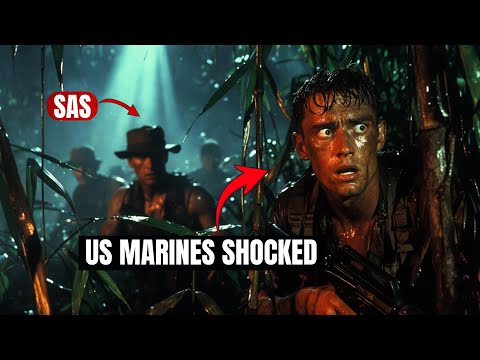
Because in the late 1960s, when Vietnam was swallowing battalions whole, when the war was loud with helicopters and artillery and search and destroy, a handful of soldiers from the other side of the world stepped into the green and did something that broke the American understanding of jungle warfare. Not with new technology, not with more firepower—with silence, with patience, with an endurance so unnatural it didn’t look like courage. It looked like something else.
And when US Marines—men who had walked the hard miles and paid the hard prices—saw what these Australians were doing out there, they didn’t laugh. They didn’t argue. They stared. And more than one of them said the same thing in different words, like it was the only honest reaction their minds could produce: “What are these blokes made of?”
Because there are legends in every war. And there are the things men whisper about when they’re not trying to sound brave. This is one of those things. A story about a unit that moved like predators and vanished like ghosts. Men whose existence was often discussed like a rumor, whose methods felt like heresy, and whose reputation spread into enemy camps as a kind of contagious dread. A unit that didn’t just fight in Vietnam—it haunted it.
And the truth, the documented, sober truth, sits under the legend like a landmine you don’t see until it’s too late. Because the strangest part isn’t what they did. It’s how they did it—and what it did to everyone watching, including the enemy, including their allies, including the Americans who thought they’d already seen everything Vietnam had to offer.
You think you know jungle war. You think it’s ambushes and firefights and helicopters dumping men into a clearing. But the canopy sealed out the sky and the ground itself seemed alive. Another war was being fought. A quieter one. A closer one. A war of nerves. A war where the first shot was the last thing you heard.
The air here is wet enough to drink. It tastes like leaves and rust. It smells like stagnant water, mold, gun oil, and the sweet-sour of vegetation decaying so fast it feels like it’s happening in real time. Every breath is heavy. Every movement is negotiation—with vines, with mud, with heat, with the knowledge that somewhere out there unseen eyes are calculating whether you’re worth the ammunition or whether a knife will do.
And in that suffocating green, a patrol moves. Not a platoon, not a company—a handful. Four, five, sometimes six. So small it feels ridiculous, like sending a matchstick into a storm. They wear the bush like it belongs to them: faces darkened, gear stripped down to the bone, no jangling metal, no loose straps, no bright tape. Their boots are quiet—or sometimes there aren’t boots at all, just careful feet that know the language of ground.
They don’t walk like conventional infantry. They glide. They stop for long stretches, not because they’re lost, but because they’re listening to the jungle breathe. They don’t talk—not whispers, not murmurs, not even the soft curses that men use to prove they’re still human. Hand signals only: a tilt of the chin, a slow fist, two fingers slicing the air like a blade.
And behind them, far behind, miles behind, somewhere in the civilized geometry of sandbags and wire, there are Americans watching them prepare with a kind of discomfort. US Marines have their own legends, their own hard-earned arrogance. Men who have done amphibious landings in hell, who have held hills under artillery, who have watched friends vanish into smoke. But this—this isn’t the Marine way. This is something older, something that feels like it belongs to hunters, not soldiers.
And that’s the first crack in the viewer’s certainty. Because the war you think is about loud power is also about invisible control. And these Australians—these long-range reconnaissance men, these special operators—weren’t trying to win by being louder. They were trying to win by making the enemy feel watched, by making them feel hunted. By making them feel like the jungle itself had turned against them.
The unit doesn’t announce itself with flags or speeches. It arrives like a rumor carried on humid air. They have a name, officially. But out there, in the mouths of the men who fear them most, names change. Ghosts. Phantoms. Jungle men. Sometimes the enemy doesn’t even name them. Sometimes it’s worse. Sometimes the enemy just starts describing the effect: sentries found in places that should be safe. Footprints that appear where no one should be able to walk. Patrols that vanish and leave behind nothing but the feeling that something stood close enough to smell their sweat—and chose not to kill them.
And then there are the Americans—some skeptical, some curious, some quietly unsettled—who attach themselves as observers, liaison, learning, watching men who came expecting to teach. Men who leave wondering if they’ve been walking through Vietnam like lanterns in the dark. Because these Australians aren’t just enduring the bush. They are dominating it.
And it’s not because they’re superhuman. It’s because they’re disciplined in a way that looks almost insane from the outside. Here, the jungle makes most men hurry. It makes them noisy. It makes them want to break the silence just to prove they haven’t disappeared. It makes them take the obvious path—the trail, the track, the open line—because the bush punishes every step off it. These Australians do the opposite.
They go where you don’t want to go. They move when you don’t want to move. They stop when every nerve in your body screams that stopping is death. And they stay out. Not for hours, not for a day—for days. Long enough that time stops feeling like a clock and starts feeling like a pressure. The sun rises and dies behind the canopy and you can’t see it. Only feel the temperature shift and hear the insects change their song.
Nights are blacker than black. Not poetic black. Practical black. The kind where your hand disappears in front of your face. Where your ears become your eyes and every sound becomes a question. A branch snaps far off. Was it wind or was it a foot placed badly? A frog croaks. Is it a frog? Or is it a signal? A faint metallic click. Is it a rifle? Or is it your imagination trying to keep you alive?
And through all of it, the Australians do something that breaks the American brain. They make the jungle their ally. They use stillness as a weapon. They use restraint as dominance. They use the enemy’s expectations like a wire trap—because conventional logic says you find the enemy, you engage. They don’t. Sometimes they watch an enemy unit walk past. Close enough to smell rice and tobacco. Close enough to hear the soft cough of a man trying not to cough. And they don’t fire. They let them go.
And that’s when the Marines start to realize the terrifying truth. These men aren’t hunting for bodies. They’re hunting for information. They’re hunting for patterns. They’re hunting the war itself. And if they choose to kill, it’s not to prove they can. It’s to bend the enemy’s mind. To make a place feel cursed, to make a trail feel watched, to make a commander doubt his own control.
Now the story tightens. Because we’re not staying in the abstract. We’re going into a moment. A single stretch of time where everything about this legend becomes real, where endurance becomes a blade, where silence becomes a trap, and where a handful of men turns the jungle into a prison.
A patrol is inserted before dawn. The helicopter doesn’t land. It hovers, rotors chopping the humid air into a violent wind that flattens elephant grass and shakes leaves loose like a green rain. The men drop fast, controlled, disappearing into the foliage before the sound can paint a target on them. Then the helicopter is gone and the world becomes close again. No radio chatter. No comforting noise—just the wet hiss of insects and the slow heartbeat of the bush.
They move in a line that doesn’t look like a line. Spacing measured in instinct. Eyes scanning not just forward, but up, down, behind. Because in Vietnam, the jungle is three-dimensional. The ground can kill you. So can the trees. So can the holes you don’t see until you’re falling into them.
They walk for what feels like hours, but time becomes meaningless. Sweat slicks their skin. Leeches find the warm gaps behind knees, inside boots, under waistbands. You don’t slap them. You don’t curse. Noise is blood. At some point, the American observer, if there is one, learns the first rule of this hidden war: comfort is the enemy. You don’t scratch the bite. You don’t adjust the strap. You don’t swat the mosquito. You let it take what it takes, because the price of movement might be death.
And the Australians—they endure it with a calm that looks inhuman. Not dramatic, not macho. Just quiet acceptance. As if discomfort is weather, as if pain is background, as if fear is something you acknowledge and then set aside like a tool.
They find signs. A bent blade of grass. A cigarette stub pressed into damp soil. A bootprint so faint it looks like a shadow. To an untrained eye, it’s nothing. To them, it’s a sentence, a direction, a number. The enemy has been here not long ago. Enough time for the soil to settle. But not enough time for the leaf edges to dry.
They stop. The patrol leader raises a fist—slow. Every man freezes, even breathing changes, smaller, controlled, as if the air itself might betray them. And then you hear it. Not a voice. Not a shout. Something softer. A small noise that doesn’t belong to the jungle. The clink of metal against metal. Somewhere ahead, unseen, men are doing something human—adjusting a weapon, shifting gear, maybe laughing quietly because they don’t know. They don’t know the bush has teeth tonight. They don’t know the shadows have eyes.
And now the Australians do something that will haunt the enemy long after the contact ends. They don’t rush. They don’t shoot immediately. They sink into the greenery and become part of it, turning their bodies into shapes that the eye refuses to separate from leaves and branches. They let the enemy come closer. Closer. Close enough that you can hear someone swallow. Close enough that you can smell the smoke on their clothes. Close enough to see the pale flash of teeth when one of them smiles at a joke that will never be finished.
And the American observer—trained in aggressive action, in seizing the initiative with violence—feels a new kind of fear. Not fear of being killed. Fear of being powerless. Because these Australians aren’t reacting to the enemy. They’re controlling the moment. They’re letting the enemy walk into a box they built out of patience.
Then, without warning, without shouted commands, without any cinematic heroism—one brief eruption. A snap of controlled gunfire so precise it sounds like tearing fabric. Not a long firefight, not a chaotic spray. A surgical burst. A few seconds, and then silence again. The jungle swallows the sound like it never happened. But something has changed. You feel it like the air has shifted. Like the insects are holding their breath.
Because somewhere out there, men are staring into the dark with a cold realization. They were not fighting soldiers. They were being harvested by something they never saw.
And the strangest part—the Australians don’t chase. They don’t celebrate. They melt away at angles, leaving no path, no trail, no direction. When the enemy fires into the bush, they’re shooting at ghosts.
That’s when the fear multiplies. An ambush you can’t locate doesn’t just hurt bodies—it hurts sleep, confidence, command. The enemy moves tighter, posts more sentries, stares into the green until shapes invent themselves.
Make the predator feel like prey. Make the hunter feel hunted. That is psychological warfare without a pamphlet, without a broadcast. The oldest kind.
When the patrol returns, they materialize near the wire like shadows condensed into men—gaunt, unreadable, calm. The Marines feel the ground shift beneath their assumptions.
They came to Vietnam thinking it was a contest of force. Then they met men who proved it could be a contest of silence—of who could endure discomfort long enough to become invisible.
So ask yourself: if the enemy realized the jungle was watching them back, what did they whisper to each other in the dark—and what else is still hiding in those trees?
Report this article
Select a reason for reporting:






