December 19th, 1944. The Ardennes forest was a frozen hell, snow swirling in icy gusts, muffling the rumble of a dozen German tanks advancing through the trees. Inside a camouflaged M10 Wolverine, Private First Class Ray Thompson peered through a fogged periscope, his hands shaking—not from fear, but from the biting cold. He had no orders to fire. Yet every instinct screamed that waiting could doom them all.
“No one fires without confirmation from command,” Captain Langston had drilled into them just days earlier. But as Thompson watched the column snake toward the Noville crossroads, he knew that if it reached its destination, the 101st Airborne Division trapped in Bastogne would lose its last supply line. Hundreds of lives hung in the balance.
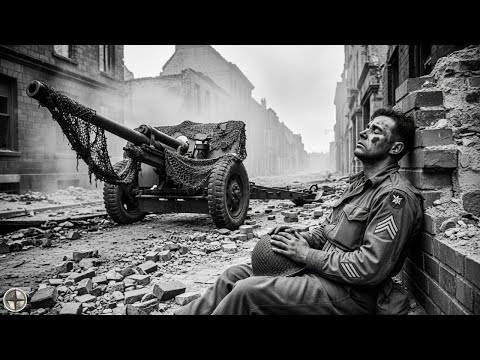
Thompson was no ordinary soldier. Back in Kansas, he had learned to see the world in angles and measurements, building slingshots with pulleys and counterweights. In Normandy, he had watched friends die in sudden, shocking ways—Jimmy Delgado vaporized by a Panzer shell, Frank Murray blown apart by a mine. After that, he stopped believing in luck. He believed in patterns. He carried a small spiral notebook, sketching tanks, noting angles, and marking weaknesses. He studied the German column like a mathematician studies numbers.
The Tiger I led, heavy and unstoppable. Panzer IVs followed in disciplined formation. Fuel trucks and ammunition carriers stayed in the middle, shielded by steel. Thompson traced their movements in his mind, where they paused, how turrets rotated, how long it took for a tank to turn. He didn’t just see tanks—he saw a system, a machine that could be broken if struck correctly.
Still, he waited. The rules demanded it. But each second felt like a noose tightening. The 101st Airborne’s last supply line could vanish if the column advanced unopposed. Every frozen breath reminded him that time was running out.
Through his periscope, he noticed tiny details: tracks pressed into the snow, treads cutting pine branches, shadows shifting on the icy road. Each note he wrote—range, bearing, wind speed—was a calculation. He imagined the perfect sequence: which tank to hit first, how a single shot could block the column, how chaos could spread like fire. But still, he could not act. Discipline was drilled into him. One wrong move could kill his crew or reveal their position.
Yet, beneath the cold and the fear, a thought stirred. The rules might be wrong. Waiting could cost lives. This was the moment when observation became planning, and planning became action. The Ardennes forest waited, unaware of the decision about to be made. One soldier, inside a metal tank, measured the world in inches, degrees, and seconds. Outside, a steel column advanced, confident and disciplined, toward a crossroads that could change everything. But this was only the beginning. What Thompson saw next would test not just his skill, but the very limits of obedience and courage in war.
Thompson’s finger hovered over the trigger. Through the periscope, the Tiger I loomed like a steel cathedral, its long 88mm gun sweeping the tree line. Behind it, the Panzer IVs crept forward in perfect spacing, engines growling low. The fuel trucks sat fat and vulnerable in the middle of the column, and Thompson’s eye kept drifting back to them—the soft belly of the beast.
He thought of Bastogne. Twenty thousand paratroopers, freezing in foxholes, their ammunition and medicine running dry. If this column reached Noville, the noose would close. “A single shot could block the road,” he whispered to himself. “But only if I take the right one.”
His loader, a wiry kid from Ohio named Petrovich, leaned forward. “Sarge, you see something?”
Thompson didn’t answer at first. He was tracing the road in his mind, measuring the distance between the third Panzer IV and the fuel truck behind it. The gap was narrow—barely twenty yards. If he hit the Panzer first, the truck would swerve, maybe jackknife, maybe block the entire column. “I see everything,” he finally said. “Load HE. Then AP. Then HE again.”
Petrovich hesitated. “But we don’t have orders—”
“I know.” Thompson’s voice was flat, calm. “Load them.”
The loader swallowed hard and slid the first shell into the breech. The metallic clack echoed inside the cramped turret. Thompson’s gunner, a quiet Texan named Hollis, adjusted the elevation wheel with trembling hands. The driver, Kowalski, kept the engine idling low, barely audible beneath the wind.
Thompson pressed his eye to the periscope one last time. The Tiger had stopped. Its turret was rotating—slowly, deliberately—scanning the tree line. Had they been spotted? No. The Tiger was just cautious. Its commander knew the Ardennes was full of surprises.
Then the radio crackled. Static. A voice, broken and distant: “…all units…hold fire…repeat…hold…” The transmission dissolved into white noise.
Thompson’s jaw tightened. The orders were coming through—too late, too garbled to mean anything. He had seconds to decide. The Tiger’s turret was still turning, its long barrel sweeping toward the ridge where the M10 lay hidden under camouflage netting. If the Tiger spotted them, it was over. The 88mm would punch through their armor like paper.
“Fire,” Thompson said.
The M10 shuddered. The shell screamed downrange, a white-hot streak cutting through the falling snow. It struck the third Panzer IV just below the turret ring—a precise, calculated hit. The tank erupted in a geyser of flame and black smoke. Its turret popped off like a bottle cap, spinning into the trees.
For a heartbeat, the forest went silent. Then chaos.
The fuel truck behind the destroyed Panzer swerved hard, its driver panicking. It clipped the tank in front of it, jackknifed sideways, and slammed into a pine trunk. The road was blocked. Behind it, half-tracks piled up, soldiers spilling out into the snow, shouting, pointing at the trees. “Sniper! Ambush!” someone screamed. They had no idea where the shot had come from.
Thompson didn’t wait. “AP, now!” he barked. Petrovich slammed the armor-piercing round into the breech. Hollis adjusted the aim—the sixth vehicle, another Panzer IV trying to push past the wreckage. Thompson fired. The shell punched through its side armor, igniting the ammunition rack. The tank blew apart in a thunderclap of fire and shrapnel.
Two shots. Two kills. The column was collapsing.
The Tiger I was still alive, its turret swinging wildly now, searching for the threat. Thompson knew he couldn’t kill it—not with the M10’s 76mm gun, not from this angle. But he didn’t need to. He needed to buy time. “HE, target the rear fuel trucks,” he ordered. “Block their retreat.”
The third shell arced over the burning Panzers and struck a fuel truck near the back of the column. It detonated in a rolling fireball, sending burning debris across the road. German soldiers dove into ditches, their formations shattered. The Tiger, trapped between burning wrecks in front and behind, could only pivot in place, its engine roaring in frustration.
Thompson lowered the periscope. His hands were steady now. The cold was gone. “Kowalski, reverse. Slow. Back into the trees.”
The M10 crept backward, its treads crunching through snow and underbrush. The camouflage netting tore away, but Thompson didn’t care. They had done what they came to do. The road to Noville was closed—not by an army, but by one gunner who had dared to disobey.
Behind them, the forest burned. Black smoke climbed into the gray sky. The German column was broken, its survivors scattering into the woods. And somewhere in Bastogne, twenty thousand paratroopers would live to fight another day.
They had gone barely three hundred yards when Hollis spoke up from the gunner’s seat, his voice tight. “Sarge, we got company. Two of ’em. Panzer IVs—they slipped around the wreckage.”
Thompson swung the periscope around. Sure enough, two tanks had broken free of the burning column and were crawling through the trees, their turrets swiveling like hunting dogs sniffing a scent. They had guessed the direction of the ambush. They were coming for revenge.
“Kowalski, hard left. Get us behind that ridge.” The M10 lurched, snow spraying from its treads. Thompson’s mind raced through the geometry of the terrain—the slope, the tree density, the angle of the sun. He needed cover, and he needed it now.
The first Panzer fired. The shell screamed past the M10’s turret, clipping a pine tree and exploding it into splinters. The shockwave rocked the tank, rattling Thompson’s teeth. Petrovich cursed loudly.
“They’re ranging us,” Hollis said. “Next one won’t miss.”
Thompson spotted it—a shallow ravine, just wide enough to hide the M10’s hull. “Kowalski, into that ditch. Now.” The driver gunned the engine, and the Wolverine slid down the embankment, snow cascading over its hull. The tank tilted at a sickening angle, but it held.
Through the periscope, Thompson watched the two Panzers approach. They were cautious now, moving slowly, their guns pointed at the ridge. They had learned to respect the trees. But they hadn’t learned to respect the man inside them.
Thompson made a quick calculation. The lead Panzer would crest the ridge in about forty seconds. When it did, its belly would be exposed—the thin armor underneath, where no tank commander ever wanted to be hit. “Hollis, aim low. Right at the crest. Wait for my word.”
The seconds crawled. The Panzer’s treads crunched closer. Thompson could hear its engine now, a deep mechanical growl that vibrated through the frozen ground. Petrovich had the AP round ready, his knuckles white around the shell.
“Steady…” Thompson whispered. The Panzer’s nose appeared over the ridge, its hull rising into view. “Fire.”
The shell struck the Panzer’s underbelly just as it crested. The explosion was instant—a blinding flash that lifted the tank’s front end off the ground. It crashed back down, flames pouring from every hatch. The second Panzer stopped dead, its commander suddenly aware that he was alone and exposed.
Thompson didn’t give him time to think. “HE, quick!” Petrovich slammed the round home. Hollis fired. The shell hit the second Panzer’s turret, jamming its rotation. The tank tried to reverse, but its tracks spun uselessly in the snow. Then it stalled, smoke pouring from its engine grille.
Silence returned to the forest. Thompson exhaled slowly, his breath fogging the periscope one last time. “Kowalski. Get us out of here. Back to the ridge. We need to report.”
As the M10 climbed out of the ravine, Thompson glanced back at the burning column. Nine vehicles destroyed or disabled. A road blocked. A division saved. And all of it done without a single order.
He pulled out his notebook and wrote one line in the margin, his handwriting steady despite the cold: “Rules protect you. But sometimes you have to protect the rules from themselves.”
Then he closed the notebook, tucked it into his jacket, and prepared himself for what came next—the questions, the reports, and the quiet reckoning with a choice that had changed everything.
Back at battalion headquarters, Captain Langston read Thompson’s report in silence. The notebook pages lay open on the desk—sketches, ranges, firing sequences. “If this had gone wrong, you could have killed Americans or yourself,” Langston said finally. Thompson met his eyes. “I knew what I saw.”
Langston paused, then nodded. The radio logs confirmed the orders never reached them—jammed, garbled, lost to static. There would be no court-martial. Only a quiet notation in the unit record and a question that would follow Thompson for the rest of his life.
Weeks later, scouts from the 101st found the wreckage outside Noville. Word spread through mess tents and radio lines: one gunner, one tank, nine vehicles destroyed, zero American casualties. The Germans, captured and ash-covered, swore they had faced a full battery. “The trees were shooting at us,” one lieutenant stammered.
Thompson returned to Kansas after the war. He married Helen, opened a repair shop, and taught his son geometry by marking angles in the dirt. He never called himself a hero. But at Fort Sill, they still teach his sequence—target the soft belly, let the enemy’s own formation become the trap.
One man. One decision. One frozen morning that changed everything. What would you have done—waited for orders, or pulled the trigger? Tell us in the comments below.
Report this article
Select a reason for reporting:






