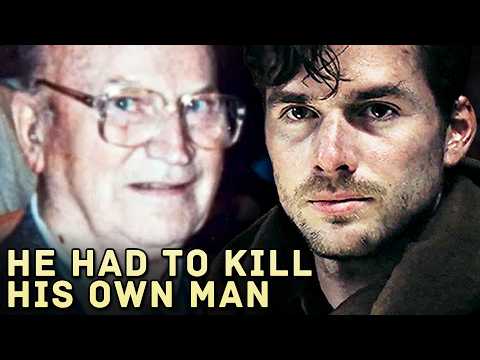
The morning of June 7, 1944, was chaos—D-Day plus one, and the fields of Normandy were still fresh with blood. Lieutenant Ronald Speirs, a man whose name would become legend, was already a figure of both awe and fear. But on this day, the rumors that swirled around him would take a dark and unexpected turn—one that would haunt him forever.
Private Art Demarzio, a 19-year-old from Ohio, lay in a ditch, his heart pounding. Beside him was a sergeant, drunk and belligerent, his shirt stuffed with whiskey bottles. “He wanted to go out and meet the Germans,” Demarzio later recalled. The sergeant, a replacement, was a straightedge soldier when sober, but alcohol unleashed a darker side.
As the platoon held their position along a hedgerow, waiting for tanks, the sergeant grew restless. “What’s this waiting around?” he demanded of Speirs. “I want to take my squad and go into those woods and get the bastards.” Speirs ordered him to hold, but the sergeant’s defiance only grew. “That’s a chicken plan, and you’re nothing but a yellow son of a—”
Speirs, seeing the man was too drunk for duty, ordered him to the rear. “Go yourself,” the sergeant spat, reaching for his machine gun. Speirs shouted a warning: “Don’t pick up that weapon unless you intend to use it.” The sergeant leveled the gun at Speirs.
In that split second, Speirs fired a burst from his Thompson submachine gun. The bullets tore into the sergeant’s chest, shattering the bottles in his shirt. Demarzio, so close that shell casings pinged off his helmet, watched in shock. The sergeant fell dead.
A chaplain rushed to administer last rites, but it was too late. Then, in a rare moment of vulnerability, Speirs wiped away a tear. “I had to take him out. I had to take him out,” he murmured to Demarzio.
The incident was quickly reported to Captain J.S. Gross, who deemed it a justifiable shooting—self-defense. No charges were filed, and the sergeant was listed as killed in action. His family would never know the truth.
But for Speirs, the memory would linger. He had killed one of his own, and though justified, it was a burden he would carry for the rest of his life.
This was the reality of war—a reality that even the most hardened soldiers could never fully escape.
Yet the story did not end there. In the days that followed, the men of Dog Company whispered among themselves, trying to make sense of what they had witnessed. Some said the sergeant had been a troublemaker from the start, a replacement who never fit in. Others insisted he was simply a broken man, worn down by the weight of war and too much cheap cider.
Demarzio, for his part, could not shake the image of Speirs wiping away that single tear. “He wasn’t a cold-blooded killer,” Demarzio said decades later. “He was a soldier who had no choice.” But the rumor mill churned on, twisting the truth into something darker. By the time Easy Company heard the tale, it had become a story of Speirs executing a man for cowardice—a version that only added to his fearsome reputation.
What few knew was that Speirs himself wrote to Dick Winters years later, offering a terse, almost clinical account. “The sergeant, by the way, was a replacement. The platoon saw it all happen without batting an eye.” There was no mention of the tear, no hint of the anguish that had flickered across his face. Speirs had learned to bury such things deep.
But the past has a way of resurfacing. In 1945, as the war in Europe ground to a halt, a young lieutenant from another company approached Speirs in a crowded mess hall. The lieutenant had heard the rumors—the ones about the drunken sergeant and the Thompson gun. “Did you really shoot one of your own men?” he asked, half-joking. The room fell silent. Speirs looked up from his tray, his eyes flat and cold. “He pointed a machine gun at me,” he said quietly. “What would you have done?” The lieutenant stammered an apology and retreated. No one else ever asked.
The sergeant’s family received a telegram stating he had been killed in action in the line of duty. His mother wrote a letter to the War Department, asking for details. The response was brief and vague: “Your son died heroically while engaging enemy forces near Ste. Come-du-Mont.” She framed the telegram and hung it in her living room. She never knew the truth, and perhaps that was a mercy.
Speirs went on to fight in Holland, Belgium, and Germany. He earned a reputation as one of the most aggressive and effective officers in the 101st Airborne. Men followed him because they sensed he would never ask them to do something he wouldn’t do himself. But those who served closest to him noticed a certain distance, a wall he kept between himself and everyone else. He never spoke of the sergeant again—not to Winters, not to anyone.
Decades later, when the book Band of Brothers brought Easy Company back into the public eye, the rumor resurfaced in a new form. Interviewers asked Speirs about it, and he deflected with a curt “That’s war.” But in a rare unguarded moment, he told a historian, “You don’t forget the face of a man you killed—even when he deserved it.” Then he changed the subject and never mentioned it again.
The sergeant’s grave at the Normandy American Cemetery remains a quiet, unremarkable marker among thousands of others. Visitors walk past it without a second glance. But for those who know the story, that white cross stands as a reminder of the terrible choices war demands—and the silent burdens carried by those who survive.
The rumors, however, had a way of growing legs. By the time Easy Company was billeted in the quiet English countryside before D-Day, the story of Speirs and the drunken sergeant had already mutated into a dozen different versions. Some said he’d shot the man for refusing to lead a patrol. Others swore it was over a poker game gone wrong. The truth—that it had been a clear-cut case of self-defense—was too mundane for the gossip mill.
One evening in a crowded pub, a replacement from another platoon, eager to fit in, repeated the most lurid version he’d heard. “They say he lined the guy up against a wall and shot him like a dog.” A hush fell over the table. From the corner, a quiet voice spoke up. It was Demarzio, who had been nursing a pint in silence. “I was there,” he said. “It wasn’t like that.” He didn’t elaborate, and no one dared ask him to.
But the damage was done. The legend of “Bloody Speirs” only grew, and he did nothing to discourage it. In fact, he seemed to cultivate it. “Fear is a weapon,” he once told a fellow officer. “If the men are afraid of you, they’ll follow you anywhere.” It was a cold calculation, but it worked. His platoon became one of the most disciplined in the battalion.
What no one knew was that Speirs kept a small, worn notebook in his breast pocket. In it, he had written the sergeant’s name—not to memorialize him, but as a reminder. “I look at it every day,” he confided to Winters years after the war. “To remember what happens when you lose control.” Winters, ever the stoic, said nothing. He understood.
The notebook was never found after Speirs’s death in 2007. It was likely discarded with his personal effects, its secret kept to the end. But those who knew him best believed it existed—a private ledger of the lives he had taken, both enemy and friend.
In the summer of 1944, as the hedgerow fighting dragged on, the incident faded into the background. There were too many other horrors to occupy the men’s minds. But every so often, a soldier would catch Speirs staring off into the middle distance, his jaw tight, and they would remember the story. They would give him a wide berth, and he would pretend not to notice.
Then came the night patrol that would change everything. Speirs was ordered to take a squad across the flooded fields near the Douve River. It was a suicide mission, and everyone knew it. As they prepared, a young private, barely eighteen, began to shake uncontrollably. Speirs walked over to him, placed a hand on his shoulder, and said, “You don’t have to be brave. You just have to do your job.” The private nodded, and Speirs turned away. But for a moment, his eyes flickered with something that looked almost like regret.
The patrol went out into the blackness, and the men who remained behind held their breath. Hours passed. Then, just before dawn, the squad returned—all of them, including the young private. Speirs was the last to come through the line, his face streaked with mud and something else. He had carried the private on his back for the last half-mile after the boy twisted his ankle. No one spoke of it, but the story spread anyway. It was the first time many of them had seen the other side of Speirs—the one that would risk everything for his men.
That was the paradox of Ronald Speirs. He could kill one of his own in self-defense, then turn around and save another without a second thought. “He was the toughest son of a bitch I ever met,” Demarzio said, “but he cared more than he let on.” The men of Easy Company never fully understood him, but they followed him anyway.
After the war, Speirs served in Korea and later in the CIA, always keeping his past locked away. He rarely spoke of the sergeant, but those who knew him best saw the weight he carried. “He never forgave himself,” his daughter once said. “Even though he knew he had no choice.”
Today, the story of Ronald Speirs is told in books and on screen, but the truth is more complicated than the legend. He was a hero, yes—but he was also a man haunted by the choices war forced upon him. And the sergeant, whose name is all but forgotten, remains a silent witness to the cost of command.
So what do you think? Was Speirs a victim of circumstance, or did he cross a line that can never be justified? Share your thoughts in the comments below.
Report this article
Select a reason for reporting:






