April 1941, Tobruk, Libya. Fourteen thousand Australian soldiers stood trapped inside a crumbling fortress as one hundred thousand enemy troops closed in for the kill. The most feared general in Hitler’s army, Erwin Rommel—the Desert Fox—expected them to surrender in days. Instead, these surrounded men did something so unexpected, so bold, that it made their enemy furious enough to give them a name meant as an insult. But they wore it like a badge of honor.
What did Rommel see that made him call them rats? And why did that name actually help them win?
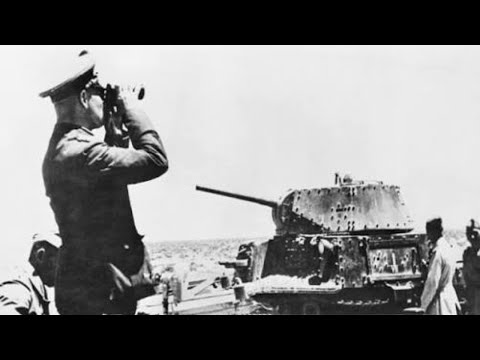
The situation was bad, really bad. Around the fortress, 100,000 enemy soldiers formed a circle that grew tighter each day. These were not ordinary soldiers. They belonged to Hitler’s Africa Corps, the same army that had crushed every force it faced. Led by General Erwin Rommel, they had swept across North Africa like a storm. Cities fell before them in days. Armies ran away in fear. Rommel had earned a nickname that made men shake: the Desert Fox. He was clever, fast, and deadly.
Just weeks before, British forces had tried to stop him. They failed. In fact, they did worse than fail. They ran. For 500 miles, British troops retreated across the burning sand, leaving behind tanks, guns, and hope. The numbers told a terrible story. The British had lost over 30,000 men. They abandoned hundreds of vehicles in the desert. Rommel’s forces had barely slowed down.
Now those same unstoppable forces surrounded Tobruk. The fortress sat on the edge of the sea, a small bump of rock and sand jutting into the blue Mediterranean waters. It was important for one reason: it had a harbor. Whoever controlled Tobruk controlled the supply lines for the entire North African coast. Rommel needed it. The British needed to keep it. But keeping it seemed impossible.
Inside the walls, the Australians counted their supplies. Six weeks of ammunition, maybe less if fighting got heavy. Water was even worse. Each man got one gallon per day—for drinking, cooking, and washing in heat that climbed past 115 degrees. Food was basic: bully beef from cans, hard biscuits, and tea. The fortress had been built years ago by the Italians, and it was falling apart. The concrete bunkers cracked in the heat. The walls crumbled under their boots.
The experts back in Cairo and London looked at the maps and shook their heads. The math was simple and cruel: 14,000 against 100,000. No way to get more troops in easily. No way to escape if things went bad. The ocean sat at their backs, but the German air force owned the sky. Any ship trying to reach the harbor would face bombs and bullets.
The smart thing, the military manual said, was to dig in deep, defend the walls, and pray that help arrived before supplies ran out. That was the conventional wisdom. That was how you defended a fortress under siege. You saved your strength. You rationed everything. You waited.
General Erwin Rommel expected exactly that. He had seen it before. Surrounded forces always did the same thing. They went quiet. They hid. They hoped. And then they surrendered.
But the man in charge of Tobruk’s defense was not a typical general. Major General Leslie Morshead stood at his command post and studied the same maps everyone else saw. He came to a different conclusion. Morshead was 51 years old, a teacher before the First World War had pulled him into uniform. He had fought in the trenches of France back in 1917 and seen what happened when men just sat still and waited to die. He was not a loud man. He did not give grand speeches. He was quiet, thoughtful, and stubborn as a mule. The Australian soldiers called him “Ming the Merciless” after a movie villain, but they said it with respect.
Morshead did not look like a warrior. He looked like someone who might teach your children math. But behind his wire-rimmed glasses, his mind worked like a machine. Always calculating, always planning. When other generals saw problems, Morshead saw possibilities.
German intelligence officers had files on the Australians. The reports were not kind. “Poorly disciplined colonials,” the files said. “Good fighters in a brawl, but not proper soldiers.” They did not salute enough. They argued with officers. They broke rules. Rommel’s staff read these reports and felt confident. The Desert Fox himself had never lost a battle in Africa. His tanks had crushed the French. His infantry had routed the British. A bunch of Australians stuck in a crumbling fortress would not slow him down for long.
On April 10th, the first German attacks began. Tanks rolled toward the walls. Artillery shells screamed through the air and exploded in fountains of rock and dust. Infantry followed behind the armor, confident they would be inside the fortress by nightfall. The bombardment was fierce. It shook the ground. It filled the air with smoke and the smell of explosives. From a distance, it looked like Tobruk was being erased from the earth.
But when the smoke cleared, the Australians were still there. And they were shooting back. The German infantry hit the outer defense lines and ran into a wall of rifle and machine gun fire. Men fell. The tanks pushed forward and discovered the ground was laced with mines. Explosions ripped through the armor. The attack stalled. Then it stopped. Then it retreated. By the end of that first day, 250 German soldiers lay dead or wounded. The Australians had lost 26 men.
That night, Morshead gathered his officers. The air in the command bunker was hot and close. Maps covered every surface. The officers expected orders about strengthening defenses, about digging deeper. Instead, Morshead said something that made them all stop and stare.
“We will not just defend Tobruk,” he told them. “We will attack. Every night if we have to. We will go out there into the dark and hit them where they think they are safe. We will make them afraid to sleep.”
The idea was crazy. Surrounded troops do not attack. They do not have enough men or supplies for that kind of war. But Morshead had done the math differently. If they just sat still, Rommel could take his time, bring up more guns, pound the fortress to dust. But if the Australians kept attacking, Rommel would have to keep his forces spread out, always watching, always nervous. It would slow him down. It would cost him men. It would buy time.
The officers looked at each other. Then they looked at their general. Some of them smiled. Australians liked a good fight, and sitting in a hole waiting to get shelled was not their idea of fighting. Morshead’s plan was risky. It would be exhausting. Men would die in the dark desert, far from the walls, but it was better than waiting like sheep in a pen.
On April 11th, Morshead issued his first patrol orders. Thirty-man groups would go out 2,000 yards beyond the fortress walls. They would find German positions. They would attack. They would disappear back into the darkness before the enemy could respond.
The British High Command in Cairo heard about Morshead’s plan and sent worried messages. “You will exhaust your men,” they said. “You need to conserve strength. This is not how a siege defense works.” But Morshead had one crucial supporter. General Wavell, the overall commander in the region, visited Tobruk on April 17th. He walked the defenses. He talked to the Australian soldiers. He listened to Morshead explain his thinking. When Wavell left, he sent a simple message back to the doubters: “Let him do it his way.”
That same week, the Australians launched their first major night raid. Thirty men crawled through the darkness toward a German supply dump. The night was black. No moon. The stars gave just enough light to see shadows. The men moved slowly, carefully, checking for tripwires and mines. They could hear German voices ahead, relaxed, casual. The enemy felt safe this far from the fortress walls. That was a mistake.
The Australians hit the dump like a thunderstorm. Grenades exploded. Machine guns chattered. In four minutes, it was over. The Australians melted back into the desert, carrying captured papers and maps. Behind them, German supplies burned. Behind them, German confidence started to crack.
The German officers could not understand what was happening. Sieges did not work like this. The surrounded forces were supposed to be the ones afraid, the ones hiding. But every night, shadows moved in the darkness around their camps. Every night, explosions and gunfire shattered the silence. Every morning, they found dead sentries and burned equipment. The Australians were not acting like trapped men. They were acting like hunters.
Morshead turned his fortress into a fighting machine. He divided the perimeter into patrol zones, each one 2,000 yards deep—half a mile beyond the walls, deep in territory the Germans thought they controlled. Patrols went out every 48 to 72 hours from each sector. Thirty men, enough ammunition for a four-hour operation, moving in darkness, striking fast, home before dawn.
The patrols had specific jobs: map enemy positions, capture prisoners, destroy supplies. But the most important job was simpler. Make the Germans nervous. A nervous enemy wastes energy watching shadows. A nervous enemy cannot focus all his power on breaking through walls.
On April 14th, a patrol brought back something more valuable than destroyed supplies: a German officer and his briefcase. Inside were detailed maps showing where Rommel planned to attack next. Morshead studied them for hours. When the German attack came three days later, Australian guns were waiting in exactly the right spots. More tanks burned. Rommel was getting frustrated.
His diary from those weeks shows his anger growing. “The enemy is extraordinarily well equipped and his soldiers are hard fighters,” he wrote. He had 100,000 troops surrounding 14,000 men, and yet he could not break through. Worse, his men were dying every night in their own camps, supposedly safe behind their own lines.
Then came the name that would live forever. German propaganda radio started mocking the surrounded forces, calling them the Rats of Tobruk. They meant it as an insult. Rats were dirty, weak creatures that lived in holes. They thought the name would make the trapped soldiers feel small and beaten.
They were wrong. Dead wrong.
The name had come from Rommel himself, who had said it first in frustration to his staff: “These Australians fight like cornered rats.” His officers twisted it into an insult for the radio broadcasts, but Rommel’s original words were an acknowledgment of a hard truth he had learned the expensive way. Cornered rats are the most dangerous fighters of all.
The Australians heard the broadcasts and laughed. They had a name now. They were the Rats, and they wore it like a badge of honor. One soldier looked at a captured German officer and grinned. “Mate, you are the one who is our prisoner. Who is really surrounded here?” The German had no answer.
Summer came and the heat became another enemy. 115 degrees in the shade, and there was not much shade. Water was life—one gallon per man per day. Most men chose to stay dirty and save the water for drinking. Their lips cracked and bled. But they kept going.
The Royal Navy ran the Spud Run, shipping food and ammunition into Tobruk Harbor under cover of darkness. Seventy-two ships were sunk or damaged keeping Tobruk alive. Sailors died in the dark waters of the Mediterranean so soldiers could keep fighting in the desert.
Back in London, Churchill refused every suggestion to evacuate. “Tobruk must be held,” he said. “The world is watching.” Britain was losing everywhere in 1941. If Tobruk held, it would prove that Hitler’s armies could be stopped.
The siege lasted 241 days. Not a single day of German progress. More than 3,000 German soldiers were killed or wounded trying to take Tobruk or defending against the constant raids. The Australians lost about 800 men. Rommel was forced to pull his entire 15th Panzer Division—tanks he desperately needed elsewhere—into the grinding fight. He wrote in his diary: “The Australians are fighting like devils.” Coming from the Desert Fox, those words meant something.
On December 10th, 1941, British forces launched Operation Crusader to break through and reach Tobruk. When the relieving troops finally made contact, they expected to find beaten, exhausted men barely hanging on. Instead, they found the Australians organized, alert, and ready to join the counterattack.
The Rats had not just survived. They had won.
Morshead returned to Australia after the war, quiet and out of the spotlight. King George VI knighted him in 1959. He died that same year at 68, his funeral small and dignified. The soldiers never forgot. They formed the Rats of Tobruk Association and gathered every year to remember the friends who died in the desert and to celebrate that they had held the line when everyone said it was impossible.
Rommel never forgot either. In his memoirs, he devoted significant pages to the siege, writing about the Australians with genuine respect. They had taught him that even the best army could be stopped by determined defenders using smart tactics. One historian calculated that Tobruk cost the Germans four months in their timetable for conquering North Africa. Four months turned out to be the difference between possible victory and certain defeat.
The Rats proved that wars are not fought on paper. They are fought by human beings with courage, cleverness, and the will to keep going when everything seems hopeless. They turned an insult into strength, and they refused to let others define them.
For 241 days in the dust of Tobruk, that was the lesson written in blood and sand. The Rats refused to surrender—and in refusing, they won.
What name have you been given that you could turn into your own badge of honor?
Report this article
Select a reason for reporting:






