July 12, 1936. The gates of a new camp swing open, and the first prisoners shuffle in, their eyes darting nervously at the rows of barbed wire and the stone barracks that will become their prison. This is Sachsenhausen, the crown jewel of the SS—a place designed not just to detain, but to showcase the terrifying power of the Nazi regime. Every brick, every watchtower, every guard’s uniform is a statement: here, the state is absolute.
But this is only the beginning. What unfolds behind these gates over the next nine years will haunt humanity forever. Two hundred thousand souls will pass through this hell, and a hundred thousand will never leave. This is the story of Sachsenhausen—a story of unimaginable cruelty, survival, and the twisted logic of a regime that turned human beings into tools for its war machine.
Heinrich Himmler, the architect of the SS, wanted a model camp. Not just a place to hold enemies of the state, but a training ground for his elite guard—a place where brutality was systematized, perfected. Sachsenhausen was to be the blueprint for the entire concentration camp network. Every procedure, every punishment, every method of killing was tested here first.
The first prisoners arrived with no idea of what awaited them. They were classified, cataloged, and marked like livestock. A number replaced their name. A uniform erased their identity. They were crowded into barracks, fed barely enough to survive, and worked to the bone. Disease and starvation were constant companions. Every morning, guards dragged them out for roll call, counting them like cattle to ensure none had escaped during the night.
Then came the work. Slave labor for the German war industry. Bricks for the Third Reich’s grand buildings, ammunition for the front lines. The prisoners produced the very materials that fueled the Nazi war machine, their hands building the weapons that would be used to conquer Europe.
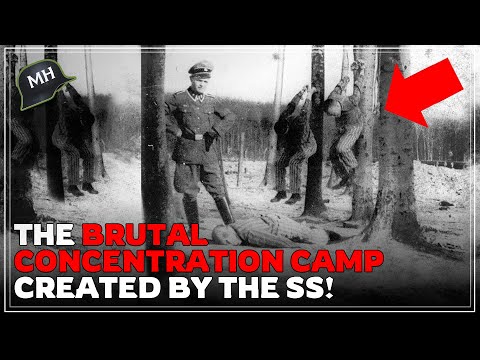
But Sachsenhausen was not just a labor camp. It was a place of punishment, of terror. The SS devised methods of torture that were as creative as they were cruel. One was the “Sachsenhausen salute”—a punishment where prisoners were forced to squat with their arms extended forward for hours. If they faltered, they were beaten mercilessly. Another was tying their wrists behind their backs and hanging them from poles. Pain was the language of the camp, and the SS spoke it fluently.
Escape was almost impossible, but for those who tried and were caught, the punishment was public hanging. All prisoners were forced to watch, a grim reminder of the consequences of defiance. Death was a constant presence. Mass shootings at Station Z, where prisoners were lined up in pits and shot. Later, gas chambers were added, perfecting the machinery of murder.
Medical experiments, too, had their place in Sachsenhausen. Prisoners were injected with experimental drugs, tested for side effects, all in the name of increasing the strength and resilience of German soldiers. They were guinea pigs, expendable lives in the pursuit of Nazi science.
And then there was Operation Bernhard—a secret mission to destabilize the British economy by printing counterfeit banknotes. Slave laborers produced millions of pounds in fake currency, a weapon of economic warfare. The irony was not lost on the prisoners: they were forced to forge the money of their enemies, even as their own lives were worth nothing.
As the war drew to a close, the SS evacuated the camp, marching 30,000 prisoners to other camps in a death march. Before leaving, they executed 3,000 inmates deemed dangerous. On April 22, 1945, Soviet troops liberated Sachsenhausen, finding only 3,000 survivors left behind. But the nightmare was not over. The camp remained open under Soviet control, now housing Nazi officials and political enemies of the Soviet regime. Twelve thousand more would die there.
Today, Sachsenhausen stands as a memorial, a stark reminder of the depths of human cruelty. But the story of what happened within its walls is far from over. The details of daily life, the acts of resistance, the stories of individual prisoners—all of this remains to be told.
The prisoners who arrived in those first transports came from every corner of German society. Communists, Social Democrats, trade unionists, Jehovah’s Witnesses, homosexuals, and Jews—all swept up in the Nazi dragnet and deposited behind the same barbed wire. They were doctors and bricklayers, teachers and factory workers, thrown together in a forced brotherhood of suffering.
Among them was Harry Naujoks, a former shipyard worker and Communist who would become one of the camp’s most important figures. Appointed as camp elder by the SS, Naujoks used his position to protect the weakest prisoners, distributing food more fairly and shielding the sick from the most brutal work details. He kept meticulous notes, hidden in the barracks, documenting the crimes he witnessed. He knew that one day, someone would need to testify.
The daily rhythm of Sachsenhausen was designed to destroy the soul before the body gave out. Roll call began before dawn, sometimes lasting hours in freezing rain or snow. Prisoners stood motionless in their thin striped uniforms, counting and recounting, while guards walked the rows with dogs and truncheons. A man who collapsed during roll call was often left where he fell—or worse.
Work details were assigned by the SS, but the internal organization of the barracks fell to the prisoners themselves. Blocks were run by kapos and block elders, prisoners given privileges in exchange for enforcing the SS’s will. Some abused their power, becoming as feared as the guards. Others, like Naujoks, walked a razor’s edge—cooperating just enough to survive, while quietly sabotaging the machine from within.
One of the most feared assignments was the brickworks, where prisoners dug clay and fired the bricks that would build Berlin’s monuments to Nazi glory. The work was backbreaking, performed in all weather, with quotas that increased every week. Prisoners who fell short were beaten; those who collapsed were left to die in the clay pits.
Yet even here, resistance flickered. Some prisoners deliberately slowed production, hiding defective bricks in the stacks. Others smuggled tools into the barracks, filing them into makeshift weapons or using them to dig escape tunnels. The SS never fully understood that they were not just fighting bodies—they were fighting spirits that refused to be extinguished.
The camp’s infirmary became another battleground. Prisoners with medical training, like the Polish doctor Stefan Kieniewicz, used their positions to falsify records, hide the sick, and divert medicines to those who needed them most. They knew the SS’s experiments were coming—and they did everything they could to prepare.
But the SS had its own plans. In 1938, the camp’s commandant Hermann Baranowski was replaced by Hans Loritz, a man whose cruelty became legendary even among the SS. Loritz introduced new punishments, new terrors. He ordered the construction of a small execution site behind the infirmary, hidden from the main camp, where prisoners were shot in the back of the head and their bodies burned.
It was during this period that the first whispers of Station Z began to circulate. Prisoners who worked in the nearby workshops saw the trucks arriving at night, heard the muffled shots, smelled the smoke from the crematorium. They knew something terrible was happening—but they could not yet imagine the scale of what was to come.
By 1939, the war had changed everything. The camp swelled with new arrivals—Polish intellectuals, Soviet prisoners of war, and resistance fighters from across occupied Europe. The SS, emboldened by victory, tightened its grip. Rations were cut again, and the barracks overflowed with bodies. Disease spread like wildfire, and the crematorium ran day and night.
It was in this cauldron of suffering that Operation Bernhard took shape. The SS selected a group of prisoners—printers, engravers, bankers—and isolated them in two sealed-off barracks. They were told they would either produce perfect counterfeit British pounds or be killed. The irony was bitter: the same men who had been stripped of their names were now asked to forge the currency of the enemy.
The operation was led by Bernhard Krüger, an SS officer who treated the counterfeiters with a strange, calculating respect. He needed their skills, and they needed to survive. In the workshops, a bizarre camaraderie formed—prisoners working alongside their captors, united by the shared secret of the forgery. They printed millions of pounds, but they also sabotaged what they could, subtly weakening the paper or introducing flaws that might be detected.
Meanwhile, the daily terror continued. Station Z was expanded in 1941, becoming a killing factory in miniature. A gas chamber was installed, disguised as a shower room. Prisoners were led inside, told they would be deloused, and then suffocated with carbon monoxide. The SS called it ‘special treatment.’ The bodies were hauled to the crematorium, their ashes dumped into the nearby river.
One of the prisoners who witnessed these horrors was Aleksander Kulisiewicz, a Polish journalist and singer. He memorized the names of the dead, composing songs and poems in his head, determined that the world would one day hear them. He became a living archive of the camp’s crimes. Every night, he recited his verses to the other prisoners, a small act of defiance that kept their spirits alive.
The resistance inside Sachsenhausen was never armed, never open. It was the resistance of the hidden note, the smuggled bread, the whispered name. Prisoners like Naujoks and Kieniewicz built networks of trust, passing information, protecting the vulnerable. They knew that the SS’s greatest fear was not rebellion—it was memory. As long as the prisoners remembered, the Nazis could not truly win.
But the SS had its own memory. They kept meticulous records—names, numbers, causes of death. They believed their crimes would be forgotten, buried under the rubble of the Reich. They were wrong. The prisoners made sure of that.
As the Soviet guns rumbled closer in April 1945, the SS scrambled to erase their crimes. They forced 30,000 prisoners onto a death march westward, shooting anyone who stumbled. The sick and the ‘dangerous’—those with military training—were executed in the final hours. On April 22, the Red Army entered the camp to find only 3,000 skeletal survivors. The gates were open, but the nightmare had not ended.
Under Soviet control, Sachsenhausen became Special Camp No. 1. The uniforms changed, but the barbed wire remained. Now it was Nazi officials, collaborators, and anti-communists who starved and died—12,000 more souls lost to the same indifference. History had turned, but the cruelty had not.
When the camp finally closed in 1950, the silence that followed was almost as terrible as the suffering. For decades, East Germany buried the truth, building over the site, pretending the past was another country’s sin. But memory has a way of clawing its way back.
In the 1990s, Sachsenhausen became a memorial. Today, visitors walk through the preserved watchtowers and barracks, reading the names of the dead. Harry Naujoks’s hidden notes, Aleksander Kulisiewicz’s songs, the testimony of survivors—all of it survived. The SS’s meticulous records, meant to be their monument, became their confession.
Sachsenhausen is not just a place. It is a warning. It reminds us that humanity’s darkest impulses can be organized, industrialized, and justified. And it asks us, every time we look at the past: what will we do when the gates begin to close again?
What do you think is the most important lesson we must carry from Sachsenhausen to ensure history never repeats itself? Share your thoughts in the comments below.
Report this article
Select a reason for reporting:






