The morning of December 13, 1945, dawned cold and gray over the Weser River. Inside Hamelin Prison, the corridors echoed with the footsteps of guards leading the condemned to the gallows. Among them were three women whose names would become synonymous with the horrors of the Holocaust: Irma Grese, Elisabeth Volkenrath, and Johanna Bormann. They had served at Auschwitz-Birkenau and Bergen-Belsen, and now they faced the consequences of their crimes.
But how did ordinary women become such ruthless killers? The story begins not in the courtrooms of Lüneburg, but in the indoctrination camps of Nazi Germany, where young girls were taught that obedience was the highest virtue and that some lives were unworthy of living.
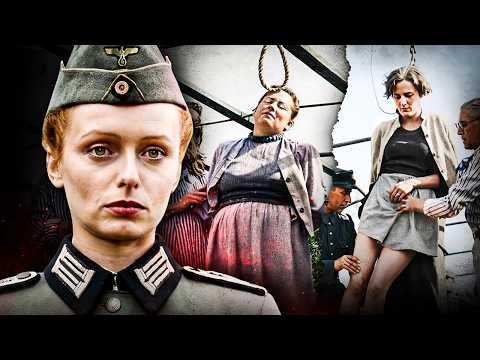
Irma Grese was just 19 when she arrived at Auschwitz. Born in 1923, she grew up in a broken home—her mother died by suicide when Irma was 13, and her father, a Nazi Party member, raised her in the ideology of the regime. She joined the League of German Girls at 10 and later applied to become an SS auxiliary guard. By 20, she was the second-highest-ranking female officer at Auschwitz, known for her braided whip and her cold, methodical cruelty.
Survivors described her as young, blond, and athletic, patrolling the camp with a Walther revolver at her hip. She participated in selections on the Birkenau platform, pointing left for labor and right for the gas chambers. “Not the violence itself, but the total absence of any sign of internal conflict,” testified Dr. Ada Bimko, one of the key witnesses at the Lüneburg trial. Grese struck prisoners with her whip during roll calls that lasted hours in freezing temperatures. She set her trained dogs on women who collapsed from exhaustion. And she did it all with an expression witnesses called “completely neutral.”
Elisabeth Volkenrath was different. Born in 1919, she was slightly older, from a modest background. She joined the SS auxiliary service in 1941 and rose to become Oberaufseherin at Auschwitz—the chief supervisor of all female guards. She was not a front-line guard acting on impulse; she was an administrator managing a system. She coordinated shifts, oversaw the female barracks, and reported directly to the male SS command. Her marriage to an SS officer inside the camp was a testament to the chilling normality that coexisted with mass murder.
Volkenrath ordered collective punishments, suspending food rations for entire barracks as retaliation for one prisoner’s escape attempt. In a place where daily rations were already below survival levels, her orders amounted to deferred death sentences. Witnesses described her striking prisoners with her open hand and a stick during roll calls, and participating in selections with a calculated coldness. “Where Grese acted with her own almost spontaneous energy, Volkenrath decided with the detachment of someone who knows exactly the reach of her decisions,” Bimko testified.
Johanna Bormann was the oldest of the three. Born in 1893, she was 51 when she was arrested—more than twice Grese’s age. She joined the SS auxiliary service in 1938, at 44, in the wake of Kristallnacht. Her entry into the system was not the result of youthful indoctrination, but a conscious choice made in full adulthood. At Auschwitz, she earned the nickname “the woman with the dogs” for systematically setting her German Shepherd on prisoners. The bites, on bodies ravaged by malnutrition, led to sepsis and death within a week.
Survivors testified that Bormann directed the dog at women who moved too slowly during roll calls, or who approached the food distribution area outside designated hours. She also beat prisoners with her hands and blunt objects, and participated in selections. Her behavior remained consistent even when Bergen-Belsen descended into chaos in the final months of the war. While other guards fled or hid, Bormann continued her routine of violence, as if the collapse of the system had no effect on her conduct.
When British troops liberated Bergen-Belsen on April 15, 1945, they found 60,000 survivors and over 10,000 unburied corpses. BBC correspondent Richard Dimbleby broke down in tears on air as he described the scene. Prisoners who could still stand pointed out the guards who had tormented them. Bormann was recognized instantly—her nickname had traveled with her from Auschwitz, and survivors identified her before investigators even knew her official name.
The three women were among 45 defendants tried at Lüneburg, the first major war crimes trial held by the Allies on German soil. The proceedings began on September 17, 1945, months before Nuremberg. The tribunal heard testimony from dozens of survivors, including Dr. Ada Bimko and Zofia Litwinska, whose detailed accounts of selections, beatings, and dog attacks left little room for doubt.
The defense argued that the women were following orders, that the testimonies were exaggerated, and that Grese’s youth and indoctrination mitigated her guilt. The tribunal rejected these arguments. On November 17, 1945, all three were sentenced to death. Irma Grese was found guilty of participation in selections, systematic violence, and direct killings. Volkenrath was convicted under the doctrine of command responsibility. Bormann’s use of the dog as a weapon was deemed sufficient evidence of her guilt.
Petitions for clemency were submitted to Field Marshal Bernard Montgomery, citing Grese’s age—she was only 22—and her childhood indoctrination. Montgomery rejected them without modification. The execution date was set for December 13, 1945, just 27 days after the verdicts.
Albert Pierrepoint, the most experienced executioner in Britain, arrived at Hamelin Prison the day before. He calculated the drop lengths for each of the 11 condemned, aiming for an instantaneous fracture of the second cervical vertebra. The executions began at 9:43 a.m. with Irma Grese.
Witnesses described her walking to the gallows with a firm step, showing no signs of fear or remorse. As Pierrepoint adjusted the noose, she spoke a single word: “Schnell.” Fast. The platform dropped. She was dead in seconds.
Elisabeth Volkenrath followed. She made no final statement, maintaining the same composed demeanor she had shown throughout the trial. She died at 10:04 a.m. Johanna Bormann was last. Unlike the others, she showed visible signs of fear. She spoke no words. By 10:45 a.m., all 11 had been executed.
The bodies were buried in unmarked graves within the prison compound. Decades later, they were exhumed, cremated, and their ashes scattered in the Weser River. No physical trace remained.
But the story of these three women is not just about their executions. It is about the system that recruited them, trained them, and used them. Irma Grese was not unique—she was representative of what the system was capable of producing. Johanna Bormann proved that the brutality was not limited to the young and indoctrinated; it crossed generations. And Elisabeth Volkenrath showed how administrative efficiency could be just as deadly as direct violence.
The Lüneburg trial established legal principles that resonate today: that obedience to orders is not a defense for crimes against humanity, that command responsibility extends to those who fail to prevent atrocities, and that criminal responsibility is not fragmented by geography. These principles were later codified in international law and applied in tribunals from The Hague to Arusha.
Yet the memory of these women has often been overshadowed by the larger Nuremberg trials. Their stories remind us that the Holocaust was not carried out by monsters alone, but by ordinary people who chose to participate in extraordinary evil. The question that remains is not how these women could do what they did, but how any of us might, under different circumstances, become capable of the same.
As the fog lifted over Hamelin that December morning, the Weser continued to flow, indifferent to the ashes it carried. The records remain—the transcripts, the testimonies, the photographs. And the survivors who pointed and said the name, ensuring that the victims would not be forgotten.
The question of how ordinary women became executioners has preoccupied historians for decades, and the answers remain uncomfortable. Christopher Browning’s study of Reserve Police Battalion 101, though focused on men, offered a framework that applies here: ordinary people, placed in specific structural conditions, can become mass killers without exhibiting prior pathological traits. The Aufseherinnen were not selected for cruelty. They were selected for availability.
But availability alone does not explain the variation. Some guards were brutal; others were not. Some requested transfers away from the camps; others requested transfers into them. The crucial variable was not circumstance but choice—the repeated, daily decision to exercise violence when the system permitted it.
Grese, Volkenrath, and Bormann each made that choice with different psychological textures. Grese acted with an almost kinetic energy, her violence spontaneous yet methodical. Volkenrath administered cruelty as a function of her position, measuring its reach with bureaucratic precision. Bormann, the oldest, acted with a consistency that defied explanation by youth or indoctrination, her methods unchanged even as the camp around her disintegrated.
What the Lüneburg trial revealed, perhaps unintentionally, was the degree to which the Nazi system had bureaucratized sadism. Every act of violence had its form, its signature, its file. The system did not merely permit cruelty—it organized it, standardized it, and rewarded it with promotions, salaries, and housing. The Aufseherinnen were not aberrations; they were employees.
This bureaucratic dimension is what makes their stories relevant beyond the specific historical context. The concentration camps were not the product of a society that had abandoned order—they were the product of a society that had perfected it. The trains ran on time. The records were meticulously kept. The guards received regular paychecks.
After the executions, the British military authorities faced a practical problem: what to do with the remaining Aufseherinnen who had served at Bergen-Belsen but were not tried at Lüneburg. Some were released; others were transferred to Allied custody. The legal machinery that had been assembled so efficiently for the first trial proved difficult to sustain. The political priorities of the Cold War soon began to eclipse the pursuit of justice.
By the early 1950s, the Federal Republic of Germany was pressing for the release of those still imprisoned from the Belsen trial. The Allies, eager to integrate West Germany into the emerging NATO alliance, proved receptive. By 1955, most of those sentenced at Lüneburg had been released. The message was unmistakable: the new geopolitical order had little room for the unfinished business of the old one.
Survivors who had testified at Lüneburg watched this development with a mixture of bitterness and resignation. Some had traveled from Israel and Poland to give evidence, believing that their testimony would ensure lasting consequences. The early releases taught them a different lesson—that justice, in the postwar world, was subject to the same political calculations as any other commodity.
Yet the trial’s legal legacy proved more durable than its immediate outcomes. The principles established at Lüneburg—individual responsibility, command accountability, the rejection of superior orders as a defense—became foundational for the international criminal justice system that emerged in the 1990s. The tribunals for Yugoslavia and Rwanda cited the Belsen precedent. The Rome Statute incorporated its reasoning.
In this sense, the three women whose executions were completed before the fog lifted over Hamelin that December morning achieved an unintended immortality. Their cases became case law. Their names became citations in legal textbooks. The system that produced them was defeated, but the legal machinery designed to judge it outlasted the system itself.
The memorial at Bergen-Belsen receives thousands of visitors each year. Most come to see the mass graves, the stone slabs marking the approximate number of dead, the open fields where the barracks once stood. Fewer visit the documentation center, where the stories of the guards are presented alongside those of the victims.
This relative obscurity is itself a form of historical amnesia. The victims of Grese, Volkenrath, and Bormann are remembered collectively, their individual identities erased by the system that killed them. The guards, by contrast, are remembered individually—their names, their ages, their methods, their final words.
There is a bitter irony in this asymmetry. The system that the three women served was designed to erase individual identity, to reduce human beings to numbers, to make death an administrative category. Yet the postwar record has preserved the identities of the executioners with far greater precision than those of their victims.
Some historians have argued that this asymmetry is unavoidable—that the perpetrators left more documentary traces because they were the ones keeping records. But others have suggested that the focus on perpetrators reflects a deeper cultural fascination with evil, a tendency to treat mass murder as a spectacle rather than a tragedy.
The question that remains, as the Weser continues to flow and the memorial at Bergen-Belsen continues to receive its visitors, is whether the story of these three women can teach us anything that the story of their victims cannot. The answer may lie not in their exceptional cruelty but in their ordinariness.
Grese was 22 when she died. Volkenrath was 26. Bormann was 52. Together they span a generational arc from the young indoctrinated from childhood to the adult who chose consciously. The system needed them all and found in each of them what it sought.
What the system sought was not monsters but functionaries. What it found was women who were willing to perform functions that most people, in most circumstances, would find unbearable. The question that haunts the postwar world is not why these three women did what they did, but why so many others, placed in similar circumstances, did not.
That question has no satisfying answer. It resists the easy explanations of ideology, pathology, or circumstance. It points instead toward something more unsettling: the possibility that the capacity for cruelty is not exceptional but latent, waiting for the right conditions to manifest.
The three women who died on the gallows at Hamelin Prison on December 13, 1945, were not the first to demonstrate this possibility, and they would not be the last. Their story is not a closed chapter but an open question—one that each generation must confront anew.
Their story is not a closed chapter but an open question—one that each generation must confront anew. And yet, the survivors who pointed at Bergen-Belsen, who testified at Lüneburg, who watched the early releases, understood something that the legal archives cannot fully capture: that justice, however incomplete, is always better than silence.
The three women died before the fog lifted. The Weser carried their ashes to the sea. But the testimonies remain, and so do the names they spoke.
“Schnell.” A word so ordinary it could belong to any morning. But spoken on a gallows, it became a final confession—an admission that even at the end, she saw death as something to be hurried, not feared.
What do you think: was that word a sign of defiance, dissociation, or something else entirely?
Report this article
Select a reason for reporting:






