On the night of January 30, 1933, thousands of Nazi party members marched through the streets of Berlin, their torches slicing through the winter dark, their boots striking the pavement in unison. It was a spectacle of raw power—a warning to anyone who dared to doubt the new order. But behind the triumphant facade, Adolf Hitler was not yet the absolute ruler he appeared to be. He was the head of a coalition government, with only two other Nazis in his cabinet. The world saw a moderate; the truth was far more sinister.
Just two days later, Hitler delivered his first radio address as Chancellor. His words were carefully chosen, his tone conciliatory. “Conspicuously absent from this speech was any sign of anti-Semitism,” notes a historian. For a moment, it seemed he might govern by the book. But the illusion would not last.
Behind closed doors, Hitler’s message was starkly different. Speaking to military commanders, he declared, “Only battle can save us, and everything else must be subordinated to this thought.” It was a chilling preview of the dual strategy he would perfect: present a moderate face to the public while preparing for war and repression.
Hitler understood that power required more than force—it required the art of persuasion. He tailored his image to his audience: a civic Hitler for the middle class, a revolutionary for the radicals, even a holy Hitler for the church. “Everyone could read into Hitler what they wanted to see,” explains a scholar. This chameleon-like approach allowed him to build a broad base of support while hiding his true intentions.
The first major test came on February 27, 1933, when the Reichstag building went up in flames. A young communist was arrested at the scene, and Hitler seized the moment. “The fire fed neatly into Hitler’s narrative of anarchy, his promise to restore order, and the communist as enemy saboteur,” the transcript reveals. The next day, he issued a decree suspending civil liberties—freedom of speech, press, and assembly were gone. It was a breathtaking power grab, dressed up as a necessary response to crisis.
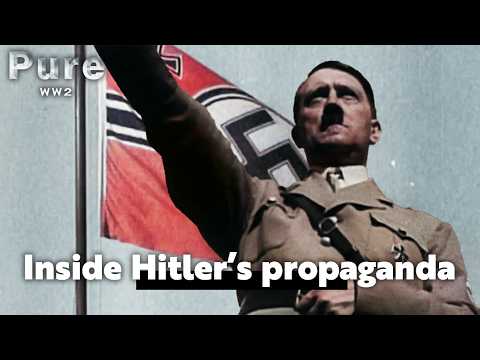
Less than a month later, Hitler stood before parliament under the looming swastika and presented the Enabling Act. This bill would allow him to bypass the constitution and pass laws without parliamentary approval. The vote was held under intimidation: armed Nazi paramilitaries surrounded the building. “Basically, he took over the engines of power,” says a historian. The act passed, and Hitler’s dictatorship was legalized.
With legislative control secured, Hitler moved swiftly to marginalize and persecute Germany’s Jewish population. On April 1, 1933, Joseph Goebbels, the new Minister of Propaganda, orchestrated a nationwide boycott of Jewish businesses. “Fear in the Nazi regime became one of their most potent persuaders,” the transcript notes. The message was clear: step out of line, and you would be targeted.
The machinery of terror was already in motion. The SA, the Gestapo, and the SS—led by Heinrich Himmler—became the enforcers of the regime, their presence a constant reminder of the violence that underpinned Nazi rule. “The role the SS, the SA, and the Gestapo played was of strength, but also of violence,” explains a historian. “And this element of violence or the threat of violence was very much part of Hitler’s politics.”
By July 1933, the first concentration camp at Dachau held nearly 27,000 people—communists, liberals, conservatives—all arrested without trial. Propaganda masked the horror, portraying the camps as places of rehabilitation. It was a lie that would only grow more monstrous with time.
Hitler’s grip on power tightened with each passing month. Through plebiscites and referendums, he manipulated public opinion, using the tools of democracy to destroy democracy itself. In August 1934, after President Hindenburg’s death, Hitler merged the offices of chancellor and president, and a referendum gave him near-total approval. “Yes, Führer, we will follow you,” posters declared. The cult of personality was complete.
But the true masterpiece of Nazi propaganda was yet to come. As Hitler set his sights on expanding the Reich, the world watched—some in awe, others in fear—as the art of persuasion reached its most terrifying heights.
The machinery of control extended far beyond the ballot box. While Hitler consolidated political power, Goebbels was waging a parallel campaign against the soul of German culture itself. “Art has traditionally been a way in which dissent is expressed,” a historian observes, “but the Nazis were very quick to take full control of art, abolishing some or banning it on the grounds that it was decadent.” On April 12, 1933, school organizations declared a period of cleansing that would culminate in a ritualized burning of blacklisted books.
On the night of May 10, bonfires were set up in Berlin, Munich, Frankfurt, Dresden, and Breslau. Lines of torch-wielding students and SA members flung books onto the flames as Goebbels and other party leaders watched from the sidelines. “Out of these ashes, the phoenix of a new age will rise,” he declared to the crowd. The ceremonies were broadcast by radio across Germany—a spectacle of destruction designed to be heard as much as seen.
Education became another frontier. Textbooks were rewritten to incorporate anti-Semitism disguised as objective biological fact. One notorious volume, The Poisonous Mushroom, peddled allegations of Jews as communists and financiers. “Classrooms became an important frontier for perpetuating Nazi ideology disguised as education,” the transcript notes. German lessons focused not merely on language but on folk tales, myths, and the blood-and-soil ideology that bound the people to the land.
Germany’s youth were considered essential to the movement’s future. Membership in the Hitler Youth swelled from around 100,000 in 1932 to over seven million by 1939. “It was the idea of each German girl or boy playing their part in the nation, almost as building blocks to create an organic whole,” explains a scholar. Summer camps, rallies, and militarized games indoctrinated a generation in the Nazi worldview.
In late 1933, Goebbels established the Reich Chamber of Culture, or RKK, made up of seven chambers covering literature, film, theater, music, visual arts, press, and radio. Every artist or journalist who wished to practice in Germany had to apply. “You can see this is a pretty ambitious program,” a historian remarks. Goebbels brought his characteristic energy to the task, aided by thousands of employees and vast resources.
He was particularly aware of the power of mass media. All films produced in Germany required RKK approval, and he identified radio as “the most modern and important instrument of mass influence that exists anywhere.” By 1932, one in four German homes had a radio. The regime introduced the Volksempfänger—the people’s receiver—a cheap set practically anyone could afford. When Hitler or other leaders spoke, the message reached millions at once.
Goebbels was careful, however, not to drum propaganda into people too overtly. He told the press to bore their readers, understanding that what people wanted was familiar content with judicious, carefully calibrated doses of ideology. “If you disobeyed directives, at best you would be fired. At worst, sent to a concentration camp.” Hundreds of scientists and artists fled Germany in response—Albert Einstein among them. Over the course of the 1930s, 300,000 Germans would leave their country.
In 1937, the RKK ran an anti-Semitic exhibition in Munich called The Eternal Jew, supported by a similarly themed play at the Bavarian State Theater. Over 400,000 people attended. Even more—two million—visited the accompanying exhibition of “degenerate art,” which targeted anything abstract or interpretive. “They wanted a very wholesome German art that emphasized myths like blood and soil,” the transcript explains, “people’s connection to the German earth and to their German heredity.”
Hitler himself was portrayed in art as a military leader in uniform or as a Teutonic messianic figure destined to lead the nation to greatness. “He was portrayed almost as a king-like figure, beyond the minor concerns of party squabbles, unimpeachable, unapproachable, and yet also the embodiment of German strength.” The pinnacle of this cult of personality was the 1935 film Triumph of the Will, a documentary of the 1934 Nuremberg rally that one scholar calls “a kind of militarized ballet.”
Disciplined forces stand at attention in rows; cheering masses raise their arms in unison; children with blonde curls greet their Führer. The neoclassical architecture of Albert Speer formed a grand stage set, enhanced by special lighting. “It’s the moment that Hitler becomes a god,” the transcript declares. “He is no longer a mere mortal.”
The rallies continued year after year, mobilizing the people and generating self-actualized acclaim for the party. In 1935, the Nuremberg rally became the site for the passing of the Nuremberg Laws, which severely limited the civil rights of Jews. “They paved the way for all subsequent laws and regulations—more than 1,000 anti-Jewish laws,” a historian notes, “and these legal processes more or less paved the way for the final aim of the Nazis to exterminate the Jews.”
One of the regime’s greatest propaganda successes came in 1936, when Berlin hosted the Olympic Games. “The 1936 Olympics is dripping with Nazi propaganda,” the transcript states. Hitler funneled massive resources into the event, spending more than any previous Olympiad, including a new stadium designed by Speer to hold 250,000 spectators. Signs reading “Jews forbidden” were removed, and Gypsies were rounded up and sent to camps. The world was shown a sanitized, modern, and vibrant Germany.
The narrative was disrupted by the success of African-American athlete Jesse Owens, who won four gold medals. Yet over 45 countries participated, implicitly acknowledging the legitimacy of Hitler’s regime. “Germany produced this brilliant PR campaign,” a historian explains. “It really was effectively bribing journalists with marvelous facilities.” The Berlin Games were also the first sporting event broadcast live on television—another display of Nazi technical superiority.
Hitler’s focus on modernization extended to the Autobahn program. Breaking ground became another ritual, with columns of marching figures carrying shovels instead of weapons. “The Autobahn and the motorways talked about putting the people back to work,” the transcript notes. For a time, the German economy appeared to boom. But it was a paper tiger, dependent on raw materials that could only be secured through territorial conquest.
Hitler converted this need into a new propaganda narrative: the urgent need for Lebensraum—living space for the German people. Rearmament was sold as a way to restore Germany’s former glory and get people back to work. Each new territorial gain was lubricated by the propaganda machine. In 1935, the Saarland voted overwhelmingly to return to Germany after an intensive campaign using cheap radios to spread false claims about opponents. In March 1936, Hitler moved 30,000 troops into the Rhineland, justified by a media campaign suggesting Germany was under threat. “I go with the certainty of a sleepwalker along the path laid out for me by providence,” he told a crowd in Munich.
In March 1938, the Anschluss brought Austria into the Reich. Hitler surveyed German tanks rolling through Vienna as cheering crowds lined the streets. “Your son has returned to his homeland,” he declared. Then, in October 1938, the Sudetenland was negotiated into greater Germany. The international community, desperate to avoid war, acquiesced.
But for Jews, the threat could no longer be ignored. On the night of November 8, 1938, Kristallnacht—the Night of Broken Glass—shattered any remaining illusions. “7,500 Jewish businesses across Germany and Austria were damaged or destroyed,” the transcript records. Synagogues burned, homes were ransacked, 30,000 Jewish men were arrested. “It symbolized the end of the German-Jewish relationship.” The world was shocked, but still unwilling to act.
Time magazine named Hitler its 1938 Man of the Year. His influence on world events was considered more significant than any other figure. Yet the German people remained opposed to all-out war. Hitler needed a new angle. After Munich, he summoned newspaper editors and declared, “Right, from now on we’ve been talking peace. Now we’ve got to prepare the German population for war.”
On September 1, 1939, Hitler confirmed once again that the very opposite of peace was true. German forces marched into Poland, and the world was plunged into the deadliest conflict in human history. The ultimate Nazi narrative device—conquest through military supremacy—had been unleashed. The art of persuasion had reached its most terrifying heights, and the cost would be measured in millions of lives.
What do you think was the most chilling moment in Hitler’s rise to absolute power—the Reichstag fire, the Night of the Long Knives, or the world’s silence after Kristallnacht? Share your thoughts in the comments below.
Report this article
Select a reason for reporting:






