Lieutenant Colonel Richard Harmon had spent thirty years believing that appearance was the first language of command. A soldier who looked like a soldier fought like a soldier. He had carried that certainty from West Point to Germany, through Korea, and into the suffocating green silence of Vietnam. But in the spring of 1967, standing at a tree line in Phuoc Tuy province, he would come face to face with men who shattered that belief without firing a single shot.
They looked like they had crawled out of the earth itself. Their uniforms were stained beyond recognition, patched and torn, woven with vegetation. Their faces were smeared with days-old camouflage paint, their eyes hollow from minimal rations and extreme heat. They were not standing in formation. They did not acknowledge his rank. And when Harmon made an observation he thought was obvious, one of them opened his eyes and answered in a flat voice that would echo in his mind for decades.
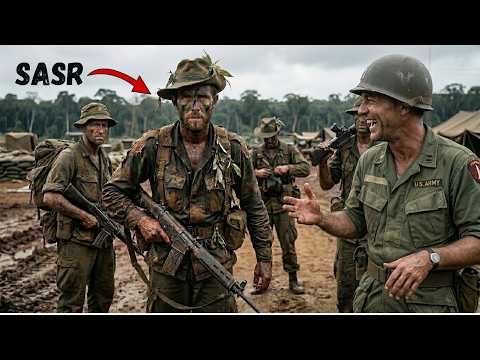
Harmon was 44, iron-gray hair cut to regulation, a jaw built to project authority. His aide, Captain Walsh, had never seen him uncertain. But at Nui Dat, the Australian SAS compound, Harmon expected to find soldiers who fit his mold. Instead, he found men who looked like something that had grown there—uniforms the color of rotting vegetation and old blood, faces blurred with paint and dirt, weapons resting with the ease of men who slept with them like pillows.
They had just returned from a five-day patrol in the Long Hai Hills. Harmon watched them and felt his certainty crack. Then he said it: they looked like a parade team—a word that meant disorganized, broken down beyond salvage. The comment was not shouted, just stated with the weight of thirty years of professional conviction.
The man who responded was sitting against a tree, eyes closed. He opened them slowly and looked at Harmon with a gaze that suggested he had been awake the entire time. “We just spent five days in the Long Hai Hills,” he said, his voice flat and devoid of hostility. “If the colonel wants to know what a parade team looks like after five days in the Long Hai Hills, he’s welcome to go in and find out.” Then he closed his eyes again.
The silence that followed had texture. Walsh felt it physically. Harmon said nothing—a kind of answer in itself, because he was not a man accustomed to silence. The Australian commanding officer, Lieutenant Colonel McPherson, arrived and steered Harmon toward the command post, where the real dismantling would begin.
McPherson did not lecture or boast. He simply explained how they operated, in the tone of a mechanic describing engine maintenance. The SAS patrols moved in four- and five-man teams in terrain where the enemy operated in company strength. Their calculus was invisibility, not firepower. “A patrol that can be detected is a patrol that is dead,” McPherson said. And what made patrols detectable were not the obvious things—but the invisible ones, the things that drifted ahead of a man in the wet heat of the jungle.
Harmon asked about the uniforms. McPherson explained: the fabric was prepared to resist olfactory detection. The enemy knew the jungle’s baseline scent with precise certainty. American soldiers carried the chemical signature of the industrial world—soap, insect repellent, toothpaste, deodorant—compounds that did not dissipate in the triple canopy. They drifted, announcing their presence hundreds of meters before arrival. The Australian SAS had removed those products entirely. They stopped using manufactured hygiene four days before a patrol, lived in their uniforms until they smelled like the environment, ate local food to alter body chemistry. “A uniform that smelled like the jungle was a uniform that kept its wearer alive,” McPherson said. “And a uniform that smelled like an American laundry was a uniform that killed its wearer as surely as a weapon pointed at his chest.”
Harmon said nothing. Then he asked about casualty figures. McPherson told him. The number was roughly what a single American infantry platoon might lose in a bad week in comparable terrain. Harmon asked him to repeat it. McPherson did, adding that he did not consider it remarkable—just the expected result of the method. “If you did not allow the enemy to find you, the enemy could not kill you.”
That was the second dismantling. Harmon had spent months signing letters to families, attributing losses to enemy advantages and terrain. He had not seriously entertained the possibility that his own forces were broadcasting their location through the chemical signature of American civilization—that the products supplied to maintain morale were functioning as homing beacons for enemy trackers.
The afternoon continued. McPherson talked about movement pace—the Australians covered ground at a rate that would have generated complaints in any American unit, not because they were slow, but because they moved with a precision of placement and frequency of stillness that turned walking into becoming part of the jungle. He talked about radio silence—the absence of regular check-ins that kept headquarters informed but also kept enemy signals intelligence triangulating patrol positions. And he talked about contact procedure, which inverted every principle Harmon had been taught.
The Australians did not seek contact. Contact represented a failure of the primary method—to remain undetected. When contact occurred, their response was designed not to win the firefight, but to survive and extract with capability intact. “A dead patrol gathered no intelligence and achieved no operational objectives,” McPherson said. “It was a pure loss, regardless of how many enemy soldiers it killed in the process of dying.” They hit hard briefly, then moved before the enemy’s reaction force could close the trap. Because in the jungle, a fixed position was a position being targeted by mortars.
Harmon had a word for this approach that he did not use: running. Every instinct told him that running was the opposite of winning. But McPherson’s casualty figures sat in the room like a third party, and Harmon was beginning to understand that the framework through which he had always evaluated military effectiveness might not be a universal truth, but a culturally specific preference. And the jungle had its own preferences.
That evening, the man from the tree—Sergeant Dennis Calligan—was at the briefing. He sat with the stillness of someone who had learned that stillness was an active skill. He described his patrol with conciseness and precision: five days, several hundred enemy observed across four occasions, one brief contact, all team members intact, intelligence already passed up the chain. No inflection, no drama—just facts transferred between people who understood what they meant.
Afterward, Harmon walked to Calligan and said something Walsh would later describe as the most difficult thing he had ever watched his colonel do. He apologized for the comment he had made that afternoon. He said it had been made from ignorance—not an excuse, but relevant context—and that he had spent the last several hours acquiring information that had materially altered his understanding. Calligan listened, then said the colonel didn’t owe him anything. “If the information was useful, that was the point of the visit.” Then he picked up his rifle and walked out.
Harmon watched him go with an expression Walsh had never seen on his face before. The closest word he could find, decades later, was educated.
The report Harmon filed upon returning to his own command ran to thirty-one pages. It covered scent discipline, movement methodology, communication security, and contact doctrine, and it was written with the clarity of a man genuinely trying to transmit something important rather than merely satisfy a reporting requirement. He recommended a formal study of Australian SAS operational methodology, with the intent of identifying specific practices adaptable for American special operations units.
He was direct about what had prompted it. He wrote that he had arrived at Nui Dat with assumptions calibrated for a different kind of war and a different kind of terrain. The Australians had not tried to disabuse him of those assumptions. They had simply shown him their results, and the results had done the work more effectively than any argument could have.
The report went up the chain. It generated several responses, none of which resulted in the formal study he had recommended. The reasons given were institutional, logistical, procedural—the standard vocabulary of organizations that have decided to file something rather than act on it. Some of the specific recommendations appeared in fragments, in different language, in updated training materials issued two years later. The connection to their origin was not recorded anywhere Harmon could find.
He did not consider this a personal failure. He had understood from the beginning that institutional change moved on its own timetable, and that his function was to provide honest input, not control what happened to it.
What he did carry—through the remaining years of his career and into retirement—was the memory of standing at that tree line and seeing nothing that matched what he knew a soldier was supposed to look like. And the slow, irreversible understanding that what he was looking at was not the failure of the men to meet his standard, but the failure of his standard to account for the terrain they were surviving in.
The Long Hai Hills were not forgiving of standards imported from other places. They were not forgiving of the assumption that methods which had worked in France or Korea would work in a jungle where the enemy had spent generations learning the difference between the smell of the earth and the smell of something that did not belong to it.
The jungle did not care about parade formations or uniform standards or the shine of a boot. It had exactly one question for the men who entered it. Not whether they looked like soldiers. Whether they could disappear.
The men who could answer yes came out. The men who answered with parade formations and radio check-ins and the chemical signature of the industrial world on their bodies answered it incorrectly. And the jungle was consistent and patient and utterly indifferent about what happened to them next.
Dennis Calligan served two more rotations in Vietnam and left the army in 1972 with a service record that was, by the standards of the war, extraordinary. The word he would have used for it, if pressed, was adequate. Because adequate was the SAS standard, and anything beyond adequate was the kind of noise that got people killed.
He went back to Queensland and worked for many years in an occupation that required patience and precision and a tolerance for long silences most people find uncomfortable—but that he had come to regard as simply the natural condition of careful attention. He did not talk about Vietnam much. There was not much to say that the people he was talking to would have understood without having been there. And the things worth saying were mostly contained in the silence itself, in the discipline of not filling it with noise when noise was the thing that killed you.
Richard Harmon retired as a Brigadier General in 1974 and wrote a memoir published privately, read by a small audience of people who had served with him or near him. The chapter about Nui Dat was the shortest in the book and the one most frequently mentioned afterward. He described the patrol coming in from the Long Hai Hills, the way they looked, the comment he made, and what he learned in the hours that followed.
He ended the chapter with a sentence that Walsh, who had been present for all of it, said was the truest thing he had ever read about being comprehensively wrong about something you had believed for a very long time. Harmon wrote that the most dangerous rank a man could hold in a jungle was not Lieutenant Colonel or General or commander of anything.
The dangerous rank was the one he had held that afternoon at Nui Dat—the rank of someone who had already decided what he was looking at before he looked.
But the story did not end with the memoir, or with Calligan’s quiet decades in Queensland, or with the thirty-one pages that vanished into the filing systems of an institution that had its own priorities. Because the war itself was still moving, and the men who had learned to disappear in the Long Hai Hills were about to be handed a terrain far less forgiving than any jungle, and a war that would test whether the lessons of invisibility could survive contact with an enemy who did not need to smell them coming at all.
It began, as these things often do, with a request that arrived at Nui Dat in the late summer of 1967—a request that McPherson read twice, then folded carefully, then carried himself to the signals hut rather than passing to a clerk. Because the request came from a place the Australians had been quietly avoiding for months, and it named a location that had already swallowed one American unit whole.
The request was for a long-range reconnaissance team to insert into the A Shau Valley—a name that had become a byword for American losses in terrain no one had properly mapped. McPherson read it and understood immediately what it meant. “They want us to go where their own people vanished,” he told Calligan, “and they want us to find out why.”
Calligan studied the maps for three days. He did not ask about support, extraction, or rules of engagement. He asked only one question: “How long do we have to stay invisible?” The answer was seven days. He nodded, then went to prepare his team the only way he knew—by removing everything that smelled like the world they were leaving behind.
The patrol that went into the A Shau that September did not look like soldiers. It looked like the jungle itself, moving. And when it came out nine days later—two days overdue, one man wounded, but all four alive—it carried intelligence that changed how a division fought for the rest of the war.
Harmon read the after-action report in his office, alone. He did not file it. He read it twice, then wrote a single line in the margin and closed the folder. “The jungle asked its question. They answered.”
What question would you have answered incorrectly, before you learned to disappear?
Report this article
Select a reason for reporting:






