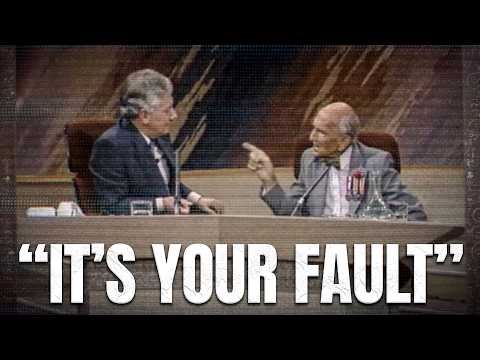
In 1988, a 93-year-old Irishman named Jack Campbell sat down for an interview that would strip away the romantic myths of war and leave behind only the raw, unvarnished truth. His voice, calm and measured, carried the weight of a lifetime spent burying memories that most men would have taken to their graves. But Jack did not bury them. He spoke of the First World War not as a hero, but as a survivor—a boy who had lied his way into hell and spent the rest of his life trying to forget what he saw there.
What emerged from that conversation was neither a patriotic tale nor a tearful confession. It was a direct, almost clinical recollection of a world where fear was constant, death was routine, and the line between man and animal blurred in the mud of the trenches.
Jack came from a family of five brothers, all of whom served between 1914 and 1918. The eldest, driven by a hunger for the world beyond Ireland’s shores, had filled their heads with stories of distant lands and grand adventures. “He spoke about how vast the world was,” Jack recalled, “and we believed him.” The army seemed like a shortcut to that dream—a way out of a life that offered nothing but routine and poverty.
But the dream was a lie. Each brother followed a different path into the war. One rose to a high rank in the Canadian artillery. Another became a machine gunner in the Irish Guards. A third was killed in an explosion at Vimy Ridge. A fourth died in the Somme. Jack himself, too young to enlist legally, lied about his age, claiming to be 18 when he was only 16. “The recruiting sergeant told me it wouldn’t be a problem,” he said, as if it were the most ordinary thing in the world.
When he reached the front, the illusion shattered. The trenches were not places of glory but of precarious survival—deep, muddy scars in the earth, three to four meters down, with improvised covers against attacks from above. “I never went over the top without fear,” Jack admitted. “There were no exceptions.” The collective shout of the soldiers as they charged was not courage, he explained, but an instinctive reaction—a way to keep the body moving when the mind was paralyzed by terror.
Inside the trenches, the enemy was not only the Germans. The weather was merciless—rain, snow, and wind that never relented. Food was scarce, and when it arrived, it was immediately threatened by hordes of rats. “They were everywhere,” Jack said. “Any food you tried to save would disappear.” But the rats did more than steal. They fed on the bodies scattered across the battlefield—bodies that could not be buried without drawing enemy fire. Those bodies were not strangers. They were comrades, friends, sometimes relatives. Living with that reality required a psychological adaptation that Jack described with chilling simplicity: “The absurd became routine.”
One night, away from the front line, Jack witnessed something that would haunt him forever. A young man beside him woke up screaming. A rat had torn away a piece of his face while he slept. The wound became infected, and within days, the young man was dead. “I often wondered how many men died not from bullets, but from those rats,” Jack said. “We never knew the number.”
But the most striking moment of his account came on the day he was hit by gas—the same day his brother was killed in the same combat sector. Jack mentioned the coincidence without dwelling on it, as if the weight of the event needed no elaboration.
The gas attack began in an almost mundane way. Jack and his comrades were hauling materials to the front line when enemy artillery found them. A fragment struck his hip, knocking him down, but there was no blood, no visible wound. “I thought nothing of it,” he said. “A blow, that was all.” He picked himself up and carried on.
Hours later, under cover of darkness, the order came to rescue wounded men stranded in open ground—territory the Germans had just abandoned. They went out. Then the shells came again, and this time they carried something worse than shrapnel. Gas. “We knew the drill,” Jack recalled. “Mask on at the first sign.” He did exactly that, believing himself protected like the men beside him.
But within minutes, something went wrong inside the mask itself. Nausea. Then a searing pain. Then the terrible, suffocating realization that he could not breathe. “It was keep it on and choke, or take it off and face the gas,” he said. He pulled the mask away.
Another soldier reached him as he fell, and it was that man who found the cause. The fragment that had struck Jack’s hip hours earlier had not been harmless after all. It had pierced the metal canister of his gas mask, tearing a hole through it. “The blow I ignored that morning was the thing that nearly killed me that night,” Jack said, his voice flat. “A small piece of metal. That was all it took.”
What followed existed in his memory only as fragments. He recalled a medical officer taking his details, then nothing—a long, blank darkness through which he was carried without knowing it. When he next opened his eyes, he was in a hospital on the coast, far from the trenches. He had no memory of the journey. “I answered questions about where I was,” he said, “and every answer was wrong.” Only later did he learn he had been moved all the way back to Dublin, carried across the sea while completely unconscious of it.
He spoke of the men who returned from leave—seven days, travel included, and every one of them back on time. “Not one deserted,” he said, and there was something like quiet pride in it. When asked if he had ever considered running, he answered at once. “Never. It wasn’t in us.”
And when the interviewer finally asked about the men he had killed, Jack did not flinch. “I don’t think about it,” he said. “Either you acted, or you were gone.” There had been no hatred in it, he explained—no faces, no names. Only the role he had accepted, and the simple, terrible arithmetic of survival.
But there was one memory Jack returned to more than any other, a detail he had never shared with his own children. It concerned a soldier named Thomas, a quiet boy from Galway who had joined up a few months after Jack. They had trained together, shared rations, and made a pact to look after each other. “He was like a brother to me,” Jack said, his voice dropping. “But the war doesn’t care about pacts.”
During a night raid near Hulluch, Thomas was hit in the stomach by a machine-gun bullet. Jack found him in a shell hole, bleeding heavily but still conscious. The nearest aid station was three hundred yards away, across open ground lit by flares. To carry him would have meant exposing them both to sniper fire. “He begged me to leave him,” Jack recalled. “He said, ‘Don’t waste yourself on me.'” Jack hesitated for a moment—the only moment of hesitation he ever admitted to—and then dragged Thomas into deeper cover and promised to return with help.
He never made it back. A counter-attack pinned down the rescue party for hours. By the time they reached the shell hole, Thomas was dead. “I don’t know if he died from the wound or from the rats,” Jack said. “I never asked. I didn’t want to know.” He paused, and for the first time in the interview, his eyes seemed to look inward. “I’ve carried that promise for seventy years. It never gets lighter.”
The interviewer asked if he had ever visited Thomas’s grave. Jack shook his head. “I couldn’t. I knew his mother. She wrote to me after the war, asking how he died. I told her it was quick. It wasn’t.” He looked down at his hands. “That lie was the only kindness I could give her.”
As the interview drew toward its end, Jack spoke about the return home—a subject he had avoided until then. He arrived in Dublin in late 1918, still recovering from the gas, his lungs permanently scarred. The city was different. People celebrated the armistice, but Jack felt nothing. “I walked through the streets and saw men laughing, and I wanted to ask them what they were laughing at,” he said. “But I knew they wouldn’t understand. They hadn’t been there.”
He found work as a clerk, married, and raised three children. He never spoke of the war at home. “My wife knew I had been in it, but she never asked for details,” he said. “I think she was afraid of what I might say.” His children learned of his service only when they found his old medals in a drawer, decades later. “They asked me why I never told them. I said, ‘Because you didn’t need to know.'”
But the war never left him. He described nightmares that persisted into his eighties—the gas, the rats, the face of the young man whose cheek was torn away. “I’d wake up choking, reaching for a mask that wasn’t there,” he said. “My wife would hold me until the shaking stopped.” He spoke of this without self-pity, as if it were simply another fact of his existence, like the weather or the passage of time.
When asked if he had any final thoughts, Jack was silent for a long moment. Then he said, “People talk about the war like it was a great adventure. It wasn’t. It was a waste. All those boys—my brothers, Thomas, the ones whose names I never learned—they died for nothing. And the ones who came back, like me, we just learned to live with the nothing.” He looked directly at the interviewer. “If you remember anything I’ve said, remember this: there is no glory in war. Only survival. And survival isn’t the same as living.”
The interview ended there. Jack Campbell died two years later, at the age of 95, in a nursing home outside Dublin. His family found a small notebook among his belongings, filled with names—dozens of them—written in a shaky hand. At the top of the first page, he had written: “Those I could not save.” The last name on the list was Thomas.
Jack Campbell died two years later, at 95, in a nursing home outside Dublin. His family found a small notebook among his belongings, filled with names—dozens of them—written in a shaky hand. At the top of the first page, he had written: “Those I could not save.” The last name on the list was Thomas.
His granddaughter, Siobhán, read the notebook in one sitting. She had known her grandfather as a quiet man who gardened and never raised his voice. Now she understood the silence. “He carried them all,” she said later. “Every single one.”
She traveled to France the following spring, to the Somme, and found Thomas’s name on the Thiepval Memorial among seventy-two thousand others with no known grave. She left a small stone and a note that read: “He tried to come back for you. He never stopped.”
On the train home, Siobhán thought about her grandfather’s words—that survival isn’t the same as living. She wondered how many other men had returned with notebooks of their own, names they never spoke aloud, promises they never kept.
The war ended over a century ago. The last voices are gone. But the question remains, waiting for each generation to answer it: what do we owe the ones who came back, and the ones who never did?
Report this article
Select a reason for reporting:






