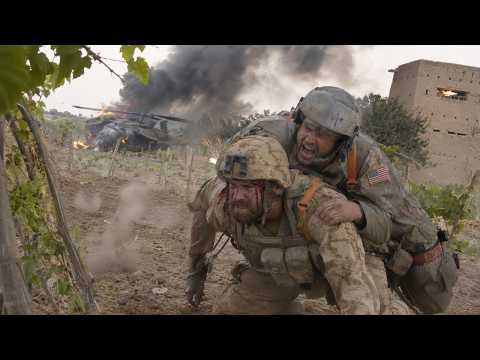
“Who gave you permission?” The colonel’s voice cut through the rotor wash before the wheels had even settled in the dust. Lieutenant Colonel Hartley stepped out of the Black Hawk medevac chopper before it stopped rocking, his medical goggles still pushed up on his shaved head. Five Australians advanced toward him through the sandstorm, their faces caked from boots to eyebrows, carrying his crew. Sergeant Tenny led them, and on his back, strapped with a luggage belt, was the crew chief everyone called “Preacher.” Behind them, a column of black smoke rose from the vine rows, leaning east with the evening wind.
The dry hill beneath their feet was pale and crusted. Every step broke the surface and kicked up a powder that hung at knee height. Two soldiers carried the pilot between them, his leg splinted with a piece of vine trellis. A third supported the second crew chief, who kept turning his head as if someone were calling his name. The co-pilot came last, carried on a helicopter door, his face pale. Hartley put his hand on the airframe and waited for an answer. “No one, mate,” Tenny said, and didn’t lower Preacher from his back. Seven hours earlier, that colonel had ordered every one of these men to stay exactly where they were. And so they had ended up on that hill, and this was the price they paid to get there.
At midday, 2,400 meters east of the village, the patrol rested in the shade of a Land Rover. The observation post was a low shoulder of gravel above a dirt track. From there, they could see the entire green belt at the edge of the village—gray-green rows, mud walls, scattered compounds. Tenny aimed his binoculars at the vines and bit his lower lip. The sun had split it a week ago, and he chewed it whenever he had nothing better to do with his face. Gecko, the scout, was cleaning sand from his pistol holster. Yowie was asleep in the driver’s seat, his cap over his eyes. The long-range patrol vehicle had a front winch that Yowie had installed himself and talked about like a kid at school.
“The only thing that winch has ever pulled out of a hole is us, Gecko,” Tenny said. Gecko replied that was one more thing than Tenny had ever pulled out of a hole in his life. Biscuit, the medic, laughed without opening his eyes. Mouse, the signaller, kept one ear on the radio and the other on the joke. A Black Hawk came in low from the south. It was Venom 2-2, the bird that had dropped their mail and water twice that month. The crew chief at the left door was Preacher, a big Texan who had drawn a cross on his helmet with a marker. He leaned out and waved as he always did. Tenny raised two fingers off his binoculars. The bird banked northwest over the big belt.
Then the PKM opened up from the vines. Short red tracer lines rose to bite the tail of the aircraft. The Black Hawk lurched, dropped nose-first, then slid out of the sky. It hit the vine trenches on its side, rolled once, and stopped across the rows. Then there was only the sound that arrived late across the distance, a dull thud followed by a smaller one. Smoke rose black and thick, fast. Yowie was awake and had the engine running before anyone told him to. Mouse was pressing the radio headset to his ear. Through the noise, an electronic warble rose and fell, faint. It was the crew’s beacon, meaning someone in that wreckage had pressed the button. Someone was alive enough to want to be found.
Tenny was already in his kit. He wanted the vehicle moving in under a minute. The wreckage lay 80 meters from a mud-brick drying hut and a few hundred from the village. He knew how fast the men who fired that burst would come down to investigate. The net filled with calls before he could give the order. Every call sign in the area came up asking what had happened. Then one voice silenced the rest. Lieutenant Colonel Hartley ran the aviation task force from the operations center at Kandahar airfield. The airspace was his. The quick reaction force was his too. So was Venom 2-2. He spoke slowly and clearly, like a man reading a decision he had already made. All units will remain in place. A company-sized QRF is being assembled and will reach the crash site in approximately four hours. No force smaller than that is to approach the site. In Kandahar, Hartley rubbed his wedding ring as he spoke. A year ago, he had sent a platoon-sized QRF to a crash site in Helmand with too few men. The platoon had gone in fast and brave, and he had written the condolence letters afterward. Since then, he counted men before he counted minutes. In his math, a single patrol at that wreckage would add names to the list, not subtract from it.
Tenny took the handset from Mouse. He didn’t switch to the patrol frequency and didn’t ask for a private word. He opened the line on the general net where every pilot, every patrol, and every duty officer in the province was listening. “Mate, they’ve got about four minutes. About four. Not four hours,” Tenny said. Silence filled the tactical operations center. For a few long seconds, there was nothing on the net but the hiss of the transmit and the beacon’s intermittent chirp beneath it. Somewhere, a pilot started laughing and then cut out. Gecko looked at Biscuit. No one had ever spoken to a lieutenant colonel like that over the command net, especially not a sergeant from another army. Hartley didn’t answer the insult. He repeated the order word for word in the same flat tone. That was the part that worried Tenny. It’s easy to ignore a colonel who loses his temper. A colonel who has a reason and keeps it to himself is something else entirely. Why was Hartley so certain that only a full company could get the crew out alive?
In the drying hut, 80 meters north of the wreckage, a man with a henna-orange beard squatted by a vent. The phone handset in his grip was cracked in the middle and taped with gray tape. He watched the smoke rise and counted the seconds it would stay visible from the air. Then he pressed the taped button and spoke to the men spread along the vine walls. No one fires again. No one approaches the wreckage. Let the smoke rise and let the beacon call. He told them the Americans always come to recover their men, and they always come in strength. And when they come, they will take this track toward the field, and the guns will be waiting. He set the handset on the edge beside a PKM and sat waiting for the company to arrive.
From the observation post, Tenny chewed his lip and looked at the ground between him and the smoke. The long-range patrol vehicle could cover most of it via the track. But it couldn’t enter the vine fields. The trenches were head-high and narrower than the vehicle, and the dividing walls would tear the oil pan. He made his decision without consulting anyone. He would take Mouse and Yowie forward in the Land Rover to a bend in the eastern track, 1,000 meters from the wreckage. From there, the gun could cover the track and Mouse could talk to the world. He, Gecko, and Biscuit would walk the rest. Yowie objected for a moment that the vehicle should stay with the foot patrol. Tenny shook his head. Three men would be hard to see among the vines. A Land Rover on that track would be a target you couldn’t miss.
The patrol was splitting, and Tenny knew exactly what that meant. Two men alone with a truck, three men alone with a burning helicopter. He pressed the radio again, this time to tell the operations center what he intended to do, not to ask permission. Hartley’s reply came within seconds. “Sergeant, if you leave your position, I will make sure you are court-martialed,” Hartley said. Then he took away the one thing that might have made the walk survivable. Two Apache helicopters had been circling over the patrol since noon, and they had already turned toward the smoke. Hartley ordered them out by name. He ordered them back to a distant assembly point south of the big belt, out of range of any support the patrol might request. The Australians were alone now, under a direct order, and the entire net had heard it.
Tenny watched the two dark shapes move away south. Their rotor noise faded under the beacon’s chirp. Mouse looked up from the radio and said the colonel was asking for confirmation of receipt. Tenny handed the handset to Mouse and told him to confirm whatever he liked. Then he picked up his rifle and walked toward the edge of the slope. Yowie was already driving the LRPV away toward the eastern cut. The winch drum on the front bumper glinted in the sun as the vehicle dipped over the first hill. Gecko and Biscuit followed Tenny. Ahead of them stretched two kilometers and more of broken ground, a dirt track, and a trench. And beyond that waited a vineyard with a gun that had gone suddenly quiet.
They walked west at a quick pace, spaced out with Gecko leading. The ground between the observation post and the vineyard was a mess of gravel spines and dry washouts that crossed each other. Every washout meant a drop, a crossing, then a climb again. Every climb put the smoke ahead of them again, a little lower toward the hills each time. Hartley made his next move before they had covered the first kilometer. Mouse came over the patrol radio to say the operations center had taken them off the air tasking net. The patrol could no longer talk to any aircraft in the province, not even to ask for help. Everything Tenny wanted to say to Kandahar now went to Mouse, then to the satellite, then to the colonel. By then the Land Rover had reached the eastern cut, and the cut lay in a low spot. The satellite antenna could no longer see more than a narrow strip of sky from that position. Mouse’s messages began to arrive broken. Half a sentence, a gap, then the rest a minute later, if at all.
Ahead, the dirt track ran straight west toward the vineyard. Beside it was an irrigation trench, dry and waist-deep, filled with camel thorn. Gecko looked at the thorn, then at the track, and stepped up onto the hardpan. It was flat and hard and pointed straight at the smoke. On that surface they could save a quarter of an hour. Tenny saw him do it and said nothing. He was counting that same quarter of an hour himself. In the drying hut, the man with the orange beard watched three figures come out of a washout onto his track. They were too few to be the company. They were also too close to the wreckage to be ignored. If they reached the crew, the Americans would have no reason to come in strength. He tapped the shoulder of the gunner once. A slot in the south wall of the hut flashed. The track jumped in a line of small white bursts, walking east toward Gecko’s boots.
The rounds cracked past his head. Each one was like a slap of air on his ear. Gecko staggered as his pack tore open, and the three of them flattened sideways into the trench. The thorn scratched the skin on their hands and faces as they fell. Gecko landed on his back, then rolled onto his knees and cursed the sky. A round had ripped the top of his pack and exited the side. Two spare magazines and a bag of sweets settled on the track above him in the sun. He started to reach for them. The gun fired another burst into the ground a meter from his hand. “Leave them, Gecko. They’re his now,” Tenny said. The PKM fired twice more along the track, short and deliberate, then stopped. No one had fired back from the trench. Tenny noticed that and filed it away. He lay with his cheek on the dry mud and waited for his breathing to slow. Biscuit checked Gecko without being asked. There was no blood. Just a long scorch on the pack frame and a tear in the shoulder strap. Gecko tied the strap with a bootlace and pushed his remaining magazines deeper into his vest. He would go into the vineyard with less than he had come out with. And they all knew it.
Tenny sent the contact report to Mouse. One gun in the hut north of the crash site firing on the track from a prepared position. No casualties. Patrol in the trench at 800 meters. The reply from Kandahar took four minutes to arrive. In the operations center, Hartley had the report read to him twice. Then he walked to the map and put his finger on the hut, the way a man presses on a bruise to see how bad it is. The gun that had held its fire until the track was occupied was not a gun that was accurate by accident. Someone had pointed it there, and someone had told it to wait. His reply came through Mouse in two broken pieces. It arrived at the trench as a single sentence. Three men, one gun, Sergeant. And that is only the first gun, Hartley said. His next words put them back in the eastern cut. They were to withdraw through the trench, return to the vehicle, and wait with the rest of the patrol. The QRF would deal with the hut when it arrived. Tenny told Mouse to tell the colonel no. Mouse sent the message. The satellite cut out halfway, and the operations center heard only the first part. The duty officer asked Mouse to confirm the patrol was withdrawing. Mouse said it was not. The link cut again. When it came back, Hartley was repeating the order, and Mouse had to start over. It went on like that. Each exchange cost three or four minutes of silence, a lost sentence, and a repeat. Mouse’s voice grew flatter and slower as he repeated the same words into the handset at the bottom of the low ground. Neither side wanted to give up the last word, and the satellite wouldn’t let either of them finish it.
In the trench, Biscuit lay on his side and watched the smoke. When the patrol entered the trench, the smoke had been black and thick. Now it was turning gray and thin, and the wind was tearing it apart before it rose high. Biscuit had seen vehicles burn before. A fire that eases like that has either eaten everything it can reach or found something new to eat. Either way, there were people under it. Twenty minutes passed among the thorn before Tenny ended it. He pressed his radio button and gave Mouse a final message to pass. The patrol will not withdraw. And it will not use the track either. The colonel could court-martial him for the first part. The second part was for Hartley, and Tenny knew it. The track had nearly put Gecko in the dirt, and that quarter of an hour had been as hard on Tenny as it had on Gecko. The colonel had seen the gun from a map table 400 kilometers away. He had read the situation correctly. “The man is right about the track, so we won’t use the track,” Tenny told the other two.
Gecko asked what they would use instead. Tenny didn’t answer. He raised his binoculars slowly through the thorn, tilting the lenses out of the sun, and aimed them at the drying hut. The hut sat on a rise at the northern end of the vineyard, higher than the village houses, and had no windows at all. Its walls were thick mud brick, the color of the dust around it. Each face was decorated with rows of narrow slots, no wider than a hand, arranged in a grid. The farmers hung grapes inside on poles and let the hot wind pass through the slots until they dried into raisins. The design was older than anyone’s grandfather and effective for what it was built to do. Tenny watched the slot the shot had come from. A faint patch of fresh dust still clung to the wall below it, where the muzzle blast had disturbed it. He watched for a long time. Then the gun fired a short burst at a dog crossing the far end of the track. A different slot flashed, two slots over from the first. The shooter had moved. He hadn’t swung the barrel to track the dog. He had carried the gun and moved it to another slot.
Tenny went back to chewing the split in his lip. A barrel pushed through a narrow slot like that barely moves sideways. It fires where the slot points and hardly anywhere else. Each slot in that wall gives the gun one narrow angle of view on the ground. To change the angle, the shooter must lift the heavy weapon, move it, and set it again. That takes seconds. It also means the gun can only shoot at what someone has already decided to watch. Tenny traced the angles of view with his eyes. The slots in the southeast face looked onto the track and the line of the trench. The slots in the west face looked onto the pale plowed field behind the wreckage. The south face, looking over the vineyard, had slots too, but they were cut high in the wall. From that height, any path the gun had through the vines crossed the vine trenches well above the earth walls on either side. Wherever the path crossed a trench, it crossed above a man’s head. A man at the bottom of the trench would be safe beneath it.
Tenny lowered the binoculars and looked along the trench. Two hundred meters west, the trench passed under a low mud culvert where water had once flowed into the first vine rows. Beyond the culvert, the vineyard wall began. And behind that wall, the trenches ran north toward the hut, and the wreckage lay across three of them, still smoking. That was the slow way in. The floor of the trench would be soft and loose. The vines would snag everything they carried, and they would have to crawl most of the way. It would cost them more of the time Biscuit was watching waste away in that smoke, but the hut gun could not reach them there unless it was moved to a slot that didn’t exist. Tenny told Gecko and Biscuit in one sentence and pointed at the culvert. Then he passed the word to Mouse and Yowie. They were to keep the Land Rover’s gun silent unless the hut fired on the crossing. The truck at a thousand meters was still a secret, and he wanted to keep it that way.
They went along the trench on their elbows and knees, hugging their rifles in the crooks of their arms. The thorn caught their sleeves and let go with a dry tearing sound. Twice the hut gun fired at the track above them. Both times the rounds went where the slot pointed, a few meters to their right and a meter above them, while the patrol kept crawling below. At the culvert, the trench narrowed into a tube of packed mud too small for a man with kit to pass through. Gecko went over the culvert on his belly, fast and flat, then dropped into the vineyard side. No one fired. Biscuit followed, dragging his medical pack by its handle. Tenny came last. On the other side, the track sloped down into the first trench. The walls rose above his helmet, crumbly at the edges, and the floor was soft with old leaves and crushed earth. Vine stems as thick as wrists twisted up the sides and met overhead to make a green-gray roof, torn and dark. The inside was dim and airless, smelling of dust and crushed leaves and a faint thread of jet fuel. Tenny kept the hut behind his left shoulder and the smoke ahead of him. He moved on his knees into the trench with Gecko directly behind him and Biscuit at the rear.
The trench ran north between its earth walls, and the first distance took longer than the whole trench before it. The floor gave under their knees like flour. Low vine stems crossed their path every few meters, and each one required flattening and sliding under it on their stomachs. Gecko took the lead and Biscuit stayed at the back. Tenny stayed in the middle where he could see both of them while neither could see much at all. The man with the orange beard saw them come apart. A helmet slid between two leaves and vanished. Then a shoulder, then a rifle barrel, then nothing for a while. He counted three. He waited and counted again, and still three. No free American company would send three men into a field first unless the rest were right behind them. So these were the eyes, sent to look and call the others forward. He raised the taped handset and spoke to the gun on the other side of the plowed field. It was to stay pointed at the open ground. It was not to fire a single round into the vineyard. Let the scouts look as much as they liked. When they called the big helicopters in to land, the field would still be waiting for them.
Near the northern end of the row, a section of the west wall had collapsed into a slope of loose earth. Tenny stopped beneath it and signaled Gecko with his hand to stop. The three men would not approach the wreckage until he had seen what lay beyond it. He pushed his helmet between the vine roots at the edge and raised his eyes very slowly, a finger’s width at a time. Beyond the smoke and two more rows of vines stretched the plowed field, pale and flat, its furrows running toward the village. On its far side was a compound wall, and in a gap in that wall sat a black shape on a bipod. A second PKM, placed low along the field and pointed away from the vineyard. Beneath the wall was a row of fresh holes. Their dug earth was darker than the field around them and still damp from the digging. Each hole faced the open ground. Tenny stayed still and worked it out. The track was covered by a gun, and the field was covered by a gun. The field was the only flat ground near the crash where a pair of big helicopters could put down a company. Any force that came to rescue the crew would have to cross one or the other.
He pressed his teeth into his split lip until he tasted blood, then slid back down the slope. He told Mouse about the second gun. The holes in the field and the whisper over the patrol radio. Mouse sent it through the satellite. The reply took six minutes and arrived in three pieces with silence between each. In Kandahar, Hartley had taken off his reading glasses and was holding them by one arm. He had been listening to the signals intercepts since late morning. A local commander had been talking on an open radio net about shooting down a helicopter and waiting for the rescue. He had promised his men a rich hunt. No one knew which valley he meant until Venom 2-2 went down. Since that moment, Hartley had known exactly which valley and why the guns had gone quiet after the first burst. He said it over the relay. In plain words, the crash was the bait. The beacon, the smoke, the silence—all of it was bait. The company would have to take the track and the field at the same moment, or the rescue would become a second crash. That was why he had asked for every man he could find. Mouse read it to the men in the trench, sentence by sentence as the messages arrived. “So he’s waiting for a company, mate. Don’t send him one,” Tenny said. Mouse passed it up. The link cut before any reply came.
Tenny didn’t wait for the reply. Hartley had been right about the trap and had told no one on the ground. He had miscalculated completely. Both guns were aimed at hundreds of men stepping off helicopters onto open ground. Three men at the bottom of a trench under a roof of leaves had no place in that plan. He pointed north and Gecko began to crawl again. The walls hid them and slowed them at the same time. Gecko brushed the east side with his shoulder, and a piece of dry mud crumbled and pattered down among the dead leaves. Two rows on, a vine caught in the front sight of his Steyr. He had to stop and pull it free by hand. Something like that happened every few meters. The leaves on the floor were dry as paper, and every leaf made a crack under a knee. Then it was Biscuit’s pack. Its corner caught on a rusted trellis wire strung between two stakes. He pulled, and the wire held and opened the side seam along most of its length. Rolled bandages and a compression dressing spilled into the dust. He gathered what he could reach without standing up. Two dressings stayed under the wire, and he left them there. He crawled away hugging the pack to his chest with one hand. They had traded speed for cover from the start. Now the cover was costing them noise as well.
Voices came from the northwest, then the sound of sandals scraping on hard ground. Men were moving along the edges of the rows from the village side, toward the sound of the cracking leaves. Gecko flattened and turned his head toward Tenny. Tenny pressed his palm down twice. Slow. They kept moving. The hot gun fired. It fired a long burst straight into the vineyard toward the place the noise had come from. The rounds passed through the canopy a meter above their helmets. Leaves shredded and stems split. A rain of green and gray fragments fell on their backs. Nothing reached the ground. The gun stopped. For a few seconds there was only the quiet settling of leaves. Then it fired again from a different slot along the wall. The rounds came from a new angle and at the same height. Stems above their heads twitched and tore, and the three men flattened beneath them and felt the debris pattering on their necks. Gecko spat out a leaf and kept moving. The shooter could move his gun from slot to slot whenever he liked. Each slot gave him a path that crossed the trench above their heads.
The heat reached them before the wreckage did. It pressed on their faces through the vines, dry and oily, and the edges of the leaves ahead of them had dried and turned brown. Then the trench widened and opened into a gap where the Black Hawk had torn the vines out by the roots. The aircraft lay across the rows ahead of them on its right side. Its tail had broken off and struck the far wall. The main cabin was burning from the inside, a low, steady fire fed by fuel from somewhere below. Tenny noticed the fire first and the men second. The left cabin door faced the sky, and the door gun hung on its mount. An ammunition belt dangled over the edge of the frame. Beside the mount, in the middle of the flames, sat the M240 ammunition boxes. Their paint had blistered and turned black. Thin smoke was leaking from the seams of their lids. An ammunition box in a fire doesn’t explode all at once. Once it gets hot enough, it cracks and throws rounds in every direction for minutes. He didn’t want anyone near the cabin when that started.
He watched the fire for a few moments. The wind was coming in broken gusts from the west. Each gust pushed the flames toward the patrol and sent heat down the trench. And each lull let them stand upright, where the heat eased on the near side. He counted three gusts and three lulls and knew the rhythm. On the fourth lull, he moved, keeping low along the east wall and around the broken tail. Gecko followed on the next lull, then Biscuit on the one after. On the other side of the tail, in the next row, they found the crew. Preacher lay on his back below the cabin where he had come out of the open door. His left leg was bent below the knee in a way legs don’t bend. Blood had soaked into the dust beneath it, leaving a wide dark patch. The second crew chief sat beside him pressing both hands on his leg, his belt half-wrapped around the thigh without being tied. He looked at the Australians and asked where the aircraft was, then looked back at his hands. The pilot sat against the west wall, his helmet off and a pistol held in his lap. His right leg was stretched out stiff on the ground. His boot pointed the wrong way. He raised the pistol an inch, saw the dust-covered faces, and lowered it again.
Biscuit was beside Preacher before anyone said a word. He moved the second crew chief’s hands aside, searched the torn pack for a tourniquet. He found one on the second try and tied it high on the thigh. Preacher opened his eyes at the pressure and swore in a slow, drawn-out Texas accent. Then he focused on Tenny. “You’re the mate who never waves back,” Preacher said. Gecko knelt beside the pilot, took the pistol gently from him, and put it in his own chest rig. The pilot let him. He said his leg was broken, maybe in two places, and that his co-pilot was still up front. He nodded his chin toward the nose of the aircraft. The cockpit lay in the last of the three rows under the edge of the trench. The nose had struck the earth wall first and folded in on itself. Through the cracked windscreen, Tenny could see the co-pilot. He was still strapped in his seat, his visor up, his face pale and wet. He was awake and watching them. His door had taken the full weight of the impact. The frame had collapsed inward against the wall and bent the hinges with it. Tenny put his fingers into the gap at the top edge where it was widest and pulled. Nothing moved. Gecko came, set the butt of his rifle into the gap, and leaned his whole weight on it. The butt slipped off the metal and scraped a layer of skin off his knuckles. They tried together again. Both braced against the trench wall. The door didn’t shift an inch. Not a crack, not a millimeter.
The co-pilot said from behind the plastic that he couldn’t feel his legs well and asked if that was bad. “Hang on, mate. It’s just a stuck door,” Tenny said. Behind them in the burning cabin, one of the ammo boxes made a dry metal tick as its lid began to bend. Tenny left the frame and wiped his torn fingers on his shirt. Hands weren’t going to open that door, and a rifle butt wasn’t either. What he needed was mounted on the front of a Land Rover a thousand meters east on a slope he had chosen himself. He pressed the radio and told Mouse to bring the vehicle. Mouse took a long moment to answer. When he did, his voice was low and fast. Men had come up the wash behind the cut while the patrol was moving slow. Six of them at least, maybe more. They were moving along the eastern bank between the vehicle and the observation post. The dust from driving down had been seen after all. Yowie had swung the gun to face them, and every burst he fired showed them exactly where the truck was. The commander hadn’t waited to see what the scouts would find. He had gone after what was supporting them. Mouse said he would pass the request to Kandahar too and that he needed sky to do it. Down in the cut, the antenna caught almost no signal. He climbed up the side of the slope to find more. The link came through clear and steady this time. Mouse knelt on the edge with the handset at his ear and the antenna pointed up. A round came out of the wash and hit him high in the left shoulder. He dropped the handset and fell onto his back, sliding down, his heels kicking up dust.
In the trench, Tenny heard his voice as a grunt and then silence. Yowie came up on the radio seconds later, breathing hard. Mouse had been hit in the shoulder, was talking and swearing, blood coming through his shirt. The truck was pinned. Any move out of the cut would put the wheels and fuel tanks wide open to the wash. Tenny leaned his back against the trench wall and looked at the broken door. He had left the truck behind to keep it hidden and keep its gun pointed at the track. It had been neither hidden nor useful. The only tool that could open the cockpit was a kilometer away, and Mouse was bleeding in the cut because Tenny had put him there. Mouse came back on with one hand, the words squeezed out between his teeth. He had the satellite link again and asked if Tenny wanted to send anything. Tenny gave him the message to pass word for word. It’s my call, and my mistake. Tenny said. The signaller is hit, the vehicle is pinned. The message reached Kandahar in two parts. Hartley stood at the map and listened to the watch officer read it. No one else in the operations center spoke. Two staff officers were watching him, and he could see what they expected him to say. He had predicted this from 400 kilometers away. Almost to the detail. He had been right before in Helmand, and being right hadn’t made the condolence letters any shorter. He leaned over the radio operator and asked one question. How many of you are still on your feet, Sergeant? Hartley said. The answer came six minutes later through Mouse. Four Australians standing, one hit but working. One American walking, two who can’t stand, and one still in his seat. Hartley wrote the numbers on the edge of the map with a grease pencil. Then he stood looking at them and didn’t wipe them off.
At the wreckage, Preacher had started to bleed again. The compression dressing had held the thigh, but the cabin door frame had made a second wound higher on the hip above the band. Biscuit packed it with the last of the gauze he had saved from the torn pack. The gauze went red almost at once. And with nothing left to pack it with, he put his fist into the wound and pressed with all his weight. Preacher’s breath came out in a long hiss. Biscuit stayed there, pressing on the hip, both hands fully occupied. Gecko took the hut. He came up on his elbows over the broken ground, fired three quick rounds through the slot nearest the track, then slid back down. The shooter replied within seconds, and the vine cover above Biscuit’s back shredded. Gecko moved ten meters along the wall and repeated it at a different slot. Each time, the man had to lift the PKM and move it to a new hole. As long as he was chasing Gecko along the south face, he wasn’t watching the track to the east. Gecko counted his magazines by feel after each climb. Two had gone into the PKM on the track. What was left was going faster than he would have liked.
Then the voices came from the northwest, close this time, and the scrape of sandals somewhere in the far row to the west. A burst of fire came straight across the floor of the trench. The rounds struck the nose of the broken cockpit and threw dirt onto the co-pilot’s window. Tenny rolled into the mouth of the row and fired back, short and low, until the sounds stopped coming closer. As he passed, Gecko pulled the pilot’s pistol from his belt and dropped it back into the pilot’s lap. The pilot turned to face east along the row without being asked. The fighters were in the vines now, between the wreckage and the village, and they were feeling their way south. Three men could hold at the wreckage for a while. But they couldn’t open the cockpit, carry four Americans, and fight their way out all at once. Tenny made his next decision knowing the price the two men in the cut would pay. He told Yowie to come anyway. From the front of the cut, not the back. Across the eastern track, then onto the vehicle track that ran along the southern edge of the vineyard. Mouse would ride on the gun. “Bring your winch, Yowie. It’s time you pulled someone else out,” Tenny said.
Yowie said nothing. Ten seconds later, Tenny heard the engine over the radio. The Land Rover climbed out of the cut in a spray of gravel. Mouse was wedged behind the gun mount, his left arm strapped to his chest, his right hand on the grips. Rounds from the trench rang off the rear body and punched a fuel can, and diesel spread across the truck bed. Yowie didn’t slow. The truck leapt west with its tail trailing fuel. Mouse couldn’t hold the gun steady with one hand. Instead, he pressed it down and fired long bursts toward the trench behind them, letting the recoil walk the rounds across the bank. It wasn’t accurate. But it forced the men in the trench to keep their heads down, and that was all Yowie needed. The vehicle track was wide open to the southeast slots of the hut. Gecko saw the dust coming and climbed the earth slope again. He emptied a full magazine through the slots on that side one after another, so that no shooter could settle on any of them. Still, a round from the PKM hit the Land Rover once. The burst starred the windscreen white, tore the canvas off the rear, and punched a hole in the left rear tire. Yowie drove the last stretch on the bare wheel rim. He swung off the vehicle track into the farthest row west and pushed the hood as far as the earth walls allowed. The winch drum stopped about 30 meters from the nose of the cockpit.
Gecko was at the bumper before the engine stopped. He took the hook and pulled the cable across the floor of the trench, laying it over the leaves and vine roots. Tenny took the hook from him under the cockpit. He wrapped the cable once around the top door frame through the gap he had put his fingers in before, and hooked it back on itself. Through the broken glass, the co-pilot watched him do it. Tenny told him to turn his face away, cover it, and stay covered. Yowie ran the winch. The cable lifted off the trench floor and went rigid with a hum. The nose of the Land Rover pulled down toward the wreckage. The door didn’t move. Yowie put the truck in reverse and gave it everything. The good tires dug into the soft floor, and the rim of the punctured wheel screamed against the dirt. For a long moment, nothing happened. Then the hinges gave with a shriek of tearing metal that drowned out the PKM. The door came out of its frame in one piece, slid across the trench floor, and struck a vine trunk. Tenny and Gecko went in through the gap. Gecko cut the harness straps with his knife. Tenny put his arms under the co-pilot’s shoulders and lifted. The man came out light and slack, his legs trailing behind him over the sill as if they belonged to someone else. The seat beneath him was dark and wet. His lips had turned gray.
Biscuit couldn’t leave Preacher’s hip. Tenny aimed his words across the three meters without looking up. Lay him flat. Check his back. Keep him talking. Tenny laid the co-pilot on the trench floor beside the pilot. He found the wound low on his back where the seat frame had gone in, and pressed a field dressing from his own pack onto it. The co-pilot asked if they were going home now. Tenny told him yes and kept pressing. From the hut, the commander watched the Land Rover nose down in the row with its rear tire on the rim. He counted the men around the wreckage. Two had come with the truck, and three had been in the vines all along. Five in total. No company was coming. No big helicopters were ever going to land in his field. The bait had drawn one truck, and the men in the truck were about to rob him of his catch. He pressed the taped handset and gave new orders to the men in the rows by the village. The attack on the wreckage was over. Now they would move south along the far rows, past the fire, to close the ends of the trenches at the vehicle track behind the truck. There would be a man at the south end of each row. Then the Australians would have only one way out, across the open field where his second gun was waiting.
Tenny heard the new orders as movement before he understood them. The footsteps behind the wreckage changed direction. They were no longer coming toward him. They were going south toward the vehicle track. In minutes, there would be a rifle at the mouth of every trench, and the truck was stopped nose-first in one of them. The LRPV could still move on its rim. It couldn’t carry everyone and keep its gunner free to fight. Tenny divided the load in a few seconds of thought. The two Americans who couldn’t stand would ride with the one Australian who couldn’t carry. Everyone else would walk. Gecko and Yowie lifted the torn cockpit door and laid the co-pilot on it face down. They slid the door over the tailgate and into the bed through the diesel and torn canvas. Gecko braced the pilot’s leg with a broken vine stake using a strap from Mouse’s pack while Biscuit guided him where to tie. Then the pilot pulled himself in beside his co-pilot and put both hands flat on the dressing low on his back. Mouse wedged himself behind the gun again, his strapped arm held tight to his chest. Preacher was left. Biscuit couldn’t walk 300 meters with his fist inside a man’s hip. He cut the sleeve off his shirt and wrapped it tight. He pulled his hand out of the wound and pushed the roll into place, and Gecko tied a cargo strap from the truck over it. Preacher gave one shout, a long Texas word with no vowels in it. A second strap went around Tenny’s chest. They lifted the crew chief onto his back and strapped him on like a pack.
They followed Yowie. “Don’t stop for us no matter what you hear,” Tenny said. Yowie’s hand was on the gear lever and he had no chance to answer. Inside the burning cabin, the first box went off with a muffled thump. Then the rest began to cook off in a ragged crackle, throwing sparks out of the doorway and the broken body of the aircraft. Tracers ricocheted off the trench walls and whined away over the vines in every direction. A round struck the mud above Gecko’s head and shook dirt down inside his collar. Along the far rows, the sounds stopped. The commander’s men were moving through narrow trenches with rounds coming from behind a wall of smoke. They didn’t know which way to point their rifles, so they lay flat on the trench floor. The PKM went quiet too. The shooter could see nothing but the sparks flying out of the wreckage and nothing else. Yowie backed the truck out of the row with a screech of tires, swung onto the vehicle track, and headed east. No one fired at him. Behind the truck, Biscuit pulled the second crew chief’s arm over his shoulders and started walking in the trench. Tenny followed with Preacher’s weight pulling at his collarbone. Gecko came last, walking backward. The rows ran southeast for a long way and then stopped short. Beyond them was a stretch of bare plowed ground, about 40 paces wide, where the farmers turned their carts. And on the far side, the next block of vines began. The low ground lay behind that block. The gap was open to the hot southeast lanes, and every one of them was open to it.
Biscuit carried the second crew chief across the gap first, running with him in a stumbling rush. Gecko climbed the trench wall and fired at the slots on that face one after another, as he had all afternoon. They reached the far vines without being hit. By then, the wreckage had begun to quiet. The last magazines emptied, and the rounds came out singly and in pairs. Then the firing stopped entirely. In the far rows, the men began to raise their heads. Tenny moved anyway. He couldn’t run with a man on his back, so he pushed himself forward in a hunched, driving walk. The thorns caught at his ankles with every step. Preacher kept talking in his ear the whole way, slow and steady. He talked about a farm outside Abilene, about his daughter’s skill with a rifle, about the marker he used to redraw the cross on his helmet every Sunday. And each time Tenny’s pace faltered, the slow voice rose. Halfway across, the hut saw them. A burst kicked up dirt in a line of small eruptions to Tenny’s left. A round struck his helmet above the ear and knocked it sideways. The chin strap bit into his jaw, and the world went white and silent. He found himself on one knee in the dirt without remembering falling. Preacher’s weight was pulling him back. Preacher’s voice was the only sound that cut through the ringing in his ears. “Get up, son. You still owe me a wave,” Preacher said. Tenny got up. He didn’t remember the rest of the crossing. Only the earth wall coming closer and Biscuit’s hands taking the strap across his chest. Then the cool of the next trench closed over them. Blood ran from his hairline into his left eye. He blinked it away and kept walking.
In Kandahar, the transmission came through clear this time. Mouse could see the sky above the vehicle track. The patrol had broken silence. Five Australians and four Americans were moving toward a dry low south-east of the wreckage. Mouse read the coordinates twice, slowly. One number at a time. Hartley stood over the map where he had written the numbers in grease pencil. He turned the ring on his finger once. Then he called up the pair of Apaches from their holding point. He gave them the go for the hut and read them the coordinates of the low ground. He told the medevac crew on the ramp to stand by and expect one more passenger. The watch officer reminded him quietly of the order he had given that evening for everyone to hear. No one approaches that site without a full company. “Then log it under my name,” Hartley said. He took his helmet off the hook by the door and walked out to the flight line.
In the hut, the commander heard the rotor noise coming from the south. Two dark shapes appeared over the vines, flying low and fast. They weren’t carrying a company. They weren’t intending to land in his field. He looked at the rows of trenches his men had closed. They were empty now except for his fighters. He looked at the gun beside him. He pressed the radio and gave his last order of the day. Every man back inside the village, and the field gun too. Then he went out the north door and didn’t stop to watch. The first Apache came in on the south face of the hut. Its cannon chewed the mud-brick walls, and the slots blew outward in clouds of brown dust. The second fired its rockets through the roof. When the dust cleared, the wall the gun had fired from was a pile of rubble with sky showing through it. The field gun never fired a round. By the time the Apaches turned west over the compound wall, the gap in it was empty. A few shapes were seen running between the mud walls of the village, and then they were gone.
The patrol came out of the last trench as the light was fading. Ahead, the low ground opened up, a shallow basin with a dry crust that showed blue in the dusk. The Land Rover was stopped at an angle on its edge with steam rising from its grille. It had lost most of its diesel through the hole in the fuel can and had died on the slope. Yowie and Mouse had already unloaded the co-pilot, still on his door, and the pilot had slid off the bed behind him. Gecko clicked on the infrared strobe and fixed it in a crack in the earth crust. It began to flash a rhythm none of them could see. Tenny didn’t loosen Preacher’s strap. If he put him down, he wasn’t sure he could pick him up again. The medevac bird came in from the south, dropped its nose, and landed in a brown cloud of its own making. The basin disappeared. For half a minute there was only the noise of dust and the shape of the aircraft inside it.
The door slid back before the wheels took the full weight, and a man in a flight helmet jumped out first. Hartley came through the dust toward them, his hand up against the sand. “Who gave you permission?” Hartley shouted. “No one, mate,” Tenny said. For a second neither of them moved. Then Tenny turned his back to the colonel and bent his torso forward. Hartley understood. He put his hands under Preacher’s good leg and his strapped hip and took the weight while Biscuit cut the cargo strap. The two of them carried him to the open door and slid him onto the floor on his back. Preacher caught Tenny’s wrist as he came in and held it until the medic pulled his hand away. The others came across the crust behind them. Gecko and Yowie carried the pilot, the vine stake still lashed to his leg. Biscuit brought the second crew chief. He climbed in under his own power and asked again where his aircraft was. Then they went back for the door. Hartley took one end without being asked. Tenny took the other, and the two of them lifted the co-pilot over the sill. The crew chief closed the cabin door, and the brown cloud fell away beneath them.
The Black Hawk headed south with its lights off. In the green glow of the instrument panel, the cabin was a jumble of legs and boots. Preacher lay along the rear bulkhead, and the flight medic was already cutting his trousers. The pilot sat braced against the seat frame. The second crew chief had folded himself into a corner and closed his eyes. Mouse was wedged by the gunner’s window, his strapped arm tight to his chest. He was asleep before they passed the ridge. Yowie knelt at the window watching the basin fall away. The Land Rover was a dark block on the edge of the low ground. A single blue light from an Apache marker flashed over it. “It stays there, Yowie. No one’s going to steal a truck with three wheels,” Tenny said. Yowie didn’t laugh. He watched until the basin disappeared behind a hill.
The co-pilot lay where they had put him, face down on his own door across the cabin floor. Biscuit was on his knees beside him with a red headlamp strapped over his helmet. The field dressing Tenny had pressed onto the back wound had gone black and heavy. Biscuit peeled it back, looked once, and pressed it down again. Then he moved to the head and turned the man’s face away from the torn fabric lining. The co-pilot was breathing in short, shallow gasps like a runner at the end of a race. His lips had no color left at all. Biscuit needed both hands at the head. He needed one to hold the jaw and one to put a needle in the arm. He left that wound alone. The flight medic was up to his elbows in Preacher’s hip. Gecko held the pilot’s splinted leg on his knees to keep it off the floor. Tenny reached toward the dressing, but his fingers were split from the cockpit frame. They wouldn’t close properly. Hartley moved first. He came down from his seat onto his knees. The aircraft tilted, and he put one hand flat on the floor to balance. Then he put both palms over the dressing, one on top of the other, and leaned forward. His glasses slid off his head and fell into the dark under the seats. He didn’t look for them. “Harder than that, sir. Like you hate it,” Biscuit said without turning around. Hartley pressed harder. His shoulders rose toward his ears with the effort. Blood came through the gauze and between his fingers, warm, and ran down the backs of his hands into his shirt cuffs. The aircraft shuddered as it passed through turbulence, and his knees slid on the wet floor. He adjusted his weight and kept pressing. The co-pilot turned his head slightly on the fabric. His eyes found the colonel’s uniform, then the face above it. He seemed to recognize it. His mouth moved twice before any sound came out. “Sir, I’m sorry about the aircraft,” the co-pilot said. Hartley said nothing. He put his weight on his arms and stared at the back of the man’s neck.
Biscuit got the needle in on the third try and taped it down. He held the fluid bag up with his fist because there was nowhere to hang it. Then he handed it to Tenny. Tenny raised the bag to the cabin ceiling, where the plastic swung with every turn the pilot made. The fluid ran into the arm in a thin, steady line. It wasn’t enough. Everyone in that cabin who had seen it before knew it. The fluid was going in one side and coming out from under Hartley’s hands on the other. His breathing changed first. The short gasps spaced out, then there was a long pause. Biscuit put two fingers on his neck and kept them there. Then he rolled the co-pilot onto his back over the door and started compressions. The medic slapped the mask into Gecko’s hand and pointed with one motion. Gecko squeezed it each time Biscuit paused. Hartley lost his grip on the wound when they turned him. He put his hands back under. He knelt with his arms under the man’s lower back and pressed upward with the weight of the compressions. Each of Biscuit’s pushes drove the body down toward his forearms. He didn’t take them away. Outside the window, the dark ground gave way to scattered orange lights. Then the long glowing grid of Kandahar airfield appeared. The pilot announced the approach over the intercom. No one in the back looked up. Biscuit kept working as they landed. The aircraft tilted, and he braced one knee on the door frame and kept going. The wheels touched, and he kept going. Sweat ran off the tip of his nose onto the co-pilot’s flight suit. He was counting under his breath. Then he stopped. He sat back on his heels and moved his hands away. He looked at his watch under the red lamp. Then he stared at nothing for a while.
Gecko lowered the mask onto the co-pilot’s chest and left it there. Hartley stayed where he was, his arms still under the man’s back, still pressing. Biscuit reached over and put a hand on the colonel’s wrist. He didn’t say anything. After a moment, Hartley pulled his arms back one at a time and knelt with his open hands on his thighs. They were red to the elbows. The cabin door slid back. Floodlights and engine noise poured in, and a crowd of medics in reflective vests ran up with stretchers. They took Preacher first, then the pilot, then Mouse, who woke up swearing and tried to walk. The second crew chief came out on his own feet between medics, asking someone about his aircraft. Gecko and Yowie went down after them into the bright light. Two men came for the co-pilot at last. They lifted him off the door onto a stretcher and covered his face with a blanket. They carried him away at a walking pace. The door stayed on the cabin floor where it had been lying. It was a piece of bent green metal and a frame, with torn hinges and an edge scraped by the trench walls. Its inner handle was still attached. The winch had torn away half its base, so it hung by a single screw. Hartley looked at it for a while. Then he took the handle and twisted it. The last screw held, then broke with a small dry snap. He stood in the doorway, stooped under the slowing rotor blades. Tenny was still sitting on the seat with the empty fluid bag in his lap and dried blood on the side of his face. Hartley held out the handle. Tenny looked at it, then at him, and took it. The metal was slick. The colonel didn’t say anything. He wiped his hands on his trousers, but it didn’t help. Then he went down onto the flight line and walked toward the lights of the tactical operations center without his helmet or his glasses. Two staff officers came out to meet him halfway. He passed them as if they were part of the floodlights. Tenny sat holding the handle in his split fingers until the crew chief gently asked him to get off the aircraft.
Eleven years after Anzac Day, the bar at the Perth Services Club was three deep by nine-thirty in the morning. The dawn service was over. Medals had been taken off some chests and put in pockets. At the back, someone was already calling for the coin toss, and a crowd around the two-up ring was getting loud. Inside, men who hadn’t seen each other in a year stood shoulder to shoulder talking mostly about knee pain. Tenny sat on a stool in the corner with a glass of beer that had gone flat. He had thickened, and gray had crept into his short beard. The split in his lip had healed long ago, leaving a faint scar that only showed when he smiled. Which wasn’t often. His keys lay on the bar beside the glass. On the ring, between the house key and the truck key, was a twisted piece of green-painted metal. It had gone smooth after a decade in his pocket.
The crowd at the door parted for a big man moving slowly. He wore a Texas belt buckle and an American flag pin next to an Anzac poppy. Below the knee, on the left side, his trouser leg rose to show a carbon-fiber socket and a steel pylon. Someone had drawn a small cross on the pylon with a black marker. Tenny saw him cross the room. Before either of them said a word, he raised his hand off the bar and waved. Preacher stopped short and grinned. He came up to the bar, leaned on it, and set a phone face-up between them. The screen was lit with a call in progress, from a US number. “Time’s still running. You took your time, son,” Preacher said. “Who’s this then?” Tenny said, nodding at the phone. “Hartley. They took his command away for flying that night. He’s been calling since breakfast, asking if you lot still drink in this bar,” Preacher said. Tenny looked at the phone for a long moment, then picked up his empty glass and finished what was in it. “Tell him he’s got his permission, mate,” Tenny said. “And he’s buying.”
The phone on the bar buzzed. Preacher thumbed the speaker and Hartley’s voice came through the noise of the club, thin and careful. “Sergeant Tenny. I hear you’re still standing.”
Tenny turned the green handle over once on the bar and set it down beside the glass. “Still standing, sir. Still owe you a wave.”
Preacher laughed and slid a fresh beer across the wood. On the screen, the call timer kept counting up, steady as a beacon in the dark.
What would you have said to the colonel after eleven years?
Report this article
Select a reason for reporting:






