For nearly a decade, the true nature of what Australia’s Special Air Service Regiment (SAS) was doing in Afghanistan remained hidden from the Australian public. The nation was told a simple story: peacekeepers, trainers, a quiet contribution to a distant war. But the reality was a regiment being secretly rebuilt, mission after mission, into something its founders would never have recognized. This is the story of how Afghanistan changed the SAS forever—and how the same machine that produced heroes also produced a reckoning that would tear the regiment apart.
The transformation did not happen overnight. It began with a regiment that was never designed to kill. Founded in 1957 on the coast of Swanbourne, Perth, the SAS was built for surveillance—small teams, vast distances, men who could infiltrate deep into enemy territory and succeed by remaining invisible. Their motto, “Who Dares Wins,” borrowed from the British, spoke not of aggression but of audacity in the art of observation. In Vietnam, this identity was forged in blood and patience: four-man patrols slipping into enemy-held jungle, counting movements, and slipping out without a shot fired. A patrol that ended in a firefight was considered a failure. The SAS was the eyes and ears of the army, and its culture was built on patience, stealth, and restraint.
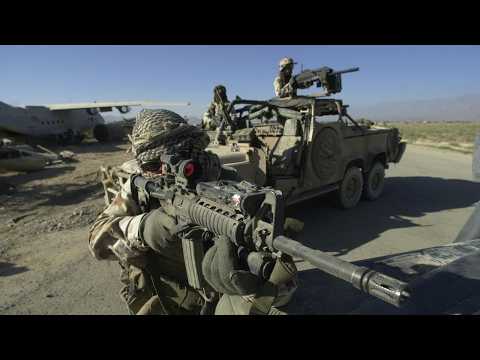
Then came Afghanistan. The war that erupted after 9/11 did not reward the silent observer; it punished him. Instead of watching and reporting, the new enemy required hunting—finding one man in a country of ten thousand villages and a hundred valleys, then reaching out in the dark and eliminating him. The SAS was no longer asked to see; it was asked to strike. And over eleven years, this regiment—trained to avoid killing—was transformed into the most lethal killing machine the Australian military had ever fielded.
The first deployment in 2001 was still recognizable. Operating from a forward base in the south, the SAS conducted long-range vehicle patrols across vast, empty deserts. They watched, they reported, they called in airstrikes. It was the old reconnaissance role, finally executed on a real battlefield. Then, in late 2002, they were withdrawn. For nearly three years, no Australian special forces were in Afghanistan at all. Had the story ended there, the SAS would have remained unchanged—its identity intact.
But the war did not end. It deteriorated. The quick, clean victory of 2001 turned into a grinding insurgency, and in 2005, Australia sent its special forces back. This time, they would not leave for eight years. And this time, the public was told almost nothing about what they would do. The pivot point was Orūzgān Province—a rugged, impoverished, mountainous region in the center-south. From Camp Russell at Tarin Kowt, year after year, the SAS operated a machine that no longer called itself a reconnaissance unit. It was now a special operations task group, and its primary job was exactly what the old regiment had spent fifty years learning not to do: it hunted people.
The logic of the war had shifted. The insurgency could not be defeated by controlling ground; it could only be dismantled person by person. A list emerged—the Joint Prioritized Effects List—containing over 2,000 names by late 2009. Against those names, coalition special forces launched raids at a tempo of dozens per week. Find the man. Fix his location through intelligence and surveillance. Reach him at night, when superior night vision made the darkness yours. Capture if possible. Kill if not. The Australians were part of that machine, and in their corner of Orūzgān, they became among its most ferocious components.
Every skill the old SAS had valued was still there—but repurposed. Patience, once used to hide for four days, now meant sitting in a compound through a freezing night waiting for one man to return. Stealth, once used to slip past the enemy unseen, now meant being inside his walls before he woke. Intelligence gathering, once the mission itself, was now merely preparation. The eyes and ears had become hands. And the tempo was relentless: intelligence would arrive, a target would be identified, an assault force would launch that night, and while they were still catching their breath, the next target would form on the screens at Camp Russell. Men served tour after tour—five, six, more—inside a system that demanded, night after night for years, that they enter a stranger’s home in the dark and make a life-or-death decision in seconds.
This was not the old SAS. But the proof of the transformation came in blood and fire. On September 2, 2008, in a valley called Karzai Ghar, a joint patrol was ambushed. RPGs and machine-gun fire poured from both flanks. In the chaos, a translator was left exposed. A soldier named Mark Donaldson ran eighty meters through open ground under heavy fire to retrieve him. He was awarded the Victoria Cross—Australia’s first in forty years. Then came Tizak, on June 11, 2010. An assault force was pinned down by intense, accurate fire from prepared positions. The only way out was forward. Private Ben Roberts-Smith charged the machine-gun nests, silencing them and restarting the assault. He received Australia’s second VC for that action. The SAS had become a force that could not only find the enemy but destroy him in the same night.
But the same machine that produced these heroes produced something else as well. The tempo—night after night, year after year—came with a cost that was not paid to the enemy. It was paid from within. In November 2020, after a four-year investigation, the Brereton Report was released. It examined the conduct of special forces between 2005 and 2016 and found credible evidence of 39 unlawful killings of prisoners and civilians in at least 23 incidents. It described a culture of “blooding”—directing junior soldiers to kill a prisoner to record their first kill—and the practice of carrying weapons and radios to place on the dead to disguise civilians as combatants. The response was severe: the Meritorious Unit Citation was revoked, and two squadrons—including the SAS’s Sabre Squadron—were struck from the order of battle. The regiment that had entered Afghanistan to observe and report left it as something extraordinary and wounded, both for the same reason.
The same qualities that made the SAS lethal—relentless tempo, autonomy, small teams operating in the dark away from oversight—were the same qualities that allowed the worst of war to happen where no one could see. For fifty years, the regiment had made itself invisible. Invisibility was both a blessing and a curse. The eyes and ears became a fist. The country cheered the fist for years without examining it. Then it had to sit and consider what the fist does when used with such intensity, in the dark, for so long. What you ask men to do repeatedly, for long enough, is what they become—not what you intended them to become. That is the lesson of Afghanistan. And it is why the SAS was changed forever.
But the reckoning did not end with a report on a shelf. It moved into courtrooms, into the slow machinery of criminal investigation, and into the lives of men who had come home years earlier expecting the war to stay behind them. The Office of the Special Investigator was created to pursue the criminal side of the allegations, and with it came a new kind of deployment: subpoenas, interviews, and the long, grinding process of testimony. For a regiment built on silence, the loudest years were still ahead.
What makes this part of the story so difficult to tell honestly is that it resists the shape of a simple moral. The same men who were investigated were the men who had carried wounded comrades out of kill zones, who had run into fire when every instinct said otherwise, who had stood between a translator and the ground he would otherwise have died on. The medals were real. The courage was real. And so were the allegations. To hold both at once is not weakness—it is the only way to see the machine clearly.
Consider what the public was actually given across those eleven years. On one side, two Victoria Crosses, a battle honour, and a narrative of extraordinary skill. On the other, a report describing practices that, if proven, would constitute war crimes. Both were produced by the same unit, in the same province, in the same darkness. The country had cheered the first and been forced to confront the second, and it had never been asked to understand how they were connected.
The connection was the tempo. The old SAS had been built around the mission as an event—planned, executed, recovered from, then planned again. Orūzgān turned the mission into a condition. There was no recovery, only the next set of coordinates. And when men are placed inside that condition long enough, the boundaries that a society assumes are fixed begin to erode—not because the men are monsters, but because the system never gave them the time to be anything else.
This is where the story of the SAS stops being a story about soldiers and becomes a story about institutions. A country that sends a quiet, patient regiment into a war that rewards speed and violence should not be surprised when the regiment comes back loud. The transformation was not a betrayal of the old identity. It was the old identity, stretched past its design limits, under pressure no one in 1957 could have imagined.
And the men themselves? Many still will not speak. Not to journalists, not to investigators, not even to each other. Some carry injuries that never appeared on a casualty list—the kind that do not heal in a hospital. The long nights, the many doors, the seconds in which everything was decided—none of that stays on the battlefield. It comes home with the men, and it sits with them in the quiet, and it does not leave.
The question that remains is not whether the SAS changed—it did, beyond recognition—but whether the country that sent them has learned anything from it. Australia celebrated the fist for years without ever asking what the fist was doing in the dark. Then it demanded an accounting, and it got one, and it is still struggling to hold both truths at once: that extraordinary courage and grave wrongdoing grew from the same root, in the same soil, under the same relentless tempo.
No one can put the old regiment back. The patient, invisible watchers of 1957 are gone, replaced by something sharper and more wounded. What Afghanistan took from the SAS, and what it gave, cannot be separated—they were the same transaction. The eyes and ears became a fist, and the fist left scars on everyone it touched, including the men who wielded it.
So the story ends where it must: not with a verdict, but with a warning. Ask men to do something long enough, and they become it. That is true of armies. It is true of nations. And it is the lesson Australia is still learning, one quiet, sleepless night at a time.
What do you think—can a country ever truly reckon with what it asked its soldiers to become? Share your thoughts below.
Report this article
Select a reason for reporting:






