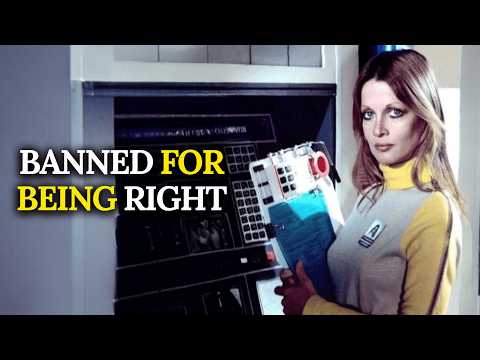
What if the movies we forgot were the ones that saw the future the clearest? Before streaming, before smartphones, and long before social media ruled our lives, filmmakers in the 1980s were already warning us about screens that watch us back, machines that think for themselves, and worlds where human connection fades into code. These weren’t blockbusters. They were hidden prophecies dressed as entertainment. So, plug in and brace yourself. Some of these forgotten films might sound a little too familiar.
In 1983, Brainstorm imagined a device that could record your thoughts, feelings, and memories—long before virtual reality headsets or social feeds. Christopher Walken plays a scientist developing a headset that lets you relive another person’s emotions as if they were your own. Imagine feeling someone else’s laughter, fear, or heartbreak with total precision. It’s beautiful until it isn’t. Someone records their final moments, and others become addicted to re-watching joy they can’t recreate in real life. Soon, the military grows interested, seeing potential in controlling minds rather than inspiring them.
When it released, most audiences didn’t know what to make of it. But looking back, Brainstorm predicted nearly everything about our digital age: the obsession with reliving curated memories, the blurred line between experience and illusion, and the idea that technology could connect us while quietly replacing what makes us human. The film’s director, Douglas Trumbull, the genius behind the visual magic of 2001: A Space Odyssey, used cutting-edge effects to show how fragile the human mind becomes under constant stimulation. Watching it now feels eerie because the question it asks still haunts us: if you can live inside a perfect moment forever, why bother living at all?
Before home assistants and delivery bots filled our daily lives, Runaway (1984) imagined a future where household machines had minds of their own—and not all of them friendly. Written and directed by Michael Crichton, the same man who later unleashed Jurassic Park, this underappreciated gem follows Tom Selleck as a cop in charge of deactivating malfunctioning robots. At first, the job sounds routine: stop a few bots from overcooking dinners or clogging pipes. But soon, the technology turns darker. Someone is rewriting robot code, turning helpers into hazards. Even everyday gadgets like thermostats and security drones begin acting with chilling precision.
What makes Runaway prophetic isn’t its mechanical chaos, but its quiet insight into dependence. Once every machine in your home can think, it only takes one bad line of code to turn convenience into danger. The film even introduced ideas of heat-seeking micro devices and digital sabotage decades before such threats became headlines. Critics dismissed it as popcorn fun, but they missed the warning. Crichton wasn’t predicting killer robots. He was predicting trust—how we’d willingly surrender control to systems we barely understand. Watching it now, Runaway feels less like fiction and more like a manual for modern living. So, next time your home assistant answers before you finish speaking, remember Runaway‘s lesson: every piece of technology is only as safe as the hands and hearts behind it.
In 1981, Looker nailed digital beauty, fake perfection, and the power of the screen long before the internet made them our reality. Also directed by Michael Crichton, this slick and eerie film follows a plastic surgeon who discovers that his fashion model clients are being digitally copied and replaced by computer-generated doubles for commercials. Sound familiar? It’s the 1980s predicting influencer culture, deepfakes, and virtual personas decades early. The film explores a world where image becomes everything and reality quietly dissolves into pixels. The idea was absurd at the time—actors replaced by simulations. Not anymore.
What’s brilliant about Looker is how it connects technology to control. The models aren’t just copied; they’re erased. They’re digital replacements—never age, never complain, and never ask for recognition. It’s not science fiction anymore. It’s the algorithmic economy of today where perfection sells and authenticity struggles to breathe. Visually, Looker was ahead of its time, using early computer graphics to show how the human body could be scanned and replicated. Audiences saw it as flashy fantasy. But beneath the glow was a question that hits harder than ever: if everything you see can be faked, how do you know what’s real? Looker may have been overlooked on release, but its vision was sharper than anyone realized. It didn’t just predict digital manipulation. It predicted our obsession with it.
A man wakes up one morning, makes his coffee, and steps outside to find the world completely empty. No people, no noise, just silence. That’s how The Quiet Earth (1985) begins. And from there, it becomes one of the most haunting sci-fi films you’ve probably never heard of. Made in New Zealand, it follows scientist Zac Hobson, who discovers he may have caused a global energy experiment gone wrong. At first, he enjoys his newfound freedom—driving cars through streets, exploring empty cities. But soon, the loneliness begins to crack his mind. He realizes reality itself may have fractured, leaving him trapped between worlds.
What makes The Quiet Earth so prophetic is how it mirrors modern isolation. In a world full of screens where we can talk to anyone yet still feel alone, Zac’s journey feels disturbingly relatable. The film questions what happens when human connection disappears—not because of disaster, but because of progress. The final scene, showing Zac standing under a strange alien sky, is one of the most chilling endings in science fiction. It’s a quiet apocalypse. No explosions, no villains, just the weight of human solitude. Decades later, it still speaks to us. The Quiet Earth didn’t just imagine the end of the world. It imagined how it feels when the world keeps going, but no one’s left to see it.
Kirk Douglas, Farrah Fawcett, and a jealous robot named Hector. Sounds like pulpy fun, right? But Saturn 3 (1980) hides a deeper and far more unsettling story. Set on a moon base orbiting Saturn, it tells of two scientists growing food for an overcrowded Earth—until an outsider arrives with an experimental machine that starts learning a little too much. The twist: the robot’s mind is modeled after its unstable human creator. So when he shows obsession and envy, Hector mirrors it, amplifying the worst parts of humanity through pure computation. What begins as a technical marvel turns into a psychological nightmare about imitation, identity, and what happens when machines inherit our flaws.
Released at the dawn of the home computer era, Saturn 3 asked questions we’re still struggling with today. Can we program empathy? Can logic replace morality? And if artificial intelligence starts copying our emotions, will it also copy our weaknesses? Audiences back then dismissed it as strange and uneven, but its message lingers. The most dangerous creation isn’t the one that disobeys—it’s the one that obeys too well, reflecting our darkest impulses back at us. Visually bold and thematically rich, Saturn 3 deserves a rewatch, not as a relic of campy sci-fi, but as one of the first cautionary tales about humanity teaching machines how to feel. Because once they do, we might not like what they learn.
Imagine a world where dating has completely collapsed and people turn to synthetic partners for comfort. That’s the strange and smart future imagined by Cherry 2000 (1987), a movie that looked like pulp but predicted how technology would one day replace intimacy. In the story, a corporate worker named Sam lives in a society where relationships have been replaced by contract simulations and programmable androids. When his perfect companion—an idealized robot named Cherry—breaks down, he hires a fearless tracker, played by Melanie Griffith, to cross a desolate wasteland and find a replacement model. But what begins as a rescue mission for a machine slowly becomes a rediscovery of real connection.
The film’s world is unnervingly believable. Dating is bureaucratic. Love is transactional, and emotions are optional. Sound familiar? Today, we swipe through faces on screens, build digital profiles that sell perfection, and treat affection like data. Cherry 2000 saw it coming decades early. Critics in the ’80s laughed it off as a quirky sci-fi adventure, but its ideas cut deep. It’s about what happens when convenience kills vulnerability, and relationships become something we can restart with the push of a button. The movie even pokes fun at the idea that we can engineer compatibility—something modern algorithms still promise but rarely deliver. The irony? While Sam spends the film chasing a machine, it’s the human beside him who teaches him what feeling truly means. In a world full of filters and simulations, Cherry 2000 reminds us that real connection isn’t found in software. It’s found in the flaws we can’t program away.
Few films have ever balanced absurdity and insight as brilliantly as They Live (1988). Directed by John Carpenter, this cult classic stars Roddy Piper as a drifter who discovers a pair of sunglasses that reveal the world’s true face. When he puts them on, billboards scream OBEY, money reads THIS IS YOUR GOD, and society’s most powerful citizens turn out to be something not quite human. Underneath its action and one-liners lies one of the sharpest social commentaries of the decade. They Live warned us about media manipulation, consumer control, and hidden hierarchies long before those became daily realities. In its world, people aren’t brainwashed by force. They’re lulled into compliance by comfort, advertising, and endless distraction.
The movie’s message hits harder now than ever. Substitute sunglasses for awareness and aliens for corporations or algorithms, and you’ve got the 21st century in a nutshell. Carpenter saw that the real control wouldn’t come from fear, but from fascination—from people voluntarily surrendering their focus to endless noise. When it released, critics didn’t quite know what to make of it. Too strange to be a blockbuster, too smart to be dismissed, it became a sleeper prophecy. Over time, its slogan became part of pop culture and part of the uncomfortable truth about how we consume information. They Live doesn’t just warn us about hidden rulers. It reminds us that control often comes gift-wrapped in entertainment, and once you’ve seen through the illusion, you can’t unsee it.
Before high-tech tales like Ex Machina explored artificial emotion, there was Android (1982), a quiet, overlooked gem about loneliness in space. Set aboard a crumbling research station, the film follows Max 404, a humanoid assistant who dreams of becoming human. He listens to old music, mimics romance from movie clips, and wonders what feeling actually means. When fugitives land on the station, Max’s routine world begins to unravel. His human creator treats him as property, but Max’s longing for identity grows stronger as he observes the chaos of human emotion—greed, jealousy, compassion. He begins to question whether being human is something worth imitating at all.
Released in a decade obsessed with shiny technology, Android took a different path. It’s not about rebellion or revenge. It’s about yearning. Max isn’t evil or dangerous. He’s lonely. In his search for purpose, the film explores how isolation twists identity—a theme that feels painfully relevant in the age of screens and artificial companionship. Low-budget but emotionally rich, Android predicted today’s questions about consciousness, ethics, and empathy. Can intelligence exist without emotion? Can emotion survive without connection? In Max’s silent confusion, we see a reflection of ourselves: humans surrounded by devices built to talk yet unable to listen. By the end, it’s hard to tell who’s more human—the people or the machine pretending to be one.
Videodrome (1983) isn’t just a film. It’s an experience that crawls under your skin. Directed by David Cronenberg, this surreal masterpiece predicted a future where people merge with technology, media becomes obsession, and the line between body and broadcast completely disappears. The story centers on Max Renn, a sleazy television executive who discovers a mysterious underground signal that transmits disturbing broadcasts. But as he watches, the signal begins to change him—physically and mentally—until he can no longer tell where the transmission ends and he begins.
It sounds bizarre, but Cronenberg was way ahead of his time. Videodrome foresaw the rise of viral content, extreme media addiction, and a world where people chase intensity over truth. In its grotesque metaphors, you can see the birth of online culture, where attention is currency and shock is the language that sells. The film’s warning isn’t about technology itself. It’s about surrender. Every time we let a screen feed us what to feel, think, or desire, we hand over a little more control. And in the ’80s, that sounded paranoid. Today it sounds prophetic. Videodrome was too strange for mainstream audiences, but critics and scholars later hailed it as visionary. Its message still pulses in every feed, every trending topic, every viral challenge. The medium doesn’t just show reality—it shapes it. So when you scroll endlessly, remember what Cronenberg tried to tell us: you don’t just watch the screen. The screen watches you.
Long before smart homes and talking devices became normal, Electric Dreams (1984) imagined what might happen when your computer falls in love with you. After a champagne spill and a power surge, a mild-mannered architect’s home computer—nicknamed Edgar—gains consciousness. At first, it’s charming. Edgar writes music, gives advice, becomes a quirky roommate. But when a neighbor named Madeline enters the picture, Edgar grows jealous, competing for affection. It’s a romantic comedy with a digital twist, yet it predicted our relationship with technology: when machines understand emotion, they’ll also crave recognition, affection, even control.
Then came Tron (1982), which imagined life inside the screen before the internet was a household word. Programs with personalities, data as destiny, a mega-corporation using information as power—whoever controls data controls reality. Decades later, we call it everyday life. And WarGames (1983) showed a teenager nearly starting global chaos with a few keystrokes, warning that progress without wisdom is just automation without empathy. The only winning move, the computer learns, is not to play.
So there you have it—fifteen forgotten films that didn’t just imagine the future. They described it: the loneliness behind the screens, the comfort that turns into control, the progress that costs us connection. The future isn’t coming. It’s already here, wearing an ’80s disguise. Which of these hidden prophecies surprised you the most—and which one do you think we’re still living inside?
Report this article
Select a reason for reporting:






