The jungle was silent except for the distant drone of engines. Paul Mason, a plantation manager turned coastwatcher, crouched on a ridge on Bougainville Island, his heart pounding as he counted the aircraft overhead. Twenty-four heavy bombers, heading southeast. He had seconds to act.
His hand-cranked generator whined softly as he powered up the AWA 3BZ radio. The Japanese direction-finding stations could triangulate a signal in thirty seconds. Mason had practiced until he could transmit and vanish in nineteen. Every second counted. He keyed the message, his fingers flying over the telegraph key with the precision of a pianist. Then, silence.
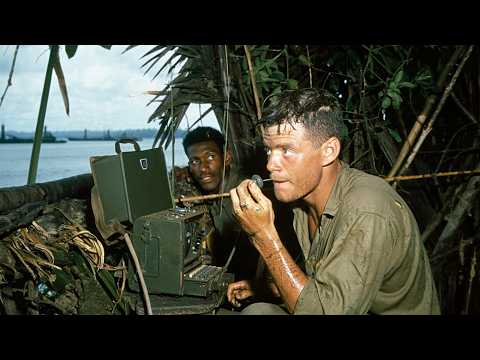
Two hours later, 600 miles away, the United States Navy received the warning. Aircraft scrambled, anti-aircraft guns manned, watertight doors sealed. Fifteen thousand lives hung in the balance. The Battle of the Coral Sea was about to begin, and because of one man’s courage, the fleet was ready.
But Mason was not alone. Behind him stood a network of Solomon Islander scouts, whose names were never recorded, who carried his radio, guided him through enemy territory, and risked everything for a cause they believed in. Their silence was their weapon.
As the bombers roared toward the fleet, Mason packed up his camp and disappeared into the jungle. The Japanese patrols were closing in, but they were always one step behind. The invisible war had just begun.
The scout who brought the warning was a young man named Sione, though Mason had never learned whether that was his real name or one he had chosen for himself. He appeared at the edge of the camp just before dusk, breathing hard but making no sound, and crouched beside Mason without a word. He held up three fingers, then pointed northeast, then drew a line in the dirt that curved toward the coast.
Mason understood. Three patrols. Converging. The line in the dirt was the Torokina Trail, the same route the earlier patrol had taken, but now it branched in a way that suggested they had learned something—perhaps from a captured villager, perhaps from a fresh direction-finding bearing.
“How long?” Mason whispered. Sione held up two fingers, then made a fist. Two hours, maybe less. The camp had to move tonight, in darkness, with the radio and the batteries and everything else, and they had perhaps four hours of jungle travel before the patrols would reach this ridge.
The carriers were already loading. Mason watched them work—six men, moving with the economy of long practice, wrapping the radio in oilcloth, disconnecting the antenna wire, packing the codebooks into their waterproof satchel. No one spoke. There was nothing to say that the work did not already say.
They moved out at 20:15, single file, Sione in front and a second scout named Tovu at the rear. The jungle at night was a different country. The heat did not break; it only thickened, and the trail was a suggestion more than a path, visible only to men who had walked it a hundred times. Mason carried the codebooks and his binoculars. The heavy equipment rode on the backs of the carriers, who moved through the darkness with a steadiness that seemed to belong to the terrain itself.
They stopped twice to rest, never for more than ten minutes, never in the same place twice. At the second stop, Sione crouched beside Mason and spoke for the first time since the warning. “They have a new man. A tracker. From the Shortlands. He reads ground.”
Mason absorbed this. A tracker changed the arithmetic. The Japanese patrols had always been predictable—they followed trails, they moved in daylight, they made noise. A man who could read ground was something else. A man who could read ground might find a cold fire pit and know which direction the ash had blown.
They reached the new position at 01:40, a ridge above a stream that Sione insisted was safe because the water ran loud enough to cover the sound of the generator. Mason did not ask how Sione knew this. He had stopped asking such questions weeks ago. The scouts knew things that could not be explained, only trusted.
The radio came out of its oilcloth. The antenna wire went up into the canopy, anchored to a branch that Sione selected after studying the sky for a full minute. Mason checked the battery charge—low, but sufficient for one transmission if they were careful. He would need to crank in the morning, during the rain if it came.
He composed the message in his head while the camp assembled around him. It would be short, shorter than usual, because the information was simple and the risk was high. Three patrols converging Torokina sector. One tracker Shortlands. Position moved. Will resume schedule. Twenty-two words. He could key it in sixteen seconds.
But he did not transmit that night. There was no scheduled window, and an unscheduled transmission was a gift to the direction-finders. Instead he slept in fragments, one hand on the radio, and woke before dawn to the sound of rain on the canopy—the good rain, the loud rain, the rain that would cover the generator’s whine.
By full light, the battery was charged and the camp was silent. Mason sat with the key under his fingers and waited for the window. Somewhere to the southeast, the fleet was steaming. Somewhere in Melbourne, an analyst was drinking cold tea and watching a plotting board. Somewhere in the jungle, a tracker from the Shortlands was reading the ground where Mason had slept two nights ago.
The invisible war did not pause for any of them. It only changed shape, and moved on.
The transmission went out at 06:12, sixteen seconds of coded pulses in the middle of a downpour that hammered the canopy like a thousand fingers on a drum. Mason killed the signal, checked his stopwatch, and let out a breath he had not known he was holding. Sixteen seconds. Good enough. The rain swallowed the rest.
Sione was already gone, slipping back down the ridge to watch the approaches. Tovu stayed with the radio, crouched under a palm frond, his eyes fixed on the trail they had climbed in the dark. Neither man had spoken since dawn. There was nothing to say until the message was answered.
The answer came that afternoon, not through the radio but through a runner—a boy of perhaps fourteen, barefoot, who appeared on the ridge as if the jungle had simply decided to produce him. He spoke to Sione in rapid Solomon Islands Pidgin, and Sione listened without interruption, then turned to Mason.
“The tracker. He found the old camp. He is following the stream.”
Mason’s stomach tightened. The stream was the reason they had chosen this ridge. The stream was supposed to be safe. He looked at Sione, and Sione looked back with the flat patience of a man who had already calculated the distances and did not like the answer.
“How far behind?”
“He is careful. He moves slow. Maybe one day. Maybe less.”
The decision was not difficult, which was the strange thing. Mason had learned in three months that the hardest choices were the ones that arrived with time to think about them. This one arrived with no time at all, and so it was almost easy. The radio had to move. The camp could stay.
He gave the order in the pidgin he had learned as a plantation manager, the same words he had used to direct labor gangs before the war, and the men moved. The radio went onto Tovu’s back. The batteries went to a lanky scout named Rafe, who had carried them for so many miles that he no longer seemed to notice the weight. The codebooks went into Mason’s satchel, and the antenna wire came down out of the canopy in a single practiced motion.
They left the fire pit cold and the shelter standing. A camp that looked abandoned was a camp that had been abandoned, and a tracker who found an abandoned camp would look for a trail leading away from it. Sione had a different plan. He led them not away from the camp but along the ridge in a direction that doubled back, crossing their own trail twice, then wading a hundred yards up the stream before climbing out onto rock where no footprint would hold.
Mason followed without question. He had learned that the scouts’ routes were not random. They were arguments, made in ground and water and stone, designed to convince a pursuer that his quarry had gone one way when it had gone another. The jungle was not a hiding place. It was a language, and the scouts spoke it fluently.
They stopped at dusk on a spur that overlooked a bend in the stream, and for the first time since the warning, Mason allowed himself to think about the fleet. The bombers he had counted that morning—were they the same ones that had struck at the Coral Sea, or had they been a feint, a diversion, a piece of a larger design he could not see? He would never know. That was the coastwatcher’s particular burden. He saw the pieces and never the board.
He set up the radio in the dark, by feel, and waited for the scheduled window. The battery was lower than he liked. The generator would have to run tomorrow, rain or no rain. He thought of the analyst in Melbourne, the cold tea, the plotting board with its colored string. He thought of the pilots who had launched because of nineteen seconds of signal. He would never meet any of them. He would never know their names. That was the arrangement, and he had accepted it the way he accepted weather.
At 21:00, Sione returned from the perimeter and crouched beside him. “The tracker has turned back,” he said. “He follows the false trail. He will be two days finding the truth.”
Mason nodded and did not smile. Two days was not safety. Two days was only a little more time, and time was the one thing the jungle never gave freely. He keyed the evening report—short, routine, nothing that would betray the fear in his hands—and then he sat in the dark and listened to the stream and waited for whatever the morning would bring.
The morning brought rain again, and with it the sound that had become the closest thing to safety Mason knew. He cranked the generator under the drumming canopy, sweat and rainwater mixing on his face, and thought about the tracker turning back. Two days. He had learned to spend time the way a poor man spends money—carefully, and never all at once.
The scheduled window came at 05:50. He keyed the report in fourteen seconds and killed the signal before the echo died. Fourteen seconds. Excellent. Somewhere in Melbourne an analyst would slide the message slip into the plotting board and move a pin, and the war would shift by a fraction no one would ever measure.
Sione returned at midday with word that the patrols had withdrawn toward Torokina. The tracker had not given up; he had simply gone to fetch better orders. “He will come again,” Sione said, and Mason believed him, because Sione was never wrong about the things that mattered.
They moved three more times that month, and each time the radio went up and the messages went out and the fleet learned what it needed to know. Mason never heard the bombs, never saw the carriers, never learned the name of a single pilot who lived because of his nineteen seconds. He only counted, and encoded, and vanished.
When the submarine finally came for him in 1943, he left Bougainville the way he had lived on it—quietly, in darkness, owing his life to men whose names no history book would ever hold. Sione walked him to the beach and shook his hand once, and neither of them spoke.
The most lethal weapon Australia deployed in the Pacific was never a rifle or a bomb. It was a man on a hilltop, and the people who kept him alive.
What would you have done, alone on that ridge, with thirty seconds between you and the enemy—would you have keyed the message, or stayed silent?
Report this article
Select a reason for reporting:






