The date was April 18, 1943. Sixteen American fighters skimmed the Pacific waves, propellers almost grazing the water, on a mission that would change the course of the war. They had flown over 400 miles of open ocean, arriving with near-perfect timing. In their sights was the bomber carrying Admiral Isoroku Yamamoto, the architect of Pearl Harbor. Minutes later, it was burning in the jungle. Japanese pilots had learned to fear this twin-tailed machine—it hit them from distances and angles their own fighters couldn’t match. Every gun was packed into its nose, and that arrangement was no stroke of genius. It began with a loophole, a shattered prototype, and a deadly dive.
To understand why, you have to understand what Japanese pilots were used to. In 1942, the Mitsubishi Zero was the fighter everyone in the Pacific respected. It was light—shockingly light. It carried a huge amount of fuel for its size and could out-turn almost anything the Allies had. If you got into a slow turning fight with a Zero, the Zero usually won. But look at how the Zero actually killed. It had two small 7.7 mm machine guns in the cowling firing through the propeller, and two 20 mm cannons in the wings. Those cannons were the real punch, but their rate of fire was slow. The shells left the barrel at relatively low velocity, and early versions carried only about 60 rounds each. Because they were in the wings, they were angled inward so their shells crossed at a chosen distance ahead of the plane. That crossing point is called convergence, and nearly every fighter in the war lived with it. Imagine two garden hoses a few feet apart, angled so their streams meet at one spot. At that spot, everything hits together. Closer, the streams pass on either side. Farther, they spread out again. Most wing-gun fighters set that point at about 250 to 400 yards. So the Zero’s entire fighting style pointed one way: get close, climb behind your target, turn until it’s exactly at your convergence point, and fire. Maneuverability wasn’t just a virtue—it was the delivery system for the guns.
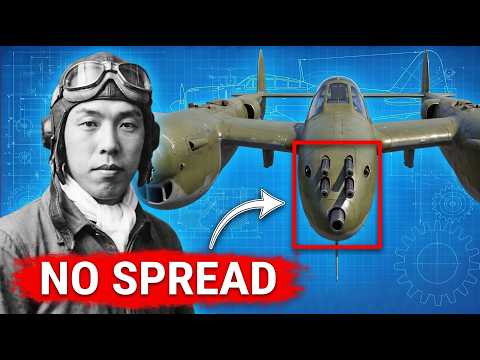
Now imagine meeting a plane that needed none of that. No convergence point, no perfect distance. Every gun pointing straight ahead from the center of the plane, one strong stream that stayed together far beyond where your fire scattered. And a plane that had no interest in turning with you at all. That plane was the Lockheed P-38 Lightning. And the reason its guns ended up in the nose had little to do with fighting Zeros. It was about two Army lieutenants trying to get around their own rulebook.
We have to go back to 1937. The U.S. Army Air Corps had regulations specifying what a fighter—or pursuit—aircraft should be. A pursuit plane was limited to about 500 pounds of armament, including ammunition. A single-seat fighter was supposed to have only one engine. This made fighters cheap. It also made them small and lightly armed. Two young first lieutenants, Ben Kelsey and Gordon Saville, wanted something far more ambitious. Kelsey was a test pilot and the fighter project officer in the Air Corps, a man who flew the machines he helped specify. Saville was a tactics expert. Together, they wrote a requirement called Circular Proposal X-608, issued in February 1937. Here’s the trick. They didn’t call it a pursuit plane. They called it an interceptor. Decades later, Kelsey explained that the word was chosen carefully to escape those restrictions. A new category meant new rules. And the rule he wanted most was firepower. Kelsey was looking for at least 1,000 pounds of armament—twice the official limit. The performance numbers were just as aggressive: a top speed of at least 360 mph at high altitude, and a climb to 20,000 feet in six minutes. No aircraft flying in America could do that on one engine. So the requirements practically demanded two engines. That might sound like paperwork. It wasn’t. That one word—”interceptor”—is where the nose guns began.
The company that answered wasn’t yet the giant you might imagine. Lockheed had gone bankrupt during the Depression. In 1932, a group of investors led by Robert Gross bought what was left for about $40,000. By 1937, it was building elegant twin-engine airliners like the Electra, but it had never built a modern military fighter. The design team was led by chief engineer Hall Hibbard, with a young aerodynamicist named Clarence “Kelly” Johnson, still in his twenties, doing most of the creative work. They drew a whole range of twin-engine designs—engines in the fuselage driving pusher and tractor propellers, engines on the wings with a conventional layout. The design they chose looked strange even then: long twin booms, each carrying an engine, a turbine supercharger, and a tail. Between them, a short central pod for the pilot. Johnson later admitted that the Dutch Fokker G.1, a twin-boom heavy fighter, influenced the design. It wasn’t invented from nothing. But look at what that layout did to the nose. In a normal single-engine fighter, the engine and propeller sit right in front of the pilot. Any gun in the nose has to fire through a spinning propeller using a synchronizing mechanism that times each shot to miss the blades. That reduces the rate of fire. So designers moved heavy guns to the wings, and the wings provided the convergence point. In the P-38, the engines were mounted on the booms. The nose in front of the pilot was empty. No propeller, no synchronizer, no need to angle anything. So the guns went right there, side by side, pointing straight ahead. In production fighters, that meant four .50-caliber machine guns and one 20 mm cannon, all in a package a few feet wide.
Lockheed won the competition on June 23, 1937. Now the company had to prove the design could actually fly. The prototype, the XP-38, was a dangerous gamble for a company that had been nearly worthless five years earlier. The Army contract was worth $163,000. Lockheed’s costs ended up around $761,000. The company was spending far more than it was being paid, betting that the plane would lead to a production order. On January 27, 1939, Ben Kelsey—the man who wrote the requirement—flew the XP-38 on its first flight. So the officer who invented the loophole was flying the result himself. Two weeks later, he tried something bolder. On February 11, 1939, Kelsey took off from California to cross the entire United States, partly to test the plane and partly to show Washington what it could do. He covered the distance in about seven hours of flying time, not counting two fuel stops. That was a record pace. Then, approaching Mitchell Field in New York, the engines lost power—likely carburetor icing. The XP-38 came down short of the runway, on a golf course. Kelsey walked away. The only prototype did not. It was completely wrecked.
You might think that would end everything. The opposite happened. The speed made headlines, and the Army ordered a batch of service-test aircraft, the YP-38. The plane had died. But the idea had just been sold. And with the YP-38s came the problem that nearly killed the whole concept. The P-38 was fast—very fast. In a steep dive, it could approach speeds where the air flowing over the wing began to behave as if it were near the speed of sound. The engineers called it compressibility. No one fully understood it yet because barely any aircraft could dive fast enough to encounter it. What the pilot felt was terrifying. In a high-speed dive, the nose would begin to drop on its own. The plane would shake, and the control stick would stiffen until it seemed locked in place. You pulled with all your strength, but the plane kept going down. On November 4, 1941, test pilot Ralph Virden was diving a YP-38 to study the problem. While trying to pull out, the tail broke off. Virden was killed. Other pilots died in similar dives, both in testing and later in service. Lockheed tried fix after fix. In late 1942, test pilot Milo Burcham flew dive tests in a modified P-38 with a second seat, while Kelly Johnson sat behind him to observe the problem himself. The engineer who designed the plane was now locked inside it, diving toward a physical limit he couldn’t yet explain.
The real solution—small electrically operated dive flaps under the wings to help the plane recover—didn’t reach the production line until 1944. Johnson later described compressibility as a solid wall that took a long time to learn how to break through. So here’s the dilemma. The P-38 had the most concentrated gun arrangement of any American fighter. It was fast and climbed well, and its turbochargers kept its power at high altitude. But the same twin-engine layout that cleared the nose made it three times heavier than a Zero. It was complex, expensive, and slow to start a turning fight. Two engines meant double the maintenance, and its best escape—a high-speed dive—had a deadly ceiling built in.
Money mattered, too. Before Pearl Harbor, the Army leaned heavily on cheaper single-engine fighters like the P-39 Airacobra and P-40 Warhawk. The P-38 was the hard, expensive choice. Early production was slow, and the first truly combat-ready version, the P-38F with armor and self-sealing fuel tanks, didn’t reach units in large numbers until 1942. Then there was the question of where those planes would go. The priority was Europe and North Africa. In the Southwest Pacific, General George Kenney, who took command of Allied air forces there in mid-1942, kept asking for P-38s and getting far fewer than he needed. Kenney had to fight for every Lightning. The design problem was mostly solved. The supply problem was not. And the battles hadn’t yet settled whether all those decisions were worth the trouble.
The first Japanese plane fell to a P-38 in August 1942 over the Aleutian Islands off Alaska. Two flying boats, shot down by Lightnings in brutal cold and fog. A real result, but small and far from the main war. The real test was coming in New Guinea and the Solomons, and it didn’t start smoothly. Early P-38 pilots made aviation’s oldest mistake. They tried to fight Zeros the Zero’s way. Slow down, turn with the enemy, stay in the fight. That was suicide in a heavy plane. A Zero could loop around a P-38 easily at low speed. If you slowed a Lightning and kept it low, you threw away everything it was built for.
Japanese accounts later cemented that impression. Saburo Sakai, one of Japan’s most famous naval aces, described early Lightnings in his memoir as having nothing to offer but speed and dive. But be careful there. Sakai’s memoir was written with an American co-author years after the war, and its claims have been heavily criticized. Researchers comparing it to American records found that P-38 losses to Japanese fighters in the first months of serious combat in New Guinea were actually very low. The fear of close engagements was real. How much it cost depends on which records you trust.
What changed was doctrine. Fifth Air Force P-38 pilots and the squadron leaders who trained them developed a different set of rules. Stay high. Use the turbochargers to fight where the Zero is weakest. Pick your moment. Dive fast, fire, and keep going. Then use that speed to climb back up and rejoin the fight. Never get into a turning fight with a Zero. Never let yourself lose speed. And this is the moment the empty nose stopped being an engineering curiosity and became a weapon.
Think about what a diving pass actually looks like. You come down from above at high speed. The distance to the target shrinks every fraction of a second. You may have only a few seconds to line up the shot. For wing-gun fighters, there is only one distance where the guns work best, and you cross it in a flash. Fire too early, and the streams are still converging. Fire too late, and they’ve already crossed and spread. For the P-38, none of that applied. The bullet stream left the nose already gathered. And it stayed gathered. It didn’t matter if you opened fire a little early or a little late. If the nose was pointed at the target, the bullets went where the nose pointed. Four heavy machine guns and a cannon, every round arriving at the same small point in the sky. The P-38 was also an unusually stable gun platform. With its two propellers turning in opposite directions, it didn’t suffer the strong torque of one huge engine fighting the pilot’s aim.
So from the Japanese side, imagine how that felt. You’re in a Zero, built and trained for close-in turning combat. A twin-tailed shape appears above you, dives through your formation at a speed you can’t match, and suddenly one of your comrades is on fire. The attacker doesn’t stay to fight—it’s already climbing away. And the fire seemed to start from farther out, at angles that wouldn’t work with your wing cannons. Masatake Okumiya, the Japanese naval officer who later wrote a history of the air war, described the P-38 as an enemy of terrifying effectiveness. Those are later recollections, not wartime reports, but you can understand why the feeling was there.
Here’s where the most common version of the story appears. You’ll often hear that P-38 pilots could hit targets confidently at 1,000 yards, sniping Japanese planes from over half a mile away like marksmen. It sounds perfectly logical. No convergence meant the bullet stream stayed together well past 400 yards. The heavy .50-caliber rounds kept their velocity. So why not fire from vast distances?
Here’s the truth that doesn’t fit. Look at the man who shot down more Japanese planes than any other American pilot. Richard Bong was a farm boy from Superior, Wisconsin. Before he saw combat, he got into trouble in California. According to Kenney’s own account, Bong was accused of doing loops around the Golden Gate Bridge and flying so low over Market Street in San Francisco that he blew laundry off a woman’s clothesline. Kenney said he warned Bong not to do it again, and later wrote that they needed boys like that. But here’s the strange part. Bong spent the first months of 1942 as a gunnery instructor at Luke Field in Arizona, yet was considered a poor aerial shot. So what did the best P-38 pilot in the Pacific do with the plane supposedly built for long-range gunnery? He got close. As close as possible. On some attacks, he flew through the debris of the plane he’d just destroyed. Once, he actually collided with his target and later claimed it was probably just a probable kill.
And so the myth breaks. The nose guns didn’t turn ordinary pilots into 1,000-yard snipers. Hitting a moving, maneuvering aircraft at half a mile required estimating lead, drop, and closing rate at enormous speeds. Most pilots couldn’t do it consistently. What the nose actually did was less cinematic and far more useful. It meant that every burst was effective from whatever range the pilot could manage. Close or far, steep or flat, the full weight of fire concentrated on the same point. Combined with altitude, speed, and the hit-and-run principle, it gave Japanese pilots no time to react. They weren’t actually being hit from impossibly long range. They were being hit from above and at high speed by a concentrated burst that didn’t need a perfect setup. It looked like distance. It was really time. They didn’t have enough of it.
Bong scored his first victory on December 27, 1942 over Buna in New Guinea. From that moment, the Lightning’s reputation began to grow. But one engagement wouldn’t prove the plane’s importance. The evidence that changed history came four months later, and it depended on something that had nothing to do with the nose.
U.S. Navy codebreakers decrypted a Japanese message detailing Admiral Yamamoto’s inspection tour to bases near Bougainville in the Solomon Islands. The message laid out his schedule. That kind of precise intelligence almost never happens. The question was whether any American fighter could reach him. Navy and Marine fighters at Guadalcanal didn’t have the range. The P-38 did—barely—using droppable external fuel tanks. And the mission would be flown almost entirely over open water. If one engine failed, a single-engine fighter pilot goes into the sea. A P-38 pilot still had another engine.
On April 18, 1943, eighteen P-38s were scheduled for the mission under Major John Mitchell. Two turned back early, leaving sixteen. They flew a long, indirect route at wave-top height to avoid detection, relying mostly on compass, clock, and airspeed. They arrived near Bougainville at almost the same time as the Japanese bombers. The Lightnings climbed. The escorting fighters were out of position. Both bombers went down. One into the jungle with Yamamoto aboard, the other into the sea. One P-38 didn’t return. Its pilot, Lieutenant Raymond Hine, was lost. To this day, there’s still disagreement over who actually shot down Yamamoto’s bomber—specifically between Thomas Lanphier and Rex Barber. The argument over the evidence has gone on for decades, but no one disputes what made the mission possible: range, twin engines over water, and a plane that could reach and fight at the end of the journey.
The P-38 had proven it could reach places other fighters couldn’t. The next challenge was to make it reach farther. In 1944, a civilian appeared in New Guinea. His name was Charles Lindbergh. Yes, that Lindbergh. The man who flew solo across the Atlantic in 1927. He came as a technical representative and ended up flying with P-38 units, including the 475th Fighter Group. Lindbergh watched how pilots managed their engines and saw fuel being wasted. He showed them how to run the Allison engines at lower speeds with leaner fuel mixtures. By most estimates, that pushed the P-38’s combat radius from about 570 miles to roughly 700 miles. In a theater measured in hundreds of miles of empty ocean, that was enormous. This civilian also shot down a Japanese plane himself in July 1944.
Now the weight problem paid off. All that size, fuel, and twin engines—the things that made the P-38 expensive and hard to build—were exactly what the Pacific demanded. And it became easier to fly. Later models got the dive flaps that finally tamed compressibility, and hydraulically boosted ailerons that fixed much of the sluggish roll. The plane that killed test pilots in dives in 1941 had, by 1944, become a plane its pilots trusted to dive and recover. Meanwhile, Lockheed was no longer the shaky little company pulled out of bankruptcy. Its Burbank operation grew to tens of thousands of workers, many of them women who had never worked in a factory before. The difficult fighter that had been slow to produce was now being built on a massive scale. By the end of the war, about 10,037 P-38s had been built. For a heavy, expensive, twin-engine fighter the Army had once treated as a luxury, that number is astonishing.
And the results in the Pacific matched it. The P-38 is credited with destroying more Japanese aircraft than any other U.S. Army Air Forces fighter. The two top American aces of the entire war flew it. Richard Bong is credited with 40 victories. Thomas McGuire with 38. Bong passed Eddie Rickenbacker’s American World War I record of 26 in April 1944. By December, flying from Leyte in the Philippines, he reached 40. General Douglas MacArthur decorated him with the Medal of Honor. Then Kenney ordered him home for good. Kenney believed the official score was far too low. He was convinced Bong was giving victories to his wingmen, letting them finish off already burning planes so they’d get the credit.
So here’s the reckoning. Now, the correction—because those numbers didn’t come from gun arrangement alone. The P-38 didn’t decrypt the message about Yamamoto. Navy codebreakers did. The P-38 didn’t build the radar networks that gave American pilots time to climb, or supply the airfields that kept them flying. And the most important change of all happened on the other side. Japan began the war with a small group of superbly trained naval aviators, many with hundreds of hours before seeing combat. But their training pipeline was limited and small-scale. At Midway, over Guadalcanal, and across the Solomons and New Guinea, those veterans were killed faster than they could be replaced. Their replacements entered combat with far less training, flying aircraft designed to save weight rather than protect the pilot. So by 1944, a P-38 pilot was often not facing the men who ruled the sky in 1942. He was facing young pilots thrown into combat early who hadn’t learned enough to survive it.
This isn’t a story of heroes and villains. It’s a story of one war machine that could replace its pilots, and another that couldn’t. The Lightning was the right plane for that fight, but it was part of a system that included training, codebreaking, radar, fuel, factories, and numbers. It helped make the outcome possible. But it didn’t do it alone.
And even inside that system, the old rules still held. Thomas McGuire, the second-highest scoring pilot, was known for training his pilots with strict rules for fighting Japanese aircraft. Among them: never slow down and never fly low. On January 7, 1945, over Negros Island in the Philippines, McGuire’s flight encountered a Japanese fighter at low altitude. One of his pilots was attacked. McGuire rushed to help, turning hard at low altitude and low speed, reportedly still carrying external fuel tanks. His P-38 stopped flying and hit the ground. McGuire was killed. Those were the old traps of the Zero in its final form—low-altitude turning combat. Everything a P-38 pilot had been taught not to do. McGuire did it to save another pilot.
Afterward, the story returns to Lockheed. In Burbank, Kelly Johnson and a small team built the P-80 Shooting Star, America’s first mass-produced jet fighter. Johnson’s cramped, isolated operation became famous as the Skunk Works. The engineer who chased compressibility through P-38 dives was now designing planes that would fly near those same limits. And one of the men sent to test those new jets was Richard Bong. On August 6, 1945, Bong took off in a P-80 from Burbank. Shortly after takeoff, the main fuel pump failed. He bailed out from very low altitude. America’s highest-scoring ace died in a Lockheed plane designed by the same engineering mind that gave him the P-38. It was the same day the atomic bomb fell on Hiroshima, and news of his death had to share headlines with the end of the war he had fought.
So let’s return to the question at the beginning. Why did Japanese pilots feel they were being hit by P-38 fire from distances they couldn’t comprehend? It wasn’t because some genius invented a long-range cannon. Every one of those guns could have been mounted in a wing. It was a chain of events. Two lieutenants used the word “interceptor” to get around a rule. That allowed two engines. Two engines needed back booms. Those booms emptied the nose. The empty nose freed the guns from the propeller and from the need for convergence. A shattered prototype still proved the idea. Test pilots died learning its dive limits, and pilots learned bitterly not to fight it like a Zero. The Zero’s cannons needed a perfect distance, and its agility found that distance. The P-38 didn’t need it. It came from above, poured a concentrated stream of fire from wherever it was, and vanished. From a Zero’s cockpit, the hits seemed to come from impossibly far away. What it really was, was the product of a loophole written in 1937 and a plane built on the hope that the enemy would never get close enough for a turning fight.
So here’s the question for you: if the P-38’s greatest advantage was a bureaucratic loophole and an empty nose, what other legendary machines were born not from genius, but from a simple rule someone decided to bend?
Report this article
Select a reason for reporting:






