The whirring of Hans Bastanier’s Arriflex camera was the only sound that cut through the stifling summer heat. Through the viewfinder, the world was bathed in the surreal, saturated hues of Agfacolor—a stark contrast to the monochrome horror that would soon unfold. German soldiers lounged on the steppe, their laughter echoing across the open plains as they played cards and posed proudly with their weapons. They were on the outskirts of Stalingrad, and victory seemed not just imminent, but inevitable. The enemy was broken, the road ahead lay wide open. But this was merely the calm before the most destructive storm of the Second World War.
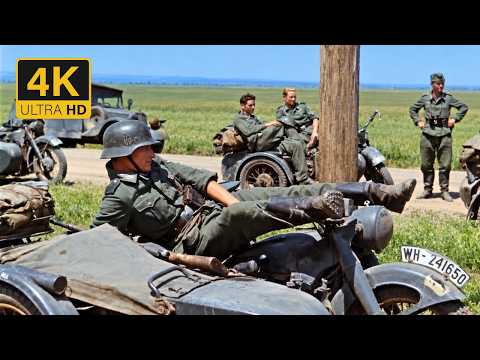
Bastanier captured it all: the leisurely construction of pontoon bridges, the confident swagger of the infantry, the endless columns of prisoners shuffling through the scorched grass. “The Führer will have his oil, and Stalingrad will fall,” one soldier boasted, his voice lost to history but his sentiment preserved in the flickering frames. The German strategy was one of lightning maneuver—avoid unnecessary engagements, bypass strongpoints, and let the Luftwaffe reduce everything else to rubble. The plains offered no natural defenses, no forests or marshes to slow the advance. The panzers, particularly the Panzer III and IV, were in their element, slicing through the open terrain with deadly efficiency.
Yet, beneath the veneer of invincibility, a storm was gathering. The Red Army, though battered and reeling from the disaster at Kharkov, was not finished. “Not one step back!” Stalin’s Order No. 227 would soon echo across the steppe, a desperate rallying cry born of existential dread. The Soviets were trading space for time, evacuating factories beyond the Urals, and producing thousands of tanks a month. The Germans, drunk on easy victories, failed to see the trap being laid. Every river crossing, every village taken, brought them closer to the Volga—and to their doom.
By mid-August, the Sixth Army had pushed the 62nd Army back across the Don, but the advance had slowed to a crawl. The Germans had covered only 100 kilometers in three weeks, and the cauldron was beginning to take shape. On August 23, the 14th Panzer Corps reached the Volga, cutting the 62nd Army in two. The siege of Stalingrad had begun. But as Bastanier’s camera continued to roll, capturing the confidence of the advancing troops, none of them could foresee the hell that awaited. The battle for the city would last over five months, and the calm of that summer would be remembered only as a distant, mocking memory.
The first shells fell on August 23, 1942, and the city turned to rubble in a matter of hours. The Luftwaffe flew over 1,600 sorties that day, dropping thousands of tons of explosives and incendiaries. “The sky turned black, then red, then black again,” a survivor would later recall. The Volga itself seemed to catch fire as oil storage tanks burned, sending columns of black smoke that blotted out the sun. German soldiers watched from the heights, their earlier laughter replaced by a stunned silence.
Bastanier filmed the inferno from a distance, his color film capturing the surreal beauty of destruction—the orange flames against the grey sky, the silhouettes of buildings crumbling like sandcastles. But the images hid the horror: thousands of civilians were killed in the first hours, their bodies buried in the rubble or burned beyond recognition. The 62nd Army, now trapped in the city, was ordered to hold at all costs. “There is no land beyond the Volga,” the defenders were told, and they believed it.
Inside the city, the battle devolved into a brutal, close-quarters struggle unlike anything seen before. The Germans called it Rattenkrieg—rat war. Every street, every building, every floor became a battleground. Soldiers fought room to room, sometimes sharing a wall with the enemy, hearing their voices through the plaster. “We have fought for three days for a single house,” a German lieutenant wrote in his diary. “The living room, the kitchen, the bedroom—each one a fortress.”
Bastanier followed the infantry into the ruins, his camera capturing the surreal juxtaposition of modern warfare and ancient ruins. He filmed soldiers advancing through a shattered factory, the machinery still standing amidst the debris, and the bodies of Soviet and German soldiers lying side by side, indistinguishable in death. The color film showed the blood as a dark stain on the grey rubble, a detail that would haunt viewers for generations.
On the Soviet side, the defenders used the ruins to their advantage, turning every basement into a bunker, every sewer into a communication trench. Snipers like Vasily Zaytsev became legends, their kills counted and celebrated. “We knew every brick, every hole,” a Soviet veteran remembered. “The Germans had the maps, but we had the memory of the streets.”
The fighting was so intense that the Germans began to call the city ‘the cauldron,’ a name that would soon take on a more literal meaning. As autumn approached, the German advance slowed to a halt. They had taken most of the city, but the Soviets held a narrow strip along the Volga, and they refused to give it up. The battle had become a war of attrition, and the Germans were not prepared for it.
Bastanier’s footage from this period shows the faces of exhausted soldiers, their uniforms dirty and torn, their eyes hollow. The early confidence was gone, replaced by a grim determination. “We are not fighting for Stalingrad anymore,” one soldier said to the camera, his voice barely a whisper. “We are fighting for our lives.”
The camera also captured the changing weather. The warm summer days gave way to cold, rainy autumn, and then to the first snows of winter. The Germans, who had expected a quick victory, were not equipped for a winter campaign. Their supply lines were stretched thin, and the promised air bridge was failing. Inside the city, the Soviets were preparing for a counteroffensive that would change the course of the war.
On November 19, 1942, the Red Army launched Operation Uranus, a massive pincer movement that encircled the German Sixth Army. Bastanier was with the German troops when the news came. “We are surrounded,” a radio operator said, his voice trembling. “The Russians have broken through in the north and south.” The camera caught the moment of disbelief, the realization that the hunter had become the hunted.
The encircled Germans now faced a new enemy: hunger, cold, and despair. The air bridge promised by Göring never delivered enough supplies, and the soldiers began to eat their horses and then anything else they could find. Bastanier filmed the daily struggle for survival, the desperate attempts to stay warm, and the growing number of frozen corpses. “The cold is worse than the Russians,” a soldier said, his breath visible in the icy air. “It gets into your bones and never leaves.”
As the weeks passed, the situation inside the cauldron deteriorated. The Soviets tightened their grip, and the Germans were pushed back into an ever-shrinking pocket. Bastanier’s film became a record of a dying army, the color images showing the grey faces of men who knew they were doomed. “We heard the Russians calling us over loudspeakers,” a survivor recalled. “They told us to surrender, that we would be treated well. But we were told not to listen. We were told the Führer would save us.”
But no salvation came. On January 31, 1943, Field Marshal Paulus surrendered, and the remnants of the Sixth Army followed. Bastanier was among those taken prisoner, his camera and film confiscated. The footage he had shot, however, would survive, hidden away in archives and later discovered by historians. It remains one of the only color records of the battle, a haunting glimpse into the heart of darkness.
The final images from Bastanier’s film show the frozen streets of Stalingrad, the ruined buildings, and the long columns of German prisoners marching east. The color film captures the red of the Soviet flags flying over the city, a stark contrast to the grey of the German uniforms. The battle was over, but the war would continue for another two years. The world had witnessed the turning point, and nothing would ever be the same.
The spring of 1943 brought a different kind of silence to the steppe. The guns had fallen quiet, and the snow was melting into a black, muddy slush that sucked at the boots of the long columns of prisoners. Hans Bastanier, now a prisoner himself, marched east with thousands of others. His camera was gone, but the images were burned into his memory—the flames, the ruins, the faces of men who had believed in a victory that never came.
He was sent to a camp near Saratov, a sprawling collection of wooden barracks and barbed wire. The work was hard, the food was scarce, but the guards were not the monsters the propaganda had promised. “They were soldiers, like us,” Bastanier would later write in his memoirs. “Tired, hungry, and longing for home. The war had ground us all down.”
It was in the camp that he met a Soviet cameraman named Dmitri, a thin man with a limp and a battered FED camera. Dmitri had filmed the defense of the city, the street fighting, the snipers. He had lost his brother in the rubble of the tractor factory. At night, they would sit by the stove, and Dmitri would describe the scenes he had captured—the Volga burning, the soldiers swimming across under fire, the women digging trenches. “We both saw the same battle,” Dmitri said one evening, his voice quiet. “But we saw it from different sides.”
The two men began to talk about the images they had recorded. Bastanier described the German advance, the confidence, the laughter. Dmitri nodded. “We saw your film too, later, after the war,” he said. “It was strange, seeing the enemy so happy. We had only seen them as shadows in the ruins, or as prisoners.” The conversation sparked an idea: what if they could combine their footage? A single record, from both sides?
Before the war ended, Dmitri managed to smuggle Bastanier’s film canisters out of the camp through a sympathetic guard. They were sent to Moscow, where they were stored in the archives. Bastanier himself would not see them again for decades. He returned to Germany in 1949, a broken man, and tried to rebuild his life. He worked as a photographer for a local newspaper, married, had children. He never spoke of the war.
But the film survived. In the 1980s, a historian named Dr. Elena Volkova discovered the canisters in a Moscow archive, labeled simply “Stalingrad—German, color.” She was stunned. Color footage from the German side was almost unheard of. She tracked down Bastanier, now an old man, and interviewed him. “I filmed what I saw,” he told her. “I did not know what it meant. I only knew it was something I had to record.”
Dr. Volkova combined Bastanier’s footage with Soviet color film from the same period—rare, but not nonexistent—and created a documentary. It showed the battle from both perspectives: the German soldiers playing cards, then the Soviet soldiers digging trenches; the German tanks advancing, then the Soviet snipers waiting; the German prisoners marching east, then the Soviet flags flying over the ruins. The film ended with a single image: the Volga, flowing quietly, indifferent to the destruction on its banks.
The documentary was shown in Germany and Russia, sparking a new conversation about the war. Veterans from both sides met, some for the first time. They shared stories, tears, and sometimes laughter. Bastanier and Dmitri were reunited in 1991, two old men with shaking hands and faded memories. “We were enemies,” Dmitri said, “but we were also witnesses. Someone had to tell the truth.”
The film remains a testament to the power of images. It shows the war not as a clash of ideologies, but as a human tragedy. The color makes it real, immediate, impossible to ignore. The soldiers on both sides were young, afraid, and far from home. They fought for different flags, but they shared the same fear, the same cold, the same hunger. And in the end, they shared the same silence.
Hans Bastanier died in 1998, at the age of 84. His obituary mentioned his work as a photographer, but not the war. The film, however, lives on. It is shown in museums, in schools, in documentaries. It is a reminder of what happened on the banks of the Volga, and of the men who filmed it—one German, one Soviet—who saw the same battle from different sides and, in the end, found a way to tell the story together.
The camera’s whirring has long since stopped, but the images remain. They are a ghostly echo of a time when the world held its breath, and the future hung in the balance. The colors are faded now, but the truth they reveal is as vivid as ever.
Dr. Volkova’s documentary premiered in a small theater in Volgograd, the city once known as Stalingrad. Among the audience were the grandchildren of both cameramen, sitting side by side in the dark. When the final image of the Volga appeared, the screen flickered and went white—then the lights came up, and no one spoke for a long moment.
“They filmed the same river,” Bastanier’s granddaughter whispered to Dmitri’s grandson. “One from the west bank, one from the east.” The young man nodded, and they walked out together into the cold spring air, the river glittering in the distance.
The film canisters now rest in a joint archive, sealed in a climate-controlled vault. Historians still argue over the details—the exact dates, the units, the names of the dead. But the images themselves need no translation. A soldier laughs. A city burns. A river flows on, indifferent and eternal.
What would those young men with their cameras have thought, to know their footage would one day sit in the same room, side by side, telling a single story?
Report this article
Select a reason for reporting:






