In the dense jungles of Phuoc Tuy Province, Vietnam, 1968, American soldiers watched with a mixture of awe and frustration as five-man Australian SAS patrols melted into terrain that had swallowed entire battalions. These men moved like ghosts, spent days deep in enemy territory without a sound, and returned with intelligence that redirected whole operations. The Americans had more men, more firepower, more of everything—yet they couldn’t replicate what these quiet Australians did without firing a single shot. They called them ‘the goats,’ not as an insult, but as a stunned, genuine respect for soldiers who navigated impossible ground as if it were home.
But to understand why these men were feared, you first have to grasp the scale of the failure around them. By mid-1968, the U.S. had 536,000 troops in Vietnam—the largest force since World War II—yet the war was slipping away. Search-and-destroy operations, meant to crush the enemy with overwhelming firepower, had run over 1,700 missions by January 1968, but the enemy only grew stronger. That same month, the Tet Offensive erupted across more than 100 cities and towns, shattering the illusion of progress. In 1968 alone, 16,592 American soldiers were killed, and the jungle seemed to be winning.
The problem was partly tactical: American patrols were noisy, detectable from hundreds of meters away. The enemy called them ‘the noisy ones’—a nickname that was a death sentence in a war where silence meant survival. The Australians, by contrast, had grown up in harsh, remote landscapes where noise was a liability and patience was the sharpest tool. They didn’t just fight the jungle; they became it.
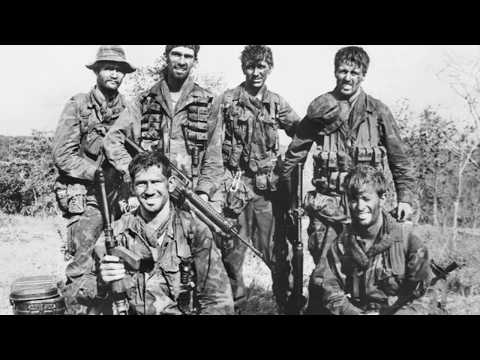
When the Australian SASR arrived in Vietnam in 1967, they brought a method refined in Malaya and Borneo: small teams, absolute stillness, and an almost spiritual respect for the environment. Their patrols moved at 100 meters per hour—slower than a sleepwalker—placing each foot with deliberate care, often stepping into the exact footprint of the man ahead. They taped their gear to silence every rattle, communicated in hand signals, and left no trace. Where an American unit could be heard from 300 meters, an SASR patrol was undetectable beyond 20.
The results were immediate. A single patrol near the Long Hai Hills spent 48 hours watching an enemy logistics operation, then withdrew without a shot, guiding an artillery strike that destroyed a major supply cache. Five men, two days, no contact—and more damage than many large-scale operations achieved. American commanders, baffled by the disparity, pressured to absorb the Australians into larger units, but Brigadier Stuart Graham resisted: “You do not use a scalpel to dig a trench.” The SASR’s silence and invisibility were the point, and no amount of scaling could replicate it.
The enemy, battle-hardened and at home in the jungle, gave them a name that spoke volumes: Ma Rung—Jungle Ghosts. For the Viet Cong, the jungle had always been an ally; now it felt like a threat. Patrols that left no trace, no direction of attack, no way to retaliate, eroded the enemy’s confidence. Captured documents ordered units to constantly change resupply routes, costing time and material. The fear was palpable, and it spread.
By 1969, the Americans had stopped arguing and started learning. Ranger units requested joint training, watching in disbelief as five men moved through scrub that had stopped their own units cold. One Ranger officer was told his men were making enough noise to get killed; he thought it was an exaggeration—until he saw the difference. The Australians taught them to listen, to move with the ground, to value intelligence over firefights. It was a lesson that would reshape American special operations for decades.
Yet the story doesn’t end in triumph. When Australia withdrew in 1971, there were no parades, no recognition—just a silence that lasted years. The men who had been feared as ghosts returned to ordinary lives, their stories untold. But their legacy lived on, quietly shaping the way elite forces operate to this day. And for those who faced them in the dark, the memory of the Jungle Ghosts—silent, patient, and utterly lethal—would never fade.
But the story of the goats does not belong only to the men who wore the sandy beret. It belongs, too, to the terrain itself—the wet, breathing green that shaped them long before they ever set foot in Vietnam. To understand why five Australians could do what half a million Americans could not, you have to leave the war behind for a moment and go back to the places that made them.
Consider the Channel Country of western Queensland, where the ground cracks into plates under a sun that seems personal in its cruelty. Water is not a resource there; it is a rumor you learn to chase. A boy raised in that country learns to read the land the way a sailor reads the sea—by subtleties, by changes in color and smell, by the behavior of birds and the direction of dust. He learns that the country is always speaking, and that the only unforgivable sin is not listening.
Or the Pilbara, red and ancient, where the heat rises off the rocks in visible waves and the horizon is a hard line that gives nothing away. Men from these places did not arrive at SASR selection as blank slates. They arrived already carrying the most important skill the regiment would ever ask of them: the ability to be patient in a landscape that did not care whether they lived or died.
That is the part the American observers kept missing. They saw the technique—the taped gear, the hundred meters an hour, the hand signals—and they thought they could learn it. And in time, many of them did. But technique without temperament is just choreography. The Australians were not performing silence. They were returning to something they had known since childhood.
There is a moment recorded in the recollections of a Ranger who trained at Nui Dat in late 1969 that captures the gap better than any after-action report. He described standing at the edge of a clearing, watching an Australian patrol prepare to move out at first light. He expected a briefing, a checklist, some visible sign of preparation. Instead, he watched five men sit on the ground for twenty minutes doing nothing at all. Not talking. Not checking equipment. Just sitting, eyes closed or half-closed, as though listening to something he could not hear.
He asked an Australian instructor what they were doing. The answer stayed with him for the rest of his life. “They’re saying hello to the jungle. It’s rude to walk into someone’s house without greeting them first.” The Ranger thought it was a joke. It was not. It was a description of a relationship with the environment that no amount of tactical instruction could manufacture in a man who had not grown up inside it.
That relationship had practical consequences. An SASR patrol could sense when the jungle had changed—when the birds had gone quiet in a way that meant something, when the insects had shifted their rhythm, when the air itself seemed to hold its breath. They could not always explain how they knew. They did not need to. The knowledge lived in their bodies, not in their manuals, and it kept them alive in places where manuals were useless.
And it was not only the landscape that shaped them. It was the way they had learned to work as five men who functioned as one organism. There was no room in a patrol for ego, for the soldier who wanted to be a hero, for the man who could not bear to wait. The SASR selection process was designed to find and remove exactly those men, sometimes with a brutality that shocked even the candidates themselves.
Men who passed selection describe a phase where they were kept awake for days, given impossible tasks, and then asked to perform them again and again until failure was the only possible outcome. The point was not to test fitness. It was to find the moment when a man’s ego broke, and to see what was underneath when it did. What the regiment wanted was not the strongest or the fastest or the most aggressive. It wanted the man who, when everything was taken from him, still had the patience to do the next small thing correctly.
That quality—the willingness to be small, to be slow, to be unnoticed—was the opposite of everything the American military culture of the era rewarded. American soldiers were trained to close with the enemy, to bring firepower to bear, to win by overwhelming force. Those were not wrong instincts. They were simply the wrong tools for a war where the enemy had decided not to be found.
The Australians had made a different choice, and it was not a choice born of weakness or timidity. It was a choice born of respect—for the jungle, for the enemy, and for the terrible cost of being heard. They understood that in Phuoc Tuy Province, the loudest man in the room was usually the deadest.
By the time the last SASR patrol left Vietnam in 1971, the regiment had written a record that no other unit in the war could match. More than a thousand patrols. Minimal casualties. Intelligence that shaped the entire Australian approach to the province. And a name, given by the enemy, that said more than any citation ever could.
But the most important thing they left behind was not a record or a reputation. It was a question—one that the American military would spend the next two decades trying to answer. What if the most powerful army in the world had been asking the wrong question all along? What if victory in that kind of war was not about how much force you could bring, but about how little you needed to bring if you brought it properly?
The men who carried that question home did not ask it loudly. They never did. They went back to their farms and their workshops and their quiet lives, and they let the record speak for itself. But the record was clear, and eventually, the most powerful military on Earth had to read it.
The reckoning came slowly, then all at once. Delta Force in 1977. A rebuilt Ranger Regiment. And in 1987, the United States Special Operations Command—a structure built on the premise that small, precise, patient teams achieve what massed conventional forces cannot. The doctrine writers had read the Vietnam record, and Phuoc Tuy was in the footnotes.
Exchange programs with the SASR became routine. Canungra’s jungle warfare syllabus, forged in Borneo and Malaya and tested under fire in Vietnam, fed directly into American special operations thinking. The lesson had traveled from the Long Green to the rooms where doctrine is written—and it changed things permanently.
By the Gulf War in 1991, the principles were no longer Australian. Small-team reconnaissance before large-unit commitment. Intelligence first, operation second. Precision over volume. These had become the foundation of how Western special forces operated, traceable to no single source but unmistakable in origin.
Afghanistan in 2001 proved the point. Australian SAS soldiers moved through mountains and dust as genuine equals to their American counterparts—often out front on the most complex missions. Same sandy beret. Same selection course. Same conviction that whatever ground you stand on will protect or destroy you depending entirely on the respect you bring to it.
That is the Goat Legacy. Not a monument. Not a parade. Five soldiers stepping quietly out of a tree line at dawn, carrying what the world’s most powerful military could not find, handing it over without drama. Not with noise—with silence. The way they were taught.
The best patrol is the one no one knows happened. But you know now. So tell us—what would you have asked those five men, if you’d been the one waiting at the tree line?
Report this article
Select a reason for reporting:






