In the shadowed corridors of power, where secrets are buried deeper than the jungle itself, one man’s name was whispered with a mixture of awe and fear. Captain Arthur Barry Petersen, an Australian officer, had done the unthinkable: he had raised an army of 1,200 Montagnard tribesmen, the Tiger Men, and they answered to him alone. But his success made him a target—not of the enemy, but of his own allies. The CIA, which had once funded his every move, now contemplated his elimination. They discussed making him a hero’s death, a body bag return, a quiet removal from the highlands he had come to love. This is the story of a man who walked a political tightrope, refusing to surrender his force or his principles, and of the agency that decided he had to go.
Petersen arrived in Saigon in July 1963, a 29-year-old captain with a knack for languages and a quiet, unassuming demeanor. He was met by an American officer and driven to a building with no signage, where acoustic tiles covered the walls and safes lined the rooms. There, in a suite of rooms that smelled of secrecy, he was briefed on a covert program: to disarm the Montagnard tribes of the Central Highlands. But Petersen, after weeks on the ground, saw the folly in that plan. Disarming the tribes would spark a general uprising, he warned. Instead, he proposed a different approach: recruit them, train them, and fight alongside them. The agency, after some hesitation, gave him latitude. It was a decision that would change everything.
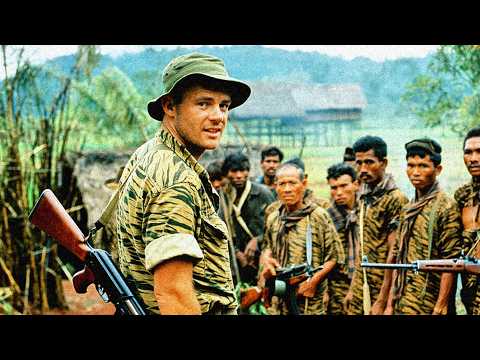
He was inserted into Ban Me Thuot, the provincial capital of Darlac Province, a town reachable by a single road and a dust airstrip. There, he began with a hundred men, assembling them not through Vietnamese intermediaries but through direct recruitment in the longhouses. He learned the Rhade dialect, mastered the rituals of rice wine and buffalo sacrifice, and honored the tribal customs that no foreign officer had bothered to understand. He paid his recruits more than the South Vietnamese army paid its own soldiers, clothed them in tiger-stripe uniforms, and armed them with untraceable weapons. Within a year, his force had grown to over 1,000 fighting men, trained in the same small-unit tactics the Viet Cong used. They operated across the border into Cambodia, disrupting North Vietnamese supply lines, and were soon considered the most dangerous self-defense force in the Highlands.
But the growth of the Tiger Men changed their political character. A unit of 100 Montagnards under nominal Vietnamese supervision was an asset; a unit of 1,200 loyal to a foreign captain, paid by a foreign agency, operating beyond Vietnamese control, was a threat. The South Vietnamese provincial chief and the corps commander in Pleiku understood this well. Petersen, by his own admission, walked a daily political tightrope, balancing the operational autonomy his force required against the sensitivities of every Vietnamese officer who saw that autonomy as an affront. The first crisis arrived in September 1964, when Montagnard tribesmen of FULRO mounted a coordinated mutiny, killing Vietnamese Special Forces officers and seizing hostages. Petersen’s force did not join the rebellion—he had carefully navigated past FULRO’s overtures—but when the rebellion began, he moved within hours to interpose himself between the rebel columns and the Vietnamese 23rd Division.
For four days, he negotiated in Rhade, French, and through interpreters, persuading the rebels to stand down and the Vietnamese not to advance. The rebellion ended without the planned assault on Ban Me Thuot. For this, he was awarded the Military Cross, but the citation did not mention what he had actually done. The agency, however, read his conduct less generously. To them, he had displayed a degree of personal authority over the tribal population that no Western officer had previously shown. One internal assessment used the term “personality cult.” The term was not casual.
In the early months of 1965, the agency assigned a new case officer, Stuart Methven, to discuss forming counter-terror teams from within the Tiger Men—teams that would remove Viet Cong cadre by direct action, without the ordinary chain of command. Petersen refused, on three grounds: the targeting process would be abused by corrupt province chiefs; the teams could be turned against Vietnamese officials; and the methodology violated Australian rules of engagement. The methodology, he later believed, was the prototype for what would become the Phoenix Program. His refusal was institutional, and it could not stand.
Around the same time, Ambassador Maxwell Taylor visited Ban Me Thuot and asked Petersen whether the Tiger Men model could be replicated across South Vietnam. Petersen’s answer was no—the model depended on unique conditions, on language and ritual standing, on small forces holding ground they understood. He had refused to endorse a strategic vision the US mission was beginning to commit to. He had become the obstacle.
The agency’s response was not immediate. It was, instead, methodical—the way a file is closed, not the way a decision is announced. Through the summer of 1965, the cable traffic between Saigon Station and Langley thickened with references to “the Darlac matter” and to “the question of command arrangements in the II Corps area.” None of it named Petersen. The institutional reader was expected to understand. The vocabulary was careful because the subject was not a battlefield problem but a political one: an Australian officer, a sovereign force, and an American agency that had lost the ability to direct what it had paid for.
What complicated the arithmetic was that Petersen had not failed. His audits were clean. His patrols produced results. The Viet Cong, in captured documents, ranked the Tiger Men among the most dangerous formations in the Highlands. There was no administrative ground on which to remove him. There was only the ground of disposition—the quiet, unfiled understanding that a field program requires a field officer who can be managed, and that Petersen could not.
It was in this period that the discussions in Saigon took on the character the later testimony would describe. The officers who attended—covert action branch men, a liaison from the military command, at least one officer who would later deny having been present—did not speak of assassination. They spoke of contingency. They spoke of what might occur if the captain, ordered home, declined to leave; if the Tiger Men, ordered to accept an American replacement, declined to accept him. The contingency was that Petersen might have to die in the field, and that his death would have to look like the war’s arithmetic rather than the agency’s decision. The body bag was discussed. The hero’s death was discussed. The presentation of his death—the return to Australia, the public honor, the closed casket—was discussed.
No minutes survive. The memorandum has been redacted. What survives is the shape: the careful language of “revised oversight,” of “programs requiring new management,” of “disposition.” The vocabulary does not speak of removal in the ultimate sense. It does not need to. The institutional reader is expected to understand.
What also survives—and this is the part the file cannot suppress—is that the agency did not act on the contingency. It chose instead the slower remedy. A separate channel of pressure was opened with the senior commander of the Australian Army Training Team Vietnam. The message was plain: an Australian officer commanding a unit funded and equipped by the agency had become unworkable. The Australian commander consulted Canberra. Canberra accepted the assessment. Orders were prepared, and in late October of 1965, Petersen was informed that his secondment was terminated.
He did not resist. He did not, as the contingency planners had feared, refuse to leave. He understood, by then, that the ground beneath him had shifted—that the war he had been fighting and the war the agency was preparing to fight were no longer the same war. He left Ban Me Thuot in the last week of October, and the departure was attended by a degree of tribal ceremony that would later enter his file as further evidence of the personality cult. The longhouses held farewell gatherings. He was dressed in the traditional clothing of a Montagnard chief. Brass armbands were placed on his arms. Buffalo were sacrificed, rice wine was consumed in long ritual sequences, and he was reclined on a low platform in the posture reserved for the headman receiving tribute.
Photographs were taken. Some of them entered the agency’s file. The officers who read the file saw in them confirmation of everything they had feared: a Western officer who had gone native, who had built a personal army, who had become, in the tribal imagination, something more than a commander. What the photographs did not show was the courtesy of it—the fact that Petersen could not, without grave offense to his hosts, have declined the ceremonies. He flew from Saigon to Singapore on a Royal Australian Air Force aircraft in the first days of November. He was placed back under the operational command of his own service.
Within weeks he was sent to Borneo, where the Indonesian confrontation was in its final phase. He served creditably. He returned to Vietnam for a second tour in the late 1960s, a major now, attached to a conventional infantry battalion, and was mentioned in dispatches for bravery under fire. He retired at the rank of lieutenant colonel, with thirteen medals across three theaters. He was never promoted further. One senior officer, writing about him later, put it discreetly: he had made himself an inconvenient career.
The replacement the agency installed at Ban Me Thuot did not establish the same standing with the Tiger Men. The unit’s effectiveness declined. Within two years it was absorbed into wider American programs and lost the cohesion that had made it the most respected self-defense force in South Vietnam. The Montagnard population of Darlac Province, in the war that followed, was decimated—by the air campaign, by the North Vietnamese offensives, by the South Vietnamese counterinsurgency, and after April 1975, by the systematic resettlement policies of the unified Vietnamese state. FULRO fought on in the forests of Mondulkiri until 1992, when the last 407 combatants surrendered to United Nations peacekeepers and were eventually resettled in North Carolina.
Petersen learned of the body bag option years after his departure, through informants whose identities he never disclosed. He spoke of it publicly only late in life—in interviews, in his memoir, in a documentary made by Australian filmmakers. He settled in Bangkok in 1992, ran a consultancy for foreign businesses, and continued by quiet means to assist Montagnard survivors in exile. He never married. He regarded the staff of his firm as his family. He died on the 28th of February, 2019, of cancer he believed had been caused by Agent Orange exposure during his first tour. He was 84 years old.
The file on him remains classified at the highest levels of the agency that drafted it. The accessible portions—his unit diaries, his reports to the Australian Army Training Team Vietnam, his reflections recorded for the Sharp End Oral History Project in 2000—document the operational record. They do not document the discussion which, on a different decision in a Saigon office in the autumn of 1965, would have ended his life. They document only its absence.
The men who attended that Saigon meeting have almost all predeceased him. The agency has never conceded, in any accessible record, that the meeting took place. The Australian government has never demanded that it should. The file is still classified, and what survives of the captain survives in the documents the agency could not entirely suppress.
He outlived them all—the case officers, the station chiefs, the contingency planners who once spoke of him in the careful language of disposition. He lived another half century, long enough to see the war end, the tribes scattered, the Tiger Men reduced to photographs and a private roll of honor he kept until the end. His thirteen medals went not to any Australian institution but to the Montagnard Foundation in the United States.
In one photograph from Ban Me Thuot in August 1965, he stands in tiger-stripe field dress, surrounded by the tribesmen who followed him into a war that belonged to neither of them. The geometry of who stands where is still visible to the trained eye. The trail closes there, and does not reopen.
But should a man be judged by the file that was kept on him—or by the army that mourned him?
Report this article
Select a reason for reporting:






